Mammoth Cave’s Uncertain Visitors
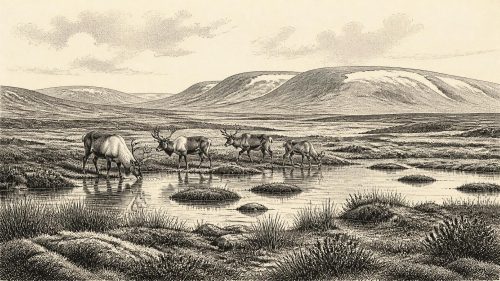
Around 33,500 cal BP, Ireland was a climatically unstable Late Pleistocene landscape, not a defined historical society or consistently frozen island. Derryvree, County Fermanagh, preserves an ice-free wetland interval beneath later glacial deposits, indicating cold, treeless tundra-like environments supporting plants, insects and freshwater habitats. Castlepook Cave in County Cork yielded mammoth, reindeer, giant deer, predators and other cold-stage fauna, although its deposits represent accumulated, disturbed evidence rather than one moment. A cut-marked reindeer femur may indicate early Upper Palaeolithic human butchery, but cannot prove permanent settlement. No secure contemporary tools, communities, institutions, beliefs, trade, farming or political structures are known.
View Record
The Derryvree Silt Lens
Labelled 31,589 BCE, this Late Pleistocene interval cannot be reconstructed as a recorded year but through environmental archaeology. Organic silts at Derryvree, County Fermanagh, lying between glacial tills, indicate a temporary ice-free freshwater tundra of sedges, mosses, herbs and cold-adapted plants, dated broadly to 36,900–31,700 calibrated years BP. Greenagho provides comparable regional evidence. Expanding ice sheets nevertheless made conditions transitional and increasingly glacial. Cave remains at Castlepook demonstrate wider Ice Age fauna, including reindeer and mammoth. A possibly cut-marked reindeer bone may indicate fleeting human activity there, but disturbed contexts and absent occupation evidence preclude claims of settled Palaeolithic society.
View Record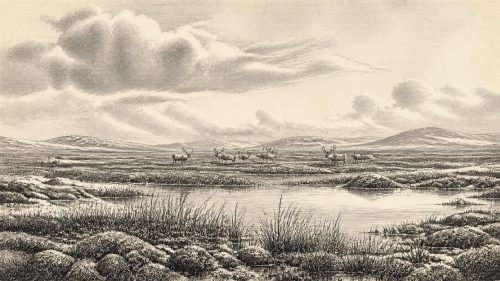
Castlepook’s Reindeer Puzzle
31,590 BCE is a modern filing date within late Marine Isotope Stage 3, not a recoverable Irish calendar year. Ireland contained varied cold environments, including tundra wetlands at Derryvree and changing regional ice cover. Castlepook Cave’s fauna, re-dated using improved methods, includes reindeer, mammoth, giant deer, hyaena and other cold-adapted animals, though its poorly recorded bones do not represent a single moment or community. A cut-marked reindeer femur may indicate Upper Palaeolithic carcass processing, but lacks associated tools, hearths or human remains. Evidence supports possible fleeting human visits, not settlement, polities or culture. Further excavation and secure dating remain essential.
View Record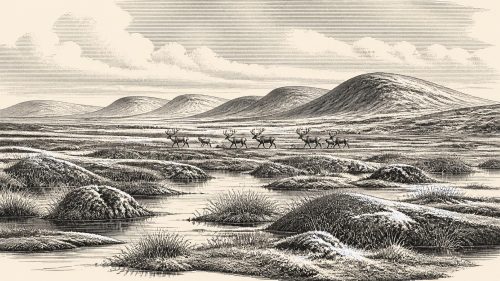
A Femur From Castlepook
31,591 BCE is best understood as a broad Late Pleistocene, Marine Isotope Stage 3 interval rather than a recoverable Irish calendar year. Ireland experienced volatile cold conditions, with developing ice, permafrost, exposed terrain, tundra wetlands and changing sea routes. Derryvree sediments in Fermanagh preserve evidence of treeless freshwater habitats between glacial advances. Castlepook Cave in Cork yielded cold-adapted fauna, including mammoth, reindeer, hyaena and horse, although cave deposits complicate interpretation. A reindeer femur bearing a possible butchery incision may indicate exceptionally early human contact, but lacks secure archaeological context. Evidence shows environmental change; human presence remains possible, contested and unproven.
View Record
Cork’s Reindeer Threshold
Around 31,592 BCE, Ireland lay within the climatically unstable Late Pleistocene, before maximum glaciation, when some areas remained ice-free. Subsequent ice sheets destroyed much evidence. Derryvree in Fermanagh preserves a tundra-like freshwater wetland, demonstrating productive open habitats. Castlepook Cave in Cork produced mammoth, reindeer, horse, giant deer and carnivore remains, showing that large animals reached Ireland during favourable intervals. A marked reindeer femur, possibly cut by a stone tool, suggests Upper Palaeolithic visitors, but cannot prove permanent settlement or continuous occupation. No contemporary Irish evidence identifies society, culture, politics or daily life; human presence remains tentative amid later encroaching glaciation.
View Record
The Fermanagh Sedge Basin
31,593 BCE is a notional point within the climatically unstable Late Pleistocene, when Ireland’s ice cover and environments varied regionally and remain uncertain. Organic deposits at Derryvree, County Fermanagh, preserved between tills, indicate cold, open wetlands containing sedges, mosses, aquatic plants and northern insects during a non-glacial interval. Castlepook Cave, County Cork, preserves fauna including reindeer, mammoth, hyaena and other open-country animals, demonstrating ecological connections with north-west Europe. A cut-marked reindeer bone may indicate early human activity, but lacks secure archaeological context. Evidence supports no settlements, politics, ritual or trade, only a landscape shaped by ice, water and animal movement.
View Record
Derryvree’s Moss Flora
At the nominal date of 31,594 BCE, Ireland’s evidence is environmental and archaeological, not historical in the political sense. Derryvree, County Fermanagh, preserves wetland sediments between glacial tills, indicating a locally ice-free MIS 3 interval with cold, open, treeless vegetation of mosses, sedges, grasses and shrubs. Castlepook Cave, County Cork, records a time-mixed cold-stage fauna including mammoth, reindeer, giant deer, predators and smaller mammals. Possible cut marks on reindeer bone suggest fleeting human activity, but cannot establish settlement. Changing sea levels and advancing ice shaped access and survival of evidence before extensive later glaciation erased much of Ireland’s earlier landscape.
View Record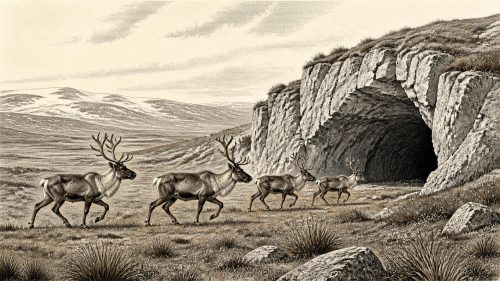
Reindeer at Castlepook
About 31,595 BCE is an imprecise modern label for late Marine Isotope Stage 3, roughly 33,500 calibrated years before present. Ireland experienced unstable cold conditions before the British–Irish Ice Sheet’s maximum expansion. Freshwater deposits at Derryvree indicate locally ice-free wetlands, while Crag Cave speleothems record milder phases. Castlepook Cave in County Cork preserved reindeer, mammoth, giant deer, predators and tundra fauna, though cave contexts and earlier dates require caution. A marked reindeer femur may indicate human butchery, but cannot establish settlement or occupation. Lower sea levels may have aided dispersal, yet routes remain uncertain. Evidence depicts environmental change, not history.
View Record
Derryvree’s Plant Bed
Although 31,596 BCE cannot be treated as a precise Irish historical year, Derryvree, County Fermanagh, preserves evidence from a broad Late Pleistocene interval encompassing it. Organic deposits between glacial tills reveal an ice-free freshwater basin with cold, treeless, varied tundra-like wetlands, before later ice advance. Castlepook Cave, County Cork, records a changing MIS 3 fauna including reindeer, mammoth, giant deer, predators and scavengers, though deposits are disturbed and dates vary. A cut-marked reindeer bone may indicate early human activity, but no occupation is proven. Together, these archives depict Ireland as environmentally unstable, periodically habitable, and connected to wider north-western Europe.
View Record
Awbeg Limestone Corridor
Around 31,597 BCE, present-day Ireland formed part of a low-sea-level, climatically volatile north-west European landmass during Marine Isotope Stage 3. It was not yet fully glaciated, although worsening conditions preceded later ice-sheet expansion. Fermanagh sub-till sediments indicate cold, open, treeless terrain with wetlands, freshwater and hardy vegetation. Castlepook Cave’s mixed faunal deposits document mammoth, reindeer, giant deer, bears, hyaenas and other cold-adapted animals, but cannot reconstruct one moment or locality. Cut marks on a reindeer bone may indicate a brief Upper Palaeolithic human visit, though this remains disputed. No settlements, institutions or ritual life are known; glaciation erased much evidence.
View Record