
Castlepook’s Reindeer Corridor
31,729 BCE is not a precise Irish historical date but an approximate position within unstable MIS 3, about 33,700 calibrated years before present. Evidence from Derryvree, Fermanagh, indicates cold, treeless freshwater wetlands supporting sedges, mosses and other adapted life. Castlepook Cave, Cork, preserves fauna including reindeer, mammoth, giant deer, hyaena and Arctic fox, showing ecological links with north-west Europe, although bones may be mixed. A marked reindeer femur possibly records human butchery, suggesting only occasional Upper Palaeolithic visitors, not settlement. No politics, trade or culture can be demonstrated. Growing, uneven ice sheets increasingly transformed habitats and obscured fragmentary Ice-Age records.
View Record
Derryvree’s Coldwater Archive
Around 31,730 BCE, Ireland has no recoverable annual history, only fragmentary Ice Age evidence. Derryvree, County Fermanagh, preserves freshwater silts between tills, radiocarbon dated broadly to 36,900–31,700 calibrated years before present, indicating local tundra wetlands before later glaciation. Comparable northern deposits and Crag Cave demonstrate cold but variable MIS 3 conditions. Southern caves, especially Castlepook, contain diverse fauna including mammoth, reindeer and hyaena, though bones may represent separate episodes. A cut-marked reindeer femur suggests possible Upper Palaeolithic visits, not proven settlement. Later ice erosion and sea-level change destroyed evidence. No political, agricultural, cultural or trade history can be established there.
View Record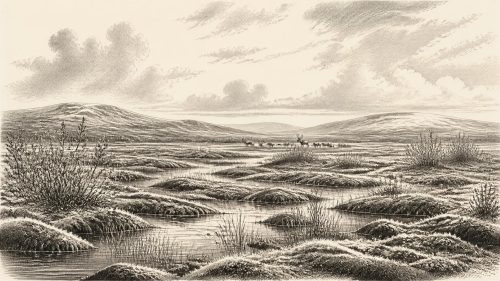
Derryvree’s Sealed Freshwater Bed
Derryvree, County Fermanagh, preserves freshwater silts between glacial tills, dating broadly to MIS 3 and indicating a temporary ice-free interval around 36,900–31,700 years ago. Its pollen, plants and insects reveal cold, treeless tundra wetlands with local ecological variation amid unstable climate. Cave fauna from Castlepook, County Cork, demonstrates changing communities including reindeer, mammoth and predators, although early excavations limit precision. A marked reindeer femur may indicate Upper Palaeolithic human activity about 33,000 years ago, but cannot prove settlement. Ireland was approaching renewed glaciation; evidence instead supports dynamic environments, cold-adapted animals and possibly brief mobile human visits during this broad interval.
View Record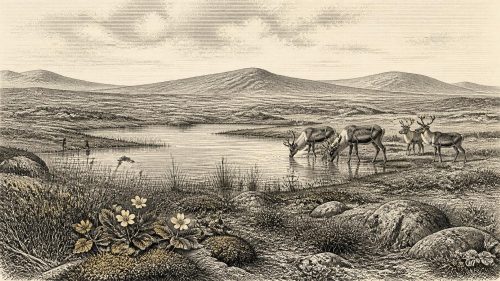
Fermanagh’s Mountain Avens
About 31,732 BCE, Ireland cannot be described through annual history, but through uncertain Late Pleistocene evidence. Derryvree, County Fermanagh, preserves freshwater silts between tills, dated broadly to 36,900–31,700 cal BP, indicating ice-free tundra-like wetlands with bogbean, mountain avens and other Arctic-alpine plants. Greenagho supports intermittent northern ice-free conditions, although glacier margins and coastal connections remain uncertain. Castlepook Cave in Cork records diverse MIS 3 fauna, including reindeer, mammoth, giant deer and predators. A possibly cut-marked reindeer bone suggests transient human activity, but no secure settlement evidence exists. Later ice expansion reworked landscapes, leaving environmental fragments rather than recoverable political history.
View Record
Derryvree’s Tundra Interval
Approximately 31,733 BCE, Ireland lay within the unstable Late Pleistocene climate of Marine Isotope Stage 3, not a precisely datable historical year. Derryvree, County Fermanagh, preserves freshwater sediments between tills, indicating a cold tundra wetland interval before renewed glaciation. Mosses and sedges suggest open, treeless terrain, while Crag Cave records milder episodes permitting water flow. Castlepook Cave’s mixed fauna, including mammoth, reindeer and hyaena, demonstrates diverse Ice Age habitats but not contemporaneous populations. A cut-marked reindeer femur may indicate brief human activity, although evidence remains insecure. Overall, geological archives reveal changing ice margins, habitats and uncertainty rather than conventional history.
View Record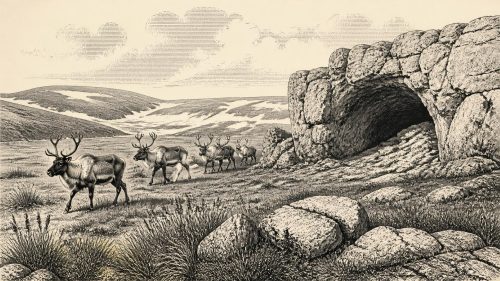
The Awbeg Reindeer Mark
Modern calendar-year precision is not available for Ireland in 31,734 BCE. The date is a...
View Record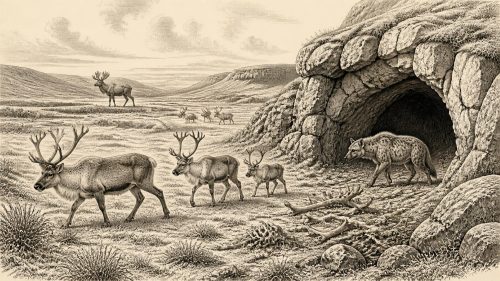
Hyenahall’s Carnivore Archive
About 33,700 calibrated years before 1950, Ireland lay in a cold, unstable MIS 3 landscape preceding maximum glaciation, with some ice-free ground, periglacial conditions and lower sea levels. Derryvree deposits in Fermanagh preserve tundra-like wetland vegetation, demonstrating locally habitable terrain. Castlepook Cave, Cork, contains Ireland’s richest pre-glacial vertebrate archive, including mammoth, reindeer, giant deer, hyaena, wolf and bear, though its time-mixed, carnivore-modified deposits demand caution. A possibly tool-marked reindeer bone suggests, but cannot prove, brief human presence. No political, cultural or settled community is recoverable; fauna instead reveal changing ecological links with north-west Europe during favourable intervals before extensive ice.
View Record
Castlepook’s Faunal Mosaic
“31,736 BCE” is a modern calendar label, not a date that can be recovered from...
View Record
Maguirebridge’s Inter-Till Waters
31,737 BCE is a modern label for a Late Pleistocene, MIS 3 interval, not a documented Irish year. Inter-till freshwater sediments at Derryvree, County Fermanagh, reveal an ice-free phase with cold, periglacial wetlands, plants and insects between glacial advances. Southern caves, especially Castlepook in County Cork, preserve evidence of mammoth, reindeer, giant deer, predators and other cold-stage fauna, though deposits span multiple periods. A marked reindeer bone may indicate early human butchery, yet lacks secure context or associated artefacts. Lower sea levels altered routes, while advancing ice created a volatile ecological frontier. Permanent occupation, polities and Irish identities remain unproven.
View Record
Derryvree and Castlepook
About 31,738 BCE, Ireland was a climatically unstable Late Pleistocene landmass, not a modern island with documented annual history. Derryvree, County Fermanagh, preserves freshwater sediments between glacial tills, showing an ice-free, cold wetland interval with open, treeless vegetation. Crag Cave, Kerry, records milder episodes through stalagmite growth. Castlepook Cave, Cork, contains a long, disturbed faunal archive including mammoth, giant deer, reindeer, bear, wolf, Arctic fox, lemmings and hyaena. A cut-marked reindeer femur may indicate early human carcass processing, but lacks secure context. Evidence demonstrates changing environments and animals, not settled communities, politics or culture at that precise nominal date, however.
View Record