Archived: 17 September 2026
Abstract
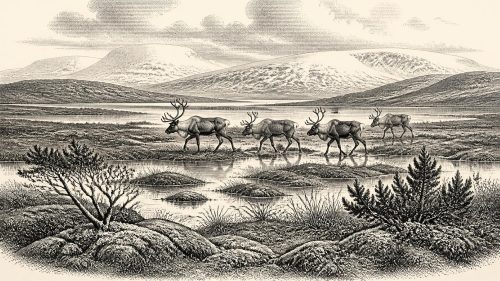
31,514 BCE is a modern label within Ireland’s unstable MIS 3 Late Pleistocene, not a recoverable historical year. Derryvree, County Fermanagh, preserves freshwater sediments dated broadly to this period, showing cold, open, locally ice-free wetlands with tundra vegetation. The major British–Irish Ice Sheet expansion followed later, subsequently erasing much evidence. Castlepook Cave, County Cork, contains time-mixed remains of mammoth, reindeer, giant deer, hyaena and other cold-stage fauna, demonstrating ecological connections. A marked reindeer femur may indicate Upper Palaeolithic butchery, but cannot establish settlement. Ireland was a changing glacial-edge environment; early human presence remains possible yet unproven at the notional date.
Read Article

Archived: 17 September 2026
Abstract
Around 31,516 BCE, Ireland was an unstable Late Pleistocene landscape, shaped by fluctuating ice, low sea levels and changing ecological connections. Derryvree sediments in Fermanagh record an ice-free interval with freshwater wetlands, tundra vegetation and insects, later buried beneath glacier deposits. Castlepook Cave in County Cork produced remains of reindeer, mammoth, giant deer, predators and other cold-adapted animals, though bones represent episodes spanning millennia. A cutmarked reindeer femur may indicate Upper Palaeolithic butchery, but disturbed context and absent associated artefacts make human presence provisional. Evidence supports temporary habitable environments, not settled communities, political history or continuous occupation on the island.
Read Article

Archived: 16 September 2026
Abstract
Around 31,529 BCE, Ireland was a cold Late Pleistocene landscape rather than a recognisable historical society. Calibrated dating places Derryvree’s freshwater deposits, preserved beneath glacial tills in County Fermanagh, within the broader period; their remains indicate open, mostly treeless wetlands with pools, sedges and cold-adapted plants. Castlepook Cave in County Cork yielded mammoth, reindeer, giant deer, predators and lemmings, showing episodic habitable open country before maximum glaciation. An incised reindeer femur may record butchery by Upper Palaeolithic people, but cannot prove settlement. No evidence supports claims of communities, institutions, farming, ritual, or human occupation. Later ice expansion transformed the island.
Read Article

Archived: 16 September 2026
Abstract
31,543 BCE is a modern chronological marker, not a recorded Irish year; evidence consists of uncertain radiocarbon ranges, deposits and animal bones. Before the Last Glacial Maximum, parts of Ireland supported wetlands, sparse treeless vegetation and cold-adapted fauna, although landscapes changed rapidly and later ice erased much evidence. Derryvree deposits demonstrate freshwater conditions, while Castlepook Cave near Doneraile preserves remains of reindeer, mammoth, giant deer and carnivores from different periods. A reindeer femur bearing a possible butchery cut mark suggests brief Upper Palaeolithic human presence around 33,000 years ago. It proves neither settlement nor society; dating and excavation are required.
Read Article
Archived: 16 September 2026
Abstract
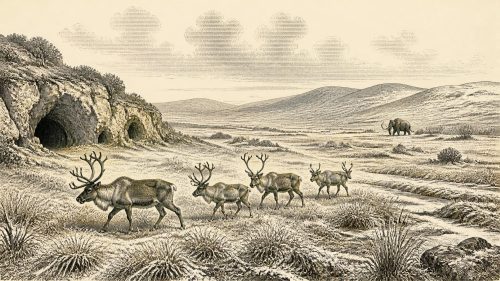
Around 33,500 calibrated years before present, later Marine Isotope Stage 3 Ireland was a cold, changing, largely treeless landscape, not an unbroken glacier. Castlepook Cave near Doneraile, County Cork, preserves important but mixed animal deposits, including mammoth, giant deer, reindeer, brown bear and spotted hyena. These animals indicate productive open steppe-tundra and complex predator-scavenger activity. Revised radiocarbon dates place some fauna well before the Last Glacial Maximum. A marked reindeer femur may record stone-tool butchery about 31,000 BC, suggesting fleeting Upper Palaeolithic visitors. However, no associated settlement, hearth, tools or other proof establishes permanent human occupation, institutions or continuous habitation.
Read Article
Archived: 16 September 2026
Abstract
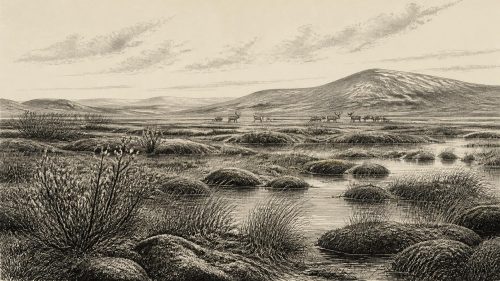
Around 31,565 BCE, Ireland’s record is environmental rather than historical, and cannot support calendar precision or claims of settlement. Derryvree, County Fermanagh, preserves a broadly dated MIS 3 interstadial deposit, indicating locally ice-free, periglacial tundra with freshwater wetlands, open vegetation and severe seasonal conditions. Castlepook Cave near Doneraile contains cold-stage fauna including reindeer, mammoth, giant deer, predators and lemmings, although deposits may combine separate episodes. A scored reindeer femur, perhaps 33,000 years old, may show stone-tool butchery and Ireland’s earliest human trace. It cannot establish a kill site, continuous occupation, settlement, society, travel routes or a single specific dated event.
Read Article

Archived: 16 September 2026
Abstract
31,575 BCE is a label for a late-Pleistocene interval, not a datable Irish event. Derryvree, County Fermanagh, preserves wetland deposits dated broadly to 36,900–31,700 cal BP, indicating treeless, cold, plant-rich terrain between glacial advances. Castlepook Cave, County Cork, contains MIS 3 remains of mammoth, reindeer, giant deer, predators and Arctic fauna, accumulated over time rather than contemporaneously. A cut-marked reindeer femur may indicate human butchery, but cannot establish settlement, chronology or continuous occupation. Lower seas may have aided movement, yet routes remain unknown. Ice expansion reshaped Ireland and destroyed sites, leaving evidence of habitats, animal movement and possible human presence.
Read Article
Archived: 15 September 2026
Abstract
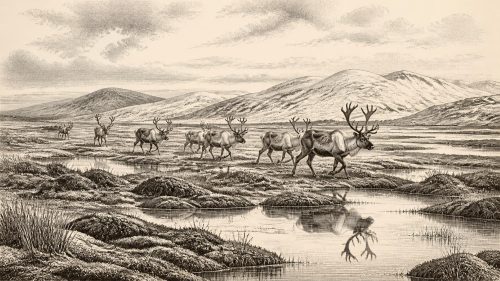
Around 31,621 BCE, a modern label within Marine Isotope Stage 3, Ireland experienced an unstable, cold Ice Age environment rather than a documented historical year. Derryvree sediments in Fermanagh record a locally ice-free tundra of wet hollows, sedges and mosses between glacial advances, while Crag Cave calcite demonstrates intermittent milder conditions. Castlepook Cave in Cork preserves mixed remains of mammoth, reindeer, giant deer and predators, indicating links with wider Eurasian fauna. A cut-marked reindeer femur may indicate exceptionally early human carcass processing, but its disturbed context prevents conclusions about settlement. No evidence supports permanent communities, agriculture, politics or named cultures.
Read Article

Archived: 15 September 2026
Abstract
31,626 BCE is a modern label within Marine Isotope Stage 3, not a recorded Irish year. Evidence from Derryvree indicates cold freshwater, tundra and steppe-tundra habitats between glacial episodes, while Ireland probably comprised open ground, meltwater, frozen terrain and advancing ice. Castlepook Cave preserves a long, mixed animal record including mammoth, reindeer, giant deer and predators. A reindeer femur, dated about 33,000 years ago, bears possible stone-tool cut marks, suggesting but not proving brief Upper Palaeolithic human activity. No secure settlement, tools, hearths, burials or cultural identity are known. Ireland's past is defined by change, fauna and uncertain human passage.
Read Article

Archived: 15 September 2026
Abstract
Around 31,631 BCE, Ireland lay in the unstable later Marine Isotope Stage 3, before the Last Glacial Maximum. Cold, open, largely treeless habitats supported reindeer, mammoth, giant deer, bears and hyaenas, although advancing ice and changing seas made access uncertain. Castlepook Cave near Doneraile preserves a long, disturbed faunal record. A reindeer femur, dated about 33,000 years ago, bears a possible stone-tool butchery mark, suggesting fleeting human activity but not settlement or continuous occupation. Derryvree sediments in Fermanagh record cold tundra wetland conditions between ice advances. Together, these fragmentary archives indicate active landscapes and possible human visitation before widespread glaciation.
Read Article

Archived: 15 September 2026
Abstract
31,635 BCE is a modern chronological label for Late Pleistocene Ireland, not a recorded historical year. During climatically unstable Marine Isotope Stage 3, changing ice, sea levels and habitats supported cold-adapted fauna. Castlepook Cave, County Cork, preserved mixed remains including reindeer, mammoth and predators. A reindeer femur, dated broadly around this period, bears a possible stone-tool cutmark, potentially Ireland’s earliest evidence of human activity, though it proves neither hunting nor settlement. Derryvree, County Fermanagh, documents treeless, wet tundra-like conditions. Lower seas altered routes, but land connections remain uncertain. Evidence suggests possible brief human visits, not permanent colonisation nor political institutions.
Read Article

Archived: 15 September 2026
Abstract
Around 31,655 BCE, Ireland was in Marine Isotope Stage 3, before the Last Glacial Maximum, with fluctuating ice, low sea levels and cold, varied habitats. Castlepook Cave near Doneraile preserves bones from repeated Late Pleistocene episodes, including mammoth, reindeer, hyaena, bear, wolf and Arctic fox, but mixed deposits prevent reconstruction of a single fauna or occupation. Derryvree wetlands indicate treeless tundra-like conditions. A dated Castlepook reindeer femur bearing a possible stone-tool mark may indicate brief human contact, yet cannot prove settlement. No securely associated camps, tools, hearths or cultural evidence exist. The record chiefly documents ecology, climate and uncertainty alone.
Read Article

Archived: 15 September 2026
Abstract
31,697 BCE cannot be reconstructed as a discrete Irish historical year, but belongs to unstable MIS 3 conditions near the Denekamp Interstadial. Ireland lacked known polities, settlements, farming or securely documented communities, while low sea levels and shifting ice and sea routes complicated access. Derryvree deposits in Fermanagh indicate cold, treeless freshwater and periglacial environments between glacial advances. Crag Cave speleothems record episodic thaw and climatic fluctuation. Castlepook Cave preserves diverse Ice-Age fauna, though its mixed assemblage spans long periods. A marked reindeer femur may suggest brief human butchery, but cannot establish permanent occupation. Ice erosion and excavation limit interpretation.
Read Article

Archived: 15 September 2026
Abstract
At the approximate horizon labelled 31,701 BCE, Ireland lay within the cold, unstable later Marine Isotope Stage 3, with open, largely treeless habitats and changing coastlines. Castlepook Cave near Doneraile preserves Ireland’s foremost cold-stage mammal archive, including mammoth, reindeer, giant deer, hyaena, Arctic fox and lemmings, although disturbed, time-depth deposits prevent their coexistence being assumed. A marked reindeer femur may indicate Upper Palaeolithic butchery, yet provides no secure proof of settlement. As ice expanded towards the Last Glacial Maximum, erosion and reworking obscured earlier evidence. This period is understood chiefly through environmental remains, not political, cultural or social history alone.
Read Article
Archived: 14 September 2026
Abstract
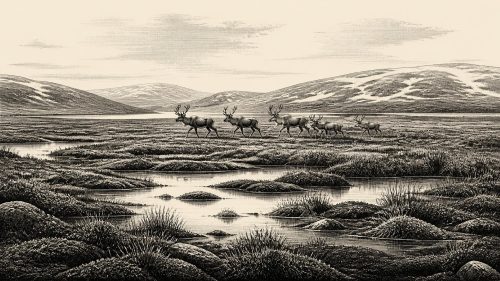
Around 31,711 BCE, Ireland’s history can only be reconstructed through broad archaeological and environmental evidence. During unstable MIS 3 conditions, Derryvree in County Fermanagh preserved an ice-free, periglacial wetland with tundra vegetation. Castlepook Cave near Doneraile yielded remains of reindeer, mammoth, giant deer, hyaena and other Ice-Age animals, accumulated over extended periods. Revised dating places much fauna in MIS 3. A marked reindeer femur may record human carcass processing about 33,000 years ago, suggesting possible brief Upper Palaeolithic visits. However, no secure settlement, tools, hearths or social evidence survives. Ireland remained a changing cold landscape, not a recoverable historical society.
Read Article
Archived: 14 September 2026
Abstract
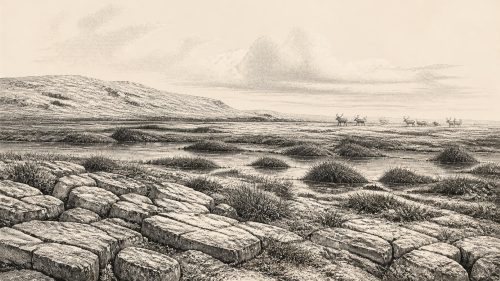
31,723 BCE is an approximation within unstable Marine Isotope Stage 3, not a datable Irish event. Before the Last Glacial Maximum, parts of Ireland remained ice-free, supporting treeless periglacial wetlands, tundra vegetation and cold-adapted animals. Deposits at Derryvree and Greenagho demonstrate changing environments, while Castlepook Cave preserves faunal remains accumulated over millennia, including mammoth, reindeer and hyaena. A scored reindeer femur, dated broadly to about 33,000 years ago, may indicate Upper Palaeolithic butchery. However, disturbed cave contexts and absent associated tools or settlements prevent proof of permanent occupation. Glaciation and sea-level rise destroyed evidence; Ireland’s human presence therefore remains uncertain.
Read Article
Archived: 14 September 2026
Abstract
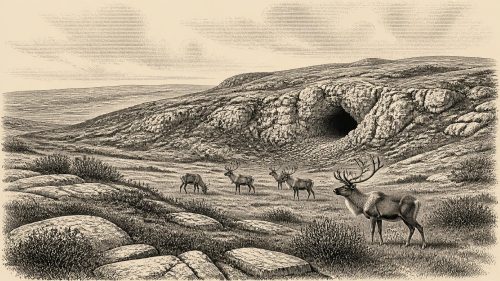
Around 31,724 BCE, a modern projection rather than a contemporary date, Ireland lay in unstable late Marine Isotope Stage 3, before the Last Glacial Maximum. Expanding ice sheets, lower seas and shifting landscapes shaped a cold, variably open environment. Castlepook, or Doneraile, Cave in County Cork preserves Ireland’s richest pre-maximum vertebrate record, including mammoth, reindeer, giant deer, bear, hyaena, lemming, Arctic fox and wolf. Revised radiocarbon dates place fauna in MIS 3. A cut-marked reindeer bone may indicate Upper Palaeolithic human activity, but no secure settlement evidence exists. The cave documents changing ecosystems, while glacial erosion and preservation constrain interpretation.
Read Article

Archived: 14 September 2026
Abstract
At approximately 31,740 BCE, Ireland lay within the fluctuating cold conditions of Marine Isotope Stage 3, before the last British–Irish Ice Sheet reached its greatest extent. Castlepook Cave near Doneraile preserves remains of mammoth, reindeer, giant deer, hyaena, lemmings and other fauna, indicating open, largely treeless habitats. An incised reindeer femur may record processing with a stone tool and therefore a Upper Palaeolithic human visit. However, old excavation context and absence of associated tools or settlement prevent certainty. The evidence neither proves permanent occupation nor later ancestry. Ice and seas obscured traces; later human activity is confirmed in County Clare.
Read Article
Archived: 14 September 2026
Abstract
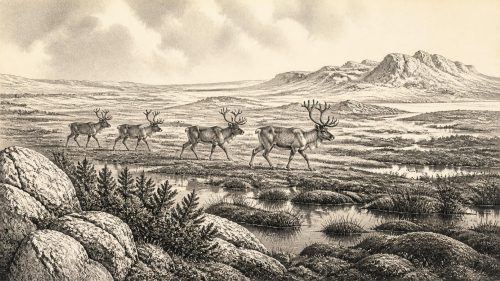
Around 31,778 BCE, Ireland lay within the climatically unstable later Marine Isotope Stage 3, before the Last Glacial Maximum. Lower seas altered coastlines and potential routes. Evidence from Derryvree indicates ice-free areas could support wet, treeless tundra vegetation during milder intervals. Castlepook Cave near Doneraile preserves a disturbed but important Ice Age fauna, including mammoth, giant deer, reindeer, hyaena and bear. A reindeer femur reportedly bears a stone-tool butchery mark and may represent Ireland's earliest human evidence. However, its poor context and uncertain interpretation preclude claims for permanent settlement, communities, routes or institutions. It therefore documents only tentative human presence.
Read Article
Archived: 14 September 2026
Abstract
31,779 BCE denotes an uncertain interval within Marine Isotope Stage 3, rather than a precise Irish event. During fluctuating Ice-Age conditions, Ireland was a cold, open Atlantic-margin landscape, with expanding ice, lower seas and uncertain routes. Castlepook Cave near Doneraile, County Cork, preserves Ireland’s richest late-glacial vertebrate collection, including mammoth, reindeer, giant deer, bear and hyaena. A reindeer femur dated to about 33,000 years ago bears a possible stone-tool cut, plausibly indicating carcass processing by humans. However, disturbed cave deposits and absent settlements, tools or human remains preclude claims for permanent population, culture or ritual. Later glaciation destroyed earlier evidence.
Read Article

Archived: 14 September 2026
Abstract
31,793 BCE is a modern filing date, roughly 33,700 years before present, within climatically unstable Marine Isotope Stage 3. Ireland was cold, treeless and regionally varied, with tundra-like wetlands, periglacial terrain and advancing, uneven ice. Castlepook Cave, County Cork, preserves fauna including mammoth, giant deer, reindeer, bears, hyaenas, wolves, foxes and lemmings, showing ecological links beyond Ireland. A marked reindeer femur may record stone-tool use and an early human visit, but disturbed deposits and uncertain dating prevent firm conclusions. Secure butchery evidence at Clare is far later. No settlement, culture, trade or society can be reconstructed; faunal evidence remains paramount.
Read Article

Archived: 10 September 2026
Abstract
At the notional date of 31,811 BCE, Ireland lay in the variable MIS 3 phase before the Last Glacial Maximum, not in a historically identifiable year. Evidence is necessarily broad and uncertain. Organic sediments at Derryvree indicate a treeless, periglacial wetland with tundra vegetation during an interval encompassing this date. Castlepook Cave preserves remains of cold-adapted fauna, including reindeer, but cave deposits are mixed and imperfectly dated. A marked reindeer femur may indicate human butchery, suggesting transient Upper Palaeolithic visits, not permanent settlement. Low sea levels altered routes but did not guarantee a land bridge. Glaciation destroyed or buried evidence.
Read Article




