Article
24 June 2026
Headlines Divided
Dublin newspapers published extensive political and military coverage on 25 January 1900, placing Ireland’s internal nationalist divisions beside the continuing conflict in South Africa. Reports on the recent Mansion House conference examined attempts to reunite the parliamentary factions separated since the fall of Charles Stewart Parnell. In adjoining columns, readers encountered military dispatches, troop movements and casualty information from a war involving thousands of Irish soldiers. The combination revealed the conflicting pressures shaping Irish public life: demands for national political unity existed alongside intense concern for men serving throughout the British Army and widespread nationalist sympathy for Britain’s Boer opponents.
Read ArticleArticle
19 June 2026
Pageantry Challenged
Nationalist newspapers have criticised Queen Victoria’s visit as an elaborate imperial spectacle staged while poverty, overcrowding and emigration continue to shape Irish life. Their editorials argue that decorated streets, military escorts and loyal addresses cannot conceal the economic hardship experienced in towns, rural districts and labouring households. Reports of cheering crowds are being answered with reminders of families divided by migration, tenants struggling upon poor land and workers surviving upon uncertain wages. In Limerick, where poverty and departure remain familiar realities, such criticism will find readers unwilling to accept royal ceremony as evidence that Ireland is prosperous, contented or politically…
Read ArticleArticle
24 June 2026
Roads Conflict
Judge Richard Adams awarded £105 compensation at Limerick County Crown Court for hay maliciously burned at Templebredin on the night of 6 December 1899. The claimant, T. M. English, had sought £116 for the destroyed property and argued that hostility arose from his position during a dispute over the maintenance of public roads. Evidence presented to the court connected the burning with an increasingly bitter campaign for the direct employment of labourers by the newly established local authorities. The case brought a rural employment controversy from council meetings into the formal machinery of criminal injury compensation.
Read ArticleArticle
24 June 2026
Broadcast Pioneer
Séamus “Clan” Clandillon was born near Gort, County Galway, on 6 June 1878 into a household closely connected with education. His father, William A. Clandillon, was a national school teacher, while his mother, Joanna Little, also came from a family shaped by work, migration and service. The countryside surrounding Gort preserved a strong inheritance of Irish-language speech, traditional singing and local storytelling. These influences entered Clandillon’s life early and later guided his work as a teacher, musician, civil servant and broadcaster. The child born in rural Galway would eventually help determine how the newly independent state presented Irish culture through…
Read ArticleArticle
22 June 2026
Labourers Organise
Agricultural labourers throughout County Limerick and the wider Munster countryside continue to campaign for better cottages, fairer wages and access to small plots of land. Their position remains distinct from that of tenant farmers seeking ownership of the farms they occupy. Labourers frequently possess neither secure employment nor property, depending instead upon seasonal hiring, daily wages and accommodation controlled by farmers or landlords. Public meetings increasingly insist that any settlement of the Irish land question must include the men and women whose labour sustains agriculture but who remain among the countryside’s poorest inhabitants. Housing is one of the campaign’s most…
Read ArticleImage
13 July 2026
George Street
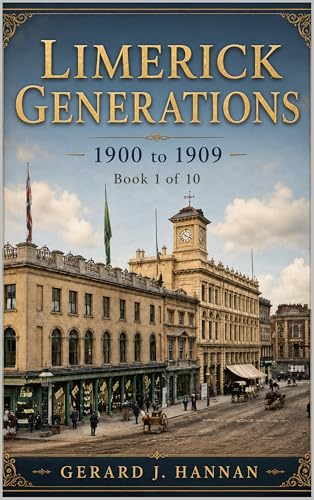
George Street, now O’Connell Street, formed the bustling commercial and social heart of Limerick around 1900. Elegant Georgian and Victorian façades lined the thoroughfare, their ornate shopfronts illuminated by gaslight and filled with goods for local shoppers. Horse-drawn carriages, jaunting cars and merchant carts crowded the roadway, while pedestrians in heavy coats and hats moved between businesses and hotels. The grand Cruises Royal Hotel stood among the street’s most prominent landmarks, welcoming merchants, travellers and visitors. This scene reflects the energy of late-Victorian Limerick before motor traffic transformed the city’s principal shopping street and historic urban centre during a changing…
View ImageImage
14 July 2026
Grange House
This reconstructed scene evokes the life of a prosperous Georgian country estate around the turn of the nineteenth century. The imposing house, formal gardens and gravel approach reflect the architectural taste and social order of the period. Elegantly dressed visitors, household servants, gardeners and horse-drawn carriages suggest activity surrounding such residences, where family life, hospitality and estate management met. Although idealised, the image offers a vivid historical impression of how the property may once have appeared when newly built, occupied and maintained, before decline altered its character and left only fragments of its former grandeur for future generations to study.
View ImageImage
15 July 2026
Knockaderry House
Knockaderry House, near Newcastle West in County Limerick, is an eighteenth-century country residence built around 1780. The detached, three-bay, two-storey house is distinguished by its balanced proportions, limestone eaves course and an attached architectural folly. Although now derelict, much of the original structure and historic fabric survives, allowing the building to retain a strong sense of its former character. The house is also remembered as the birthplace of pioneering Irish aviator Sophie Peirce-Evans. Set within the rural Limerick landscape, Knockaderry House remains an important reminder of the county’s architectural, social and aviation heritage for future generations to study and appreciate.
View ImageImage
14 July 2026
Shannon 1850s
By the mid-nineteenth century, Limerick remained one of Ireland's most strategically significant river cities, its fortunes long tied to the Shannon as a route for trade, defence, and settlement. The medieval walls and towers still visible in this period recalled centuries of contested history, from Norman fortification to the sieges of the seventeenth century that shaped the city's identity. Alphonse Dousseau's romanticised depiction reflects a wider mid-Victorian fascination among European artists with Ireland's older townscapes, capturing Limerick at a moment when its historic core coexisted with the pressures of modernisation, emigration, and post-Famine recovery reshaping much of the country during…
View ImageImage
16 July 2026
Thomond Gate
Thomond Gate Distillery stood beside the River Shannon from 1809 until 1919, forming an important part of Limerick’s industrial and distilling heritage. During the nineteenth century, the complex operated three copper pot stills and produced traditional Irish whiskey under several owners, including Stein Brown & Co. and Archibald Walker’s Limerick Distillery. These reconstructed scenes imagine the surrounding streets, workers, carts, buildings and towering chimneys during the distillery’s active years. Although production eventually ceased, the Thomond Gate name has been revived through an independent Limerick whiskey brand dedicated to preserving the memory and traditions of the original enterprise for future generations.
View Image