Article
3 August 2026
Forbidden Schools
Limerick’s Catholic families entered the post-treaty period believing that their religion would receive protection, yet the education of their children soon became a target of Parliament. The 1695 Act to Restrain Foreign Education prohibited Irish subjects from sending children abroad to Catholic colleges, schools, religious houses or private families. It also penalised anyone who supplied money for their maintenance. This struck communities whose educational choices were already limited at home. In Limerick, a city connected through trade and migration with continental Europe, the measure threatened both family strategy and the preparation of future clergy, teachers, merchants and professional men alike.
Read ArticleArticle
26 June 2026
Yeomanry Depart
Reports from Cape Town in early March 1900 carried the movement of the Leicestershire Yeomanry into Limerick homes already preoccupied with the South African War. The 7th (Leicestershire) Company of the 4th Battalion, Imperial Yeomanry, had reached the Cape near the end of February and was ordered inland with its battalion on 4 March. Although this county contingent had not been recruited in Limerick, its departure held local meaning because the Royal Munster Fusiliers drew heavily from Limerick city and county, while their 1st Battalion was already serving in South Africa.
Read ArticleArticle
24 June 2026
Reunion Negotiations
John Redmond’s Parnellite followers opened formal communications with their former anti-Parnellite opponents as pressure intensified to repair the divisions created by the fall of Charles Stewart Parnell. Since the parliamentary split of 1890, Irish constitutional nationalism had broken into competing groups whose leaders differed over authority, organisation and political strategy. Redmond led the principal Parnellite body, John Dillon commanded much of the anti-Parnellite majority, and Timothy Healy exercised influence through a separate following. Years of rivalry had weakened nationalist discipline at Westminster and frustrated supporters who believed that factional quarrels were obstructing Home Rule and land reform.
Read ArticleArticle
19 June 2026
British Absence
The completed general election has again demonstrated the weakness of the principal British political parties throughout nationalist Ireland. John Redmond’s reunited Irish Parliamentary Party has taken seventy-seven of Ireland’s 103 seats, while candidates standing directly for the British Liberal and Conservative parties made little impression across the south, west and much of the midlands. In Limerick, voters returned nationalist representatives without any prospect of an ordinary contest between the parties governing and opposing at Westminster. Irish political organisation remains shaped principally by the constitutional struggle between nationalism and unionism rather than by the divisions governing electoral life in Great Britain.…
Read ArticleArticle
24 June 2026
Garrison Announced
A new military garrison was announced for Limerick on 2 January 1900, although the arrangement proved provisional. Contemporary reports stated that the 3rd Battalion, Oxfordshire Light Infantry, formerly the Royal Bucks Militia, would be embodied at High Wycombe and sent to Limerick for garrison duty during the South African War. The announcement also noted that the home details left behind by the regiment’s 1st Battalion, which had departed Aldershot for active service, had already reached the city. Within days, however, the proposed destination was altered, and the militia battalion was directed to Buttevant rather than Limerick.
Read ArticleImage
16 July 2026
Monument Gathering
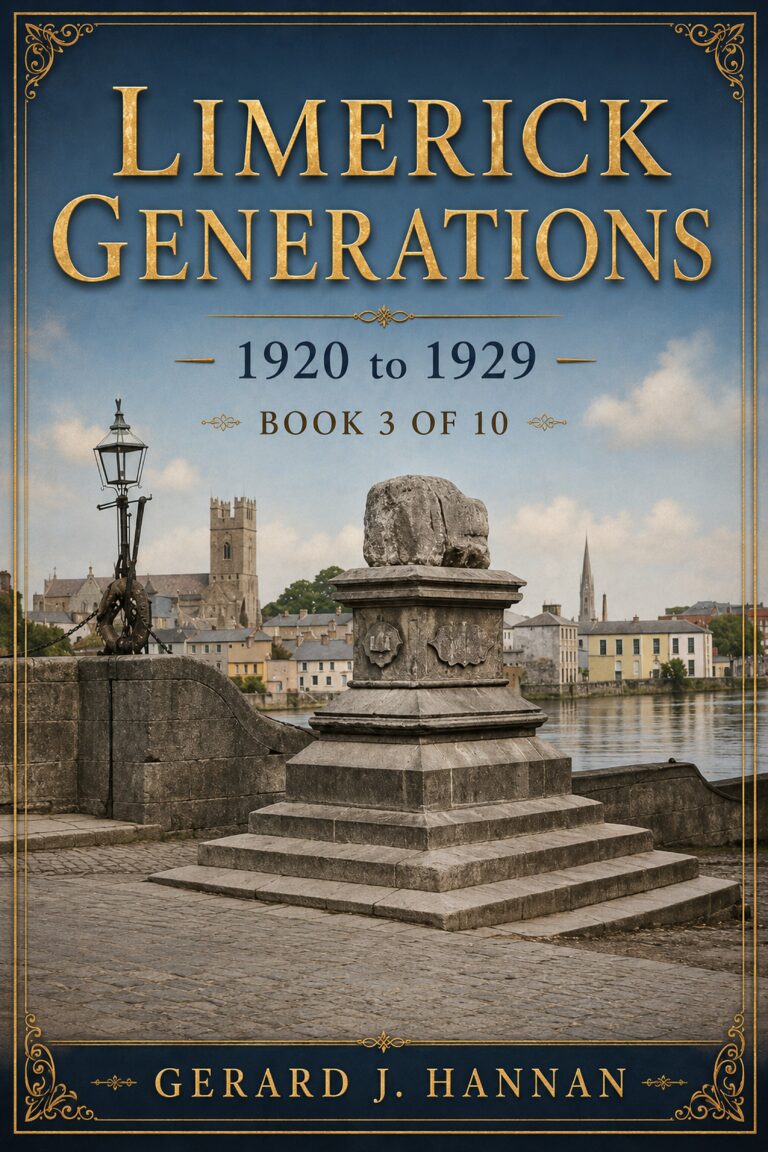
This reconstructed image depicts the Treaty Stone in Limerick as it may have appeared around 1880, standing on its substantial stepped pedestal as a powerful emblem of the city’s past. Groups of townspeople, including men, women and children in period clothing, gather around the monument in a lively public setting. In the background, traditional buildings, stone walls and the nearby tower reinforce the historic atmosphere of the riverside area. Long associated with the Treaty of Limerick of 1691, the stone remained an important civic landmark, meeting place and symbol of memory, identity and local heritage in nineteenth-century Limerick.
View ImageImage
10 July 2026
Place Limerick
At Baker Place in early twentieth-century Limerick, Saint Saviour’s Dominican Church stands at the centre of a broad cobbled streetscape, its Gothic stone façade, rose window, pointed arches, and carved doorways giving the scene a strong ecclesiastical presence. To the right, Tait’s Clock rises above the roadway as a civic landmark, balanced by red-brick industrial buildings and smoking chimneys behind it. Period pedestrians, a horse-drawn cart, street lamps, and a small wooden kiosk add everyday activity. The view captures a city shaped by faith, industry, commerce, public memory, and the architectural confidence of Edwardian urban life in Limerick’s historic core.
View ImageImage
10 July 2026
Local Identity
On Sarsfield Bridge in 1940s Limerick, the 1916 Memorial rises proudly beside the roadway, enclosed by green iron railings and watched over by elegant lamps. Its pale stone pedestal supports bronze figures commemorating the Rising, their solemn poses lending dignity to the riverside setting. Trees line the background, softening the urban scene and framing the monument against a bright open sky. Pedestrians in period dress walk along the bridge, suggesting ordinary city life continuing around a place of remembrance. The image captures civic pride, republican memory, and the enduring presence of national history within Limerick’s daily landscape and local identity.
View ImageImage
15 July 2026
Says Croker
Built in 1774 for John Croker, Ballynagarde House near Ballyneety was once among County Limerick’s grand Georgian residences. The five-bay mansion stood over a raised basement, with a central breakfront, cut limestone detailing, extensive outbuildings, walled gardens and classical statues. Raised on the site of an earlier stronghold, it remained the Croker family seat for generations. Financial mismanagement during the late nineteenth century began its decline, and the estate was divided by the Land Commission in the 1930s. Now ruined, the house survives in local folklore through tales of “Doubt It Hall” and a mysterious visitor allegedly possessing cloven hooves.
View ImageImage
16 July 2026
Castle Time
Castlegarde Castle, near Cappamore in County Limerick, is regarded as Ireland’s oldest continuously inhabited castle. Established by the O’Brien family around 1190, its five-storey medieval tower rises from a limestone outcrop, strengthening its defensive position. Original features include an internal well and a murder hole above the entrance passage. In 1820, Waller O’Grady commissioned architects James and George Pain to add a castellated Gothic extension, harmonised with the ancient keep. A carved head of Brian Boru overlooks the entrance, while three unusual stone figures representing Bacchus, Pallas Athene and Aphrodite survive within the gatehouse. Today, it remains a private residence.
View Image