
Shandon’s Red-Deer World31882 BCE
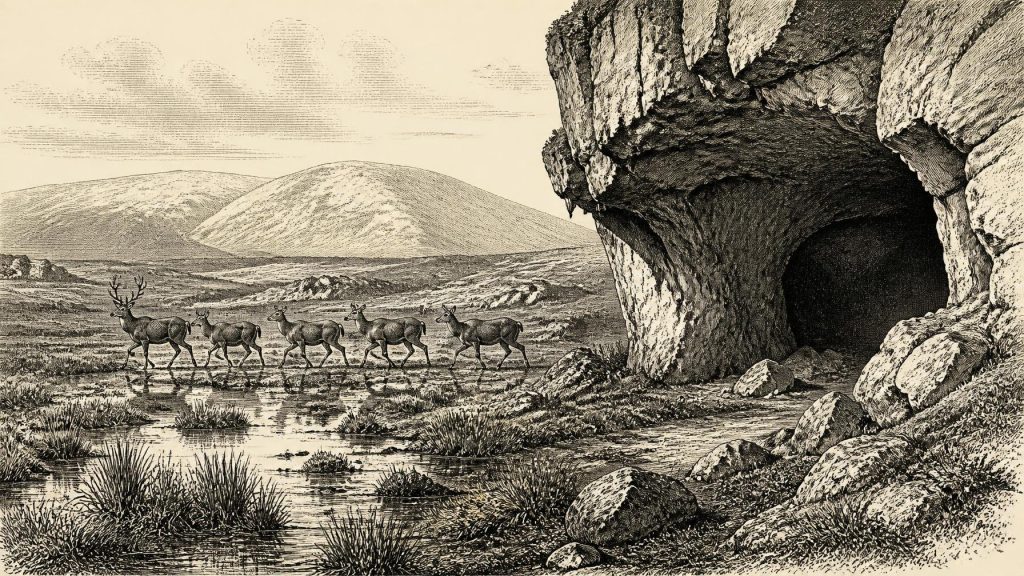
Around 31,882 BCE, Ireland was a climatically unstable Late Pleistocene landscape, not a settled or historically documented society. Calibrated radiocarbon evidence from Shandon Cave, County Waterford, indicates red deer were present during a broad period overlapping this date. Derryvree sediments in Fermanagh suggest cold, open, seasonally wet tundra habitats, while cave assemblages reveal changing communities of large herbivores, predators and small mammals. Later glaciation destroyed much evidence. Claims for early human visits, including a possibly cut-marked Castlepook bone, remain unproven. No secure Palaeolithic dwellings, tools or burials exist. Ireland’s record instead documents intermittent Ice Age ecological opportunity and fragmented survival.
Dateline
The label 31,882 BCE should not be treated as a year in which Irish archaeology can identify an event, ruler, battle or settlement. It is a modern calendar conversion, approximately 33,800 calendar years before AD 1950, and evidence at this depth of time comes with probability ranges rather than annual precision. The responsible setting is the Late Pleistocene, within Marine Isotope Stage 3 and the Irish Middle Midlandian sequence: a long, climatically unstable phase of the last Ice Age, well before the Last Glacial Maximum. Ireland was not the permanently inhabited island of later prehistory. It was a changing north-western landscape whose animal life, vegetation, coastlines and ice margins shifted over millennia.
For a date around this point, the most directly relevant Irish evidence is not a human camp but animal bone and environmental sediment. A red-deer specimen from Shandon Cave in County Waterford has been assigned a calibrated range of about 34,524–32,713 cal BP, a broad interval that overlaps the modern label 31,882 BCE. Such a range does not tell us what happened in a particular season or generation. It does, however, establish that red deer were present in south-eastern Ireland during part of this period. Together with cave remains from Cork, Waterford, Clare and elsewhere, it shows that Ireland supported substantial mammals during intervals before the great late-glacial ice expansion.
A Date With No Annals
There are no written sources, named communities or datable political institutions for Ireland at this time. Nor is there evidence for kingdoms, diplomacy, formal warfare, farming, permanent villages, monuments or organised religion. It would be misleading to fill these silences with familiar prehistoric imagery. The Gaelic language, Irish place-names, megalithic tombs, metalwork and the social structures known from later archaeology all lay tens of thousands of years in the future.
Even the word “Ireland” needs care. The modern island was part of a wider physical zone shaped by lower global sea levels, changing ice and exposed continental shelves. Connections to Britain and onward to mainland Europe may at times have been easier than today, but the exact geography changed repeatedly and remains a subject of reconstruction rather than certainty. Animal movement into and out of the island is strong evidence that barriers were periodically permeable; it is not, by itself, proof of a particular continuous land bridge, nor of human migration along one.
Radiocarbon science adds a further warning against false exactitude. A laboratory result is usually expressed in radiocarbon years before present, where “present” is conventionally AD 1950. Atmospheric carbon levels have varied through time, so those results must be calibrated against independently dated records. At around 34,000 calendar years ago the resulting ranges can be broad, and revised treatment of samples can materially alter an age estimate. A calendar-year heading is therefore best understood as a point within a longer archaeological window, not as an anniversary in the modern sense.
Open Ground and Cold Water
The environmental record from Derryvree near Maguiresbridge, County Fermanagh, provides an important northern comparison. Organic silts and fine sands, later covered by glacial deposits, produced a radiocarbon age of roughly 30,500 BP with a sizeable uncertainty. Their pollen, mosses and small fauna indicate open tundra or muskeg vegetation under periglacial conditions. Herbs predominated; woody cover, if present locally, was sparse. The few tree-pollen grains recovered are not sound evidence for a forest. This was a landscape of sedges, mosses, low herbs, wet ground and exposed mineral soils, with a strongly seasonal climate.
Derryvree cannot be read as a photograph of every part of Ireland in 31,882 BCE. It is a regional deposit of a different age measure, and the island’s weather, ice limits and habitats varied across time and place. Yet it provides a defensible model for the type of country available during cold Middle Midlandian intervals: treeless, windy and locally waterlogged, but not necessarily lifeless or wholly ice-covered. In the south and east, limestone caves and fissures accumulated bones; in the north, lake and wetland sediments preserved plant traces. Together these fragmentary archives illuminate an Irish environment otherwise heavily damaged or removed by later glaciation.
The approaching climatic danger was real. The British–Irish Ice Sheet had not yet reached its later maximum configuration, but ice growth was becoming an increasingly important force in the region. Later advances eroded older soils, reworked sediments and buried or destroyed many possible occupation surfaces. That destructive history helps explain why the record is so uneven. A cave can retain a few bones while whole landscapes of paths, hearths, campsites and lake margins disappear. Absence of such evidence cannot prove that nobody ever crossed the land; equally, it cannot be used to manufacture a settled Palaeolithic population.
The Cave Fauna
Shandon’s red deer belongs to a wider Irish Pleistocene faunal story. Cave collections, especially those from Castlepook near Doneraile in north County Cork, include remains attributed to reindeer, mammoth, giant deer, brown bear, wolf, Arctic fox, hare, lemmings and spotted hyaena. They were not all necessarily contemporaries. Many were recovered in nineteenth- and early twentieth-century excavations, when recording standards were inconsistent and deposits were often disturbed. Modern direct dating has shown that bones once grouped together in a cave may derive from very different episodes. The correct picture is therefore not a single, crowded Ice Age scene, but a succession of animal communities using or being carried into caves over long spans of time.
Nevertheless, the animals reveal much. Red deer imply viable grazing and browsing opportunities; reindeer and lemmings indicate colder, open habitats; mammoth and giant deer point to a broader mosaic capable of sustaining large herbivores; and hyaenas and wolves show that carnivores ranged through the same food webs. Caves were not simply shelters. Hyaenas may have dragged carcasses and bones underground, bears may have used them for hibernation, and water, frost and later excavation could move remains again. Tooth marks, breakage patterns, sediment position and microscopic surface study are consequently as important as species identification.
For everyday life, the fauna offers stronger evidence for animal ecology than for people. A reindeer femur from Castlepook has been publicised as bearing a mark consistent with cutting by a stone tool, and its reported antiquity has made it significant in debates over the earliest possible human activity in Ireland. This is an intriguing claim, not a licence to describe a resident hunting band in a precise year. The age of a bone, the age of its sedimentary context and the origin of a surface mark are separate questions. The National Museum of Ireland still notes that clear Palaeolithic evidence for humankind in Ireland has not emerged. That institutional caution reflects the extraordinary evidential burden imposed by such an early claim.
Possible Visitors, Not a Proven Society
If people did reach Ireland in this general period, they would have been highly mobile Upper Palaeolithic hunter-gatherers, dependent on detailed environmental knowledge and portable technologies of stone, bone, hide and wood. This is an inference from better documented communities in north-west Europe, not a demonstrated description of an Irish group. No securely excavated dwelling, hearth, tool assemblage, burial, artwork or human bone has yet established their presence in Ireland around 31,882 BCE. Nor can hunting, food-sharing, kinship, ritual or language be reconstructed specifically for the island.
What can be said is more modest and more interesting. Ireland lay at the edge of a larger Ice Age world in which animals evidently moved across changing routes, while climate repeatedly rearranged the opportunities for both prey and predators. A small human party could have left little behind even if it visited; later ice could have erased still more. But sporadic access is different from continuous occupation. The best-established early human evidence in Ireland remains much later, including the butchered brown-bear bone from Alice and Gwendoline Cave in County Clare, dated to the terminal Pleistocene. The deep antiquity claimed for Castlepook should therefore be treated as an important research frontier rather than settled historical fact.
Meaning at the Margin
There was no Irish economy in the later sense: no agriculture, coinage, market, port or long-distance trade documented here. The material economy visible in the evidence was ecological. Grazers converted tundra plants into meat; predators followed them; caves became accidental archives. If human visitors were present, animal carcasses and skins would have been vital resources, but the record does not permit claims about regular hunting territories or exchange networks. Likewise, there is no evidence from Ireland at this date for shrines, sacred places or formal learning. The caves are scientifically invaluable, but their later archaeological importance must not be mistaken for proof of Palaeolithic ritual.
The enduring significance of this date is thus not a single event but a threshold of knowledge. Shandon Cave, Derryvree and Castlepook show that the island’s prehistory reaches into a far older, colder and more complicated world than older textbook narratives allowed. They also show why archaeological restraint matters. Around 31,882 BCE, Ireland can be approached through calibrated ranges, fossil assemblages, pollen, mosses, sediment and changing ice—not through annual chronicle. Its history at this depth is the history of a landscape intermittently hospitable to Ice Age life, and of a record that survives only in scattered, hard-won traces.
Primary Sources
- A reconsideration of the radiocarbon dating of the Marine Isotope Stage 3 fauna from southern Ireland
- The Irish Quaternary Fauna Project
- The Irish Quaternary Fauna Project (full-text copy)
- Palaeoecology: IQUA Field Guide No. 16
- A Middle Midlandian Freshwater Series at Derryvree, Maguiresbridge, County Fermanagh, Northern Ireland
- Irish Pleistocene Biostratigraphy
- The Geology of Ireland
- Quaternary Site Descriptions
- Ireland Through Geological Time
- Quaternary Data and Maps
- Phylogeographic, Ancient DNA, Fossil and Morphometric Analyses Reveal Ancient and Modern Introductions of a Large Mammal: The Complex Case of Red Deer (Cervus elaphus) in Ireland
- Growth and Retreat of the Last British–Irish Ice Sheet, 31,000 to 15,000 Years Ago: The BRITICE-CHRONO Reconstruction
- Timing, Pace and Controls on Ice Sheet Retreat: An Introduction to the BRITICE-CHRONO Transect Reconstructions of the British–Irish Ice Sheet
- Stratigraphic and Palaeo-Geomorphological Evidence for the Glacial-Deglacial History of the Last British-Irish Ice Sheet in the North-Western Irish Sea
- The Problem of a Late Quaternary Landbridge Between Britain and Ireland
- The IntCal20 Northern Hemisphere Radiocarbon Age Calibration Curve (0–55 cal kBP)
- IntCal Publications
- Prehistoric Details
- New Insights on the Fauna of Ireland's Younger Dryas and Early Holocene from Alice & Gwendoline Cave
- New Insights on the Fauna of Ireland's Younger Dryas and Early Holocene from Alice & Gwendoline Cave (author manuscript)
- Archaeological Heritage of County Cork
- Ireland's Palaeolithic Archaeology – Fleeting Footprints in a Frozen Land
- Sedimentary Ancient DNA Reveals Late Pleistocene Faunal Connectivity Between Ireland and Eurasia