Castlepook’s Open Tundra31852 BCE
31,852 BCE is a modern chronological label rather than a recoverable Irish historical year. During volatile MIS 3, Ireland was intermittently ice-free, with open periglacial tundra, freshwater hollows, sparse vegetation and changing climates before later ice-sheet expansion reworked much evidence. Deposits at Derryvree, Greenagho and Hollymount, alongside Kerry speleothems, indicate non-glacial episodes but cannot define conditions everywhere. Cave faunas, notably at Castlepook, include reindeer, mammoth, bear, hare, fox and hyaena, demonstrating ecological links with north-west Europe. A possibly cut-marked reindeer bone suggests human activity around 33,000 years ago but proves neither settlement nor culture. The record is fragmentary and environmental.
Dateline
“31,852 BCE” is a modern numerical label, not a year that can be isolated in Ireland’s archaeological record. There were no written calendars, named communities or datable events on the island from which a history of one particular year could be recovered. In conventional calendar terms, the label falls about 33,800 years before AD 1950, within the later part of the Late Pleistocene and broadly within Marine Isotope Stage 3 (MIS 3), a climatically volatile interval of the last Ice Age. The responsible history of this point in time is therefore one of ranges, deposits and probabilities: what the evidence can show about Ireland around this span, and what it cannot.
The most important fact is that Ireland was not yet the continuously settled island of later prehistory. If people entered it at all during this part of the Ice Age, their presence was probably brief, sparse and vulnerable to environmental change. The landscape was also on the threshold of a profound transformation. Over the following millennia the British–Irish Ice Sheet expanded towards its much greater Late Glacial extent, reworking land surfaces and destroying or burying much of the evidence that might otherwise have survived.
A Point Within a Long Chronology
Radiocarbon measurements do not translate directly into calendar years. They must be calibrated against internationally maintained curves, and uncertainty becomes substantial at this depth of time. A useful local comparison is Derryvree, near Maguiresbridge in County Fermanagh. There, organic-rich freshwater silts and fine sands lay between two tills: deposits left by separate phases of glaciation. The material produced a conventional radiocarbon determination of about 30,500 years before present, with a large error margin; published calibration places it approximately between 36,900 and 31,700 calendar years before present. That broad interval encompasses the modern label 31,852 BCE.
Derryvree does not date an occupation, a journey or an individual season. It dates organic material within a sedimentary sequence. Its importance is environmental and geological. It demonstrates that, during at least part of this long interval, north-central Ireland had ice-free ground, standing or slow-moving freshwater, and living plant and insect communities before later ice covered the site. Greenagho, also in Fermanagh, and Hollymount near Maguiresbridge provide related, though differently dated and interpreted, evidence for cold non-glacial episodes between earlier and later tills. Together these sites caution against any simple picture of an island permanently sealed beneath ice.
Ground Between Ice Advances
Ireland’s regional name for the last glacial cycle is the Midlandian. Around the notional year considered here, conditions varied dramatically over time and place. The later MIS 3 record from Crag Cave in County Kerry is especially revealing. Speleothems – cave calcite formed as mineral-rich water drips – grew episodically during warmer interstadial phases. Their growth requires liquid water moving through ground and bedrock, so it offers evidence against a landscape that was everywhere continuously frozen. At the same time, interruptions in growth register repeated returns to colder conditions.
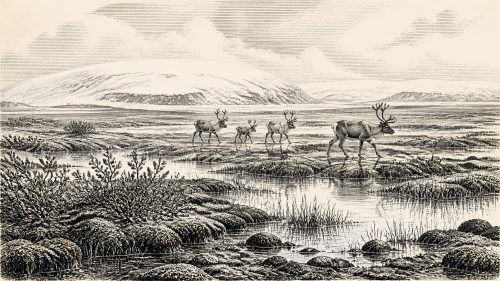
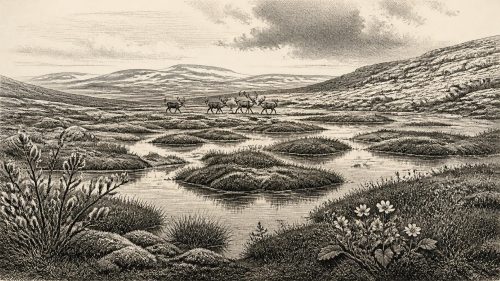
These cave records do not yield a precise temperature reading for every part of Ireland in 31,852 BCE. They do show that the island lay at the Atlantic edge of a climate system capable of rapid swings between relatively milder and much harsher phases. At Derryvree, mosses, sedges, herb pollen and insects of cold northern character point to an open, periglacial setting. Trees were not the dominant feature. The familiar Irish mosaic of enclosed pasture, woodland, bog and village had no existence. In its place was a sparse landscape of wet ground, exposed mineral soils, seasonal frost and low vegetation, with local water bodies gathering fine sediment.
Wind, freezing and thawing would have been active forces in shaping this world. Bare or thinly vegetated slopes were susceptible to erosion; water carried sand and silt into hollows and shallow lakes. The later glacier that passed over much of Ireland would leave drumlins, tills and scoured rock, but those famous glacial forms should not be imagined as a finished landscape at this date. They are the outcome of successive processes, including the ice advances still to come.
Animals in a Changing Island
Irish caves and museum collections preserve the strongest evidence for animal life during MIS 3. The Irish Quaternary Fauna Project, followed by more recent redating, established that a range of large mammals reached Ireland at different times between roughly 45,000 and 20,000 years ago. Castlepook Cave near Doneraile in north County Cork is particularly important because it contains both pre- and post-Last Glacial Maximum faunal material. Improved sample treatment has shown that some older cave radiocarbon determinations were too young, making parts of the faunal history appreciably older than once believed.
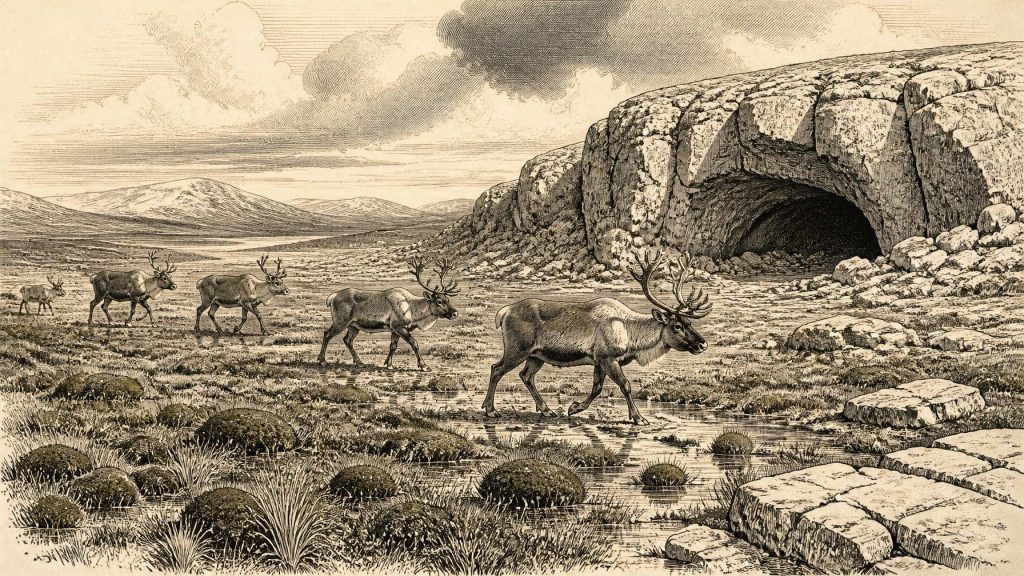
The pre-glacial cave fauna includes animals suited to cold, open country, among them reindeer, brown bear, hare, fox and spotted hyaena; Castlepook investigations have also produced evidence of woolly mammoth. Not every species was necessarily present in every valley, or even in County Cork, at the same moment. Cave deposits can accumulate bones over long periods, while carnivores, water, collapse and older excavation methods can mix their contents. Nevertheless, the record decisively overturns the idea that Ice Age Ireland was biologically empty before the final glacial maximum.
Reindeer are especially significant because their grazing habits fit a broad, treeless, herb-rich landscape. Their presence suggests possible seasonal movement through open terrain, not a domesticated herd managed by people. Large herbivores and their predators formed ecological connections to Britain and the wider north-west European plain. Whether those connections were open coast, temporary crossings, sea ice, exposed shelf or routes altered by shifting ice and sea level depended on the particular phase of the glacial cycle. It would be unsafe to draw a single, fixed coastline or a guaranteed land bridge for this one notional year.
The Castlepook Human Question
The possibility of people in Ireland around this time rests on evidence that is compelling enough to deserve attention but too slight to support a conventional narrative of settlement. A reindeer femur from Castlepook Cave has been identified as bearing a deep incision interpreted as a cut mark made with a sharp stone tool during butchery. County Cork heritage material has presented it as evidence for human activity in Ireland about 33,000 years ago. If that interpretation is correct, it would push the island’s known human story far back beyond the better-attested terminal Pleistocene evidence.
Several distinctions matter. The radiocarbon date establishes the age of the bone, not the identity, number or residence of the people who may have marked it. The interpretation of a line on bone as a human tool mark is a separate taphonomic judgement: it must be distinguished from damage caused by carnivores, sediment movement, weathering, collecting or earlier handling. Nor does a butchered animal prove that a group lived in the cave. A carcass could have been processed in the open and bones later carried, washed or dragged into the cave system.
Accordingly, the evidence supports no claims about tribes, languages, kin groups, leaders or a permanent population. There is no securely attributable house, hearth, stone-tool assemblage, burial ground, art panel or camp surface from Ireland that can be assigned to 31,852 BCE. There is also no basis for supposing political authority, warfare, diplomacy or organised territorial boundaries. These are not missing chapters awaiting imaginative reconstruction; they are subjects for which the surviving Irish record is silent.
Life, Culture and Economy: What Cannot Be Recovered
If the Castlepook mark records human butchery, the most modest inference is that one or more people obtained access to a reindeer carcass and used a sharp lithic edge. That act could have supplied meat, marrow, hide, sinew or bone, each valuable to highly mobile hunter-gatherers elsewhere in Upper Palaeolithic Europe. But it cannot tell us whether the animal was hunted, scavenged, found dead, shared among a group or processed during a short visit. It says nothing direct about clothing, shelters, fire, family life or ritual in Ireland.
There is likewise no evidence for agriculture, livestock, pottery, metalworking, market exchange or seaborne trade. The economy of a hypothetical human visit would have depended on wild resources and movement through a demanding environment, not farming surplus or permanent settlement. Stone technology is plausible only in the narrow sense that the proposed cut mark is attributed to a sharp stone implement; no associated toolkit has been recovered. Culture and learning were undoubtedly present among Upper Palaeolithic people elsewhere in Europe, but no cultural tradition can responsibly be assigned to Ireland from this single disputed trace.
An Archive of Fragments
The history of Ireland around 31,852 BCE is thus principally an environmental history, illuminated by silts, pollen, mosses, insect remains, cave calcite, animal bones and glacial sediments. It records an intermittently ice-free island with open cold-country habitats during parts of MIS 3, connected ecologically to a wider Pleistocene world and increasingly exposed to the advance of ice. Castlepook offers a tantalising indication that people may have entered that world. It does not yet establish an Ice Age Irish community.
That restraint is not a failure of the evidence. It is its meaning. Later ice sheets and tens of thousands of years of erosion have left a very partial archive, while newer dating techniques continue to revise older conclusions. Around this modernly numbered year, Ireland was a place of tundra-like ground, freshwater hollows, cave refuges and wandering fauna – and perhaps, briefly, of people whose presence survives only as a possible human-made mark on a reindeer bone.
Primary Sources
- A Reconsideration of the Radiocarbon Dating of the Marine Isotope Stage 3 Fauna from Southern Ireland
- The Irish Quaternary Fauna Project
- Trimlines, Blockfields and the Vertical Extent of the Last Ice Sheet in Southern Ireland
- Early Midlandian–Middle Midlandian, Pleistocene, Northern Ireland
- Palaeoecology: The Middle Midlandian Palaeoenvironment of South Fermanagh
- Figure 6: The Subdivision of the Quaternary Period in Ireland
- Middle Midlandian Interstadial Deposits at Greenagho, Near Belcoo, County Fermanagh, Northern Ireland
- Episodic Speleothem Deposition Tracks the Terrestrial Impact of Millennial-Scale Last Glacial Climate Variability in SW Ireland
- Growth and Retreat of the Last British–Irish Ice Sheet, 31,000 to 15,000 Years Ago: the BRITICE-CHRONO Reconstruction
- Stratigraphic and Palaeo-Geomorphological Evidence for the Glacial-Deglacial History of the Last British-Irish Ice Sheet in the North-Western Irish Sea
- Stratigraphic and Palaeo-Geomorphological Evidence for the Glacial-Deglacial History of the Last British-Irish Ice Sheet in the North-Western Irish Sea
- Archaeology Research Excavation Grant 2022: Castlepook Cave Project Final Report
- Castlepook Cave, County Cork, 2022 Excavation Report
- Heritage Artefacts of County Cork
- New Insights on the Fauna of Ireland’s Younger Dryas and Early Holocene from Alice & Gwendoline Cave
- First Evidence of a Late Upper Palaeolithic Human Presence in Ireland
- The IntCal20 Northern Hemisphere Radiocarbon Age Calibration Curve (0–55 cal kBP)
- Marine20—The Marine Radiocarbon Age Calibration Curve (0–55,000 cal BP)
- The Problem of a Late Quaternary Landbridge Between Britain and Ireland
- Growth and Retreat of the Last British–Irish Ice Sheet, 31,000 to 15,000 Years Ago: British Antarctic Survey Record
- Spatio-Temporal Dynamics of Speleothem Growth and Glaciation in the British Isles
- Introduction to the Late Quaternary and Holocene of Northern Ireland