Crag Cave’s Winter Drips31764 BCE
Around 31,764 BCE, Ireland was a climatically unstable Late Pleistocene landscape rather than a documented historical society. Derryvree deposits in County Fermanagh reveal freshwater pools, patchy tundra vegetation and periglacial conditions during a broadly dated interval encompassing this label. Crag Cave speleothems in Kerry show intermittent warmer phases when liquid water penetrated limestone. Cave fauna, including reindeer, giant deer, mammoth, bears, wolves and hyaenas, indicates intermittently habitable open country. A marked reindeer bone from Castlepook may suggest human handling, but cannot prove settlement. No evidence supports communities, politics, religion, trade or permanent occupation. Later glaciation obscured much of this record.
Dateline
“31,764 BCE” is a modern chronological label, not a year that anyone in Ireland could have named or recorded. At this depth of time, calendar-year precision is unavailable. The label falls about 33,713 years before the conventional radiocarbon-present date of AD 1950, within the later part of Marine Isotope Stage 3 (MIS 3), a climatically unstable interval of the Late Pleistocene. The safest account of Ireland at this point is therefore not a sequence of events, but a reconstruction from deposits, fossils, cave calcite and the later traces of ice. These sources offer dated ranges and environmental snapshots, not an annual chronicle.
The closest important Irish environmental archive is Derryvree near Maguiresbridge, County Fermanagh. Roadworks there exposed freshwater silts and fine sands trapped between two substantial sheets of glacial till. The organic layer produced a conventional radiocarbon determination of 30,500 years before present, with a large uncertainty, and has been calibrated in scholarship to a broad range of roughly 36,900–31,700 calendar years before present. That range embraces the modern label used here, but it cannot identify conditions in one particular season, decade or year. What it does establish is that, during part of this cold-stage interval, freshwater and life persisted in an inland Fermanagh landscape before a later ice advance buried the deposit.
Water Beneath a Cold Sky
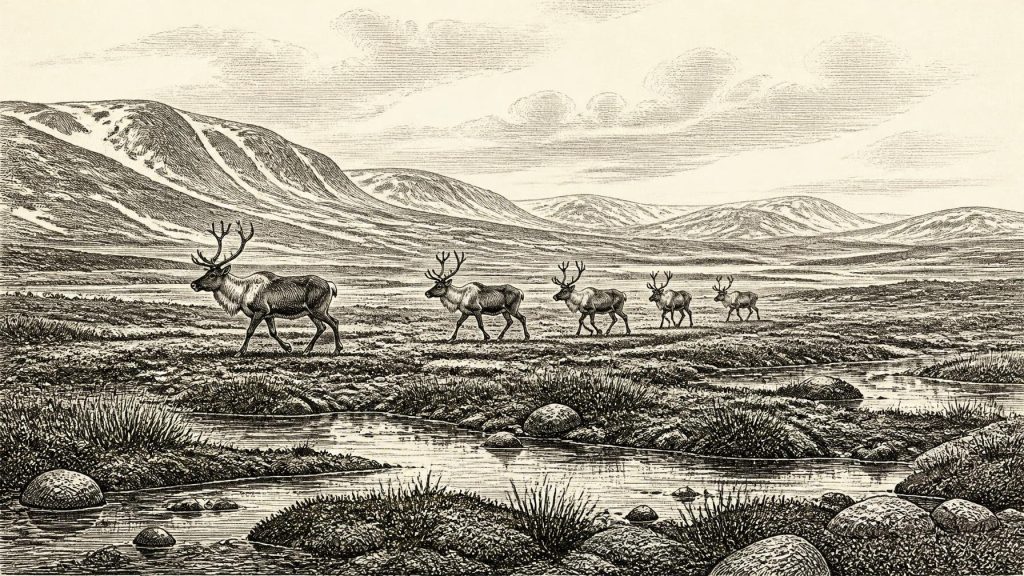
Derryvree’s plant and animal remains indicate open tundra or tundra-like vegetation in a periglacial regime: ground subjected to intense freezing and thawing, but not necessarily covered by glacier ice at that precise time. Mosses, sedges and other low-growing plants mattered more than trees. A fossil seed of bogbean, a wet-ground plant, is a small but powerful indication of shallow freshwater habitat. Insects and pollen complement this picture, pointing to a treeless, exposed environment with wet hollows, silty pools and seasonally harsh ground.
This was not the familiar green, wooded Ireland of later millennia. Nor should it be imagined as a uniform white desert. Even in a cold climate, watercourses, marshy basins, snow patches, gravelly ground and sheltered slopes created different local conditions. Vegetation would have been patchy and vulnerable to abrupt weather shifts. The environmental record supports the existence of open country and freshwater niches; it does not permit a precise map of every valley, coastline or plant community in 31,764 BCE.
South-west Ireland provides a second kind of evidence. At Crag Cave near Castleisland in County Kerry, calcite formations grew intermittently during the last glacial period. Such speleothems form only when liquid water can percolate through soil and limestone above a cave. Uranium-thorium dating of many broken and redeposited calcite pieces shows repeated growth episodes during MIS 3, broadly corresponding with warmer North Atlantic interstadials. Their existence demonstrates that Ireland’s climate could ameliorate enough, at intervals, for water to move through shallow karst systems rather than remain permanently frozen. Their interruptions show that these milder phases did not last.
An Atlantic Climate of Abrupt Change
The date label falls in a world of rapid North Atlantic climatic oscillations. Greenland ice-core records provide the wider framework, while Crag Cave offers an Irish response to it. A shift from a colder stadial to a milder interstadial could be substantial on human timescales, changing snow cover, season length, ground moisture and the availability of plants for grazing animals. Yet Irish cave calcite should not be treated as a thermometer reading for a single calendar year. It records episodes favourable to deposition, not a continuous weather diary.
Nor had the last great expansion of the British–Irish Ice Sheet reached its full extent. Research on landforms, offshore sediments and dating programmes places the major Last Glacial Maximum later, broadly from the high twenties into the low twenties thousands of calendar years before present, though its timing and pattern varied around the island. At roughly 33.7 thousand calendar years before present, Ireland was approaching a more severe glacial phase, rather than already possessing the fully developed ice-covered landscape often pictured for the Ice Age. Later glaciers would erode, transport and bury much earlier evidence, making this prehistoric interval unusually difficult to recover.
Animals in the Open Country
Caves, especially Castlepook Cave near Doneraile in north County Cork, preserve the strongest evidence for the animals that could occupy Ireland during the wider MIS 3 period. Re-dating of cave bones has demonstrated a much older presence than earlier work suggested for several species. The Irish record includes reindeer, brown bear, giant deer, Arctic fox, mountain hare, lemmings, wolf, woolly mammoth and spotted hyaena. Not every one of these animals can responsibly be placed at Derryvree or in the exact notional year under discussion. Their dates span long intervals, and cave deposits may mix material accumulated at different times. Together, however, they show that Ireland could support a diverse cold-stage fauna during favourable parts of the Late Pleistocene.
Reindeer are particularly appropriate to an open, cold and seasonally variable landscape. Their presence does not prove that they moved in the enormous, predictable herds familiar from some modern Arctic settings, but it suggests that grazing and browsing animals could find usable forage. Giant deer, despite their popular association with Ireland, were not an exclusively Irish creature; they ranged widely across Eurasia. Spotted hyaena remains are equally important because they indicate a carnivore guild unlike that of modern Ireland. A cave full of bones need not have been a human hunting camp: carnivores could carry prey in, gnaw bones, and alter the assemblage, while water and sediment could later redistribute it.
The coast and sea also require caution. Global sea level was much lower than today, but ice-sheet growth, local crustal movements and changing shorelines make simple maps misleading. The present shoreline is not the shoreline of this period. Lower sea levels expanded continental shelves and altered passages between Ireland, Britain and mainland Europe, but the evidence does not justify a confident claim that a particular dry route was open, or that any animal followed one, in 31,764 BCE. Faunal movement is real evidence; a mapped migration corridor at this date would be interpretation.
The Castlepook Human Question
The most intriguing, and most limited, evidence bearing on people is a reindeer femur from Castlepook Cave. It has been reported as roughly 33,000 years old and bears a deep incision interpreted by zooarchaeologist Ruth Carden as a possible cut or chopping mark made with a stone tool while the bone was fresh. If that interpretation is sustained, it would indicate human handling of an animal in Ireland far earlier than the island’s long-recognised Mesolithic settlement record.
It must not, however, be made to carry more historical weight than it can bear. The bone dates the animal’s death, not automatically the moment the mark was made; it does not establish the size, identity, technology or duration of a human party; and the old cave collection lacks the secure excavation context expected of modern archaeology. A cut-mark interpretation also needs comparison with damage made by carnivore teeth, trampling, sediment movement and excavation. The femur is therefore best described as potentially important evidence of a brief Palaeolithic human visit or butchery episode, not proof of a village, a permanent population or continuous occupation.
No excavated dwelling, hearth securely dated to this interval, worked stone-tool assemblage, human burial or unequivocal art has yet provided a corresponding Irish settlement record. Later evidence from Alice and Gwendoline Cave in County Clare demonstrates that humans did reach Ireland during the terminal Pleistocene, but that is many millennia after the period considered here and cannot be projected backwards. The responsible conclusion for 31,764 BCE is agnosticism: people may have entered or visited Ireland, but the material evidence remains too slight to describe an established community.
Society Beyond the Evidence
For that reason, there can be no evidence-based account of Irish political affairs, diplomacy, named leaders, territories, warfare or institutions at this date. There are no texts, monuments or settlement patterns from which to infer them. Likewise, there is no direct Irish evidence for ritual practice, formal religion, artistic traditions, teaching, language or shared symbolic systems. Upper Palaeolithic peoples elsewhere in Europe produced sophisticated art, ornaments and stone technologies, but nearby cultural richness is context, not proof that equivalent practices occurred in Ireland.
Economy and trade must be framed just as carefully. There were no farms, fields, livestock economies, markets or metalworking communities known in Ireland at this time. If people were present, the marked Castlepook bone would be consistent with the procurement and processing of animal food, hides, sinew or marrow. That is a reasonable functional inference, not evidence for a settled hunting economy. Nothing demonstrates regular exchange networks, seasonal camps or a sustained system of resource ownership on the island.
What This Date Can Mean
The most important development around this notional year was environmental, not political: Ireland lay within a living but precarious Ice Age landscape, where open wet tundra, cold-adapted mammals and periodic milder intervals existed before the later maximum of the ice sheet. Derryvree preserves a freshwater world that the ice subsequently sealed beneath till. Crag Cave preserves evidence that liquid water repeatedly returned during warmer pulses. Castlepook preserves animals, and perhaps a fleeting human intervention, from a landscape that later glaciation and time largely erased.
These archives also explain why the history is fragmentary. Most evidence is indirect, local and separated from the date label by wide chronological margins. Rather than inventing a year of first settlement or a prehistoric drama, the evidence invites a more revealing picture: Ireland was a changing Atlantic frontier, ecologically connected to the wider Pleistocene world, intermittently habitable for animals, and perhaps briefly encountered by people, on the eve of far more extensive glaciation.
Primary Sources
- Middle Midlandian Freshwater Series at Derryvree, Maguiresbridge, County Fermanagh, Northern Ireland
- Episodic Speleothem Deposition Tracks the Terrestrial Impact of Millennial-Scale Last Glacial Climate Variability in SW Ireland
- A Reconsideration of the Radiocarbon Dating of the Marine Isotope Stage 3 Fauna from Southern Ireland
- The Irish Quaternary Fauna Project
- First Evidence of a Late Upper Palaeolithic Human Presence in Ireland
- New Insights on the Fauna of Ireland's Younger Dryas and Early Holocene from Alice & Gwendoline Cave
- The Colonization of Ireland: A Human Ecology Perspective
- Timing and Pace of Ice-Sheet Withdrawal Across the Marine–Terrestrial Transition West of Ireland During the Last Glaciation
- Maximum Extent and Dynamic Behaviour of the Last British–Irish Ice Sheet West of Ireland
- Oscillating Retreat of the Last British-Irish Ice Sheet on the Continental Shelf Offshore Galway Bay, Western Ireland
- Trimlines, Blockfields and the Vertical Extent of the Last Ice Sheet in Southern Ireland
- Stratigraphic and Palaeo-Geomorphological Evidence for the Glacial-Deglacial History of the Last British-Irish Ice Sheet in the North-Western Irish Sea
- Timing, Pace and Controls on Ice Sheet Retreat: an Introduction to the BRITICE-CHRONO Transect Reconstructions of the British–Irish Ice Sheet
- The IntCal20 Northern Hemisphere Radiocarbon Age Calibration Curve (0–55 cal kBP)
- IntCal: Radiocarbon Calibration
- The Subdivision of the Quaternary Period in Ireland
- Palaeoecology
- 2022:564 – Castlepook Cave, Castlepook South, Cork
- Archaeological Heritage of County Cork
- Heritage Artefacts of County Cork
- Spatio-Temporal Dynamics of Speleothem Growth and Glaciation in the British Isles
- Middle Midlandian Freshwater Series at Derryvree, Maguiresbridge, County Fermanagh, Northern Ireland