Maguirebridge’s Mossy Interlude30745 BCE
Thirty thousand seven hundred and forty-five BCE is a modern label rather than a recoverable Irish historical year. Derryvree, near Maguiresbridge, preserves freshwater sediments between glacial tills, indicating a local ice-free MIS 3 interval with tundra-like vegetation, wetlands, insects and seasonal pools. Its radiocarbon evidence is broad and cannot date individual events. Castlepook Cave’s mixed faunal remains, including mammoth, reindeer, giant deer and hyaena, show intermittent ecological links with north-western Europe, but not coexisting populations at one time. No secure evidence establishes human settlement, camps or crossings. Ireland’s record therefore documents life in temporary habitats amid fluctuating climate and ice.
Dateline
“30,745 BCE” is a useful modern label, not a year that can be recovered from Ireland’s prehistoric record. No written calendar, event, ruler or human community can be assigned to it. In archaeological terms, the date falls about 32,695 years before AD 1950, during the Late Pleistocene’s Marine Isotope Stage 3 (MIS 3), a climatically unstable part of the last Ice Age. The closest Irish evidence is dated in broad calibrated ranges, not annual units. It allows a careful reconstruction of environments and animals, but not an annal-like account of what happened in one particular year.
A Wetland Beneath the Drumlin
The most revealing Irish evidence near this notional date comes from Derryvree townland, about two kilometres north-east of Maguiresbridge in County Fermanagh. Road excavations in 1969 cut through a drumlin and exposed an exceptional sequence: glacial till below, freshwater silts and fine sands with organic material in the middle, and a second thick till above. Till is unsorted clay, stones and debris deposited directly by glacier ice. The order of the layers establishes a simple environmental history. Ice had occupied the locality; later, an interval without ice at that spot permitted freshwater sediment and organic remains to gather; eventually, renewed glaciation buried the deposit.
Organic material from the freshwater series yielded the radiocarbon determination BIRM-166, 30,500 radiocarbon years before present, with a large laboratory uncertainty of +1,170 and −1,030 years. That is not a calendar date. Radiocarbon ages must be calibrated because atmospheric carbon-14 levels have changed over time, and the uncertainty of both measurement and calibration becomes considerable this far back. Modern discussion places the Derryvree evidence broadly within a range extending across the later part of MIS 3, rather than at a date precise enough to identify 30,745 BCE as a moment within the sediment. The numbered year belongs within the period illuminated by the deposit; it cannot be attached to a particular pool, plant, animal or season.
This distinction matters. Derryvree is evidence from one protected basin in northern Ireland, not a complete map of the island. It proves that its immediate locality was not continuously under ice while the freshwater beds accumulated. It does not prove that every region of Ireland was simultaneously ice-free, nor that the same vegetation and animals occupied every district. Much of the older Irish landscape was subsequently scoured, reworked or buried by later ice, which makes the Derryvree survival unusually valuable but also necessarily local.
Open Ground, Pools and Frost
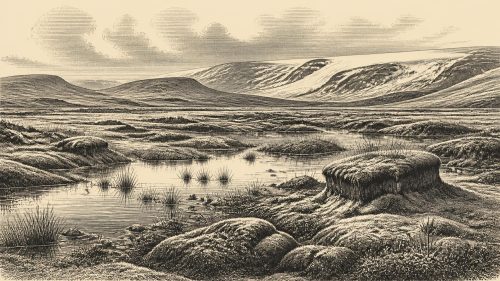
The plant and insect assemblages from Derryvree indicate open tundra-like country and a periglacial climatic regime. Pollen, plant macrofossils and mosses point away from woodland and towards sedges, grasses, herbs, low shrubs and wetland vegetation. Aquatic and marsh plants show that shallow, standing or slowly moving fresh water existed locally during the growing season. Moss-rich, waterlogged ground surrounded pools and silty margins. Earlier scholarship used the word “muskeg” for this kind of wet, organic-rich terrain; it should not be mistaken for a familiar modern Irish peat bog, still less for a settled rural landscape.
The wider setting was likely severe. Exposed soils, frost action and seasonal thaw mattered more than mature trees, pasture or fields. The evidence supports cold winters, short growing seasons and sparse cover away from wetter hollows. Yet it also shows a living landscape rather than a featureless white desert. Plants rooted and decayed; insects found terrestrial and aquatic niches; water carried mineral sediment and organic matter into the basin. A frozen-looking terrain could include thawed margins, pools and productive patches during summer. Precisely how temperatures changed from year to year cannot be known from this deposit, and neither can the exact depth or duration of snow cover.
Elsewhere, the British–Irish Ice Sheet was developing towards the much more extensive conditions of the Last Glacial Maximum, conventionally dated broadly to c. 26,000–19,000 years ago. Its margins did not advance and retreat evenly. Oceanic evidence and ice-sheet reconstructions show a highly dynamic system, while Greenland ice-core records demonstrate that MIS 3 climate repeatedly shifted between colder stadials and comparatively milder interstadials. Irish sequences rarely have the chronological resolution needed to match securely with one named Greenland event. The responsible conclusion is that Ireland around this broad horizon experienced changing, regionally varied Ice Age conditions, not a single fixed climate.
The Cork Cave Record
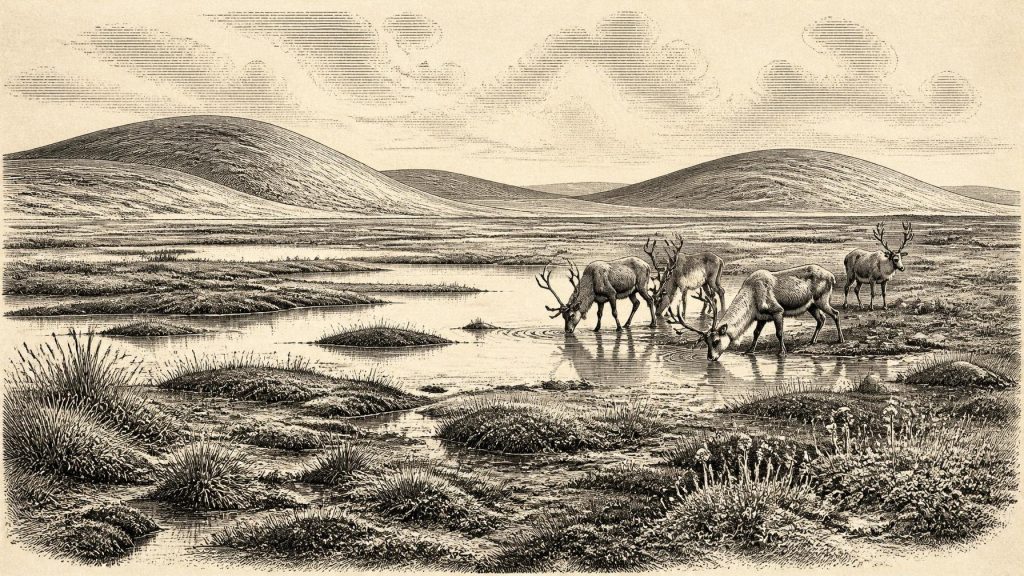
Animal bones from Castlepook Cave, near Doneraile in County Cork, provide a complementary but separate line of evidence. The limestone cave, also known historically as Mammoth Cave, has produced Ireland’s richest known assemblage of pre-Last Glacial Maximum vertebrate remains. Its fauna includes woolly mammoth, giant deer, reindeer, brown bear, wolf, Arctic fox, lemmings and spotted hyaena. These animals demonstrate that Ireland was connected ecologically, if intermittently and imperfectly, with the cold-open environments of north-western Europe.
Castlepook must nevertheless be handled with care. Many bones were recovered in antiquarian excavations during the early twentieth century; cave sediments had also been disturbed by carnivores, water and later activity. Bones from different phases could be mixed in a single collection or gallery. Direct radiocarbon dating has improved the chronology, but reassessment has also shown that some older dates need renewed testing because advances in pretreatment can remove contaminants that once made samples appear younger. The cave is therefore strong evidence that these species occurred in Ireland during parts of MIS 3, but not a licence to place every listed animal together beside the Fermanagh wetland in 30,745 BCE.
Spotted hyaenas are particularly important because their remains, teeth and coprolites indicate that caves could be carnivore dens as well as traps for sediment and bones. Mammoth and reindeer suggest open habitats with extensive grazing, but their Irish records are sparse. Giant deer, later famous as the “Irish elk”, was not an exclusively Irish animal and should not be made a national emblem for this early landscape. Such creatures moved through a changing world of forage, snow, exposed ground and ice margins. Their presence records ecological possibility and movement over long spans of time, not an annual census.
People: Possibility Is Not Settlement
There is no securely excavated dwelling, hearth, stone-tool assemblage, human burial or settlement surface from Ireland that can be assigned to this date. Consequently, political affairs, diplomacy, named conflict, social rank, religion, formal learning, farming and trade cannot responsibly be described for Ireland in 30,745 BCE. There were no known Irish polities, and there is no evidence for villages, agriculture, livestock, pottery, monuments or exchange networks on the island at this point.
Claims of very early human presence require especially strict scrutiny. A reindeer bone from Castlepook has been discussed as bearing possible marks from human processing, and it has attracted interest because it may relate to a late MIS 3 context. A single modified bone, particularly one from a disturbed historic excavation, is not equivalent to a habitation site. It cannot demonstrate a resident population, a hunting camp, a voyage route or continuous occupation. Nor should animal cut-marks be assumed where carnivore damage, trampling, weathering or excavation damage remain possible explanations. New work at Castlepook is recovering and dating surviving stratified deposits, an essential task before stronger conclusions are made.
There is firmer published evidence for people in Ireland much later: a butchered brown-bear bone from Alice and Gwendoline Cave in County Clare dates to roughly 12,800–12,600 calibrated years before present. Even that trace does not turn the much older MIS 3 landscape into a continuously inhabited country. Around 30,745 BCE, people may have lived in parts of continental Europe and Britain when conditions allowed, but Ireland’s water separation and harsh, fluctuating environments posed formidable barriers. Any arrival would have required a crossing; no boat, camp or tool-kit establishes that such a crossing occurred at this date.
What Everyday Life Cannot Tell Us
It is tempting to fill this gap with a familiar picture of Ice Age hunters pursuing reindeer. The evidence does not support it for Ireland. We cannot identify a local language, kin group, ritual, food-sharing practice, clothing style or seasonal round. No evidence demonstrates hunting tactics, organised warfare or exchange between Irish groups because no group is securely known. The landscape itself is the principal historical subject: a cold and shifting island environment in which wetland plants, insects and some large mammals persisted during an interval between glacial episodes.
Derryvree and Castlepook also explain why the record is so uneven. One is a freshwater archive sealed beneath till; the other is a cave archive assembled by geological and animal processes as well as excavation. Both survived by chance. Their evidence is not diminished by that limitation, but it must be read for what it is. Around this date, Ireland is known through silts, pollen, mosses, insect fragments and bones. The most important story is not a lost kingdom or a forgotten battle, but the resilience of life in temporary habitable pockets before later ice reshaped the island again.
Primary Sources
- A Middle Midlandian Freshwater Series at Derryvree, Maguiresbridge, County Fermanagh, Northern Ireland
- The Irish Quaternary Fauna Project
- A Reconsideration of the Radiocarbon Dating of the Marine Isotope Stage 3 Fauna from Southern Ireland
- The Colonization of Ireland: A Human Ecology Perspective
- First Evidence of a Late Upper Palaeolithic Human Presence in Ireland
- New Insights on the Fauna of Ireland's Younger Dryas and Early Holocene from Alice & Gwendoline Cave
- Castlepook Cave: County Geological Site Report
- The Archaeological Heritage of County Cork
- Preliminary Assessment of the Archive of Faunal Remains from Excavated Irish Cave Sites
- Irish Pleistocene Biostratigraphy
- Growth and Retreat of the Last British–Irish Ice Sheet, 31,000 to 15,000 Years Ago: the BRITICE-CHRONO Reconstruction
- New Data for the Last Glacial Maximum in Great Britain and Ireland
- Dimensions and Chronology of the Last Ice Sheet in Western Ireland
- Maximum Extent and Dynamic Behaviour of the Last British–Irish Ice Sheet West of Ireland
- The Last Glacial Maximum
- The IntCal20 Northern Hemisphere Radiocarbon Age Calibration Curve (0–55 cal kBP)
- A 60,000 Year Greenland Stratigraphic Framework and Chronology
- Irish Association for Quaternary Studies: Quaternary Research in Northern Ireland Field Guide
- Irish Association for Quaternary Studies: References and Recommended Reading
- 2022:564 – Castlepook Cave, Castlepook South, Cork
- A Middle Midlandian Freshwater Series at Derryvree, Maguiresbridge, County Fermanagh, Northern Ireland