
Castlepook’s Uncertain Blade31396 BCE
31,396 BCE is not a recoverable Irish historical year but falls within an unstable Late Pleistocene interval. Derryvree, County Fermanagh, preserves freshwater silts between glacial tills, indicating a locally ice-free, treeless wetland with tundra vegetation during part of MIS 3. Castlepook Cave, County Cork, contains a mixed, long-lived fauna including mammoth, reindeer, giant deer, hyaena and Arctic species, evidencing open cold landscapes. A cut-marked reindeer femur may represent Ireland’s earliest humanly processed animal, though it proves neither settlement nor identity. Later glaciation obscured much evidence there, leaving only cautious indications of changing climates, animal movements and possible brief human visits.
Dateline
The label 31,396 BCE is a modern chronological convenience, not a year that can be recovered from Irish evidence. No calendar, writing system, named people or historical record existed in Ireland at this depth of time. In archaeological terms it lies about 33,345 calendar years before AD 1950, within the Late Pleistocene and Marine Isotope Stage 3 (MIS 3), a long and climatically unstable part of the last Ice Age. The responsible way to approach it is therefore through dated ranges, layers, bones and environmental traces, rather than by inventing an event for a particular year.
The nearest relevant Irish chronological anchor is not a document but a buried wetland at Derryvree, near Maguiresbridge in County Fermanagh. Organic material there produced the conventional radiocarbon determination Birm-166, about 30,500 radiocarbon years BP, with a substantial uncertainty. Calibrated against modern radiocarbon curves, that result has been expressed broadly as c. 36,900–31,700 cal BP. The numbered year in this article falls within that wide interval, but it does not follow that the Derryvree sediments formed in that exact year, or even in a single century. The range establishes a period of environmental possibility, not an anniversary.
A Wetland Beneath Ice
Derryvree matters because its geological order is unusually clear. Road works exposed fine sands and organic freshwater silts enclosed between two deposits of till, the unsorted debris laid down by glacier ice. An earlier glacial advance created the lower till. Ice then ceased to occupy the site long enough for standing or slow-moving freshwater, vegetation and small animals to leave their traces. A later advance covered the deposit with a fresh body of till. This sequence is direct evidence for profound regional change: ice, then a locally ice-free and waterlogged landscape, then ice again.
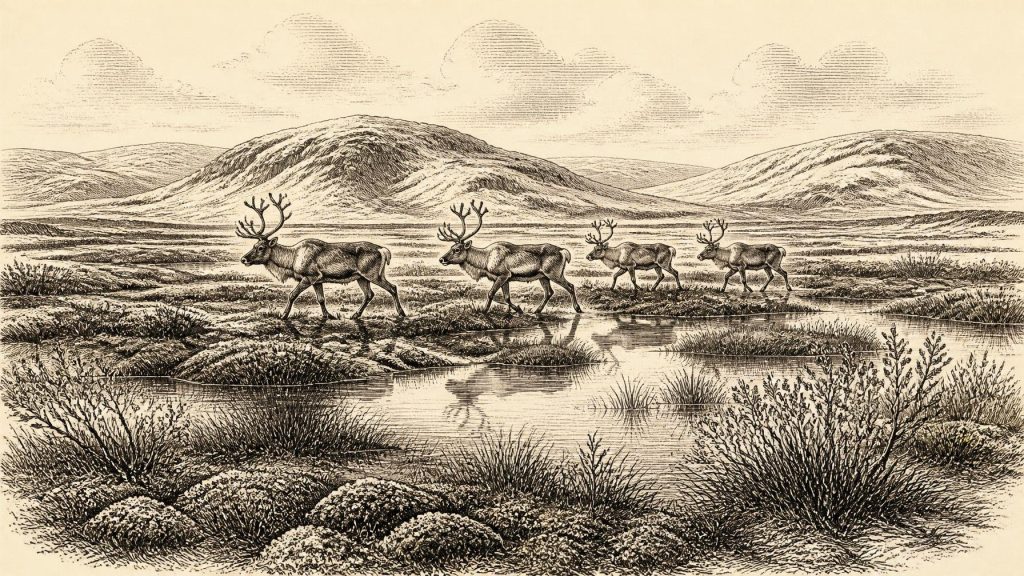
The fossils from the intervening deposit suggest a treeless, cold and wet environment often described as tundra or muskeg. These words should not conjure a uniform white wilderness. The evidence includes mosses, sedges, grasses, hardy herbs and low shrubs, as well as aquatic and marsh plants. Fossil remains of bogbean and dwarf willow are especially eloquent: they point to pools, wet margins and ground capable of supporting a brief but real growing season. Insect evidence reinforces the image of shallow freshwater and mossy vegetation. At Derryvree, Ireland’s Ice Age landscape included ecological niches, not simply an ice-front desert.
Yet Derryvree was one small place in what is now Fermanagh. It cannot prove that all parts of Ireland were simultaneously ice-free, equally wet or covered by the same plants. Nor can it reveal the precise appearance of the landscape in 31,396 BCE. Its value lies in demonstrating that, during part of later MIS 3, northern Ireland contained periglacial ground: terrain shaped by intense freezing and thawing, seasonal water and severe winters, but not continuously buried beneath glacier ice. Subsequent advances destroyed or reworked much comparable evidence, making this sealed deposit exceptionally important.
Castlepook’s Long Animal Record
Far to the south, Castlepook Cave near Doneraile in north County Cork provides the principal Irish archive of animal life before the Last Glacial Maximum. The limestone cave, once popularly called Mammoth Cave, was explored in the early twentieth century. Its narrow galleries and chambers yielded thousands of bones and teeth. The surviving assemblage is now chiefly associated with the National Museum of Ireland’s Natural History collections. Modern dating and re-examination have made Castlepook essential, while also showing why old cave collections require caution.
Individual specimens from Castlepook span a very long period, roughly 45,700 to 19,950 years BP. They do not represent a single living herd, one hunting episode or a neatly sealed floor. Water movement, carnivore activity, ancient excavation and later disturbance mixed materials from different times and parts of the cave. A cave can be a shelter, den, trap, scavenging point and sediment repository over millennia. It is consequently wrong to arrange every species recovered there into one imagined scene set in 31,396 BCE.
Nonetheless, the fauna gives a powerful picture of the wider Ice Age world that intermittently reached Ireland. Castlepook has produced remains attributed to woolly mammoth, reindeer, giant deer, brown bear, wolf, Arctic fox, mountain hare, lemmings and spotted hyaena. The presence of spotted hyaena is particularly revealing. It indicates not merely isolated wandering animals but an ecological setting in which large herbivores, scavengers and predators could be sustained, at least during favourable phases. The cave’s evocative names, including Hyaena Hall and Elephant Hall, preserve the astonishment of its first investigators; they should not be mistaken for evidence that all those creatures occupied the chambers together.
Such animals imply open country rather than later Irish woodland. Reindeer and mammoth are consistent with grassland, herb-rich tundra and cold-steppe mosaics; hyaenas and wolves point towards wider food webs. But ecology is not a photograph. Animal ranges shift with season, vegetation and climate, while bones may be carried into caves after death. The direct evidence is the bone itself and its identification. The interpretation is that parts of Ireland, or its changing surrounding land and coastal zones, supported a varied cold-adapted fauna during portions of MIS 3.
The Reindeer Femur
One Castlepook object has made this remote period newly significant for Irish human history: a hind-leg femur of reindeer bearing a deep linear mark. Zooarchaeologist Ruth Carden has interpreted the incision as damage made with a sharp stone tool while the bone was fresh, during butchery. County Cork’s heritage publication places the specimen broadly around 31,000 BC. If that interpretation is sustained by further study, it is potentially the earliest presently claimed sign that people handled an animal in Ireland, vastly earlier than the better-established terminal Pleistocene traces of human activity.
It is an important claim, but a narrow one. A radiocarbon date determines the age of the animal’s death, not automatically the exact moment when the mark was made. A mark interpreted as a tool cut does not identify its maker, establish a language or culture, or show whether a kill occurred at the cave. Nor does it demonstrate a permanent settlement. No securely associated hearth, stone-tool assemblage, dwelling surface, burial, food store or repeatedly occupied camp of this age has yet been published from Castlepook. It is possible that a butchered limb was transported by scavengers, especially hyaenas or wolves, before entering the cave.
Accordingly, the femur supports a cautious formulation: people may have reached Ireland, or the landmass that would become Ireland, and processed a reindeer during this broad Ice Age interval. It does not support a detailed narrative of a resident population. The distinction is crucial. Archaeology often advances through small, difficult objects whose significance grows or diminishes as microscopy, dating techniques and fresh excavation test them. Castlepook’s unexcavated deposits therefore matter as much as the celebrated bone already in a museum collection.
Life Without a Recorded Society
There is no evidence for political affairs in the conventional sense: no chiefs, territories, treaties, institutions, armies or diplomacy can be identified in Ireland around this horizon. There is equally no evidence for farming, fields, livestock, pottery, metalworking, monumental building or trade networks. The island was not the settled and wooded country of later prehistory. If humans were present, they would have depended on mobile hunter-gatherer practices: acquiring food from animals and plants, making short-lived equipment from stone, wood, hide and bone, and moving according to weather, game and accessible terrain. That is a reasonable inference from Upper Palaeolithic lifeways elsewhere in north-west Europe, not a securely demonstrated description of an Irish camp.
The same restraint applies to conflict, religion, culture and learning. Hunting large animals may have required cooperation; knowledge of animal movement, safe ground, weather and stone sources would have been valuable. Groups elsewhere in Ice Age Europe made symbolic objects and art. But Ireland has no securely attributable artwork, ritual deposit, burial or occupational assemblage of this date from which to infer comparable beliefs or customs. It would be misleading to import cave art, named archaeological cultures or ceremonial practices from France, Iberia or Britain and present them as Irish facts.
Movement is the central theme that the evidence does allow. Animal populations evidently reached Ireland during favourable intervals, despite changing coastlines and difficult northern waters. Lower global sea levels exposed more continental shelf than exists today, but the precise arrangement of sea, seasonal ice, shorelines and passable routes cannot be reconstructed for one year. Neither the Castlepook bone nor the Derryvree wetland proves a land bridge, a boat crossing or a regular migration route for people. They show instead that Ireland stood on the mobile western edge of Ice Age Europe, intermittently connected ecologically to a much broader world.
Before the Great Expansion of Ice
This was not yet the Last Glacial Maximum. Research on the British–Irish Ice Sheet shows that its growth and maximum extent were regionally uneven, with the largest ice volume occurring much later, around 23,000 years BP, and widespread maximum conditions broadly within the later range of c. 27,000–21,000 years ago. The contrast gives the evidence its historical drama. Derryvree records a wet, locally ice-free interval; Castlepook preserves animals that used an open, cold landscape; later ice would cover, erode and obscure much of the evidence they left.
For 31,396 BCE, then, Ireland’s story is not one of named events but of fragile survival in the record. Freshwater silts under a Fermanagh drumlin prove that plants and small creatures found room between ice advances. A Cork cave preserves a long, mixed archive of mammoth, reindeer and hyaena. One marked reindeer bone raises the possibility of a human hand. Together these traces offer neither a settled society nor a precise annual history. They reveal something more fundamental: an Irish landscape repeatedly transformed by climate, inhabited by animals now absent, and perhaps briefly entered by people whose presence remains tantalising rather than secure.
Primary Sources
- Heritage Artefacts of County Cork
- Cork County Geological Site Report: Castlepook Cave
- Spotted Hyena Skull
- The Exploration of Castlepook Cave, Co. Cork. With 3 Plates.
- Proceedings of the Royal Irish Academy, Volume 34
- 2022:564 – Castlepook Cave, Castlepook South, Cork
- The Irish Quaternary Fauna Project
- New Insights on the Fauna of Ireland’s Younger Dryas and Early Holocene from Alice & Gwendoline Cave
- A Middle Midlandian Freshwater Series at Derryvree, Maguiresbridge, County Fermanagh, Northern Ireland
- Early Midlandian–Middle Midlandian, Pleistocene, Northern Ireland
- Figure 6.— The Subdivision of the Quaternary Period in Ireland
- Quaternary of Northern Ireland
- Menyanthes trifoliata L.
- Salix herbacea L.
- Irish Pleistocene Biostratigraphy
- Growth and Retreat of the Last British–Irish Ice Sheet, 31,000 to 15,000 Years Ago: the BRITICE-CHRONO Reconstruction
- Last Glacial Maximum Cirque Glaciation in Ireland and Implications for Reconstructions of the Irish Ice Sheet
- Early Deglaciation of the British-Irish Ice Sheet on the Atlantic Shelf Northwest of Ireland Driven by Glacioisostatic Depression and High Relative Sea Level
- The IntCal20 Northern Hemisphere Radiocarbon Age Calibration Curve (0–55 cal kBP)
- IntCal Publications
- AMS Radiocarbon Dating of Ancient Bone Using Ultrafiltration
- The Problem of a Late Quaternary Landbridge Between Britain and Ireland
- Ireland’s Palaeolithic Archaeology – Fleeting Footprints in a Frozen Land
- The Mesolithic in Ireland: When Was It?