
Derryvree’s Calcareous Silt31395 BCE
At roughly 33,500 calibrated years BP, Derryvree, County Fermanagh, preserves freshwater silts and organic deposits laid down between glacial advances. Pollen, plants and invertebrates indicate cold, open wetland with sedges, grasses, shrubs and mountain avens, rather than permanent settlement. Lower sea levels and unstable climate created changing landscapes as ice expanded, though conditions across Ireland remain uncertain. Castlepook Cave, County Cork, documents diverse Late Pleistocene fauna, including reindeer, mammoth, giant deer, predators and scavengers, across a lengthy period. A cut-marked reindeer bone may signal early human carcass processing, but proves neither occupation nor society. Evidence records environmental change, not institutions.
Dateline
Modern calendar-year precision is not available for 31,395 BCE. Nobody in Pleistocene Ireland used a calendar that can be aligned with that label, and archaeological science cannot identify an event, season or individual life at such a narrow point. The date is best understood as a conventional marker for roughly 33,344 years before AD 1950, within the Late Pleistocene and Marine Isotope Stage 3 (MIS 3). The closest relevant Irish evidence is a radiocarbon-dated organic deposit at Derryvree, near Maguiresbridge in County Fermanagh: its original determination, BIRM-166, was 30,500 ± 1,100 radiocarbon years BP, subsequently expressed in scholarship as broadly about 33,500 ± 1,200 calibrated years BP. That is a useful range, not an anniversary.
A Landscape Between Ice Advances
At Derryvree, road-cutting through a drumlin exposed a remarkable sequence: glacial deposits below, freshwater sands, silts and organic muds in the middle, and another mass of glacial till above. This arrangement matters more than any modern place-name. It demonstrates that a cold but living landscape occupied part of Fermanagh between episodes when ice moved across the district. Later ice buried the wet ground, compacted the sediments and ultimately shaped the hill into a drumlin. In doing so, it also sealed a rare archive of an Irish landscape that would otherwise have vanished.
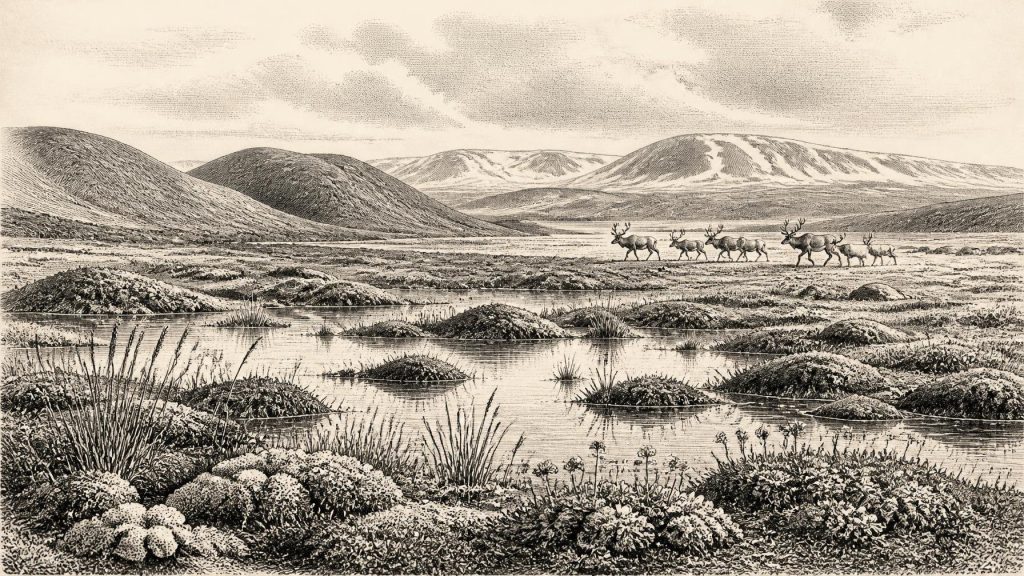
The fine deposits record standing or slowly moving freshwater, wet margins and saturated ground rather than a settled lakeside village. Pollen, plant macrofossils, mosses and invertebrate remains point to a largely treeless, tundra-like or muskeg environment. Sedges and grasses were important; low shrubs and cold-adapted herbs occupied better-drained patches. The presence of mountain avens, an arctic-alpine plant, among the macrofossils is especially evocative, though it should not be taken to mean that every part of Ireland resembled a single uniform tundra. Derryvree was one small locality, and its evidence represents a span of deposition rather than one day in 31,395 BCE.
Cold, Open and Changeable
Ireland at this point was not simply the island familiar today with its deeply incised coasts, blanket bogs, woodland history and agricultural fields. Global sea level was substantially lower because immense quantities of water were held in northern ice sheets. Modelling for the British–Irish region places relative sea level around 50 to 100 metres below its present level at approximately 31,000 years ago, although local land elevation, ice loading and shoreline positions were changing. Broader coastal plains existed in some areas, and sea crossings between Ireland, Britain and continental Europe were different from later ones. Yet a low sea stand did not automatically create an easy, continuous land bridge in every direction; routes changed with topography, tides, rivers, ice margins and climate.
The climate was severe and unstable. The Derryvree sediments belong to a cold phase in the older Irish Quaternary framework, while modern reconstructions of the British–Irish Ice Sheet show ice building rapidly around the northern and western seaways during the wider 31,000-year horizon. At the precise interval represented by 31,395 BCE, however, the geographical detail remains uncertain. It would be wrong either to picture the entire island as ice-free pasture or to insist that it was all buried beneath a single unbroken ice sheet. The responsible reconstruction is regional: exposed, periglacial ground and wetland persisted in some places; growing ice masses, cold winds, frozen soils and seasonal meltwater were increasingly important elsewhere.
Animals of the Open Country
The best evidence for large animals comes not from Derryvree but from Castlepook Cave, near Doneraile in north County Cork. The cave is Ireland’s richest known Late Pleistocene vertebrate-fauna site. Its collections include reindeer, woolly mammoth, giant deer, brown bear, wolf, fox, hare, lemmings and spotted hyaena. Together these animals indicate that Ireland could, during suitable intervals, support a varied community of grazing animals, browsers, scavengers and predators. Reindeer and mammoth suggest open country with extensive herbaceous forage; hyaena and wolf remind us that carcasses were contested resources in a dangerous food web.
But the Castlepook assemblage is not a snapshot of the same year, nor even necessarily of a single climate phase. Cave deposits accumulated through animal deaths, carnivore activity, water movement, sediment reworking and early twentieth-century excavation. Improved radiocarbon pretreatment has also shown that several previously accepted cave dates were too young, with revised Castlepook results thousands of radiocarbon years older. The cave therefore offers a long record of changing MIS 3 fauna, not an exact inventory for Fermanagh in 31,395 BCE. This distinction is central: animal bones establish that such species reached Ireland; they do not prove that they all grazed beside the Derryvree wetland together.
The Human Question
A reindeer femur from Castlepook has brought human history unexpectedly close to this date. It has been reported as carrying a deep mark consistent with cutting or chopping fresh bone using a sharp stone tool, and its age has been associated broadly with about 33,000 years ago. If that interpretation is sustained, it would be Ireland’s earliest evidence for a person handling an animal carcass, pushing possible human activity far beyond the formerly accepted terminal-Pleistocene evidence from County Clare. It is an important observation, but its implications require restraint.
One marked bone is not a settlement. No securely dated Irish house, hearth, stone-tool assemblage, burial, art object, boat, camp floor or rubbish deposit belongs to this horizon. There are no human remains, and no associated tools at Castlepook demonstrate who made the mark. The bone may indicate a short visit by one or more Upper Palaeolithic hunters, perhaps taking advantage of a reindeer carcass in an open landscape. It cannot establish whether they killed the animal, entered the cave, lived locally, travelled regularly along a route from Britain, or left descendants on the island. The National Museum of Ireland’s continuing caution that clear Palaeolithic human presence has not yet been demonstrated reflects the absence of a secure occupation context.
No Polity, No Annals
Consequently, there can be no responsible account of Irish political affairs, diplomacy, named leaders, warfare or institutions for this date. Nor can religion, language, learning, music or artistic traditions be recovered from Derryvree’s silts or Castlepook’s cave fauna. These are not subjects awaiting a lost written source: the evidence does not establish a resident human community from which such practices might be inferred. Ireland’s historical and later prehistoric categories—kingdoms, tribes, farms, monuments and trade networks—belong to vastly later worlds.
If people did reach Ireland during this phase, comparison with contemporary Upper Palaeolithic societies elsewhere in north-west Europe makes small, mobile hunter-gatherer groups more plausible than permanent villages. Such groups could have depended on detailed seasonal knowledge of animals, shelter and stone resources. They may have shared meat, hides, sinew and stories within close-knit travelling bands. Yet those possibilities are comparative interpretation, not Irish evidence. Castlepook has not supplied a blade, a hide-working area or a hearth of this age. At most, the cut-marked femur offers a narrow potential glimpse of carcass processing.
Economy Without Trade
The island’s demonstrable economy was ecological rather than human. Grazers turned sparse vegetation into meat; predators and scavengers redistributed remains; wetland plants and insects responded to water, frost and short growing seasons. There is no evidence for farming, pottery, metalwork, managed woodland, long-distance exchange or a regular Irish trade system. A travelling hunter might have carried stone tools or personal equipment from elsewhere, but no material evidence presently proves such movement. Even the likelihood of crossings must be framed cautiously: lowered seas may have reduced marine barriers, but glacial waters, shifting coasts and bad weather could still make movement hazardous.
The principal historical development around 31,395 BCE was therefore environmental instability. Derryvree preserves a brief chapter in which freshwater and cold-adapted vegetation survived between glacial incursions. Castlepook preserves a separate, time-depth-rich record that Ireland supported impressive Pleistocene fauna and possibly received a human visitor. In the following millennia, advancing ice would reshape terrain, remove or bury older surfaces and make the archaeological record still harder to read. What survives is not an Irish yearbook but a handful of durable witnesses: calcareous silt, pollen grains, seeds, bones and marks whose meanings must remain proportionate to the evidence.
Primary Sources
- A reconsideration of the radiocarbon dating of the Marine Isotope Stage 3 fauna from southern Ireland
- Growth and retreat of the last British–Irish Ice Sheet, 31,000 to 15,000 years ago: the BRITICE-CHRONO reconstruction
- First evidence of a Late Upper Palaeolithic human presence in Ireland
- New insights on the fauna of Ireland’s Younger Dryas and Early Holocene from Alice & Gwendoline Cave
- The Irish Quaternary Fauna Project
- Castlepook Cave: Cork County Geological Site Report
- A Guide to the Quaternary of Ireland
- The IntCal20 Northern Hemisphere Radiocarbon Age Calibration Curve (0–55 cal kBP)
- Reconstructing the last Irish Ice Sheet 2: a geomorphologically-driven model of ice sheet growth, retreat and dynamics
- Radiocarbon constraints on the age of the maximum advance of the British-Irish Ice Sheet in the Celtic Sea
- Late Pleistocene chronostratigraphy and ice sheet limits, southern Ireland
- The deglaciation of the western sector of the Irish Ice Sheet from the inner continental shelf to its terrestrial margin
- Last Glacial Maximum cirque glaciation in Ireland and implications for reconstructions of the Irish Ice Sheet
- Prehistoric Details
- 32564: Castlepook Cave, Castlepook South, County Cork
- Archaeology Research Excavation Grant 2022: Final Report
- Heritage Artefacts of County Cork
- An Inventory of Scenic Landscapes in County Cork: Castlepook Caves
- Quaternary Geology of Ireland
- Dryas octopetala in Fermanagh