Doneraile’s Pleistocene Threshold31336 BCE
31,336 BCE is a modern label, not a precisely datable Irish event, within climatically unstable Marine Isotope Stage 3. Ireland’s ice margins, sea levels and coastlines were changing, although full British–Irish Ice Sheet cover came later. Derryvree deposits in Fermanagh reveal cold, treeless, waterlogged tundra wetlands supporting varied life. Castlepook Cave, County Cork, preserves remains of reindeer, mammoth, giant deer, predators and other cold-adapted fauna, accumulated across different periods. A roughly 33,000-year-old marked reindeer bone may indicate human butchery, but lacks secure archaeological context. No settlement or society can be inferred. This period is reconstructed through environmental and faunal evidence.
Dateline
The label 31,336 BCE gives a useful point of entry into Ireland’s deep past, but it must not be mistaken for a date at which a recorded Irish event occurred. No written calendar, political chronology or year-by-year human history exists for this period. In scientific terms, the notional year falls about 33,285 years before AD 1950, within the later part of Marine Isotope Stage 3 (MIS 3), a long and climatically unstable phase of the last Ice Age. The evidence is dated in broad ranges, not to a single modern calendar year, and Ireland’s record is especially fragmentary. What can responsibly be reconstructed is an Ice Age island-edge landscape, changing ice margins, wet tundra habitats and a remarkable assemblage of animals.
A Date Beyond Calendar Precision
Radiocarbon dating does not produce a simple equivalent of a BCE year. It measures the remaining radioactive carbon in once-living material, returns a radiocarbon age with an uncertainty range, and must then be calibrated against a changing atmospheric record. At more than 30,000 years ago, the calibrated ranges may be wide. The present international northern-hemisphere curve, IntCal20, extends to 55,000 calibrated years before present, but its use underscores rather than removes the need for caution. A year such as 31,336 BCE is therefore a modern filing device: it cannot identify a particular season, generation or episode in prehistoric Ireland.
The wider interval matters more. MIS 3 is conventionally placed at roughly 57,000–29,000 years ago and was marked by abrupt shifts between colder stadials and relatively milder interstadials across the North Atlantic world. Greenland ice-core records show that such changes could be rapid on geological timescales. Conditions in Ireland did not simply alternate between an entirely frozen island and a temperate one. Ice sheets expanded, retreated and reorganised; coastal and inland environments responded differently; and local shelter, drainage and altitude shaped the ground available to plants and animals.
Ice, Water and Open Ground
Ireland was approaching the more severe part of the last glacial cycle, but 31,336 BCE predates the best-dated local maximum of the British–Irish Ice Sheet. Research places that maximum at about 27,000 calibrated years before present, with ice eventually covering Ireland and its continental shelf between roughly 27,000 and 23,000 calibrated years ago. Earlier MIS 3 ice behaviour is less securely mapped. Recent syntheses nevertheless indicate that the ice sheet had already grown during the preceding cold stages and experienced dynamic retreat–advance phases during MIS 3. It would be unsafe to draw a single neat ice edge for the notional year.
Southern Ireland provides an important corrective to older ideas that treated extensive deposits there as relics of a much earlier glaciation. Optically stimulated luminescence dates from the Courtmacsherry Raised Beach and related sediments show that shallow-marine environments on the south coast belonged to MIS 4–3. Other evidence suggests that ice loading and local relative sea level were already affecting Irish coasts in complex ways. Global sea level was lower than today, but local sea level depended also on the weight of regional ice depressing the land. The familiar modern coastline did not exist, and neither did a simple, demonstrable land bridge joining Ireland to Britain at this time.
For people or animals, the practical landscape would have been defined by cold, exposed terrain, ice and water barriers rather than by modern county boundaries. Lowlands, river corridors, cave systems and margins beyond active ice might at times have offered passage and forage. Yet any route across or around the Irish Sea remains an inference unless supported by direct finds. The later Pleistocene seascape has also been profoundly altered by glacial erosion, rising seas and sediment movement, so possible camps or pathways may lie destroyed, buried or submerged.
The Derryvree Landscape Archive
The most informative evidence for Ice Age environments in Ireland does not come from an inhabited settlement. At Derryvree near Maguiresbridge in County Fermanagh, roadworks exposed freshwater silts and fine sands sealed between till deposits beneath a drumlin. The deposit produced pollen, plant macrofossils, mosses and insect remains, alongside a radiocarbon determination of 30,500 radiocarbon years before present, with a substantial laboratory uncertainty. It is not a year-specific record for 31,336 BCE, and its radiocarbon age must not be casually converted into an exact BCE date. It does, however, illuminate the kind of mid-glacial environment that existed in Ireland within the broad period under discussion.
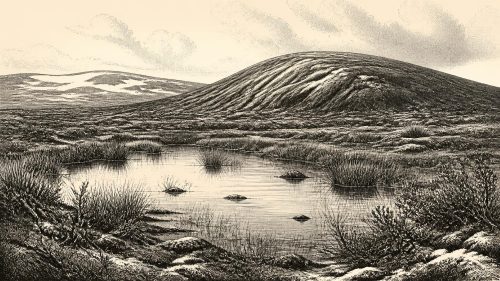
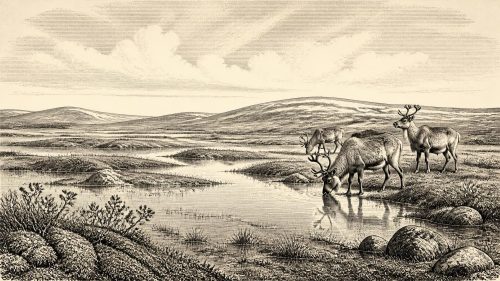
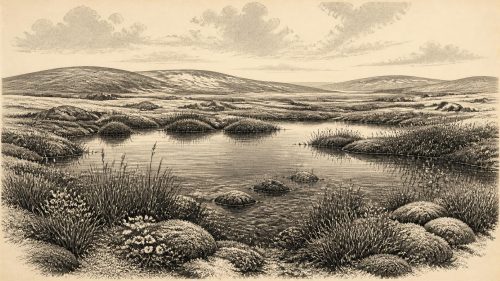
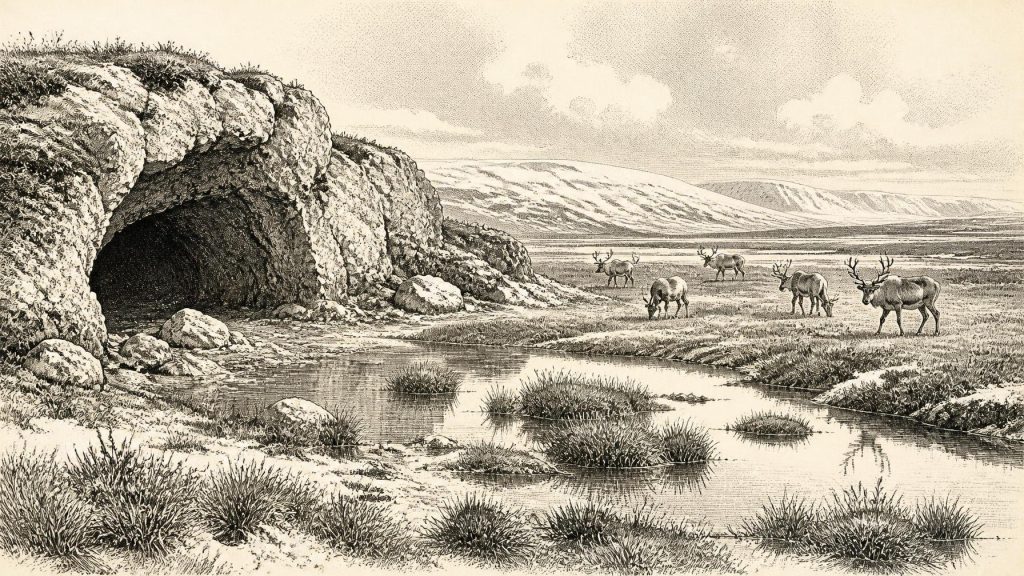
The Derryvree evidence points to a cold, treeless and waterlogged landscape. Sedges, mosses and aquatic or wet-ground plants indicate pools, marshy hollows and slow-moving freshwater. Pollen was dominated by herbs associated with tundra vegetation. Sparse dry-land cover, rather than woodland, is the responsible reconstruction. The presence of freshwater organisms is particularly significant: even within a generally harsh climate, local wetlands could support productive ecological niches. Such places may have concentrated grazing animals, predators and scavengers, while also preserving the biological traces by which later researchers can recognise vanished environments.
This was not the blanket, featureless ‘snow desert’ often imagined by older popular accounts of the Ice Age. It was a mosaic whose details changed with climate, season and proximity to ice. Periglacial processes—freeze-thaw action, unstable soils and intense winter cold—would have shaped exposed ground. In sheltered basins there could be standing water and vegetation; elsewhere wind and frost could keep plant cover thin. The evidence does not justify assigning exact temperatures to Ireland in this particular notional year, but it firmly supports an open, cold-adapted environment very unlike the later wooded island.
Animals at Castlepook
In north County Cork, Castlepook Cave near Doneraile—historically called Mammoth Cave—provides the most striking faunal archive relevant to this era. Antiquarian excavations between 1904 and 1912 recovered a large assemblage from a complicated cave system. Subsequent dating programmes have shown that Irish caves preserve animal remains spanning different phases of the Late Pleistocene. At Castlepook and associated southern Irish cave sites, dated or identified material includes reindeer, woolly mammoth, giant deer (Megaloceros giganteus), brown bear, wolf, Arctic fox, mountain hare, lemmings and spotted hyaena.
These names should not be treated as a roll-call of animals standing together outside the cave in one year. Cave deposits can accumulate through carnivore activity, animals dying in natural traps, water movement, roof collapse and excavation disturbance. The Irish Quaternary Fauna Project warned that many nineteenth- and early twentieth-century collections had limited contextual records and disturbed deposits. Modern redating has also altered the chronology substantially: some Castlepook specimens proved between about 5,000 and 12,000 radiocarbon years older than previously thought. The cave is valuable precisely because it records repeated ecological episodes, but that makes it unsuitable for a simple snapshot.
Even so, the broad picture is powerful. Reindeer and mammoth are consistent with open, cold grassland-tundra or steppe-tundra habitats capable of sustaining large herbivores. Giant deer, often misleadingly called the ‘Irish elk’, was neither an elk nor unique to Ireland; its presence speaks to a much wider European Pleistocene fauna. Wolves and spotted hyaenas indicate a predator-and-scavenger guild, while Arctic foxes and lemmings reinforce the severity of at least some conditions. Ireland was not biologically empty before the later full glaciation. It was intermittently part of a changing north-west European ecological world.
The Marked Reindeer Bone
A reindeer femur fragment from the Castlepook collection gives this date unusual historical importance. It has been publicly reported as about 33,000 years old and bears deep marks interpreted by zooarchaeologist Ruth Carden as possible cuts or chops made with a stone tool during butchery. County Cork heritage material accordingly presents the find as evidence that Stone Age hunters may have handled reindeer in the area around 31,000 BCE. If the modification is confirmed as human-made, it would push direct evidence for human activity in Ireland dramatically earlier than the formerly accepted post-glacial record.
But the limits of the claim are as important as its promise. The dated bone records the death of the reindeer, not necessarily the precise moment at which a mark was made. It came from an old collection rather than a modern excavation of a securely stratified occupation surface. No associated hearth, stone-tool assemblage, dwelling, human burial or food-processing area of comparable age has been identified at Castlepook. Nor can one modified bone demonstrate that people lived permanently in Ireland, travelled there regularly, or left descendants. It is best regarded as potentially momentous evidence of a brief human encounter with an animal, pending fuller publication and contextual confirmation.
No Kingdoms, No Trade Network
There is no evidence from Ireland around this point for rulers, territories, diplomacy, warfare, formal religion, monuments, farming or trade. Nor is there a basis for reconstructing family structures, languages, ritual practices or artistic traditions. Upper Palaeolithic communities elsewhere in Europe made sophisticated stone tools, ornaments and cave art, but importing those achievements into Ireland would be speculation. The absence of evidence is not proof that no person ever reached the island; it is a warning against converting a fragile clue into an imagined society.
If humans were present, their economy would have depended on mobile foraging and the procurement of animal and plant resources, not agriculture. Reindeer would have offered meat, fat, hide, sinew and bone, but Castlepook’s single marked specimen cannot establish a hunting strategy. A cave may have been a temporary refuge, a carnivore den or merely the place where bones accumulated. No evidence supports a settlement at Doneraile, and no political or cultural continuity can be traced from any possible Ice Age visitors to later Irish populations.
What This Year Can Mean
The responsible history of Ireland around 31,336 BCE is therefore an environmental and archaeological one. It concerns a northern island-edge repeatedly reshaped by ice, water and climatic instability; wetlands preserving a tundra flora in Fermanagh; and caves in Cork preserving traces of an animal world later extinguished or displaced. It also concerns the discipline required by deep time. The evidence can show that Ireland held habitats and large mammals during MIS 3, and it can raise the possibility of an exceptionally early human visit. It cannot furnish a datebook of events.
That restraint makes the period more, not less, compelling. Castlepook and Derryvree demonstrate that Ireland’s earliest past survives not in chronicles but in bone collagen, pollen grains, insect fragments, cave sediments and glacial deposits. Each improved date, re-examined bone and carefully excavated layer may alter the picture. For now, 31,336 BCE marks no known Irish battle, ruler or foundation. It marks a threshold: a time when the island’s Ice Age ecosystems were real, richly inhabited by animals, and perhaps—only perhaps—briefly encountered by people.
Primary Sources
- Prehistoric Details
- Heritage Artefacts of County Cork
- A Reconsideration of the Radiocarbon Dating of the Marine Isotope Stage 3 Fauna from Southern Ireland
- The Irish Quaternary Fauna Project
- The Exploration of Castlepook Cave, County Cork, Being the Third Report from the Committee Appointed to Explore Irish Caves
- Palaeoecology
- Late Pleistocene Chronostratigraphy and Ice Sheet Limits, Southern Ireland
- Timing and Pace of Ice-Sheet Withdrawal Across the Marine–Terrestrial Transition West of Ireland During the Last Glaciation
- Advance and Retreat of the Marine-Terminating Irish Sea Ice Stream into the Celtic Sea During the Last Glacial: Timing and Maximum Extent
- The Timing and Magnitude of the British–Irish Ice Sheet Between Marine Isotope Stages 5d and 2
- Ireland: Submerged Prehistoric Sites and Landscapes
- The Problem of a Late Quaternary Landbridge Between Britain and Ireland
- Sea-Level Change in the Irish Sea Since the Last Glacial Maximum: Constraints from Isostatic Modelling
- Growth, Dynamics and Deglaciation of the Last British-Irish Ice Sheet: The Deep-Sea Ice-Rafted Detritus Record
- A Stratigraphic Framework for Abrupt Climatic Changes During the Last Glacial Period Based on Three Synchronized Greenland Ice-Core Records
- Dansgaard–Oeschger Events in Climate Models: Review and Baseline Marine Isotope Stage 3 Protocol
- Marine Isotope Stage 3 Sea Level Fluctuations: Data Synthesis and New Outlook
- The IntCal20 Northern Hemisphere Radiocarbon Age Calibration Curve (0–55 cal kBP)
- Phylogeographic, Ancient DNA, Fossil and Morphometric Analyses Reveal Ancient and Modern Introductions of a Large Mammal: The Complex Case of Red Deer (Cervus elaphus) in Ireland
- New Insights on the Fauna of Ireland's Younger Dryas and Early Holocene from Alice & Gwendoline Cave
- Irish Cave Exploration
- Ireland Through Geological Time
- Who Lived in Ireland Before Neolithic Times?
- The Mesolithic in Ireland: When Was It?