Derryvree’s Open Fen31183 BCE
The label 31,183 BCE is a modern filing date, not a recoverable event. Derryvree’s organic deposits, between glacial tills in County Fermanagh, date broadly to 36,900–31,700 calibrated years BP, showing ice-free conditions during Marine Isotope Stage 3. Plant, pollen and insect evidence reconstruct a cold, open freshwater fen of mosses, sedges and herbs. Other deposits and Castlepook Cave’s fauna demonstrate intermittent non-glacial habitats and large mammals, but not contemporaneity. Possible human modification of a Castlepook reindeer bone remains unconfirmed; no secure contemporary settlements or social history exist. Later ice erased much evidence, leaving environmental reconstruction rather than dated human narrative.

Dateline
“31,183 BCE” is a modern filing date, not a year that can be recovered from Ireland’s prehistoric record. There were no written calendars, named rulers or dated events on the island, and neither archaeology nor environmental science can identify what happened in a particular twelve-month interval so deep in time. In calendar arithmetic, the label falls about 33,100 years before the conventional radiocarbon baseline of AD 1950. The responsible history is therefore one of calibrated ranges, deposits and probabilities rather than a dated episode.
This point belongs to the Late Pleistocene, within Marine Isotope Stage 3, a climatically unstable stretch of the last Ice Age. Ireland was not the wooded, settled island of later prehistory. Its environments changed markedly across regions and centuries as cold phases, relatively milder intervals, shifting ice margins and lower sea levels altered habitats. The closest securely relevant Irish evidence is environmental rather than political or archaeological: a buried freshwater deposit at Derryvree, near Maguiresbridge in County Fermanagh.
Dating an Undated Year
The distinction between a radiocarbon result and a calendar date is essential. Radiocarbon laboratories measure the residual carbon-14 in once-living material and report an age in radiocarbon years before present. Atmospheric carbon-14 has varied over time, so such results must be calibrated against internationally maintained curves. For ages beyond the reach of securely continuous tree rings, calibration combines evidence from floating tree-ring sequences, lake sediments, corals and cave deposits; uncertainty consequently remains substantial. “Before present” also means before AD 1950, not before today.
At Derryvree, organic-rich silts and fine sands lay between two tills: deposits left by separate episodes of glacier ice. The organic horizon produced a conventional radiocarbon age of 30,500 ± 1,200 years BP. Published calibration has placed it broadly at about 36,900–31,700 calibrated years BP. That wide interval includes the modern label 31,183 BCE, but cannot pin the wetland, its plants or any animal visit to that exact year. It does, however, show that north-central Ireland was locally ice-free during part of this Middle Midlandian interval, before the last Irish Ice Sheet grew to its later maximum.
Nearby sites reinforce the point while also demonstrating the limits of precision. Organic deposits at Greenagho near Belcoo and at Hollymount near Maguiresbridge preserve other episodes of cold, non-glacial conditions. Their dates and environmental records do not form a neat annual sequence. They are fragments, separated by erosion, later ice action and the immense spans of time represented by glacial sediments. Together they rule out a simple picture in which all Ireland remained continuously buried beneath ice throughout the whole last cold stage.
A Cold Freshwater Landscape
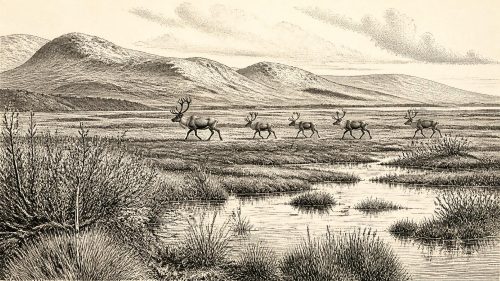
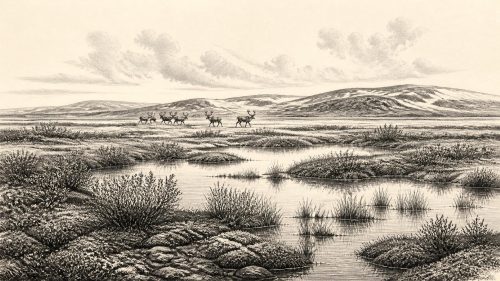
The Derryvree deposit is especially valuable because it records a living environment, not merely the movement of ice. Its plant remains, pollen and insect evidence indicate open, cold country with freshwater pools or sluggish channels, wet ground, mosses, sedges and herbs. The vegetation was tundra-like and periglacial rather than forested. Periglacial does not necessarily mean ice covered the site: it means that severe freezing and thawing shaped soils, watercourses and plant communities in ground lying beyond or between major glaciers.
Such a setting would have been seasonally demanding. Long, cold winters, short growing seasons and frozen or waterlogged ground restricted trees and favoured hardy plants. Yet it was not lifeless. Freshwater plants and mosses imply shallow water and wet margins; insects provide evidence for the local climate and microhabitats; sediments register shifting water energy. A fen is not a grand monument, but its organic matter preserves the minute traces through which an otherwise vanished Irish landscape can be reconstructed.
It would be misleading, however, to turn this into a complete national scene. Derryvree was one locality in what is now County Fermanagh. Its wetland cannot establish identical conditions on Atlantic coasts, limestone uplands or the southern lowlands. The prudent interpretation is a mosaic: open habitats and freshwater refuges in at least some ice-free areas, set within a wider North Atlantic world becoming colder and increasingly dominated by expanding ice.
Before the Great Expansion
At this horizon the Last Glacial Maximum still lay ahead. Later in the last glaciation, ice covered most of Ireland and reshaped the island profoundly, eroding earlier surfaces and depositing the tills, drumlins and other landforms familiar today. Research on the chronology of the Irish Ice Sheet places major expansion after the Derryvree interval, with southern Ireland crossed by inland-sourced ice after about 24,000 calibrated years BP. This later advance both transformed habitats and destroyed or buried much evidence of the landscapes that preceded it.
This is why the archaeological record is so sparse. Absence of a camp, hearth or burial from 31,183 BCE does not prove that no person ever reached Ireland. Ice erosion, acidic soils, rising seas after the Ice Age and the limited investigation of deeply buried deposits have all reduced the chance of survival and discovery. But preservation problems cannot be used to invent a population either. The surviving record permits a history of landscape and fauna; it does not permit a confident narrative of communities.
Castlepook’s Animal World
County Cork provides the principal complementary evidence. Castlepook Cave, also called Mammoth Cave, near Doneraile, produced one of Ireland’s most important collections of Late Pleistocene animal remains. Its historic excavations recovered bones attributed to spotted hyaena, reindeer, woolly mammoth, giant deer, brown bear, foxes, hares and smaller animals. The National Museum of Ireland describes Castlepook as the country’s most important site for mammal remains of the last cold stage and notes that hyaenas and other mammals reached Ireland from Britain during a broad interval of roughly 45,000 to 30,000 years ago.
The fauna shows that Ireland could, at various times, support or be reached by sizeable grazing animals and their predators or scavengers. Reindeer were adapted to open, sparsely vegetated country. Mammoths and giant deer indicate substantial grazing landscapes during the periods represented by their bones. Spotted hyaenas point to a more complex food web than the modern island possesses. Animal movement also implies changing accessibility between Ireland and neighbouring landmasses as sea level, coastlines, ice and possible crossing routes changed.
But Castlepook is not a census taken in one season. Cave bone collections can be accumulated by carnivores, natural deaths, water movement and repeated use over thousands of years. Much of Castlepook was excavated between 1904 and 1908, before modern expectations for stratigraphic recording and microscopic taphonomic analysis. Later re-dating has shown that some old Irish cave dates were substantially too young, a warning against treating every specimen in a collection as contemporaneous.
The Human Question
A reindeer femur from Castlepook has been publicised as bearing a mark consistent with cutting or chopping fresh bone using a stone tool, while County Cork heritage material places the animal’s death broadly around 30,000 BCE. If confirmed, that interpretation would be momentous: it could indicate that a person handled a reindeer in Ireland in the Upper Palaeolithic, far earlier than the formerly accepted evidence for human activity. Yet the distinction between possibility and proof must be retained. The bone’s date, the interpretation of its surface mark and the date of any human action are separate questions.
There is no securely excavated settlement, hearth, stone-tool scatter, burial, dwelling floor, cemetery or artistic assemblage in Ireland that can be assigned to this date. Nor does one potentially worked bone establish a permanent population, repeated hunting territory, descent into later Irish communities or a route by which visitors arrived. The first published evidence generally treated as secure for Palaeolithic human activity in Ireland is much later: a cut-marked brown-bear patella from Alice and Gwendoline Cave in County Clare, dating to the terminal Pleistocene.
No Kingdoms, No Trade Network
Accordingly, there is no evidence for political affairs in Ireland in 31,183 BCE: no kingship, chiefdom, diplomacy, warfare, law or named people. “Irish” is a geographic description here, not an ethnic or linguistic identity. There is likewise no Irish evidence from this date for religion, formal learning, monuments, grave rites, cultivated crops, livestock or trade networks. Upper Palaeolithic societies elsewhere in Europe made sophisticated tools, images and ornaments, but those continental achievements are context, not proof that equivalent practices occurred in Ireland.
If people did briefly visit, they may have been mobile hunter-gatherers capable of exploiting animal resources in a severe seasonal environment. That remains an inference from broader European prehistory and the possible Castlepook evidence, not a demonstrated Irish social system. Nothing allows us responsibly to reconstruct their language, kinship, clothing, rituals or beliefs. The most important story is instead ecological: an open, cold island landscape with wetlands, large mammals and fluctuating opportunities for movement, on the threshold of much more extensive glaciation.
What the Fen Preserves
Derryvree’s importance lies precisely in its modest scale. A buried fen, sealed between glacier deposits, preserves proof that life persisted in an ice-age landscape that later ice almost erased. Its mosses, sedges, aquatic plants and insects offer stronger evidence for Ireland around this broad horizon than any invented tale of a ruler, battle or settlement could. Around 31,183 BCE, the island’s history is not yet a sequence of human events. It is the deep environmental precondition from which the much later histories of settlement, society and culture would eventually emerge.
Primary Sources
- A Middle Midlandian Freshwater Series at Derryvree, Maguiresbridge, County Fermanagh, Northern Ireland
- Trimlines, Blockfields and the Vertical Extent of the Last Ice Sheet in Southern Ireland
- Early Midlandian–Middle Midlandian, Pleistocene, Northern Ireland
- Freshwater Organic Deposits and Stratified Sediments Between Early and Late Midlandian (Devensian) Till Sheets, at Aghnadarragh, County Antrim, Northern Ireland
- The Quaternary Period in Ireland: An Overview
- A Reconsideration of the Radiocarbon Dating of the Marine Isotope Stage 3 Fauna from Southern Ireland
- The Irish Quaternary Fauna Project
- Spotted Hyena Skull
- The Exploration of Castlepook Cave, Co. Cork. With 3 Plates.
- Occurrence of Mammalia Relicts at Site Castlepook Cave
- Heritage Artefacts of County Cork
- Archaeological Heritage of County Cork
- Late Pleistocene Chronostratigraphy and Ice Sheet Limits, Southern Ireland
- Early Deglaciation of Western Ireland and Implications for the Timing of Late Pleistocene Climate Change
- Deglaciation Chronology of the Donegal Ice Centre, North-West Ireland
- Growth and Retreat of the Last British–Irish Ice Sheet, 31,000 to 15,000 Years Ago: the BRITICE-CHRONO Reconstruction
- Last Glacial Maximum Cirque Glaciation in Ireland and Implications for Reconstructions of the Irish Ice Sheet
- The IntCal20 Northern Hemisphere Radiocarbon Age Calibration Curve (0–55 cal kBP)
- Quaternary
- Revisiting Alice and Gwendoline Cave, Co. Clare: New Light on the 1902 Excavations
- First Evidence of a Late Upper Palaeolithic Human Presence in Ireland
- New Insights on the Fauna of Ireland's Younger Dryas and Early Holocene from Alice & Gwendoline Cave