
BIRM-166’s Reindeer World31016 BCE
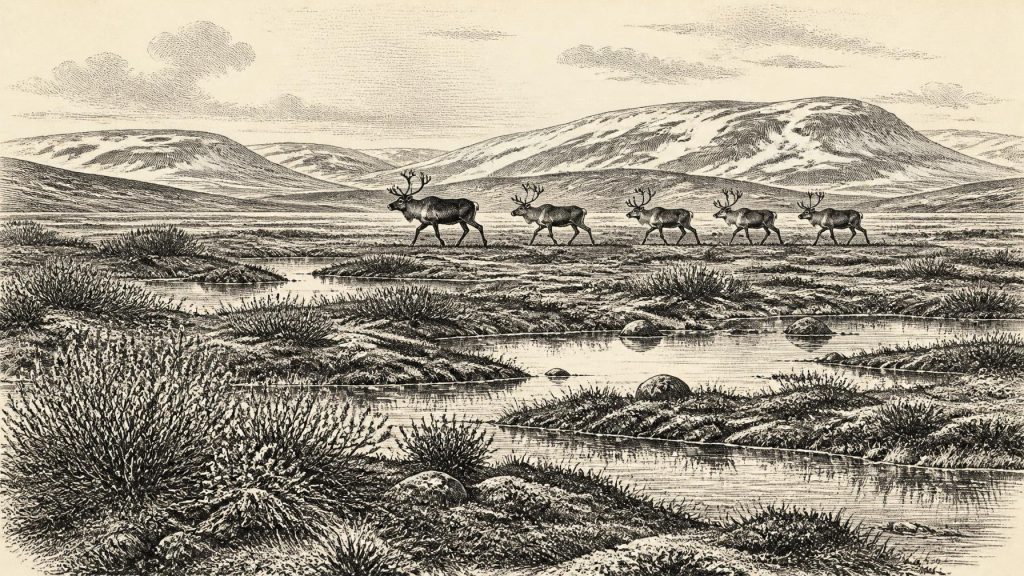
Labelled 31,016 BCE, this period cannot be reconstructed as a single year, but falls within a late Marine Isotope Stage 3 interval of the Midlandian glaciation. Derryvree, County Fermanagh, records an ice-free freshwater tundra episode between glacial advances, with mosses, sedges, cold-tolerant plants and northern insects indicating wet, treeless, strongly seasonal conditions. Castlepook Cave, County Cork, preserves a mixed cold-stage fauna including mammoth, reindeer, giant deer, hyaena and lemmings, though its deposits are cumulative. A marked reindeer femur may indicate brief human activity, not settlement. Ireland’s changing ice, sea and land conditions supported no known polity, agriculture or permanent occupation.
Dateline
“31,016 BCE” is a useful modern filing label, not a date that people in prehistoric Ireland could have named or recorded. At this depth in time there is no calendar-year history: no written testimony, no securely dated settlement surface, and no archaeological method capable of isolating a particular winter, hunt or generation. The responsible frame is therefore a broad one. This nominal year falls at roughly 33,000 calendar years before the radiocarbon convention of AD 1950, within the later part of Marine Isotope Stage 3, a variable phase of the last Ice Age known in Ireland as the Midlandian.
The most relevant evidence comes not from an event dated to this year, but from deposits with wide calibrated ranges. At Derryvree, near Maguiresbridge in County Fermanagh, roadworks exposed organic freshwater silts and fine sands sealed between two tills: unsorted sediments laid down by separate glacial advances. Organic material from the intervening layer produced a conventional radiocarbon determination of 30,500 years BP, with a substantial uncertainty. Modern calibration places the deposit broadly at about 36,900–31,700 calibrated years BP, or approximately 34,950–29,750 BCE. Thus 31,016 BCE lies within the span relevant to Derryvree, but cannot be pinpointed within it. The deposit records an environment that existed over time, not a diary entry for a single year.
Freshwater Between the Ice
Derryvree offers the clearest sequence for understanding Ireland around this broad horizon. First, ice deposited the lower till. Then an ice-free interval allowed water, fine sediment and organic matter to accumulate in a low-lying basin. Finally, another advance buried the freshwater deposits beneath upper till. The order is secure even where the duration of each stage is not. It demonstrates that northern Ireland was not simply a timeless white expanse: glaciation, periglacial wetland and renewed glaciation succeeded one another as climate and ice margins changed.
The plants and insects preserved in the Derryvree sediments indicate open, treeless tundra or muskeg: wet, mossy ground with pools and sedge-rich margins, rather than forest or farmland. Fossils include freshwater mosses and sedges, while finds of bogbean, water-milfoil, mountain-avens, dwarf willow and other cold-tolerant plants point to a mosaic of shallow water, damp soil and sparse vegetation. Insects of northern aspect reinforce the interpretation of harsh conditions. This was a periglacial landscape, meaning one shaped by severe cold and frost without necessarily being permanently covered by glacier ice at that precise location.
That evidence supports a landscape with a strongly seasonal regime. Summer thaw could sustain ponds, plant growth and insect life; winter frost, snow and reduced daylight would have sharply restricted productivity. It does not establish exact temperatures for 31,016 BCE, nor prove that every part of Ireland had the same conditions. Local relief, drainage, distance from the sea and the changing position of ice all mattered. Yet it makes a wooded, temperate Ireland impossible for this period. The visual world was one of open ground, wet hollows, low vegetation and a climate capable of changing markedly over centuries or millennia.
Animals at Castlepook
The best-known animal evidence comes from Castlepook Cave, near Doneraile in north County Cork, long called Mammoth Cave because of its remarkable Pleistocene bone assemblage. The cave has produced remains attributed to woolly mammoth, reindeer, giant deer, spotted hyaena, wolf, bear, foxes, hares and lemmings. Together these animals belong to a cold-stage ecosystem unlike that of modern Ireland. Reindeer and lemmings, in particular, accord with the open, northern-looking habitats indicated at Derryvree; hyaenas and wolves show that large carcasses and mobile herbivores formed part of a wider predator-prey system.
Care is required, however. Cave deposits are rarely straightforward snapshots. Carnivores can drag bones underground; water can move them; later occupants can disturb them; and early excavations did not always record layers to modern standards. Some older radiocarbon measurements on Irish cave bone have been reassessed because techniques for removing contamination have improved. Castlepook is exceptionally important, but it is a cumulative bone archive, not an excavated camp floor. Its fauna demonstrates that cold-adapted mammals reached Ireland during this phase; it does not show that all these animals lived together at one moment or in one precisely defined landscape.
A reindeer femur from Castlepook has added a consequential but still limited human question. The bone has been reported as bearing a deep mark interpreted as consistent with chopping or butchery by a stone tool, and has been publicised as evidence for human activity around 33,000 years ago. If that interpretation is sustained through continued specialist study, it would represent a very early Upper Palaeolithic human presence in Ireland. It would not demonstrate a permanent population, a village, a named group or continuous occupation. Nor can it establish that the reindeer was killed in the cave: people may have processed part of an animal elsewhere and carried or lost the bone in the cave system.
People: A Possibility, Not a Polity
There is no evidence for political institutions, rulers, diplomacy, territorial states or warfare in Ireland at this time. Such categories belong to much later history and should not be projected onto a Late Pleistocene landscape. If people were present, the most defensible model is of small, highly mobile foraging parties moving through the wider north-west European world in pursuit of animals, raw materials and seasonal opportunities. Ireland’s position at the Atlantic edge, alongside lower sea levels and changing ice conditions, would have made routes and access variable. It cannot safely be assumed that a permanent land bridge existed at this particular moment, or that crossing was easy.
The possible marked femur implies, at most, an episode of animal processing. Reindeer could supply meat, marrow, hides, sinew, bone and antler, but the bone alone cannot tell which resources were taken or whether a party remained for days, weeks or a season. No securely associated stone-tool assemblage, hearth, dwelling, burial, artwork or repeated occupation horizon has yet been demonstrated for this date in Ireland. The distinction matters. Upper Palaeolithic communities elsewhere in Europe made sophisticated stone tools, ornaments, images and social networks, but continental and British evidence is context, not proof that the same activities occurred on Irish ground.
Accordingly, society and everyday life can only be described conditionally. A visitor able to hunt reindeer would have needed portable clothing, practical knowledge of weather and terrain, and social co-operation sufficient to travel and share risk. These are reasonable inferences from the demands of cold-climate foraging, not directly observed Irish facts. There is no basis for reconstructing language, kinship rules, ritual, leadership, trade partnerships or beliefs. Religion and learning leave no identifiable trace in the surviving Irish evidence of this age.
Economy Without Markets
There was no agricultural economy. Fields, livestock, cereal cultivation, pottery, metalwork and permanent settlement lay far in the future. The local economy, if human groups entered Ireland, was one of direct use of living landscapes: hunting, scavenging where safe, gathering seasonal plant foods and exploiting animal materials. The potential importance of large herbivores is clear, but it must not obscure the precariousness of the setting. A cold, open terrain could offer grazing and visibility, yet food supply varied greatly across seasons and severe weather could make movement dangerous.
There is likewise no direct evidence for trade within Ireland. Stone, animal products and people may have moved across wider landscapes, but no trace allows a network to be mapped for this particular period. The absence of proof is especially unsurprising because later ice advances eroded, reworked and buried many older surfaces. What survives is biased towards caves, protected sediment lenses and chance exposures such as the Derryvree road cutting. Much of the evidence that might once have revealed camps, tracks or tool-making places has probably been destroyed or remains undiscovered beneath glacial deposits, peat or the sea.
An Island in Formation
Ireland’s regional geography was also changing. The last British–Irish Ice Sheet had not yet reached its best-established maximum extent, generally dated later, around 26,000–19,000 years ago, although ice growth and retreat were not synchronous everywhere. Research on the ice sheet shows that advance began and peaked at different times in different sectors. Around the broad period represented by Derryvree and the older Castlepook fauna, conditions could shift between locally ice-free terrain, advancing ice margins and landscapes affected by frozen ground and meltwater.
Speleothems in Crag Cave, County Kerry, provide a complementary climatic perspective. Their episodic growth during parts of the last glacial period required liquid water moving through the cave and therefore conditions less persistently frozen than during full glaciation. They do not describe Derryvree or Castlepook directly, but they underline an important point: Irish Ice Age climates were dynamic. A long cold stage included abrupt fluctuations and regional contrasts, rather than one unchanging era of ice.
For 31,016 BCE, then, Ireland’s history is environmental before it is political. The securely observed record is a freshwater tundra basin in Fermanagh, animal remains in a Cork cave, and the stratigraphic evidence of glaciers that advanced before and after locally open conditions. The possible human trace at Castlepook is important precisely because it is so slight: one marked reindeer bone may hint at an ephemeral encounter between people and an Ice Age landscape. It cannot yet bear the weight of a settled national origin story. The honest history of this date is one of sediments, bones, wet ground and uncertainty—evidence sufficiently rich to imagine a real world, but not to invent a year-by-year past.
Primary Sources
- A Middle Midlandian Freshwater Series at Derryvree, Maguiresbridge, County Fermanagh, Northern Ireland
- Irish Pleistocene Biostratigraphy
- Early Midlandian–Middle Midlandian, Pleistocene, Northern Ireland
- A Reconsideration of the Radiocarbon Dating of the Marine Isotope Stage 3 Fauna from Southern Ireland
- The Irish Quaternary Fauna Project
- The Exploration of Castlepook Cave, Co. Cork
- Pleistocene Vertebrates in the British Isles
- Growth and Retreat of the Last British–Irish Ice Sheet, 31,000 to 15,000 Years Ago: the BRITICE-CHRONO Reconstruction
- Dimensions and Chronology of the Last Ice Sheet in Western Ireland
- Trimlines, Blockfields and the Vertical Extent of the Last Ice Sheet in Southern Ireland
- Stratigraphic and Palaeo-Geomorphological Evidence for the Glacial-Deglacial History of the Last British-Irish Ice Sheet in the North-Western Irish Sea
- Timing and Pace of Ice-Sheet Withdrawal Across the Marine–Terrestrial Transition West of Ireland During the Last Glaciation
- Exploring Controls of the Early and Stepped Deglaciation on the Western Margin of the British Irish Ice Sheet
- Episodic Speleothem Deposition Tracks the Terrestrial Impact of Millennial-Scale Last Glacial Climate Variability in SW Ireland
- Spatio-Temporal Dynamics of Speleothem Growth and Glaciation in the British Isles
- Figure 6—The Subdivision of the Quaternary Period in Ireland
- Quaternary Geology of Ireland
- Heritage Artefacts of County Cork
- First Evidence of a Late Upper Palaeolithic Human Presence in Ireland
- Ireland: Submerged Prehistoric Sites and Landscapes
- BSBI: Menyanthes trifoliata
- The IntCal20 Northern Hemisphere Radiocarbon Age Calibration Curve (0–55 cal kBP)