
BIRM-166’s Buried Freshwater31030 BCE
Labelled 31,030 BCE, this period is known only through broad archaeological and environmental evidence, not annual events. Derryvree, County Fermanagh, preserves freshwater deposits between glacier tills, indicating an ice-free interval within a fluctuating Midlandian glacial landscape. Fossils reconstruct wet, treeless tundra with cold-adapted plants, pools and seasonal thaw. Elsewhere, deposits and cave formations demonstrate changing regional climates. Castlepook Cave, County Cork, contains remains of mammoths, reindeer, predators and other cold-stage fauna, though its assemblage is chronologically complex. A possibly tool-cut reindeer bone suggests transient human contact, but no settlement is proven. Ireland’s record chiefly documents ice, ecosystems and human possibilities.
Dateline
“31,030 BCE” is a useful filing label, not a date at which Irish history can be observed year by year. No calendar, writing, named individual or datable event survives from this depth of time. In conventional archaeological terms the point is roughly 32,980 calibrated years before present, with “present” fixed at AD 1950. It falls within the later part of Marine Isotope Stage 3 (MIS 3), during Ireland’s Midlandian cold stage. The responsible approach is therefore to describe a broad interval, using evidence with ranges rather than pretending that a particular winter, journey or encounter can be recovered.
The closest important Irish environmental sequence is Derryvree, near Maguiresbridge in County Fermanagh. Organic freshwater silts and fine sands exposed in a road cutting in 1969 produced the radiocarbon determination Birm-166: 30,500 radiocarbon years before present, with a large error range. Modern calibration places this evidence broadly within about 36,900–31,700 calibrated years before present. The notional year 31,030 BCE lies within that span, but cannot be assigned to a particular layer or moment in it. Derryvree is evidence for conditions over generations or longer, not a snapshot of a single year.
A Landscape Between Ice Advances
Derryvree’s special value lies in its physical setting. The freshwater deposits were trapped between two thick layers of till, the unsorted sediment left by glacier ice. In simple sequence, ice had occupied the locality; then an ice-free interval allowed water, sediment and organic remains to accumulate; later ice advanced and sealed the deposit beneath another till sheet. This makes the site a rare witness to a phase when at least part of Ireland was not continuously buried beneath glacier ice. It does not demonstrate that the whole island was ice-free at once, nor that every region shared Fermanagh’s exact climate.
The wider British–Irish Ice Sheet was growing and changing markedly during this period. Its eventual maximum was still to come, although different sectors advanced at different times. At around this notional date, Ireland was not a stable, familiar island landscape but part of a fluctuating north-west European glacial world. Lower sea levels altered coastlines and, at intervals, reduced the sea barriers between Ireland, Britain and the continental shelf. Yet the precise routes available at any one time depended on sea level, local ice margins, rivers and seasonal conditions. “Land bridge” should not be imagined as an easy road: it could have meant exposed, windswept terrain interrupted by watercourses, marshes and moving ice.
Tundra, Pools and Short Summers
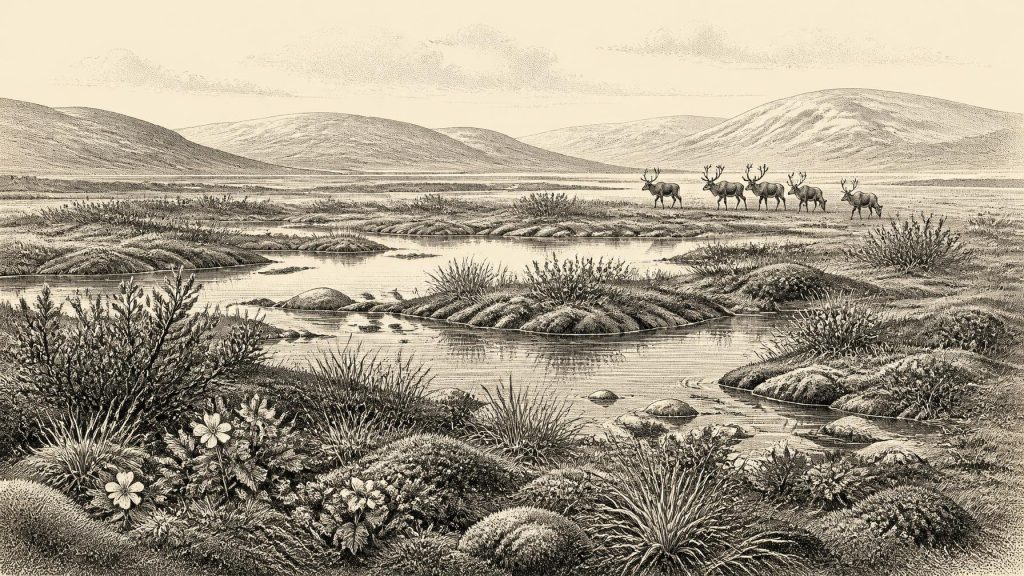
The Derryvree fossils indicate open tundra vegetation and a periglacial climate: cold conditions shaped by repeated freezing and thawing near an ice-sheet margin. This was not a landscape of oak woods, hedges or peat bogs as later Irish generations would know them. Pollen and plant macrofossils point instead towards grasses, sedges, herbs, mosses and low-growing cold-adapted plants. Finds associated with the deposit include bogbean, dwarf willow, mountain avens and alternate water-milfoil. Together, they indicate that severe cold did not make the country biologically empty. Shallow freshwater, wet ground and summer thaw supported local plant communities.
Researchers have described the Derryvree setting as a treeless muskeg or wet tundra mosaic: saturated patches rich in mosses and sedges, open pools and sparse vegetation on better-drained ground. That reconstruction should not be converted into a picturesque certainty. Fossil remains are selective; pollen may be poorly preserved or transported; and a road-cut deposit samples a very small area. Nevertheless, the combination of sediments, seeds, mosses and pollen makes an open, wet, cold landscape much better supported than either a forested countryside or a featureless sheet of snow.
Other northern Irish deposits, including records from Aghnadarragh in County Antrim and Greenagho near Belcoo, show why regional caution matters. Their stratigraphy, insects, plants and dates have helped archaeologists and Quaternary scientists debate the timing of cold, ice-free and glaciated phases. They do not provide a political map of prehistoric Ireland, but they reveal a country repeatedly altered by ice advance, water, frost and ecological recolonisation. Crag Cave in County Kerry adds another kind of evidence: its dated stalagmites show that liquid water sometimes circulated through shallow cave systems during milder episodes of the last glacial period. Climatic improvement was episodic, not a simple march towards warmth.
Animals in the Southern Caves
In southern Ireland, Castlepook Cave near Doneraile in County Cork preserves a striking, though complicated, fossil archive. Its collections include remains attributed to woolly mammoth, reindeer, giant deer, brown bear, wolf, Arctic fox, lemmings, mountain hare and spotted hyena. This is powerful evidence that, during portions of MIS 3, Ireland could sustain or receive a much richer cold-stage mammal fauna than the modern island. It also places Ireland within a wider ecological zone extending through Britain and continental Europe.
But a cave bone assemblage is not a census of one living community. Carnivores could carry carcass parts into a den; water, collapse and excavation could mix deposits; and animals represented in one cave may have lived centuries or millennia apart. Modern radiocarbon re-dating has shown that several older Castlepook dates underestimated the antiquity of bones by thousands of years. The strongest conclusion is therefore deliberately limited: cold-adapted and large mammals occurred in Ireland at intervals during MIS 3, while individual bones and species need their own dating and taphonomic assessment.
One Castlepook reindeer femur has generated particular interest because it bears a deep incision interpreted by Ruth Carden as consistent with cutting by a sharp stone tool. County Cork’s heritage record places the specimen broadly around 31,000 BC. If the mark is genuinely human-made and contemporary with the bone, it could indicate carcass processing by an Upper Palaeolithic visitor close to the broad period considered here. It would not establish a settled population, a camp, a hunting territory, a named people or a continuous Irish occupation. No securely associated stone-tool assemblage, hearth, dwelling floor or human burial of this age has been found at Castlepook.
People: A Question, Not a Population
This distinction sets the limits of social history for 31,030 BCE. Ireland has no secure evidence of a community living here at that exact time. The Castlepook incision is an important lead, but remains an isolated object in a disturbed cave context. The earliest widely accepted direct evidence for human activity in Ireland is much later: cut marks on a brown-bear kneecap from Alice and Gwendoline Cave in County Clare, dated to approximately 12,810–12,590 calibrated years before present. That later discovery proves that people reached Ireland during the terminal Pleistocene; it cannot retrospectively populate the country twenty millennia earlier.
There can consequently be no responsible account of governments, chiefs, diplomacy, warfare, tribal boundaries or law for this notional year. There are no houses, graves, domestic hearths, weapons, ornaments or tool-making floors that can document them. Nor is there evidence for local farming, herding, mining, long-distance commerce or a traded economy. Reindeer and other animals might have offered meat, hide, sinew, bone and antler to any passing hunters, but assigning hunting strategies or seasonal movements to people in Ireland would go beyond the evidence.
The absence of such evidence is itself historically meaningful. Later glaciation could scour, bury or disperse fragile camps, while caves tend to preserve animal bone more readily than open-air occupation surfaces. Ireland’s record is therefore biased towards environmental traces and faunal remains. Archaeologists must distinguish “not yet found” from “did not exist”, but neither gap can be filled with confident stories. Human presence is possible in the broad MIS 3 landscape; permanent or recurrent settlement is unproven.
Culture Without Recoverable Ritual
Religion, art, language and learning are equally beyond direct recovery. There is no Irish cave art, carved object, musical instrument, burial rite or symbolic assemblage securely dated to around 31,030 BCE. Continental Europe had Upper Palaeolithic communities capable of elaborate art, ornament and technical knowledge, but proximity does not prove their presence in Ireland. The most that can be said is that, if small groups ever reached this changing northern margin, they would have needed formidable practical knowledge: reading weather and animal movement, managing warmth and food, and travelling through a severe seasonal environment. That is an inference from comparable hunter-gatherer circumstances, not evidence of a specific Irish culture.
The central development around this date was environmental instability. In Fermanagh, freshwater life and tundra vegetation accumulated between two glacial episodes. In Cork, caves preserve evidence for large mammals and predators from parts of the same broad cold-stage world. Across the island, ice-sheet growth, altered sea levels and periglacial conditions repeatedly transformed where animals—and perhaps occasional people—could move. Ireland’s history at this depth is not yet a record of societies and events. It is a carefully assembled record of sediments, plants, animal bones and ice, from which the possibility of human contact emerges cautiously rather than conclusively.
Primary Sources
- A Middle Midlandian Freshwater Series at Derryvree, Maguiresbridge, County Fermanagh, Northern Ireland
- Palaeoecology: Middle Midlandian Palaeoenvironment of South Fermanagh
- Figure 6: The Subdivision of the Quaternary Period in Ireland
- A Reconsideration of the Radiocarbon Dating of the Marine Isotope Stage 3 Fauna from Southern Ireland
- Castlepook Cave: County Geological Site Report
- Heritage Artefacts of County Cork 2021
- Spotted Hyena Skull
- The Irish Quaternary Fauna Project
- New Insights on the Fauna of Ireland's Younger Dryas and Early Holocene from Alice & Gwendoline Cave
- First Evidence of a Late Upper Palaeolithic Human Presence in Ireland
- Growth and Retreat of the Last British–Irish Ice Sheet, 31,000 to 15,000 Years Ago: the BRITICE-CHRONO Reconstruction
- Maximum Extent and Dynamic Behaviour of the Last British–Irish Ice Sheet West of Ireland
- Exploring Controls of the Early and Stepped Deglaciation of the British-Irish Ice Sheet
- Episodic Speleothem Deposition Tracks the Terrestrial Impact of Millennial-Scale Last Glacial Climate Variability in SW Ireland
- Spatio-Temporal Dynamics of Speleothem Growth and Glaciation in the British Isles
- The IntCal20 Northern Hemisphere Radiocarbon Age Calibration Curve (0–55 cal kBP)
- Introduction to the Late Quaternary and Holocene of Northern Ireland
- Freshwater Organic Deposits and Stratified Sediments Between Early and Late Midlandian (Devensian) Till Sheets, at Aghnadarragh, County Antrim, Northern Ireland
- BSBI: Menyanthes trifoliata
- BSBI: Salix herbacea
- BSBI: Dryas octopetala
- BSBI: Myriophyllum alterniflorum
- Landscapes and Environments of the Last Glacial-Interglacial Transition: A Time of Amazingly Rapid Change in Ireland