Derryvree Between the Tills30724 BCE
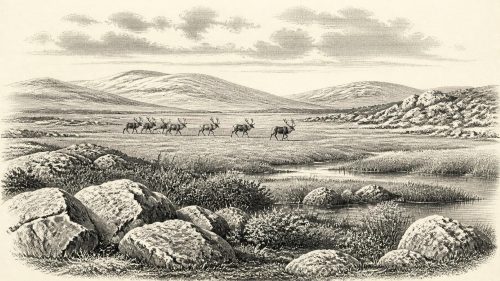
30,724 BCE is an imprecise modern label for a volatile later Ice Age interval, reconstructed from deposits rather than records. At Derryvree, County Fermanagh, freshwater sediments sealed between glacial tills indicate a temporary treeless tundra wetland, with pools, mosses and herbs, during fluctuating ice conditions. Ireland’s ice expanded unevenly towards a later maximum, preserving rare evidence of habitable, though severe, environments. Castlepook Cave, County Cork, contains remains of mammoth, reindeer, giant deer, bears, hyaenas and other cold-stage fauna, demonstrating ecological connections beyond Ireland. A possibly tool-marked reindeer bone may indicate early human presence, but cannot prove settlement, culture or occupation.

Dateline
30,724 BCE is a useful modern label, not a date at which Ireland’s past can be described with calendar-year accuracy. There are no written records, named communities, rulers, battles or identifiable events from this depth of time. The number lies about 32,674 years before AD 1950, the reference point used for “Before Present” dating, but even that conversion should not be mistaken for precision. Radiocarbon determinations must be calibrated against changing atmospheric carbon levels, and their resulting calendar ranges can span many centuries or millennia. The responsible history of Ireland at this point is therefore a history of deposits, animal remains and probabilities.
The period belongs broadly to the later part of Marine Isotope Stage 3, a highly unstable phase of the last Ice Age. Across the North Atlantic, Greenland ice cores register repeated switches between very cold stadials and comparatively milder interstadials. Those oscillations mattered profoundly at Ireland’s Atlantic edge: they affected temperature, seasonality, available water, vegetation, the extent of ice and the routes by which animals—and perhaps people—could reach the island. Yet an island-wide reconstruction for this particular numbered year is not possible. The best evidence is local, unevenly preserved and of differing dates.
A Wetland Beneath the Ice
The clearest Irish environmental archive close to this notional date comes from Derryvree, near Maguiresbridge in County Fermanagh. Roadworks in 1969 exposed a drumlin containing an unusual sequence: freshwater silts and fine sands, including organic material, lay sealed between two thick deposits of glacial till. The lower and upper tills show that ice occupied the locality before and after the wetland existed. Between those advances, however, water ponded in a landscape that was not continuously buried beneath glacier ice.
The organic horizon, known by its laboratory designation Birm-166, produced a conventional radiocarbon determination of 30,500 years BP, with a large uncertainty of +1,170/−1,030 years. Later calibration places the deposit broadly between about 36,900 and 31,700 calibrated years BP, or approximately 34,950–29,750 BCE. Thus 30,724 BCE falls within the wide chronological window relevant to Derryvree, not at a securely pinpointed moment within it. Scholars have tentatively correlated the interval with several Greenland interstadials, roughly GI-8 to GI-5, but such matching does not allow an annual narrative.
Derryvree’s plant and animal traces show a cold, treeless and periglacial environment. Pollen was poorly preserved, but the surviving record is overwhelmingly herbaceous. Macrofossils included mosses and plants associated with wet, open ground; insect evidence indicates a muskeg-like setting of shallow pools, plant-rich mud and mossy margins. Dwarf shrubs and herbs could have occupied drier patches, while the basin itself supported freshwater vegetation. This was no forested Ireland, nor a featureless desert of snow. It was a sparse tundra wetland, sensitive to season, frost and shifting water levels.
Open Country, Moving Ice
The Derryvree succession also supplies an important corrective to the familiar image of an island locked beneath a single, unchanging ice cap throughout the Ice Age. Ireland was glaciated repeatedly and extensively during the last glacial cycle, but the growth, coalescence and retreat of the British–Irish Ice Sheet were regionally uneven. At around 32,700 years ago, substantial ice was building in and around Ireland, yet the later local maximum was still ahead. Reconstructions place major expansion across the Irish shelf in the period after roughly 31,000 years ago, with the Irish sector reaching its maximum areal extent near 26,000 years ago. Southern Irish tills formed after about 24,000 calibrated years BP.
That wider sequence makes the two tills at Derryvree historically valuable. They are not simply layers of anonymous clay: they record a landscape that alternated between glacial occupation and an interval when freshwater, plants, insects and exposed ground persisted. The upper till eventually buried and protected the wetland evidence. Much of the older Irish surface record was later scoured, overridden or obscured by advancing ice, so such sealed deposits are unusually important. They demonstrate that parts of Ireland could sustain terrestrial and freshwater ecosystems during a difficult middle phase of the last glaciation.
Climate did not determine every local detail. Bedrock, relief, drainage and proximity to ice margins all shaped particular habitats. But the broad implications are clear. Winters were severe, ground was likely frozen for long periods, and tree growth was not viable in the Derryvree area. Summers nevertheless brought enough thaw and meltwater to sustain pools and wetland plants. In such circumstances, the usable landscape would have been patchy: sheltered hollows, lakeside fringes, river corridors and exposed uplands offered very different prospects for plants and animals.
Castlepook’s Mammal World
County Cork provides a contrasting archive. Castlepook Cave, near Doneraile—also called Mammoth Cave—has produced Ireland’s richest assemblage of pre-Last Glacial Maximum vertebrate remains. Its collections include woolly mammoth, giant deer, reindeer, brown bear and spotted hyaena; later Ice Age material includes wolf, Arctic fox and both Norwegian and collared lemmings. These animals do not all belong to one day, season or necessarily one ecological community. Radiocarbon results from individual bones cover a very long span, approximately 45,700 to 19,950 years BP, and water, carnivore activity, cave processes and antiquarian excavation disturbed parts of the deposit.
Nevertheless, the cave establishes an essential point: Ireland hosted, or was repeatedly reached by, a much richer cold-stage mammal fauna than its later historical landscape would suggest. In the broad period around this article’s date, reindeer, mammoth, giant deer, bear and hyaena were among the animals capable of using Irish environments. Reindeer and lemmings are particularly consistent with open, cold country; mammoth and giant deer imply substantial grazing resources across the wider landscape. Spotted hyaenas were not merely visiting curiosities. Gnawed bones, hyaena remains and the character of the bone assemblage indicate that Castlepook served at least in part as a carnivore den or repository.
This was a dynamic food web rather than a peaceful parade of “Ice Age animals”. Hyaenas and wolves could scavenge or hunt; bears used different habitats and seasons; herbivores moved through landscapes whose forage changed quickly with snow cover and thaw. A cave collection cannot directly measure herd sizes or prove that every species lived together, but it reveals an ecological connectivity with Britain and continental north-west Europe. At lower glacial sea levels, Ireland’s surrounding seas and land connections were configured differently from today, although routes were repeatedly constrained by water, sea ice and expanding land ice. Animal colonisation must have depended on changing windows of access, not on a permanently open bridge.
The Human Question
One object from Castlepook gives this era exceptional archaeological interest: a fragment of reindeer femur reported to carry a deep mark interpreted as having been made by a sharp stone tool while a fresh carcass was processed. Public heritage material associates the bone with about 33,000 years ago, placing it broadly near the period under discussion. If microscopic study and further contextual work confirm that interpretation, it would be extraordinarily early evidence of human activity in Ireland—far older than the securely dated late Upper Palaeolithic bear-bone evidence from Alice and Gwendoline Cave in County Clare, dated to about 12,810–12,590 calibrated years BP.
The claim must, however, be kept narrow. The dated object is an animal bone from an old cave collection, not a modern excavation of an intact camp floor. Its date measures when the reindeer died, not independently when a surface mark was made. Castlepook has not yielded a securely associated hearth, dwelling, burial, stone-tool assemblage or undisturbed butchery area of comparable age. Nor can one marked bone establish whether people hunted the animal, found it already dead, stayed briefly nearby, travelled in a small party, or returned over generations. The cave’s carnivore use and disturbed deposits make those distinctions especially difficult.
It would therefore be irresponsible to write of a settled “Irish population” in 30,724 BCE. At most, the reindeer femur offers a potentially momentous indication that one or more Upper Palaeolithic people may have handled a carcass in Ireland during the broader interval. If people were present, their lives would have depended upon highly mobile hunting and gathering, knowledge of animal movements, temporary shelter and close adaptation to severe conditions. Those are reasonable inferences from Upper Palaeolithic lifeways elsewhere, not direct evidence for a camp, language, kin group or culture in Ireland.
What Cannot Be Recovered
There is no evidence from Ireland at this time for political institutions, diplomacy, formal territorial rule, farming, trade networks, metalworking, monuments, writing or organised religion. Equally, there is no basis for assigning beliefs, rituals, artistic traditions or ethnic identities to the possible visitors suggested by the Castlepook bone. The absence is archaeological, not a judgement on the capacities of any people who may have entered the island. It reflects the fragility of camps, wooden shelters, clothing, food remains and human bodies in an environment repeatedly altered by ice, erosion and later excavation.
The most important development was environmental rather than political: Ireland contained habitable but harsh patches within an unstable Ice Age world, while ice was advancing towards its later maximum. Derryvree records a tundra wetland briefly preserved between glaciers. Castlepook records large herbivores and formidable carnivores moving through the island’s wider cold-stage ecosystems. Together they make 30,724 BCE meaningful—not as the date of a named event, but as part of the long, precarious prehistory in which Ireland’s landscapes, fauna and perhaps its first fleeting human visitors were shaped.
Primary Sources
- A Middle Midlandian Freshwater Series at Derryvree, Maguiresbridge, County Fermanagh, Northern Ireland
- Palaeoecology: The Middle Midlandian Palaeoenvironment of South Fermanagh
- The Irish Quaternary Fauna Project
- Castlepook Cave, County Geological Site Report
- Growth and Retreat of the Last British–Irish Ice Sheet, 31,000 to 15,000 Years Ago: The BRITICE-CHRONO Reconstruction
- Timing and Pace of Ice-Sheet Withdrawal Across the Marine–Terrestrial Transition West of Ireland During the Last Glaciation
- Late Pleistocene Chronostratigraphy and Ice Sheet Limits, Southern Ireland
- Episodic Speleothem Deposition Tracks the Terrestrial Impact of Millennial-Scale Last Glacial Climate Variability in SW Ireland
- Landscapes and Environments of the Last Glacial-Interglacial Transition: A Time of Amazingly Rapid Change in Ireland
- The IntCal20 Northern Hemisphere Radiocarbon Age Calibration Curve (0–55 cal kBP)
- IntCal Publications
- Dansgaard–Oeschger Events in Climate Models: Review and Baseline Marine Isotope Stage 3 Protocol
- The Nature of MIS 3 Stadial–Interstadial Transitions in Europe: New Insights from Model–Data Comparisons
- First Evidence of a Late Upper Palaeolithic Human Presence in Ireland
- New Insights on the Fauna of Ireland's Younger Dryas and Early Holocene from Alice & Gwendoline Cave
- Archaeology Research Excavation Grant 2022: Castlepook Cave
- Castlepook Cave, Cork, 2022 Excavation Report
- Heritage Artefacts of County Cork 2021
- Pleistocene Vertebrates in the British Isles
- Proceedings of the Postglacial Colonisation Conference