The Derryvree Sand Lens30596 BCE
At roughly 30,596 BCE, Ireland experienced an unstable later Pleistocene climate rather than a recoverable historical year. Organic freshwater sediments at Derryvree, County Fermanagh, dated broadly to 36,900–31,700 calibrated years before present, show that this locality was temporarily ice-free between glacial advances. Pollen, plants and animal remains indicate a treeless, periglacial tundra wetland with sedges, mosses and dwarf willow. Castlepook Cave, County Cork, preserves bones of mammoth, reindeer, predators and other cold-climate fauna, though its disturbed deposits limit precision. A marked reindeer bone may suggest human butchery, but no securely associated settlement, tools, hearths or population evidence survives. Later glaciation.
Dateline
“30,596 BCE” is a useful modern label, but it cannot describe a recoverable Irish year. No written record, calendar, settlement sequence or event horizon allows archaeologists to isolate twelve months at this depth of time. In radiocarbon and palaeoenvironmental terms, the date lies roughly 32,500 calendar years before AD 1950, within the later Pleistocene and Marine Isotope Stage 3. The responsible approach is therefore to examine evidence whose calibrated ranges overlap this point, while keeping the difference between physical traces and historical interpretation firmly in view.
The most valuable Irish evidence is not a palace, battlefield or village, but a layer of organic freshwater sediment revealed at Derryvree near Maguiresbridge, County Fermanagh. The deposit lay between two bodies of glacial till in a road-cut through a drumlin. Its position records a broad sequence: ice deposited the lower till; a period followed in which standing or slow-moving freshwater, plants and small animals occupied the site; then a later ice advance buried that environment beneath further glacial sediment. The sequence is an unusually direct reminder that Ireland’s Ice Age was not a single, unchanging freeze.
A Date Within a Range
Organic material from the Derryvree silts produced the conventional radiocarbon determination BIRM-166: 30,500 radiocarbon years before present, with a large uncertainty of +1,170 and −1,030 years. “Present” in this technical convention means AD 1950, not today. Because atmospheric radiocarbon has varied through time, a radiocarbon result cannot simply be converted into a BCE year by subtraction. Published calibrations place the deposit broadly around 36,900–31,700 calibrated years before present. The modern label 30,596 BCE falls within that wide span, but the evidence cannot establish what happened at Derryvree in that particular year, decade or even century.
The range is not a weakness to be concealed; it is part of the evidence. It tells us that the dated organic horizon belongs to a cold stage of the last glacial cycle before the fullest expansion of the British–Irish Ice Sheet. It also permits a secure relative conclusion from stratigraphy: at least this part of Fermanagh was ice-free when the freshwater deposits accumulated, despite having been glaciated earlier and being overridden later. It does not prove that the entire island was simultaneously free of ice, nor does it map the position of every ice margin.
The wider ice-sheet chronology reinforces the need for regional caution. Much of Ireland and its surrounding continental shelf would later be covered during the Last Glacial Maximum, conventionally placed chiefly around 27,000–23,000 calibrated years before present, though timing differed between sectors. Around 30,596 BCE, the island was moving through a dynamic earlier phase of ice growth and climatic deterioration, not yet a landscape that can safely be portrayed as uniformly entombed beneath the maximum ice cover. Local ice, permafrost, watercourses and exposed ground could coexist across a changing region.
Wet Tundra Under a Hard Climate
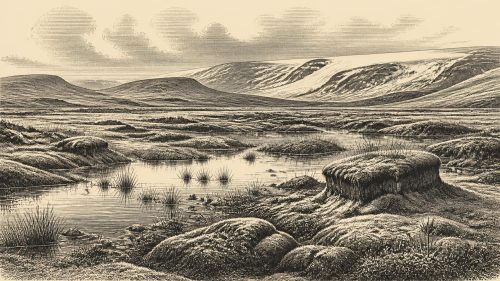
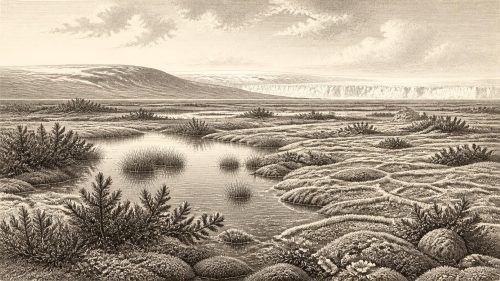
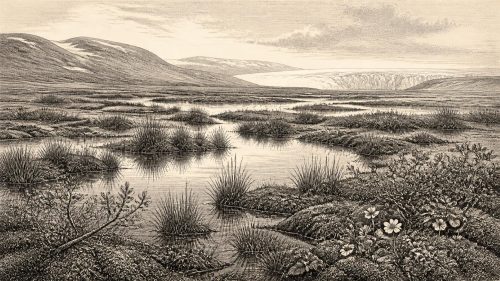
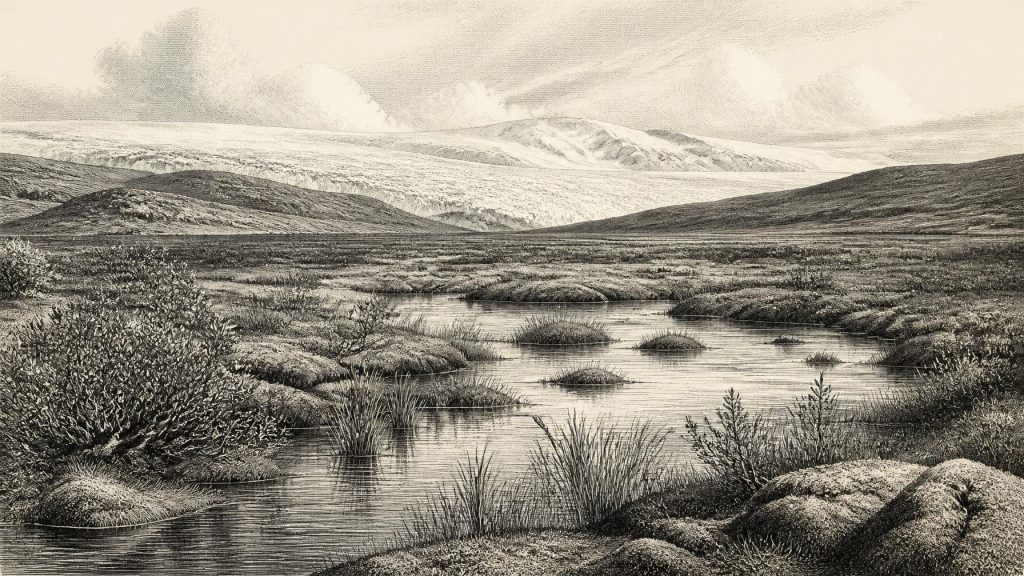
Derryvree’s organic silts and fine sands contain pollen, plant macrofossils, mosses and animal remains that point to an open tundra environment and a severe periglacial climate. The landscape around the freshwater hollow was not forested Ireland. Trees were absent or extremely scarce. Instead, the record includes plants suited to cold, exposed ground and wet margins, among them sedges, mosses, dwarf willow, mountain-avens, bogbean and aquatic water-milfoil. Such evidence supports a mosaic rather than a single blank expanse: shallow water and marshy edges in the basin, low vegetation on nearby ground, seasonally frozen soils and little shelter from wind.
That does not mean every plant recovered from the deposit grew at precisely the same moment or in precisely the same microhabitat. Pollen may travel, water can redistribute material, and deposits accumulate over extended intervals. Yet the combined assemblage is strong evidence for a cold, largely treeless environment capable of sustaining wetland plant communities during at least part of the Derryvree interval. It offers a rare ecological view of inland Ireland before later ice reshaped and, in many places, removed older landscapes.
Seasonality would have governed everyday survival for any animal using this terrain. Long cold winters, short productive summers, frozen ground and variable freshwater supplies imposed tight limits. Plants did grow; the Derryvree deposit itself demonstrates that they did. But there is no basis for imagining later Irish pasture, woodland or bog. The familiar modern coastlines also did not exist. Global sea levels were lower because enormous quantities of water were stored in ice sheets, while the configuration of ice and sea around Ireland and Britain was changing. Whether particular routes were dry land, glacier surface, sea ice or water at a given time cannot be settled from the Fermanagh deposit alone.
Castlepook’s Animal Archive
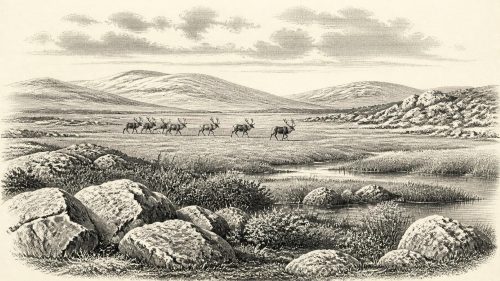
County Cork provides the other important, though more complicated, window onto this broad era. Castlepook Cave near Doneraile, also called Mammoth Cave, yielded a substantial collection of Pleistocene bones from early excavations and later discoveries. The assemblage includes animals associated with cold, open environments: reindeer, woolly mammoth, giant deer, arctic fox, wolf, hare, lemmings, brown bear and spotted hyaena. A mammoth bone was once dated to about 33,400 radiocarbon years before present, while subsequent reassessment has underlined both the antiquity of the fauna and the uncertainties created by disturbed cave deposits, mixed materials and nineteenth- and early twentieth-century excavation methods.
Castlepook therefore supports an important general proposition: parts of Ireland were reached by a varied large-mammal fauna during Marine Isotope Stage 3. It cannot furnish a census for 30,596 BCE. Bones accumulated in caves through carnivore activity, deaths, water movement and other processes, possibly across many generations. A cave hyaena’s use of a chamber as a den, for example, can concentrate prey remains in a way that looks far more like a single scene than it really is. The absence of a species from the excavated collection is equally not proof that it never lived elsewhere in Ireland.
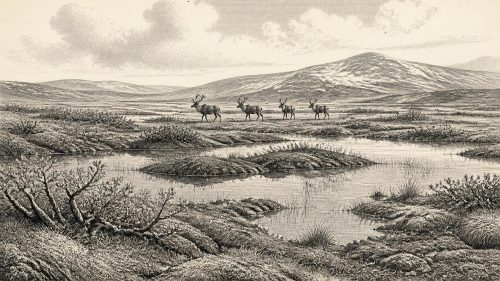
Reindeer have particular significance because a Castlepook femur has been publicly interpreted as carrying a deep mark made by a stone implement on fresh bone. The specimen has been reported as approximately 33,000 years old and has been presented as potential evidence for Palaeolithic butchery. If that interpretation and its chronological association are upheld, it would indicate human handling of a reindeer in Ireland during this wider interval. That would be remarkable, but its implications must remain narrow. The bone is not a securely excavated camp floor and was not recovered with a demonstrably associated hearth, tool assemblage, shelter, burial or repeated occupation surface.
People: A Possibility, Not a Polity
There is consequently no responsible basis for describing an Irish population, tribe, chiefdom or political territory at this date. Nor is there evidence for diplomacy, warfare, formal religion, art, education, trade networks or permanent settlement in Ireland around 30,596 BCE. These are not merely missing details in an otherwise complete story; they are categories for which the surviving Irish record is presently silent. The landscape can be investigated through sediments, fossils and landforms. Social institutions require traces that have not yet been found.
If the Castlepook incision proves to be anthropogenic, the most that can presently be inferred is a brief action by one or more mobile people using a sharp stone edge to process an animal. Such visitors might have moved through the north-west European Upper Palaeolithic world, following game and seasonal opportunities. They may have hunted the reindeer, scavenged a carcass, or handled it elsewhere before a carnivore or natural process transported part of it into the cave. None of these possibilities establishes continuous occupation. There are no known houses, hearths, worked-stone assemblages or human remains securely tied to this Irish date.
Economy, if human activity occurred, would therefore have been immediate and mobile rather than agricultural. Reindeer could potentially supply meat, fat, hide, sinew, bone and antler; this is a general inference from Upper Palaeolithic lifeways elsewhere, not direct evidence for a settled Irish hunting economy. Likewise, there is no basis for claiming exchange across the Irish Sea. Lower sea level may have altered distances and routes, but accessibility depended on local ice, water and season, and the archaeological record has not preserved the journeys.
An Island Before Its Later History
The most important development around this point is environmental rather than political: Ireland contained ice-free cold-stage habitats during an unstable glacial world, but these habitats were vulnerable to renewed ice advance. Derryvree’s freshwater lens was eventually sealed below till. Later glaciation eroded, transported and buried much evidence of the landscapes and animals that preceded it. This helps explain why the record is so uneven and why a wetland deposit and a cave-bone collection carry disproportionate historical weight.
For Ireland in 30,596 BCE, then, the honest picture is both vivid and limited. In the Fermanagh interior, cold-water sediments preserve a treeless tundra wetland, alive with hardy plants through a period of severe periglacial conditions. In north Cork, cave deposits indicate that large grazing mammals and formidable predators belonged to the wider Ice Age fauna. A marked reindeer bone raises the possibility of a very early human visit, but does not yet reveal a community. The evidence illuminates ecology, climate and changing ice; it does not yield a calendar-year event or a conventional national history. That restraint is what makes this remote Irish past intelligible rather than imaginary.
Primary Sources
- A Middle Midlandian Freshwater Series at Derryvree, Maguiresbridge, County Fermanagh, Northern Ireland
- New data for the Last Glacial Maximum in Great Britain and Ireland
- Radiocarbon constraints on the age of the maximum advance of the British–Irish Ice Sheet in the Celtic Sea
- Pattern and timing of retreat of the last British-Irish Ice Sheet
- Deglacial Rates and Controls for BIIS Western Margin
- Trimlines, blockfields and the vertical extent of the last ice sheet in southern Ireland
- Late Pleistocene Chronostratigraphy and Ice Sheet Limits, Southern Ireland
- Dimensions and chronology of the last ice sheet in Western Ireland
- Timing and pace of ice-sheet withdrawal across the marine–terrestrial transition west of Ireland during the last glaciation
- Stratigraphic and palaeo-geomorphological evidence for the glacial-deglacial history of the last British-Irish Ice Sheet in the north-western Irish Sea
- Ireland: Submerged Prehistoric Sites and Landscapes
- A critical review and re-investigation of the Pleistocene deposits
- The Irish Quaternary Fauna Project
- A Reconsideration of the Radiocarbon Dating of the Marine Isotope Stage 3 Fauna from Southern Ireland
- Pleistocene Vertebrates in the British Isles
- Occurrence of Mammalia Relicts at Site Castlepook Cave
- The Exploration of Castlepook Cave, County Cork
- New Insights on the Fauna of Ireland's Younger Dryas and Early Holocene from Alice & Gwendoline Cave
- Post-Glacial Colonisation of Ireland
- Heritage Artefacts of County Cork