BIRM-166’s Fermanagh Interval30476 BCE
30,476 BCE is not a recoverable Irish historical year, but an approximate horizon within unstable Marine Isotope Stage 3. At Derryvree, County Fermanagh, freshwater silts and organic remains between two glacial tills document a cold, treeless tundra wetland before renewed ice advance. BIRM-166, dated to 30,500 radiocarbon years BP, carries broad uncertainty and cannot identify a precise calendar date. Plant, insect and cave-fauna evidence indicates varied seasonal habitats supporting cold-adapted mammals. A possibly butchered reindeer bone suggests human visits, but proves neither permanent occupation nor social organisation. Ireland’s record is environmental, preserving dynamic interactions among ice, water, vegetation and fauna.
Dateline
“30,476 BCE” is a modern calendar label, not a recoverable year in Irish prehistory. No community in Ireland left a written date, named ruler, settlement sequence or historical event that can be tied to it. By simple conversion from the archaeological convention of “before present” (BP, where present is AD 1950), the label falls roughly 32,425 years before present. That arithmetic is not a scientific age determination. At this depth in time, radiocarbon results carry substantial uncertainties and calibrate into ranges rather than individual years. The responsible history of Ireland at this point is therefore an account of a late Ice Age environment, reconstructed from buried sediments, fossil plants and insects, cave fauna, ice-sheet evidence and carefully qualified interpretation.
A Cold Interval in Marine Isotope Stage 3
The broad setting was Marine Isotope Stage 3 (MIS 3), a climatically unstable part of the last glacial cycle. Ireland lay at Europe’s Atlantic edge, affected by changing temperatures, precipitation, sea levels and the fluctuating margins of the British–Irish Ice Sheet. It was not the Last Glacial Maximum itself: that much more extensive cold-stage episode is generally placed at about 26,500–19,000 calibrated years BP. Yet the ice sheet was not simply absent before then. Recent syntheses stress that its earlier growth and retreat were complex, with ice advances, local withdrawals and substantial uncertainty about its precise extent in different regions during MIS 3.
That distinction matters. It would be wrong to picture the entire island in 30,476 BCE either as a uniform white ice cap or as an open, fully habitable plain. Different evidence records different places and different spans of time. A cave deposit in Cork, a raised shore in the south-west, a marine core offshore and a wetland sealed beneath a Fermanagh drumlin do not describe one simultaneous national landscape. Together, however, they show an island and surrounding seas undergoing repeated, sometimes abrupt environmental change.
Derryvree’s Buried Freshwater World
The most directly relevant Irish archive lies at Derryvree, near Maguiresbridge in County Fermanagh. Roadworks in 1969 cut through a drumlin and revealed an extraordinary sequence: one thick glacial till beneath a layer of freshwater silts and fine sands, itself sealed by a later till. Till is the stony, unsorted debris deposited by glacier ice. The order of the layers is firm evidence that ice occupied the site, a non-glacial interval followed in which freshwater sediment and organic remains accumulated, and ice later returned or advanced across the ground.
Organic material from the freshwater bed produced the conventional radiocarbon determination BIRM-166: 30,500 radiocarbon years BP, with a large published uncertainty of +1,170 and −1,030 years. Such a result cannot be converted honestly into a precise BCE anniversary. Modern calibration curves correct for changing atmospheric radiocarbon, but at this age their probability ranges remain broad. The numerical year used here belongs within the general chronological horizon illuminated by Derryvree, not to a particular season of wetland life. The finding is important precisely because it is so well bounded stratigraphically: a living landscape was preserved between episodes of glaciation.
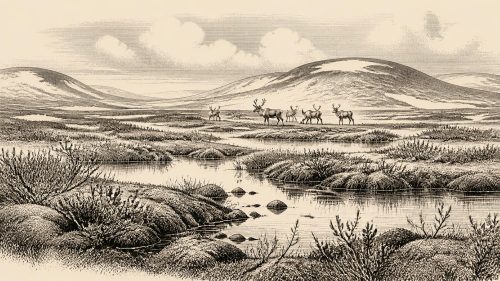
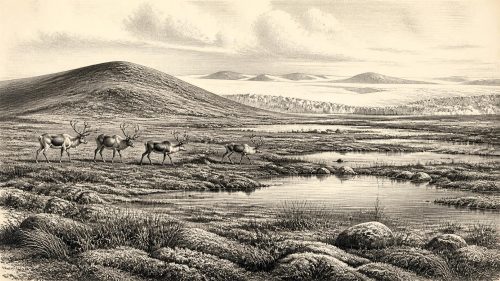
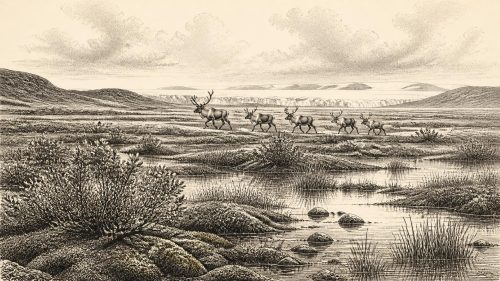
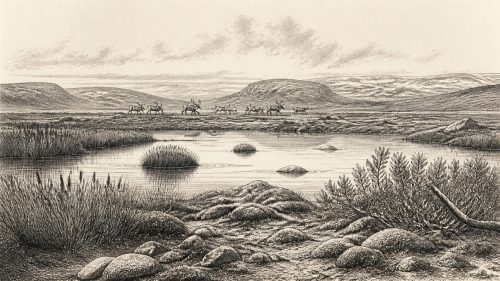
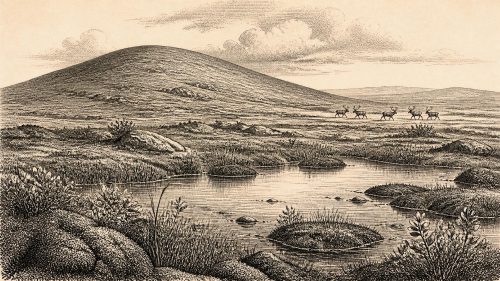
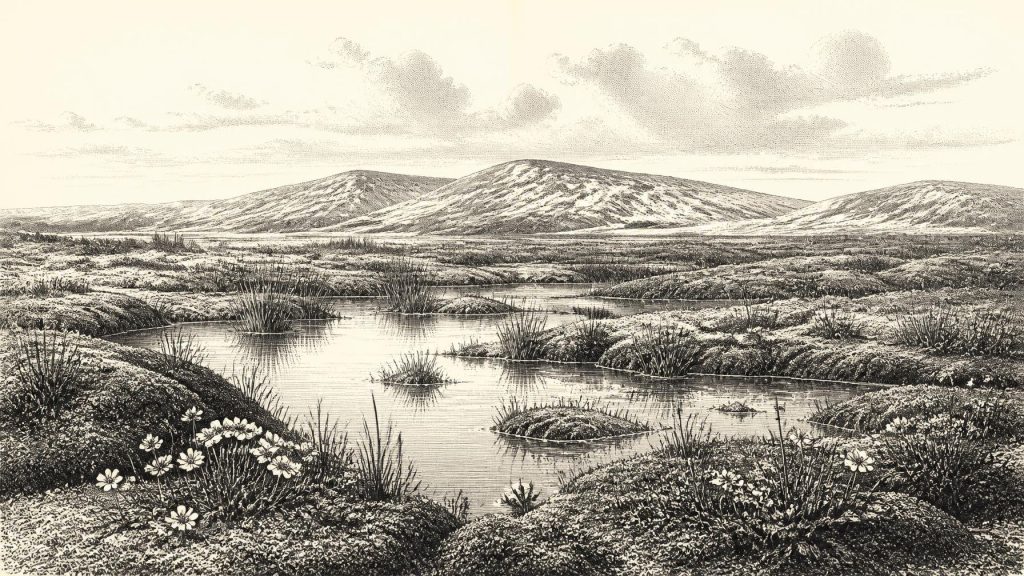
Plant macrofossils, pollen, mosses and insect remains from Derryvree point to open tundra vegetation and a periglacial climate. The evidence includes sedges, mosses and wetland plants such as bogbean and water-milfoil, alongside arctic-alpine taxa including mountain-avens and lesser clubmoss. These remains support a picture of shallow or slow-moving freshwater, saturated margins and low vegetation in a cold, treeless setting. They do not establish modern temperatures, rainfall or vegetation cover, nor should they be treated as a photograph of all Ireland. They show that this part of Fermanagh contained a functioning wetland ecosystem during a cold interval: water carried silt, plants rooted and decayed, insects occupied niches, and short growing seasons permitted life between severe winters.
Not an Empty Landscape
“Tundra” can misleadingly suggest lifelessness. Derryvree instead records an ecological mosaic. Open water and muddy margins would have differed from better-drained ground nearby; wind exposure, snow cover, drainage and local relief could produce sharply varied microhabitats. The low vegetation was not woodland, pasture or farmland. There is no evidence for fields, grazing livestock, hedges, crops or permanent villages. But the plants and invertebrates demonstrate that cold ground could be biologically productive during the favourable part of the year.
Cave faunas provide a wider, though more difficult, perspective. Castlepook Cave near Doneraile in north County Cork has yielded remains attributed to reindeer, woolly mammoth, giant deer, wolf, fox, Arctic fox, brown bear, spotted hyaena and lemmings. Revised radiocarbon work has shown that several older Irish cave dates needed reassessment because improved bone pretreatment can produce substantially different results. The cave record is also complicated by carnivore activity, sediment movement, old excavation methods and material collected before modern stratigraphic standards. It is strongest as evidence that cold-adapted and open-country animals occurred in Ireland during parts of MIS 3, rather than as a simple census of animals alive at one moment.
Reindeer are particularly apt for the broad environment suggested by Derryvree: they are animals of open, seasonal landscapes and could have moved across extensive ranges. A pre-Last Glacial Maximum deer specimen from a Waterford cave has been calibrated to 32,930–31,280 cal BP, demonstrating that large herbivores were present in Ireland within the wider period. Mammoth and hyaena remains show that the island’s fauna was at times more varied than later Irish history might imply. Their presence nevertheless cannot reveal herd sizes, annual migration routes or the exact configuration of sea, ice and land available to them.
The Uncertain Human Question
The most striking possible evidence for people is also the most limited. A reindeer femur from Castlepook has been publicly identified as about 33,000 years old and as bearing a deep mark interpreted by zooarchaeologist Ruth Carden as the result of butchery with a sharp stone tool. If that reading is sustained, it would show human handling of a reindeer in Ireland during the Upper Palaeolithic, far earlier than the island’s well-established post-glacial settlement record. It would be a major discovery.
It does not, however, prove a permanent Irish population in 30,476 BCE. The specimen came from an old cave collection rather than a newly excavated occupation floor with a securely associated hearth, stone-tool assemblage, dwelling, burial or food-processing area. No published site of this age in Ireland supplies that fuller package of evidence. Nor can one marked bone identify the visitors’ language, ancestry, route of travel, group size, duration of stay or relationship to later inhabitants. Current excavation at Castlepook has located surviving Pleistocene deposits and aims to clarify the cave’s history, but the question remains open.
Comparison with contemporaneous Upper Palaeolithic groups in Britain and continental Europe makes brief visits by mobile hunter-gatherers conceivable. Such groups elsewhere used stone technologies, moved across large territories and exploited animal and seasonal resources. This is context, not a demonstrated Irish social history. It must not be inflated into an invented tribe, camp or hunt on the basis of a single bone and a broad date.
What Cannot Be Recovered
There is no evidence from which to describe political institutions, chiefs, diplomacy, organised warfare, territorial borders, trade partnerships, religious ceremonies, formal learning or artistic traditions in Ireland at this date. There are no named people, no inscriptions, no monuments, no graves and no securely dated houses. These are not gaps that can responsibly be filled by borrowing stories from better-known European Palaeolithic sites. Even if people briefly reached Ireland, the surviving record does not show how they organised themselves.
The same restraint applies to economy. There is no direct evidence for agriculture, animal husbandry, exchange networks or a settled subsistence economy. The clearest economic relationships visible are ecological: herbivores feeding in open habitats; predators and scavengers using animal carcasses; plants exploiting wet ground; and water, frost and ice remaking the landscape. A possible episode of reindeer butchery would indicate resource use, not a regional economy or a lasting settlement system.
Ice, Water and Survival
The principal development around this point was environmental rather than political. Ireland’s regional history was being shaped by the advance and retreat of ice, shifts in drainage, changing sea level and the arrival or disappearance of species. At Derryvree, later ice sealed a fleeting freshwater environment beneath glacial sediment. That destructive advance also created the conditions for preservation: without the protecting till, the silts and their delicate plant remains might never have survived.
The best picture for 30,476 BCE is therefore restrained but vivid. In at least one northern locality, cold open country contained freshwater pools, sedges, mosses and specialised tundra plants. Across the island, changing habitats could support large mammals at intervals, while cave deposits preserve traces of predators and prey. Human presence is possible and potentially momentous, but not yet established as continuous occupation. Ireland’s story at this depth is written not in chronicles but in silt, bone, pollen, moss and ice: evidence of a harsh, dynamic land at the far western margin of Ice Age Europe.
Primary Sources
- A Middle Midlandian Freshwater Series at Derryvree, Maguiresbridge, County Fermanagh, Northern Ireland
- Palaeoecology: The Middle Midlandian Palaeoenvironment of South Fermanagh
- Figure 6: The Subdivision of the Quaternary Period in Ireland
- Pleistocene Glaciations in Ireland
- The Timing and Magnitude of the British–Irish Ice Sheet Between Marine Isotope Stages 5d and 2: Implications for Glacio-Isostatic Adjustment, High Relative Sea Levels and ‘Giant Erratic’ Emplacement
- Growth and Retreat of the Last British–Irish Ice Sheet, 31,000 to 15,000 Years Ago: the BRITICE-CHRONO Reconstruction
- Exploring Controls of the Early and Stepped Deglaciation on the Western Margin of the British Irish Ice Sheet
- Pattern, Style and Timing of British–Irish Ice Sheet Advance and Retreat Over the Last 45,000 Years: Evidence From NW Scotland and the Adjacent Continental Shelf
- Episodic Speleothem Deposition Tracks the Terrestrial Impact of Millennial-Scale Last Glacial Climate Variability in SW Ireland
- The Nature and Timing of MIS 3 Interstadials; New Constraints From U-Series Dated Speleothems From Crag Cave, SW Ireland
- A Reconsideration of the Radiocarbon Dating of the Marine Isotope Stage 3 Fauna From Southern Ireland
- Phylogeographic, Ancient DNA, Fossil and Morphometric Analyses Reveal Ancient and Modern Introductions of a Large Mammal: the Complex Case of Red Deer (Cervus elaphus) in Ireland
- New Insights on the Fauna of Ireland’s Younger Dryas and Early Holocene From Alice & Gwendoline Cave
- 2022:564 – Castlepook Cave, Castlepook South, Cork
- Heritage Artefacts of County Cork
- The Irish Quaternary Fauna Project
- Pleistocene Vertebrates in the British Isles
- The IntCal20 Northern Hemisphere Radiocarbon Age Calibration Curve (0–55 cal kBP)
- The IntCal20 Approach to Radiocarbon Calibration Curve Construction: A New Methodology Using Bayesian Splines and Errors-in-Variables
- A Stratigraphic Framework for Abrupt Climatic Changes During the Last Glacial Period Based on Three Synchronized Greenland Ice-Core Records: Refining and Extending the INTIMATE Event Stratigraphy