
Castlepook’s Pre-Glacial Fauna31389 BCE
Around 31,389 BCE, Ireland lay within the fluctuating cold conditions of Marine Isotope Stage 3, not a recoverable historical year. Derryvree deposits in Fermanagh record treeless, wet tundra with sedges, mosses, shallow pools and cold-adapted plants, later buried by ice. Castlepook Cave in Cork preserves mixed faunal remains, including mammoth, reindeer, giant deer, hyaena and lemmings, demonstrating a cold, open ecosystem. A marked reindeer femur may indicate early human activity, but disturbed context and uncertain interpretation prevent firm conclusions. No evidence supports permanent settlement, politics or culture. Fragmentary archives reveal changing climates, expanding ice and possible transient visitors to Ireland.
Dateline
31,389 BCE is not a year that can be recovered from the Irish archaeological record in the ordinary historical sense. Nobody in Ireland left writing, a dated monument, a settlement sequence or an annually resolved archive from which a particular season, person or occurrence can be identified. The label is a modern chronological convenience. It falls roughly 33,300 calendar years before AD 1950, within the later part of Marine Isotope Stage 3, an unstable middle phase of the last Ice Age. The responsible way to describe Ireland at this point is therefore through overlapping calibrated and radiocarbon ranges, environmental deposits and animal remains—not through a year-specific event.
A Cold, Changing Island
Ireland then belonged to the Pleistocene world, long before the island acquired its familiar coastlines, woods, farms or human communities. Climate in the North Atlantic did not simply move in one direction towards the Last Glacial Maximum. It swung sharply between relatively milder interstadial episodes and colder stadials. Greenland ice-core chronologies reveal such abrupt shifts at a regional scale, but they cannot tell us the weather in Ireland in a given year. Nor should an Irish sediment bed be assigned too confidently to one short Greenland event without direct, high-resolution correlation.
The broad tendency was nevertheless towards severe cold and the growth of the British–Irish Ice Sheet. The great maximum of the last Irish glaciation lay still in the future, mainly between about 26,500 and 19,000 years ago, but ice was already an active and expanding force in the wider region. Its margins, thickness and timing before the maximum remain subjects of research. Some parts of Ireland may have been ice-free at times; others may have lain close to glaciers or beneath ice. A map with neat fixed boundaries would imply a certainty the evidence does not possess.
Derryvree’s Freshwater Evidence
The most revealing Irish environmental archive for this broad age comes from Derryvree near Maguiresbridge in County Fermanagh. Roadworks there exposed freshwater silts and fine sands caught between two tills: deposits left by ice at different stages. The intervening organic layer returned a radiocarbon determination of 30,500 +1,170/−1,030 BP. Radiocarbon years are not identical to calendar years; when calibrated using modern curves, such a result represents a broad calendar-age range rather than a single date. Its uncertainty is substantial, but it makes Derryvree highly relevant to the environmental world in which 31,389 BCE belongs.
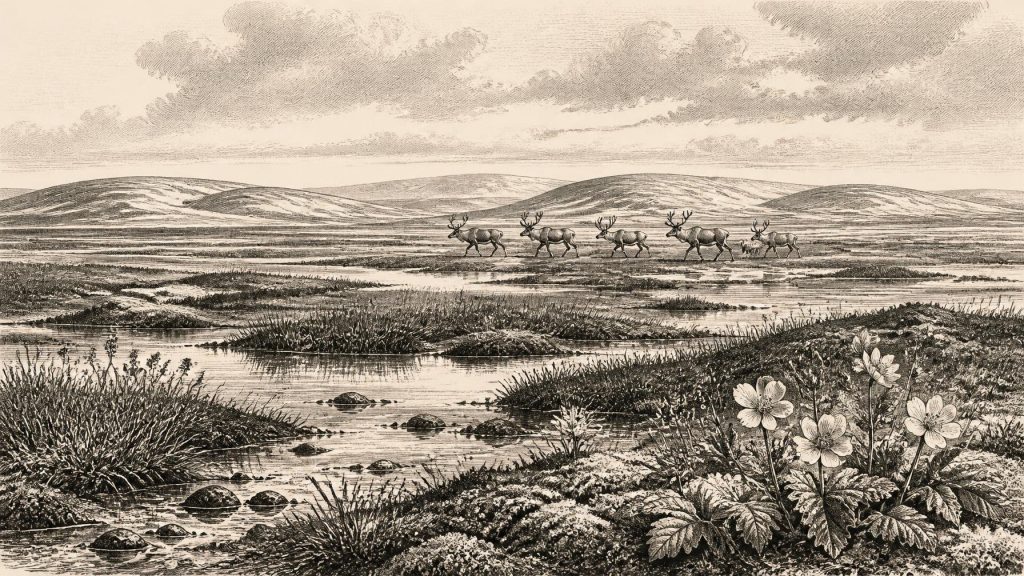
The fossils from this deposit describe neither forest nor a featureless snow desert. Pollen, seeds, mosses and insects point instead to an open tundra or muskeg landscape: wet ground with shallow pools, sedges and mossy vegetation, interrupted by drier, sparsely vegetated surfaces. Macrofossils include bogbean (Menyanthes trifoliata) and mountain avens (Dryas octopetala), plants capable of surviving in cold environments. Juniper and herb pollen occur, but tree pollen is too limited and potentially too easily transported to demonstrate a local woodland. The best-supported reconstruction is a treeless, periglacial wetland mosaic with a short growing season and hard winters.
That evidence matters because it restores complexity to Ice Age Ireland. Water remained liquid in sheltered basins for at least part of the year. Plant matter accumulated, insects occupied ecological niches, and wetlands could support animal life. Yet this was a fragile landscape. Permafrost, seasonal thaw, wind exposure, frozen ground and repeated climatic reversals would have constrained vegetation and altered drainage. Later glacial action buried the Derryvree deposits beneath till, preserving a narrow sample of a lost world while also demonstrating that its conditions did not last indefinitely.
Castlepook’s Animal World
In north County Cork, Castlepook Cave—also called Mammoth Cave, near Doneraile—offers another, very different window. Antiquarian excavations in the early twentieth century recovered a large and mixed collection of bones from its passages and chambers. Subsequent radiocarbon work has shown that part of its fauna belongs to Marine Isotope Stage 3, broadly between about 45,000 and 20,000 years ago. Individual remains need not be contemporary merely because they came from the same cave, and the old excavation methods greatly limit their original context. Still, Castlepook establishes that cold-stage animal communities reached Ireland before the Last Glacial Maximum.
The recorded fauna includes woolly mammoth, reindeer, giant deer, spotted hyaena, wolf, fox, Arctic fox, bear, hare and lemmings. This is not a direct inventory of animals living together on one day. Caves accumulate bones through carnivore denning, scavenging, water movement, deaths in or near a cave, and excavation disturbance; hyaenas in particular may have transported carcass parts underground. The assemblage does, however, support the larger conclusion that north Cork formed part of a cold, open north-west European ecological zone. Reindeer and mammoth indicate broad grazing country, while small mammals and carnivores add texture to a varied, demanding habitat.
Castlepook also warns against using familiar names too casually. The ‘Irish elk’ or giant deer was not a modern Irish species and did not define a national landscape; it was a Pleistocene deer, Megaloceros giganteus, with an exceptionally wide Eurasian distribution. Equally, mammoth bones do not prove a continuous resident herd at the cave. They demonstrate that these animals, or their remains, were present in Ireland during portions of the period represented by the cave archive. The distinction between a dated specimen and a reconstructed living population is essential.
The Reindeer Femur Question
A reindeer femur from Castlepook is especially important because it has been reported as bearing a deep mark interpreted by zooarchaeologist Ruth Carden as a stone-tool cut or chop made while the bone was fresh. County Cork heritage material associates the specimen broadly with c. 31,000 BC. If the modification is confirmed as human-made and contemporary with the animal’s death, it would be a striking indication that Upper Palaeolithic people reached Ireland far earlier than the island’s previously secure terminal-Pleistocene human evidence.
Its significance must remain conditional. Direct dating identifies the age of the animal bone, not necessarily the instant of marking; recognising a cut-mark involves separate taphonomic judgement. Carnivore damage, trampling, sediment abrasion, recovery damage and later handling all have to be excluded. More importantly, Castlepook has not produced a securely associated hearth, stone-tool assemblage, dwelling surface, human burial or repeatedly occupied camp of this age. The bone came from an old, disturbed cave collection. It can support a hypothesis of brief human activity, perhaps carcass processing by a small travelling group, but not a claim for a permanent population or an identifiable ‘first Irish’ society.
People, Mobility and the Sea
If people did visit, they were almost certainly mobile hunter-gatherers, comparable in broad economic terms to Upper Palaeolithic groups elsewhere in north-west Europe. Reindeer could have supplied meat, marrow, hide, sinew, antler and bone, while stone tools would have been vital for cutting and working materials. This is contextual inference, not excavated Irish evidence. No Irish toolkit of this age has been securely recovered, and no surviving Irish site demonstrates how a party travelled, camped, divided labour or organised its seasons.
Travel to Ireland was possible only within a changing physical geography. Lower sea levels exposed more of the continental shelves than today, and Britain, Ireland and the now-submerged lands between them had different coastlines. But lower sea level does not automatically mean a dry land bridge at every moment. Waterways, ice fronts, tidal channels and difficult lowlands could still have separated regions. The archaeological evidence cannot identify a route into Ireland, whether from Britain, the continent or another direction. The most that can be said is that animal dispersal and possible human movement occurred within a wider, shifting north-west European landscape.
No Politics to Recover
There is no evidence from Ireland at this date for political authority, named leaders, territorial states, diplomacy, formal warfare or law. Nor can archaeology identify an Irish language, ethnicity or ancestry connecting any possible visitors directly to later populations. Calling them ‘Irish’ is useful only geographically: they would have been people on, or visiting, the landmass that is now Ireland. A single altered bone cannot reveal kinship, gender, status, social hierarchy or collective identity.
For the same reason, religion, culture and learning must not be invented. Upper Palaeolithic communities elsewhere in Europe made art, ornaments, musical instruments and sophisticated tools, but those achievements cannot be projected onto Ireland without Irish finds. No contemporary ritual place, artwork, engraving, burial, shrine, monument or notation system has been securely demonstrated here. The cultural fact most clearly visible is the knowledge embodied in survival: animals occupied difficult habitats, and any human visitors would have needed practical understanding of cold, terrain, prey and materials. That is a reasonable inference about capability, not proof of a specific tradition.
Evidence Before Narrative
The central development around 31,389 BCE was environmental rather than political. Ireland was part of an Ice Age world in transition: open wet tundra is recorded at Derryvree; cold-adapted mammals are represented at Castlepook; and ice was becoming increasingly consequential across the island and its surrounding shelves. These archives are incomplete precisely because glaciers eroded older surfaces, rising seas later drowned lowland routes, and early cave excavations did not preserve the contextual information expected today.
Yet the fragments are powerful. They show that Ireland was not simply absent from prehistory until the Holocene. It had climates, wetlands and animal communities of its own during Marine Isotope Stage 3, and it may have briefly been entered by people. Future excavation, direct dating, microscopic study of bone surfaces, sedimentary ancient DNA and refined ice-sheet reconstructions may clarify that possibility. Until then, the most honest account of this notional year is one of cold pools beneath future drumlins, reindeer and mammoth in the wider landscape, growing ice, and a tantalising but unconfirmed human trace in a Cork cave.
Primary Sources
- The IntCal20 Northern Hemisphere Radiocarbon Age Calibration Curve (0–55 cal kBP)
- Radiocarbon Dating and Chronological Modelling
- A Stratigraphic Framework for Abrupt Climatic Changes During the Last Glacial Period Based on Three Synchronized Greenland Ice-Core Records: Refining and Extending the INTIMATE Event Stratigraphy
- The Middle Midlandian Palaeoenvironment of South Fermanagh
- The Subdivision of the Quaternary Period in Ireland
- Quaternary Site Descriptions
- Irish Pleistocene Biostratigraphy
- The Irish Quaternary Fauna Project
- A Reconsideration of the Radiocarbon Dating of the Marine Isotope Stage 3 Fauna from Southern Ireland
- HERITAGE ARTEFACTS of County Cork
- 2022:564 – Castlepook Cave, Castlepook South, Cork
- Mammoth Cave, County Cork
- First Evidence of a Late Upper Palaeolithic Human Presence in Ireland
- New Insights on the Fauna of Ireland's Younger Dryas and Early Holocene from Alice & Gwendoline Cave
- The Timing and Magnitude of the British–Irish Ice Sheet Between Marine Isotope Stages 5d and 2
- Growth and Retreat of the Last British–Irish Ice Sheet, 31,000 to 15,000 Years Ago: the BRITICE-CHRONO Reconstruction
- Dimensions and Chronology of the Last Ice Sheet in Western Ireland
- Trimlines, Blockfields and the Vertical Extent of the Last Ice Sheet in Southern Ireland
- Maximum Extent and Dynamic Behaviour of the Last British–Irish Ice Sheet West of Ireland
- Late Pleistocene Chronostratigraphy and Ice Sheet Limits, Southern Ireland
- Deposits of the Last Glaciation
- Menyanthes trifoliata L.
- Dryas octopetala L.
- Terra Incognita: The Palaeolithic Record of Northwest Europe and the Information Potential of the Southern North Sea