
Start Exploring
Choose a route into Ireland’s past: follow the newest additions, find a particular year or subject, or browse every available period.

Latest Discoveries
Archived: 1st November 2026
Mag Itha’s Second Encounter
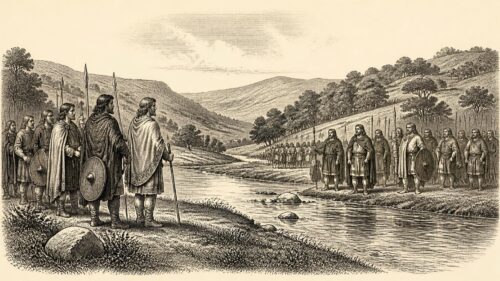
In 733, Áed Allán of Cenél nEógain again fought Cenél Conaill at Mag Itha in the Finn valley, killing Conaing of Fánad and many others, strengthening his northern position. The annals place this conflict within wider rivalry among Northern Uí Néill dynasties, without proving an immediate all-Ireland kingship. Elsewhere, Dúngal violated sanctuary on Tory Island, while succession and deaths exposed instability in Dál Riata. Killings, defeats and contested authority at Tailtiu and Tlachtga reflected regional insecurity. Obituaries from Clonmacnoise and Armagh, Donnchad Midi’s birth, and a remarkable cow recorded at Delg Inis reveal intertwined political, ecclesiastical, maritime and pastoral worlds.
Archived: 1st November 2026
Bann Fleet and Kingship
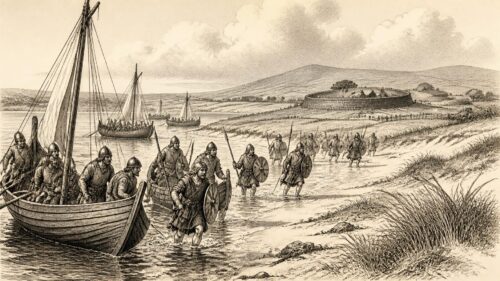
In 734, Áed Allán of Cenél nÉogain displaced Flaithbertach of Cenél Conaill as leading claimant to Tara after conflict at Mag nÍtha and a failed Dál Riata-supported naval effort near the Bann. Annals indicate slaughter on both sides but record Áed’s rule, while Flaithbertach retired into religion. The change strengthened Cenél nÉogain and curtailed Cenél Conaill’s wider influence, without creating a unified Irish monarchy. Regional rulers, including Munster’s Cathal, remained powerful. Churches supplied political and intellectual authority through relics, learning and patronage. Most people continued rural mixed farming, though warfare affected supplies, travel and local obligations across Ireland in practice.
Archived: 1st November 2026
Faughart and Bélach Éile
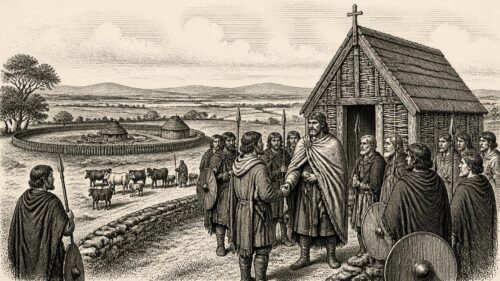
In 735, battles at Faughart in Muirthemne and Bélach Éile reshaped Irish political relationships. Áed Allán of the northern Uí Néill defeated the Ulaid, killing King Áed Róin and demonstrating influence along strategically important northern routes. At Bélach Éile, Munster and Leinster suffered severe losses, including Cellach of Osraige and Déisi princes; conflicting annals leave Cathal mac Finguine’s victory or defeat unresolved. Connacht lost its king and another leading ruler, while an abbot was slain and Nendrum’s bishop died. Agrarian communities and churches underpinned power. Irish annalists also recorded Bede’s death and an ominous celestial prodigy reported at autumn’s end.
Archived: 1st November 2026
Precarious Shelter
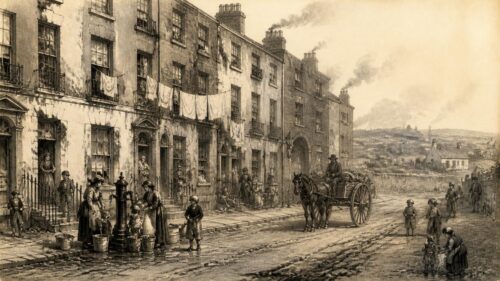
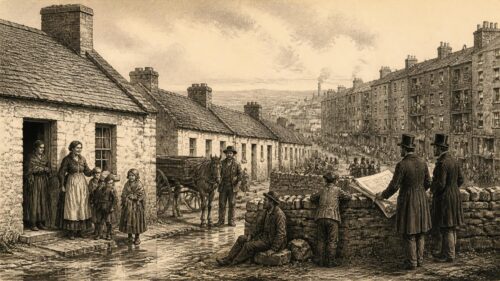
Housing and homelessness have shaped Irish lives from the Poor Law workhouse to the tenement room, the rural labourer’s cottage, municipal estates and the emergency accommodation of the present era. This history shows that shelter was never merely private: it reflected landholding, public health, migration, family formation, labour and political power. Irish evidence complicates narratives. Tenements were places of danger but also communities; cottages brought security but not equality; council building transformed lives yet later contracted. Homelessness, obscured by institutions and informal lodging, eventually acquired legal recognition. The crisis belongs to contested history of provision, exclusion and citizenship.
Archived: 1st November 2026
Clonard and Lusk
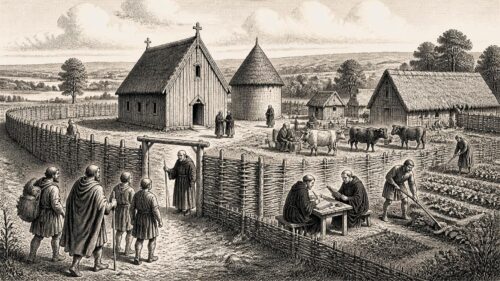
In 736, Irish annals recorded deaths of abbots at Clonard, Lusk, Ardbraccan and Mag Bile, alongside the passing of the scholar-anchorite Duiblitir on Inis Bó Finne. Máel Fothartaig was killed by fellow Leinstermen, while Bodbthach, king of Cairpre, died, illustrating localised political authority and conflict. These terse notices reveal churches as influential economic, social and political centres, though succession details remain unknown. Across the North Channel, Pictish king Óengus devastated Dál Riata, capturing Dúnadd and imprisoning Selbach's sons. The evidence indicates transition rather than collapse, highlighting Ireland's ecclesiastical networks, regional rivalries and maritime connections. Dating uncertain; precise dates remain unrecorded.
Archived: 1st November 2026
Rent Reckoning
This article traces how housing and rent reform in Ireland developed from nineteenth-century struggles over land, labour and unhealthy dwellings into a modern system of public provision, tenancy rights and regulated rents. It examines rural labourers’ cottages, urban slum clearance, post-independence building, wartime rent restriction, constitutional reversal, and the later rebuilding of tenant protections. The central argument is that Irish reform repeatedly balanced property rights with public health, social security and political stability. It also stresses discontinuity: expansion in one tenure often coincided with retreat in another. Evidence, interpretation and retrospective myth are carefully distinguished throughout when evidence remains incomplete.
Archived: 1st November 2026
Tír Dá Glas Meeting
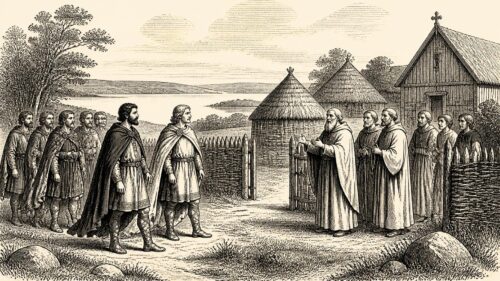
In 737, Áed Allán, northern Uí Néill overking, met Cathal mac Finguine of Munster at the monastery of Tír dá Glas, probably to limit conflict, although terms remain unknown. Annals then declared Patrick’s law effective in Ireland, projecting ecclesiastical legitimacy and wider order rather than recording a uniform national code. The year nevertheless saw dynastic violence in Brega, where Conaing defeated Cernach and Cathal son of Áed died, alongside deaths of regional rulers and abbots. Failbe of Applecross drowned with twenty-two sailors, illustrating Gaelic maritime links. These records reveal negotiation, church influence, instability, and aspirations to unity amid fragmented kingship.
Archived: 1st November 2026
Cultural Continuities
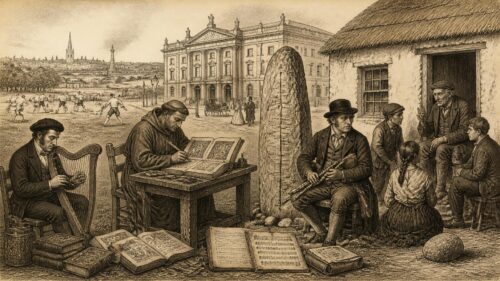
This article traces Irish cultural milestones not as a single uninterrupted national story, but as an evolving set of languages, arts, institutions and inherited practices. From ogham stones and medieval manuscript learning to the devastating nineteenth century linguistic shift, it examines how revivalists, theatres, collectors, musicians, emigrants and new communities reshaped what Irish culture could mean. It separates material evidence from later legend, and national aspiration from everyday practice. The essay follows culture across the island and diaspora, recognising conflict, exclusion and adaptation alongside achievement, and concludes with Irish culture as a living, contested inheritance rather than a finished canon.
Archived: 1st November 2026
Earned Legitimacy
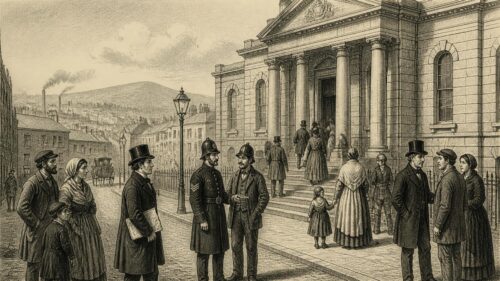
This article examines public trust in Northern Ireland’s justice institutions in 2026 as a historical achievement rather than a settled possession. It traces the transformation from contested policing during the Troubles to the post Agreement architecture of the PSNI, Policing Board, Police Ombudsman and devolved Department of Justice. Recent surveys show substantial confidence and feelings of safety, while victims’ experiences, complaints, representativeness, funding pressures and unresolved legacy cases reveal important limits. The evidence suggests neither simple success nor institutional failure. Trust is plural, conditional and unevenly distributed, sustained when justice is visible, fair, answerable and capable of delivering credible remedies in practice.
Archived: 1st November 2026
Unequal Warmth
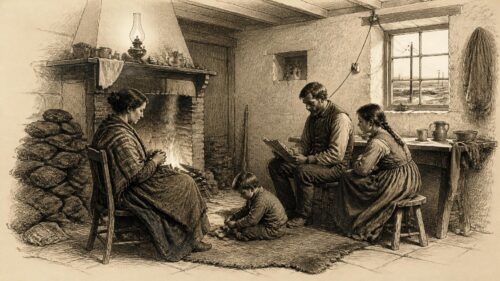
This article traces the Irish history behind a modern phrase: energy poverty. It follows the movement from household reliance on turf, coal and other solid fuels, through national electrification and postwar peat development, to welfare payments, efficiency schemes and statutory climate planning. The account argues that Ireland’s energy transition has always involved questions of distance, income, housing quality, health and public responsibility. It distinguishes documentary evidence from retrospective interpretation, and cautions against treating turf, electricity or heat pumps as simple cultural symbols. The central historical lesson is clear: decarbonisation succeeds durably only when warmth, affordability and security are treated as goods.



