After Máel Sechnaill1022 CE
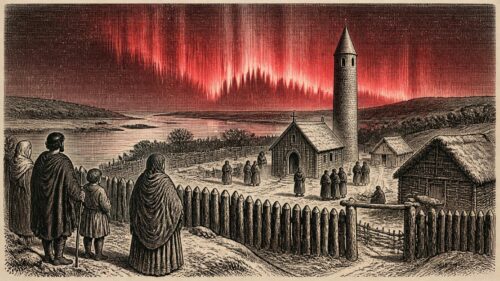
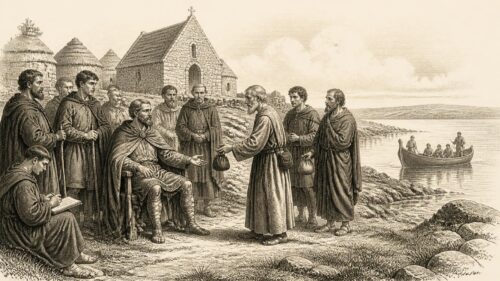
In 1022, the death of Máel Sechnaill mac Domnaill, king of Mide and foremost post-Clontarf claimant to Ireland’s high-kingship, exposed the weakness of island-wide authority. He died at Cró Inis on Lough Ennell, honoured by churches and remembered for royal generosity, though later accounts elaborate his final rites. His loss, following the death of his heir in 1021, intensified succession disputes. Warfare continued: Waterford’s Sitriuc was killed, Ulaid defeated Dublin at sea and attacked Airgialla, while regional rulers and heirs fell. Kildare was plundered, churchmen and poets died, and Irish kingship, trade, maritime power and ecclesiastical wealth remained closely intertwined.
Dateline
A Year Of Endings
The Irish year 1022 is dominated by the death of Máel Sechnaill mac Domnaill, king of Mide and the leading claimant to the kingship of Ireland after the fall of Brian Bóruma at Clontarf. The annals give several other killings, church deaths and military actions, but his passing on 2 September at Cró Inis on Lough Ennell gave the year its largest political meaning. It closed the career of the most important southern Uí Néill ruler of his generation and exposed how fragile island-wide authority remained in early eleventh-century Ireland.
The record for the year is unusually rich because several annalistic traditions preserve overlapping notices. The firmest points are those repeated across independent or semi-independent chronicles: the death of Máel Sechnaill, the killing of Sitriuc son of Ímar of Waterford, deaths among churchmen and regional kings, a sea fight involving Dublin and Ulaid, and renewed conflict in the north-east. Other details, especially the fuller penitential scene at Máel Sechnaill’s death and a last victory over the Dubliners reported by the Annals of the Four Masters, are useful but should be read as later or more elaborated testimony rather than as a complete diary of the year.
The King At Cró Inis
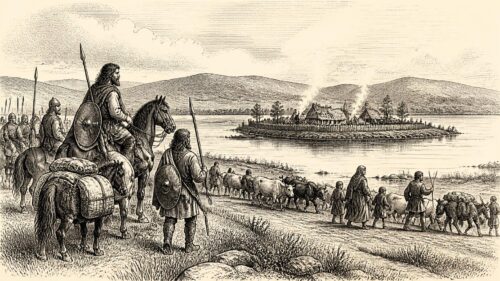
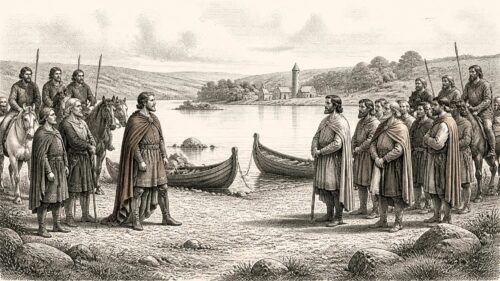
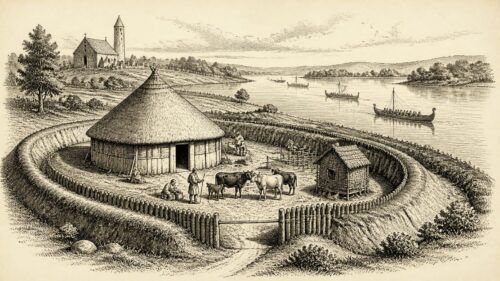
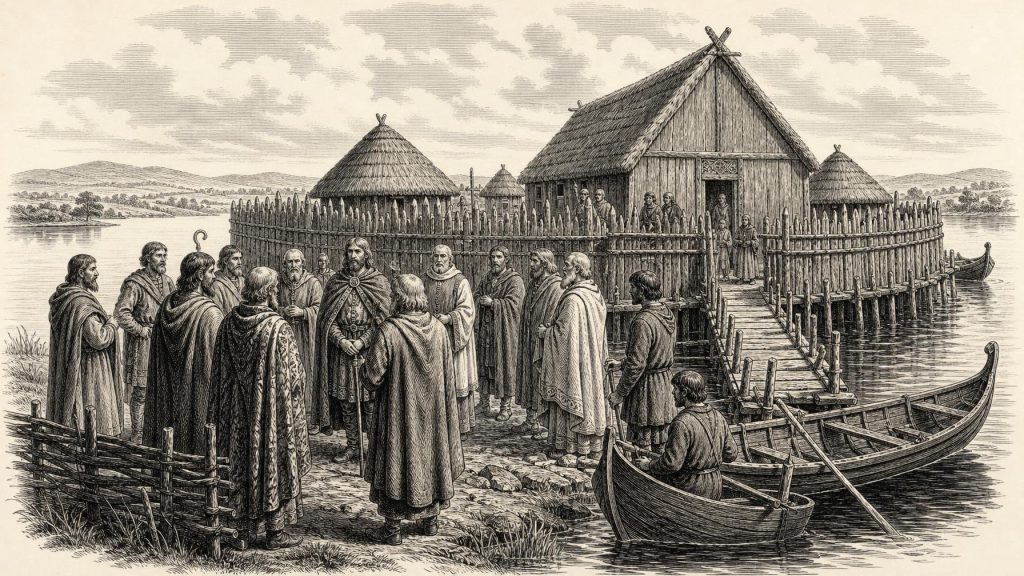
Máel Sechnaill died at Cró Inis, a lake-dwelling or crannog associated with the rulers of Mide, in Loch Ainninn, now Lough Ennell in County Westmeath. The Annals of Ulster state that he died in the forty-third year of his reign and in the seventy-third year of his age, on Sunday, 2 September. Chronicon Scotorum adds that he died penitent and at peace, with the successors of Patrick, Colum Cille and Ciarán present; the Four Masters expand this into a solemn deathbed scene of communion, anointing, masses and psalms. Even if the later phrasing is devotional, the association is believable in political terms. Armagh, Iona’s Columban tradition and Clonmacnoise were not merely spiritual names: their churches helped confer memory, legitimacy and prestige.
Cró Inis itself helps explain the social world around the notice. It was not a romantic island retreat but a defensible aristocratic residence in a watery landscape of routeways, lake traffic, cattle lands and royal estates. Archaeological survey around Lough Ennell has identified crannogs, platforms, timber features and associated settlement, a reminder that kingship was exercised from places that were at once homes, storehouses, hospitality centres and strongholds. The short praise verse preserved with Máel Sechnaill’s obit stresses food, clothing and guesting: royal generosity was not ornament but government. A king fed retainers, rewarded poets and clerics, kept hostages, and redistributed cattle, garments, metalwork and honour.
High-Kingship In Question
Máel Sechnaill had first risen to prominence in the late tenth century and had long contested power with Brian Bóruma. Brian’s supremacy before 1014 had forced Máel Sechnaill into a reduced position, but Clontarf killed Brian, Brian’s son Murchad and many Munster nobles. In the aftermath, Máel Sechnaill again became the most widely recognised king in Ireland, though recognition did not mean a centralised state. Ireland remained a mosaic of provincial, over-kingdom and local lordships: Mide, Brega, Leinster, Osraige, Munster, Connacht, Ulaid, Airgialla, Cenél nEógain and Cenél Conaill all mattered, and the Scandinavian towns of Dublin and Waterford were active political players.
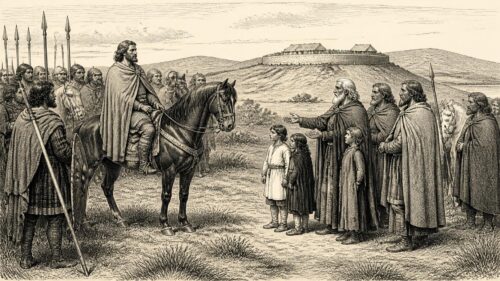
The importance of 1022 lies partly in what had already happened. In 1021, Aed son of Flann son of Máel Sechnaill, described as an heir-designate of Ireland or Tara, was killed. That death left the ageing king without a smooth succession. The annalistic references after 1022 to rival rulers in Mide and to outside kings taking hostages from Meath, Brega and Dublin show the consequences, but the crisis began in this year. The old Uí Néill claim to Tara did not vanish at once, yet Máel Sechnaill’s death made it much harder to turn traditional prestige into practical control.
War On Land And Sea
Violence in 1022 was not confined to royal succession. The annals record that Sitriuc son of Ímar, king of Port Láirge, Waterford, was killed by the king of Osraige. This points to the contested position of the southern Scandinavian port between Irish inland powers and maritime dynasts. Waterford’s fleets, walls and trading links made it valuable, but the town could not stand outside regional politics. Osraige, lying between Munster and Leinster, was especially well placed to intervene.
Dublin was also at war. The Annals of Ulster record a naval combat in the open sea between the foreigners of Áth Cliath and Niall son of Eochaid, king of Ulaid. The Dubliners were defeated; many were killed, prisoners were taken, and other accounts say ships were captured. The detail matters. Warfare in Ireland was not only cattle-raiding across land borders. Sea power linked Dublin, the Isle of Man, Britain and the Irish coasts, and a fleet could raid churches, move warriors or carry captives and goods. Niall’s victory shows that Ulaid could challenge Dublin beyond the shoreline, not merely resist raids inland.
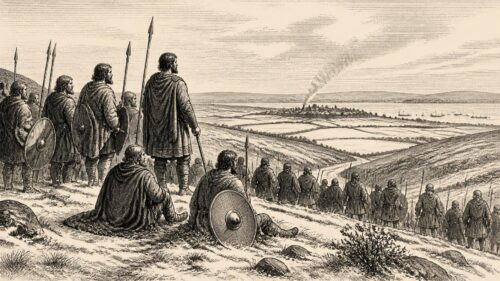
The same Niall is credited in 1022 with defeating the Airgialla at Sliab Fuait, with heavy slaughter. Airgialla occupied a politically sensitive zone between Ulaid, the northern Uí Néill and the midland routes. A victory there strengthened Ulaid’s hand and suggests that Niall was one of the most active military rulers of the year. Other killings point to the same unsettled landscape: Mac Léiginn son of Cairell, king of Airgialla, died as a penitent; Mathgamain son of Laidgnén, king of Fernmag or Farney, was killed by Cathal Ua Crícháin in Clones; and Domnall, grandson of Murchad Glún Ilar and styled king of the North in some sources, was slain by the Cianachta of Glenn Geimin.
Regional Losses
Several notices are terse enough to frustrate modern interpretation. The son of Cerball, king of Éile, was killed. Domnall Ua Cellaig, king of Fotharta, was killed. Muirchertach Ua Carraig, described as an heir-designate of Tara, was slain by In Got, probably the Máel Sechnaill Got who appears in later Meath politics. Domnall son of Aed Ua Máeldoraidh was also slain. These entries read like fragments, but together they show a political class losing men in many regions during the same year. Kingship was elective within dynastic limits; the death of a royal heir or local king could redirect alliances, provoke vengeance, or open a lordship to intervention.
The Annals of the Four Masters also report that Máel Sechnaill won a final bloody victory at Ath Buidhe Tlachtgha over the foreigners of Dublin about thirty days before his death. Because this notice is not presented in the same way by the earlier annals, it should not be treated as securely as the death notice itself. Still, it fits the broader pattern of hostility between Mide and Dublin. If the report preserves genuine tradition, the old king’s final month was not one of withdrawal from politics but of continued military authority close to his midland base.
Churches And Learned Men
The church was deeply entangled with these events. In 1022 Flann Ua Tacáin, superior or erenagh of Durrow, died; Lachtnán, coarb of Inis Cain Dega, died at Armagh; and the Four Masters add Cathasach, lector of Clonmacnoise, and Joseph son of Dúnchad, spiritual adviser of Clonmacnoise. Such men were not peripheral. Erenaghs managed church lands and revenues, lectors taught and preserved learning, and coarbs represented the authority of founding saints. Their deaths remind us that the annals were often written in ecclesiastical environments and that monasteries were centres of literacy, estate management, craft patronage and political negotiation.
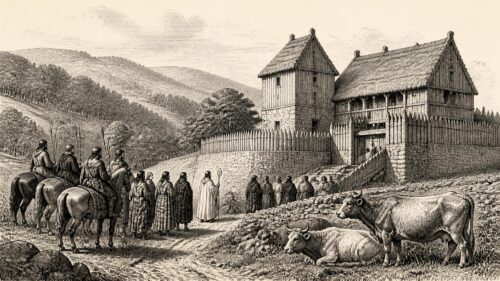
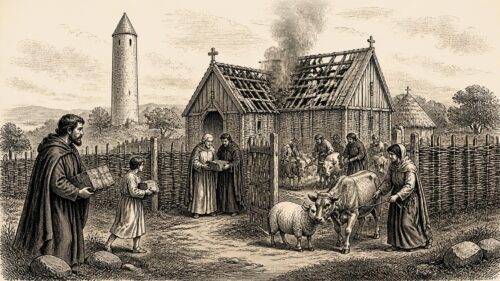
Kildare was plundered by Donn Sléibe and the Uí Fáeláin. The entry is brief, but the target was one of Ireland’s most prestigious ecclesiastical settlements, associated with Brigit and with Leinster kingship. A raid on such a place was both economic and symbolic. Churches held livestock, metalwork, books, relics and dependants; they were also places where royal violence could bring reputational danger. Two years earlier, Armagh, Kildare, Glendalough, Clonard, Swords and Clonmacnoise had suffered burnings in annalistic reports. The 1022 plundering of Kildare belongs to that harsher world in which sacred status did not guarantee security.
The year also touched the learned secular orders. Muiren the Linguist was killed, and another notice names Muiredach Ua Sléibíne, chief poet of the north of Ireland, slain by the Fir Rois. Poets, linguists and historians preserved genealogies, praise, satire, legal memory and political claims. Their deaths were worth recording because words carried authority. The short verses attached to Máel Sechnaill’s death show the same culture at work: commemoration turned a ruler’s hospitality into public memory.
Everyday Wealth And Wider Trade
Most people in 1022 lived far from annalistic notice, yet the entries reveal the economy around them. Cattle, captives, ships, church treasure, clothing and food recur in the records of these decades. Tribute and hostage-taking were the language of lordship; raids damaged ordinary households as much as royal rivals. The praise of Máel Sechnaill’s forts as places of distribution hints at the labour behind aristocratic generosity: herding, dairying, tillage, textile production, brewing, metalwork and transport by road, river and lake.
The Scandinavian towns added another dimension. Dublin was one of the great trading settlements of the western Viking world, with craft production, imported goods, silver exchange and sea routes beyond Ireland. Waterford, too, belonged to this maritime network. The fighting of 1022 therefore linked inland kingship to overseas commerce. An Irish overking wanted hostages and obedience from towns not simply for glory, but because ports concentrated ships, wealth, craftsmen and access to Britain and the wider Atlantic world.
The Shape Of The Year
The safest reading of 1022 is that it was a year of transition rather than sudden collapse. Máel Sechnaill died peacefully, not in battle, and the annals honour him in unusually elevated language. Yet around that dignified death lay killings in Éile, Fotharta, Airgialla, Farney and the north; fighting with Dublin and Waterford; and the plundering of Kildare. The calendar year did not create Ireland’s fragmentation, but it removed one of the few rulers with a plausible island-wide reputation. After 2 September 1022, the question was not whether Irish kings would seek supremacy. They would. The question was who could make that supremacy last.
Primary Sources
- The Annals of Ulster: Year U1022
- The Annals of Ulster
- Chronicon Scotorum: Annal CS1022
- Chronicon Scotorum
- The Annals of Tigernach, Part 16
- Annals of the Four Masters, Part 12
- Annals of Inisfallen
- Annals of Inisfallen: CELT Document Details
- Annals of Loch Cé, Part 1
- Annals of Loch Cé A.D. 1014–1590
- Lebor na Cert: The Book of Rights
- Lebor na Cert, Part 1
- Donnchadh Ó Corráin, Nationality and Kingship in Pre-Norman Ireland
- Seán Duffy, Life after Brian: The High-Kingship
- Ua Néill, Flaithbertach | Dictionary of Irish Biography
- Ua Máelshechlainn, Conchobar | Dictionary of Irish Biography
- Viking | National Museum of Ireland
- Early Medieval Ireland: Archaeological Excavations 1930–2009
- The Irish Sea and the Atlantic Trade in the Viking Age
- Royalty and Renewal in Viking Age Ireland
- 1989:098 – CRO-INIS, Dysart, Westmeath | Excavations.ie
- Islands of Lough Ennell | Ask About Ireland
- Archaeology of Lough Ennell | Ask About Ireland
- The Roles of Poets | The Cambridge History of Irish Poetry
- Medieval Irish Rhetorical Traditions