Tides of Rivalry1045 CE
In 1045, Irish annals depict a politically fragmented island ruled by competing Gaelic dynasties and Hiberno-Norse Dublin. Deaths of regional kings destabilised succession, while Ímar of Dublin killed Ulaid forces and heir Ragnall Ua hEochada on Rathlin. Ulaid retaliated or pressured Dublin by burning Swords and Fingal. Muirchertach Ua Néill’s raid in Brega ended in tidal disaster at Casán Linne. Munster saw aristocratic killings and rivalry beneath Donnchad mac Briain. Churches at Clonfert and elsewhere suffered violence, fire and exactions, despite their influence. A crop failure compounded insecurity, although farming, Dublin trade, monastic institutions and scholarly annal-writing sustained durable networks.
Dateline
The surviving annals make 1045 unusually vivid, though they do not provide a continuous story of the year. They record deaths, raids, killings and fires from Rathlin Island to Cashel and Clonfert, while saying almost nothing about long stretches of ordinary life. Their entries show an Ireland divided among competing dynasties, provincial overkings and Hiberno-Norse maritime rulers. Kingship rested on personal alliances, tribute, hostages and the ability to mobilise armed followers; no ruler exercised uncontested authority across the island.
A Divided Political Landscape
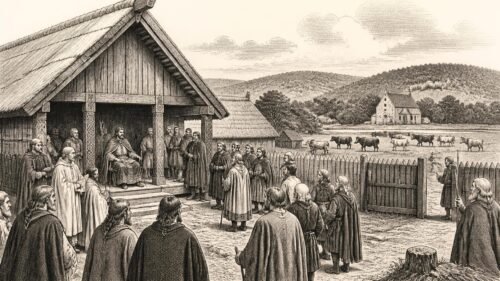
Donnchad mac Briain, son of Brian Bóruma, remained the leading king in Munster, but his power did not recreate his father’s supremacy. Diarmait mac Maíl na mBó was consolidating his position in Leinster, while Niall mac Eochada ruled Ulaid and Ímar son of Harald controlled Dublin. Northern politics were divided among Cenél Conaill, Cenél Eógain, Airgíalla, Ulaid and numerous smaller kingdoms. The annals consequently describe several simultaneous centres of power rather than a single national court.
A series of prominent deaths underlines this fragmentation. Flaithbertach Ua Canannáin, king of Cenél Conaill, died during the year, as did Glún Iarainn Ua Cléirchéin, king of Uí Chairpri, and Congalach Ua Lochlainn, king of Corcu Mruad in north-west Munster. Domnall Ua Cétfada, described as head of Dál Cais and the glory or dignity of Munster, also died. These were not merely private losses. A king’s death could reopen questions of succession, release subordinate peoples from personal obligations and encourage neighbouring dynasties to test the strength of his heirs.
Slaughter on Rathlin
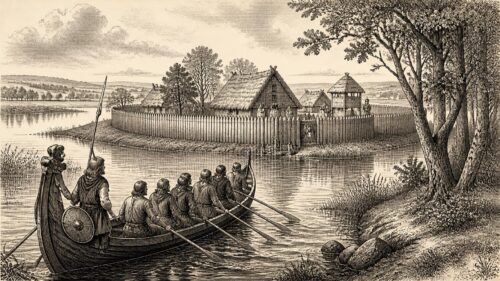
One of the year’s most important firmly dated events was a major defeat of the Ulaid on Rathlin Island. The Annals of Inisfallen and the later Annals of the Four Masters state that three hundred men or nobles were killed, among them Ragnall Ua hEochada, royal heir of Ulaid. The attacker was Ímar son of Harald, ruler of Dublin, whom the Irish chronicles classed among the “foreigners” of Áth Cliath. The number of casualties may be conventional or exaggerated, but the agreement that Ragnall fell makes the political importance of the encounter clear.
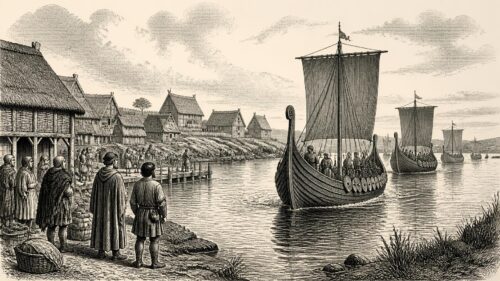
Rathlin stood within the maritime world linking north-eastern Ireland, western Scotland, the Hebrides, Man and Dublin. Control of ships and landing places allowed rulers to strike far beyond the territories that they could dominate on land. The attack therefore belonged to more than a simple Irish-versus-Viking conflict. By 1045 Dublin’s Hiberno-Norse population had lived in Ireland for generations, traded with Irish communities and participated in shifting alliances with Gaelic kings. Ímar’s expedition was an act of dynastic and strategic warfare by an Irish Sea ruler.
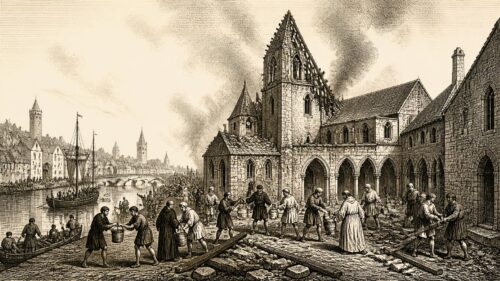
The Annals of Tigernach also record a hosting by Mac Eochada and a ruler named Máel Sechnaill into the territory of the foreigners, during which Swords and Fingal were burned. The entry does not explicitly call this revenge for Rathlin, so a direct connection cannot be asserted. Nevertheless, it demonstrates continuing pressure between Ulaid and Dublin. Burning Swords and the surrounding district attacked both an ecclesiastical settlement and the productive hinterland north of the town. It could damage food supplies, intimidate dependants and weaken Dublin’s control of its approaches.
Defeat at Casán Linne
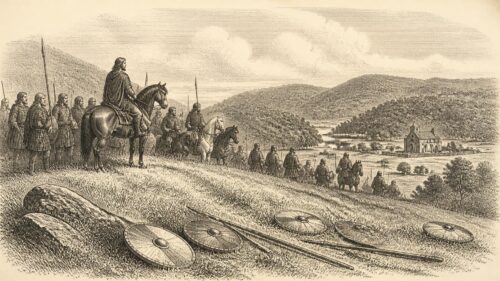
Another northern expedition ended disastrously at Casán Linne, whose precise location remains uncertain but whose name and the annalistic account indicate a tidal setting in or near Brega. Muirchertach Ua Néill led a raid into the territory of the men of Brega. Gairbíth Ua Cathasaig, king of Brega and leader of the Saithne, intercepted him as the sea stood at full tide ahead of the raiders. Trapped between water and their pursuers, Muirchertach and many of his followers were killed.
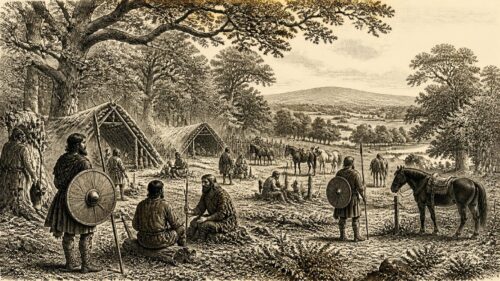
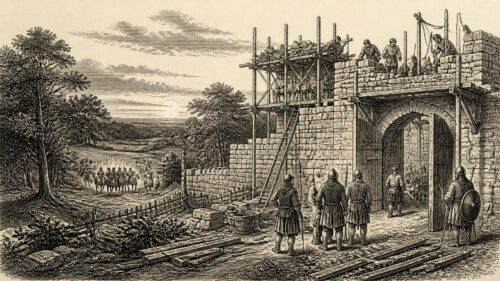
The episode reveals the practical nature of warfare. Most campaigns were not prolonged sieges or set-piece battles but rapid expeditions intended to seize cattle, captives and movable wealth. Success depended upon intelligence, local guides, speed and a safe route home. At Casán Linne, knowledge of tides and terrain proved as decisive as weapons. The death of a leading Ua Néill figure also reduced Cenél Eógain influence at a time when rivalry within the northern Uí Néill remained intense.
Violence in Munster
Munster’s internal divisions surfaced in the killing of Carthach son of Saerbrethach, king of Eóganacht Chaisil. He and numerous nobles were burned inside a house deliberately set alight by a descendant of Longargán son of Donn Cuan. The sources give no fuller explanation, and it would be unsafe to reconstruct a feud from the bare notice. The method, however, suggests a planned attack on an assembled aristocratic company rather than an accidental fire.
Carthach’s death mattered because the Eóganachta remained prestigious competitors to the Dál Cais and to Donnchad mac Briain’s authority. Elsewhere in Munster, the king of Múscraige Ua hAeda was killed, while an heir of Uí Chonaill also fell. Together with the deaths of Domnall Ua Cétfada and Congalach Ua Lochlainn, these notices portray a province composed of resilient regional kingdoms. Donnchad was powerful, but local rulers still commanded their own warbands, negotiated alliances and fought over succession and territory.
Churches Under Pressure
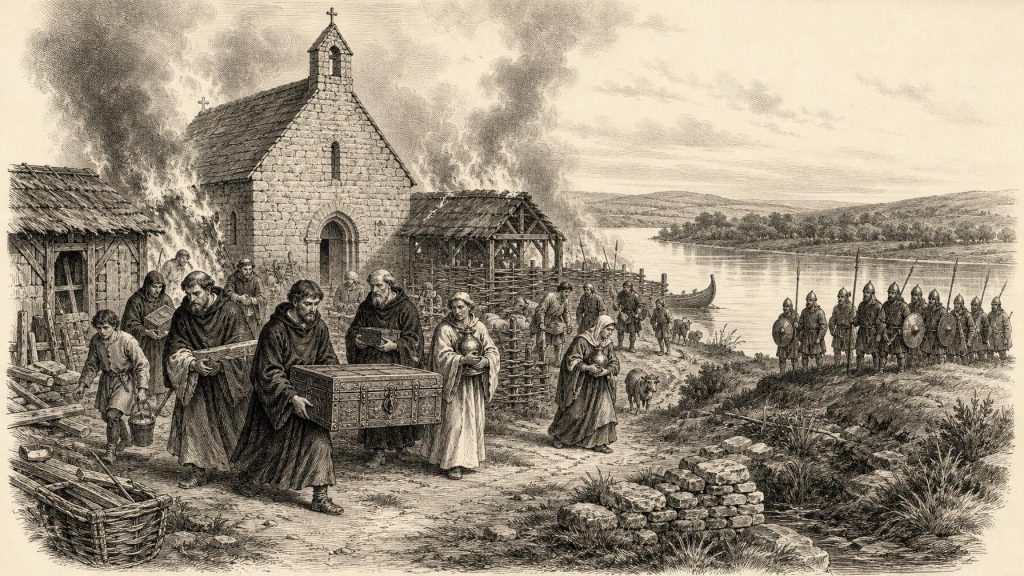
Ecclesiastical settlements were sacred places, centres of learning and major landholders, yet they were not outside politics. At Clonfert, the Uí Maine burned the stone church and killed Cúchonnacht son of Gadhra Ua Dúnadaig. The Annals of Inisfallen add that he was taken from the church and slain on its green. The mention of a stone building is significant: timber remained common, while masonry churches represented substantial investment, skilled labour and the prestige of a major foundation associated with St Brendan.
The Annals of the Four Masters also state that Clonard, including its stone church, burned three times within one week. This detail is preserved in a much later compilation and the cause is not supplied, so it should not automatically be treated as another military attack. Even accidental fire could be catastrophic in a densely occupied ecclesiastical settlement containing timber houses, workshops, stores and livestock enclosures.
Other entries expose the uncertain protection offered by sanctuary. The superior of Leighlin was killed at or before the church. Amalgaid son of Flann, king of Calraige, died after forcing hospitality from Clonmacnoise; the annalists interpreted his sudden illness as punishment by Saints Ciarán and Brendan. Whatever the medical cause, the story preserves the Church’s moral claim that compulsory billeting and the seizure of monastic provisions were violations deserving divine retribution.
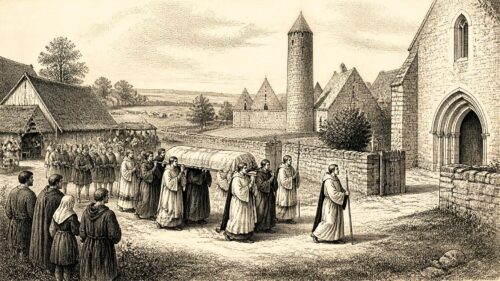
The year also saw the peaceful deaths of several senior churchmen, including Muiredach, superior of Duleek; Cathasach Ua Cathail, successor of St Kevin; Maenach Ua Círdubáin, superior of Louth; Cana, a priest of Aghaboe; and Máel Martain Finn, lector of Kells. Titles such as successor, superior, lector and airchinnech reflect complex institutions combining worship, education, estate management and hereditary patronage. Their leaders could possess influence comparable to that of secular lords.
Harvest, Work and Exchange
The Annals of Inisfallen close their account with a grave statement that retribution came throughout Ireland and the crops were destroyed. This should be treated cautiously: it may express a Munster chronicler’s religious interpretation of regional hardship rather than a measured report of total island-wide crop failure. Even so, it is valuable evidence that the harvest of 1045 was remembered as seriously damaged. The source does not identify drought, excessive rain, frost, disease or warfare as the cause.
For farming households, a poor grain crop threatened supplies of oats, barley and wheat, seed for the following spring and rents owed to kings or churches. Cattle remained the principal movable measure of wealth in much of Gaelic society, supplying milk, meat, hides, traction and tribute. Raids targeted herds because animals could be driven away, redistributed among followers or used to compel submission. Pigs, sheep, fishing and gathered foods offered some resilience, but poorer dependants were especially vulnerable when harvest failure coincided with military requisitioning.
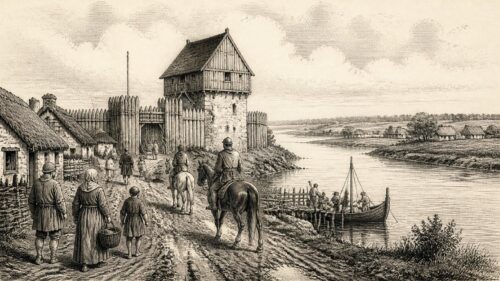
Dublin presented a different, though connected, economic landscape. Its craftsmen worked in wood, bone, antler, leather and metal, while merchants exchanged silver, textiles, hides, foodstuffs and enslaved captives across the Irish Sea. Silver pennies had been minted there since the time of Sitric Silkbeard, although barter, weighed silver and payments in livestock continued elsewhere. Rural estates, monasteries and towns were interdependent: Dublin required agricultural produce, while its port gave Irish rulers access to imported goods and overseas networks.
Memory and Learning
No surviving manuscript can be assigned securely to an Irish scriptorium in the calendar year 1045, but the recording of the year itself testifies to active learned communities. Annalists calculated the weekday and lunar age of the first of January, preserved genealogically precise names and occasionally noted events in Britain and continental Europe. Irish and Latin learning coexisted in major churches, where clerics copied scripture, law, poetry, genealogies and historical material.
The picture left by 1045 is therefore one of movement and insecurity rather than simple collapse. Armies crossed provincial boundaries, ships carried war to Rathlin, tides destroyed an Ua Néill raid, and churches could be both sanctuaries and targets. Yet farms continued to support rulers and monasteries, Dublin remained commercially active, and scholars preserved the names of those who died. Political authority was fiercely contested, but Ireland’s regional networks of kinship, religion, trade and learning remained durable enough to survive a violent and difficult year.
Primary Sources
- The Annals of Ulster: Year U1045
- The Annals of Tigernach: Annal T1045
- Annals of Inisfallen: Annal AI1045
- Annals of the Four Masters: Annal M1045
- Annals of the Four Masters: Irish Text, Annal 1045
- Annals of Loch Cé: Annal LC1045
- Irish Texts at CELT
- Translated Texts at CELT
- Donnchad
- Diarmait (Diarmait mac Maíl (Máel) na Mbó)
- Echmarcach
- Viking
- 950–1450: Vikings, Normans and Medieval Mints
- The Corpus of Early Medieval Architecture of Ireland
- Case Studies: Digital Atlas of Early Irish Carved Stones
- Monasticism and Its Limits: Rematerialising Monastic Space in Early Medieval Ireland
- Clonmacnoise Monastic Site
- Clonmacnoise Visitor Guide
- Irish School of Illumination, c. 650–1100
- High Crosses
- Swords Cultural Quarter Archaeological Assessment
- Saint Brendan's Cathedral, Clonfert, Galway
- Animals and the Economy of Medieval Ireland: A Zooarchaeological Analysis of the Faunal Remains from Caherconnell Cashel, County Clare