Hostages and Holy Places1048 CE
In 1048, Ireland’s fragmented politics linked provincial kings, church families and Hiberno-Norse towns through alliance, hostage-taking, raiding and feud. Donnchad mac Briain marched through Mide and Brega, securing hostages from Diarmait mac Máel na mBó and submission from Dublin, though neither proved permanent. Diarmait raided the Déisi and, with Niall mac Eochada, attacked Mide’s churches. Conchobar Ua Máelshechlainn raided Kildare lands and captured Brega’s ruler. Áed Ua Conchobair destroyed Inis Locha Cime, beginning western expansion. Deaths of rulers, churchmen and poet Cenn Fáelad altered local power. Raids exposed cattle-based rural economies, while Dublin’s trade connected Ireland to wider Irish Sea.
Dateline
In 1048 Ireland had no single government capable of imposing lasting peace across the island. Power rested with provincial kings, lesser rulers, ecclesiastical families and the Hiberno-Norse towns, all bound together by shifting alliances, hostages, marriage and feud. The year’s record is therefore not a national narrative in the modern sense. It is a series of connected struggles, concentrated especially in Leinster, Mide, Munster and Connacht, alongside the deaths of rulers, church leaders and a celebrated poet.
Reading the Year
The annals identify 1048 as a leap year and place 1 January on a Friday. Their entries are brief, and several survive in only one compilation. Events reported independently by multiple annals can be treated with greater confidence, while unique notices require more caution. Differences also occur: the Chronicon Scotorum names Donnchad son of Brian as leader of a major expedition, whereas one translation of the Annals of Tigernach gives Domnall son of Brian. Modern historical accounts generally attribute the action to Donnchad mac Briain, king of Munster.
Donnchad Asserts His Authority
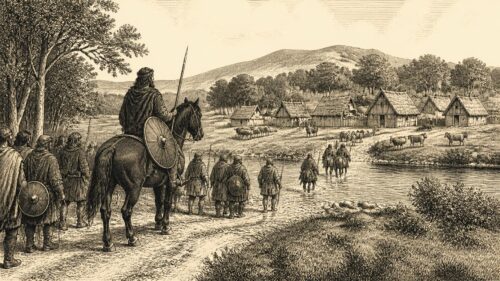
The principal political event was Donnchad mac Briain’s march through Mide and Brega towards Dublin and Leinster. Donnchad, a son of Brian Bórama, had ruled Munster since the confused aftermath of Clontarf. Although he never reproduced his father’s supremacy, he remained one of Ireland’s most formidable kings. His progress in 1048 demonstrated that Munster could still project force far beyond the Shannon.
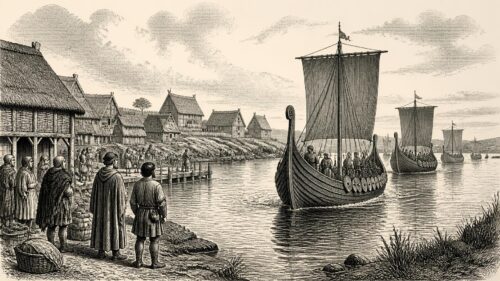
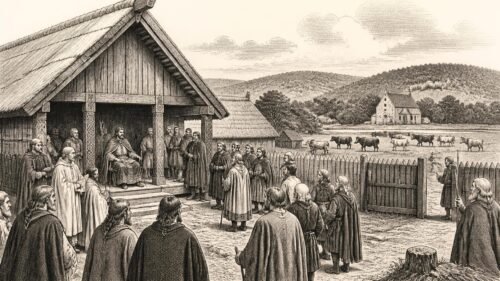
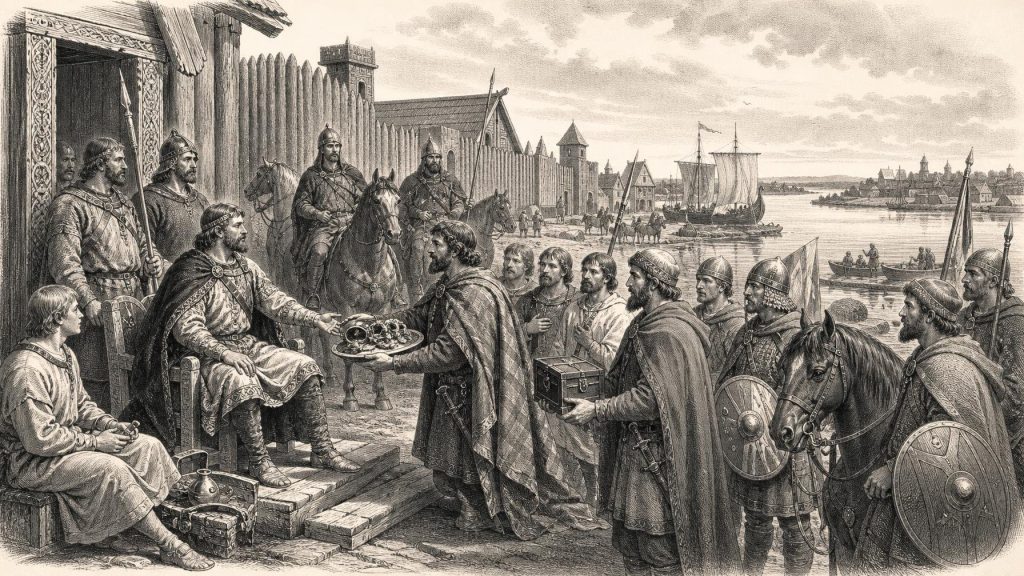
Donnchad obtained hostages from Diarmait mac Máel na mBó and received what the Chronicon Scotorum calls his due from the foreigners, meaning the Hiberno-Norse inhabitants or rulers of Dublin. Hostages were political guarantees rather than prisoners taken at random. Their delivery acknowledged, at least temporarily, the superior position of the king receiving them. Dublin’s compliance also mattered economically: its harbour, merchants, ships and silver connected Ireland with Britain and the wider Irish Sea.
The submission should not be mistaken for a permanent conquest. Diarmait was consolidating control over Uí Chennselaig and wider Leinster, and would become the dominant Irish ruler of the later eleventh century. In 1048, however, he still had to accommodate Donnchad’s greater immediate reach. The episode captures a recurring feature of Irish politics: a king might surrender hostages without surrendering his own kingship, buying time until circumstances favoured resistance.
Raids and Counterstrokes
Diarmait soon struck south-westwards into the Déisi, carrying away cattle and captives. This raid is recorded in both the Annals of Tigernach and the Annals of the Four Masters. Cattle were mobile wealth, providing food, breeding stock, dairy produce and the means to reward followers. Their seizure weakened an opponent while feeding and enriching the raiding army. Captives might be retained as dependants, exchanged, ransomed or sold. Such expeditions were therefore economic weapons as well as displays of military power.
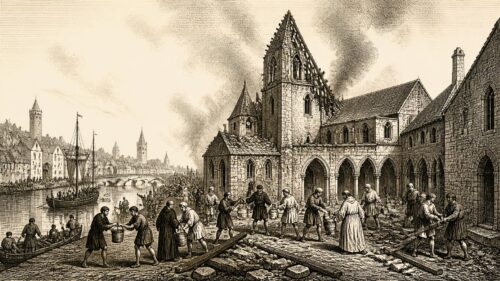
A more destructive notice survives in the Chronicon Scotorum. It says that the son of Eochaid—probably Niall mac Eochada, king of Ulaid—and Diarmait invaded Mide and burned almost all the churches of its people. The statement is not repeated so fully elsewhere and its sweeping language may be rhetorical, but it points to a serious campaign. Churches were repositories of food, valuables, manuscripts and political authority. Burning them attacked both the material resources and the sacred prestige of the communities associated with Mide’s rulers.
War Across the Midlands
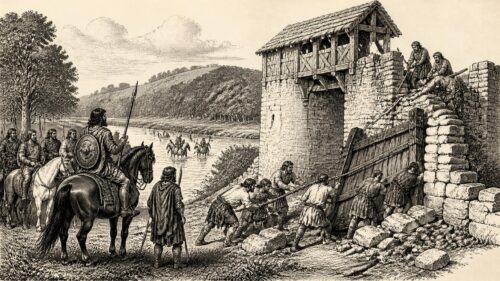
Conchobar Ua Máelshechlainn, king of Mide, was himself active. The Annals of Tigernach report that he raided Mag Life, the Liffey plain, and the church lands of Kildare, taking considerable booty. The Uí Fháeláin of northern Leinster retaliated by raiding Clonard. Thus two renowned ecclesiastical landscapes became entangled in a secular contest. Neither Kildare’s association with Brigit nor Clonard’s with Finnian made its lands immune from attack.
The Four Masters add that Conchobar captured Gairbith Ua Cathasaigh, ruler of Brega. Gairbith secured his release by leaving seven hostages. This smaller episode illustrates how warfare, negotiation and kinship guarantees operated together. Victory did not always end with an execution or annexation. A captured ruler could be more useful alive, bound by pledges that transferred the risk of renewed resistance to his family and supporters.
A Turning Point in Connacht
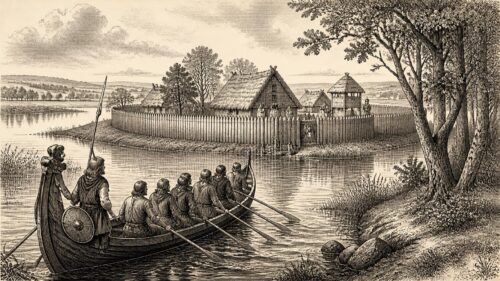
In western Connacht, Áed Ua Conchobair sacked and razed Inis Locha Cime, an island stronghold in Lough Hackett, County Galway. The Annals of Inisfallen alone preserve the event under 1048, but it fits Áed’s campaign against the rulers of Maigh Seóla and Iar Connacht. The attack should be seen as part of a developing struggle rather than an isolated destruction. During the following years Áed overcame Amalgaid Ua Flaithbertaig and established a stronger Ua Conchobair presence in the west. The 1048 assault consequently marks an early stage in a regional transformation that eventually helped make the dynasty the leading royal house of Connacht.
Deaths and Dynastic Strain
The annals record the deaths of several regional rulers. Fergal Ua Maíl Muaid, king of Fir Chell in the midlands, died, as did Gilla Coluim Ua hEicnig, overking of Airgíalla. The Annals of Tigernach say that Gilla Coluim was buried at Downpatrick, an important ecclesiastical centre whose sanctity could enhance a ruler’s memory. Máel Fábaill Ua hEidinn, king of Uí Fhiachrach Aidne in south Galway, also died, leaving another opening in a politically unsettled Connacht.
In eastern Leinster, Dúnlang son of Dúngal, ruler of Uí Briúin Cualann, was killed by his own brothers or kinsmen. One annalist called him the glory of eastern Ireland, making the violence appear especially grievous. His death demonstrates the danger within royal kindreds. Irish kingship was not governed by automatic inheritance from father to eldest son. Several adult male relatives could possess credible claims, and competition among brothers, cousins and nephews regularly became lethal.
Church Leaders and Sacred Offices
The ecclesiastical obituaries reveal a dense network of churches led by bishops, superiors and successors of founding saints. Céile, bishop of Ardachadh, associated with Bishop Mel, died. Clothna Muimnech, successor or coarb of Ailbe at Emly, also died. Emly was one of Munster’s foremost churches, and the title of coarb expressed inherited guardianship of a saint’s community, lands and authority rather than succession to a modern diocesan office.
Dúnchad Ua Céilechair, successor of Ciarán of Saigir at Seir Kieran, died, while Ferdomnach Ua hInnascaig, successor of Finnian, was killed by a son of Tadc Ua Maelruanaid. The Four Masters also report that Áed son of Máelán Ua Nuadhat, airchinnech or erenagh of Swords, was killed there on the Friday before Easter. An erenagh managed church property and obligations, often as a member of a hereditary ecclesiastical family. These notices show that religious office could bring local status and resources, but not protection from feud or political violence.
Poetry, Memory and Worship
Cenn Fáelad Ua Cúill, described variously as chief poet of Munster and chief poet of Ireland, died in 1048. The Annals of Inisfallen add that he received Communion and the Eucharistic sacrifice before death. His obituary joins learning and Christian devotion: the professional poet was not merely an entertainer, but a trained guardian of genealogy, praise, political memory and verbal law. A poem attributed to him survives, although its transmission does not permit every detail of his career to be reconstructed securely.
Another literary connection appears in the killing of the son of Cú Mara, grandson of Mac Liag, Brian Bórama’s celebrated poet. Even where texts have vanished, such family notices suggest that learned reputations could continue across generations. Poetry remained closely tied to royal households, where ancestry and honour had practical political value.
Life Beyond the Annals
The chronicles concentrate on elites, but their raids reveal the foundations of everyday life. Most people lived in dispersed farming settlements, including ringforts, cashels and unenclosed homesteads. Cattle dominated political accounting, while communities also raised sheep and pigs and cultivated cereals. Wooden vessels, iron tools, woven cloth and leather goods were ordinary essentials. A raid that removed herds or burned stored produce could endanger households never named by the annalists.
The coastal towns formed a different but connected environment. Dublin contained streets, timber houses, workshops and waterfront activity. Craftspeople worked wood, iron, bone, antler, amber and precious metals, while traders used silver, weights and coins. Hiberno-Norse culture was by then deeply rooted in Ireland, and distinctions between Scandinavian and Irish material traditions were increasingly blurred. Dublin’s rulers participated in Gaelic diplomacy, while rural Irish sites exchanged goods with the port.
1048 was therefore a year of forceful but unstable claims. Donnchad compelled hostages, Diarmait answered with raids, Mide and Leinster struck at one another’s church lands, and Áed Ua Conchobair advanced in the west. Alongside these campaigns, the deaths of kings, coarbs and a renowned poet altered local balances of authority. The annals offer only fragments, but together they depict an island whose political competition, sacred institutions and material economy were inseparably linked.
Primary Sources
- The Annals of Ulster: Year U1048
- The Annals of Tigernach: Annal T1048
- Annals of Inisfallen: Annal AI1048
- Annals of the Four Masters: Annal M1048
- Chronicon Scotorum: Annal CS1048
- Annals of Loch Cé: Annal LC1048
- Diarmait (Diarmait mac Maíl (Máel) na Mbó)
- Donnchad
- Ua Máelshechlainn, Conchobar
- Echmarcach
- Ua Briain, Tairdelbach
- Donnchad
- Viking
- 950-1450: Vikings, Normans and Medieval Mints
- Early Medieval
- Early Medieval Ireland, AD 400-1100
- The Dublin Region in the Middle Ages: Settlement, Land-use and Economy
- Guide to the National Museum of Ireland
- Tuam: Irish Historic Towns Atlas
- Seir Kieran Monastic Site
- Clonard Heritage Trail
- Clonmacnoise Monastic Site
- Vikings in Mayo and Connacht
- Dessi Genealogies