Tairdelbach’s Shannon Bridges1071 CE
In 1071, Diarmait mac Máel na mBó’s southern Irish dominance weakened after dynastic losses, while his ally and foster-son, Tairdelbach Ua Briain of Munster, increasingly supplied the military force behind their authority. Tairdelbach took Leinster and Mide hostages for Diarmait, raided midland rivals, and mobilised Munster to build Shannon bridges at Áth Caille and Killaloe, improving strategic communications. Violence, depositions and killings affected Ulaid, Donegal and the midlands. Kildare, Glendalough and Clondalkin were burned amid Leinster instability. Despite warfare, farming, craft production, trade and ecclesiastical learning continued, as Tairdelbach’s infrastructure, diplomacy and campaigns foreshadowed his rising power in southern Ireland.
Dateline
Ireland’s political landscape was unusually fluid. Diarmait mac Máel na mBó, the ageing king of Leinster and dominant ruler of the southern half of the island, remained formidable, but the deaths of close relatives had weakened his dynasty. Beside him stood his former protégé and foster-son, Tairdelbach Ua Briain, king of Munster, whose armies now operated far beyond his own province. Their alliance shaped the year: Tairdelbach intervened in Leinster and Mide, collected hostages for Diarmait and mobilised the men of Munster for campaigns and major building work. Yet local wars continued from Donegal to Offaly, while the burning of three important Leinster churches exposed the vulnerability of even the greatest religious settlements.
An Alliance Under Strain
Diarmait had risen from the Uí Cheinnselaig of south-east Leinster to dominate Leinster, Dublin and much of southern Ireland. Control of Dublin gave him access to ships, warriors, craftsmen, commerce and connections across the Irish Sea. His position was nevertheless less secure than its grand titles suggest. Irish overkingship depended upon personal authority, alliances, tribute and the delivery of hostages; it was not a permanent office supported by a central administration. A king who lost relatives, military strength or the obedience of subordinate rulers could see his influence contract rapidly.
The death in 1070 of Diarmait’s son Murchad, previously king of Dublin and an important military commander, left a dangerous uncertainty. The Annals of Inisfallen record fighting in Leinster between a son of Murchad and a son of Diarmait’s brother Domnall Remar. Tadc Ua Riain, king of Uí Dróna in the Carlow region, was killed with many others. This was more than a private family quarrel: rival branches of the ruling kindred were competing over territory and succession while Diarmait was approaching the end of his life.
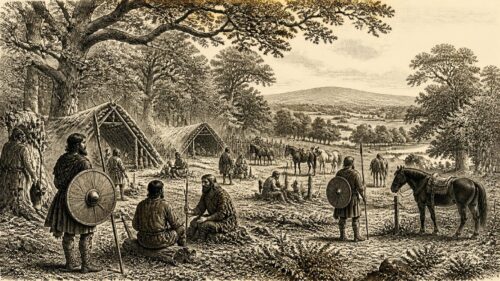
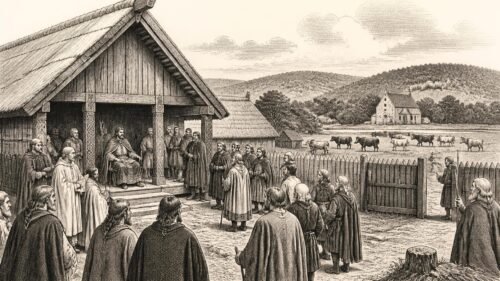
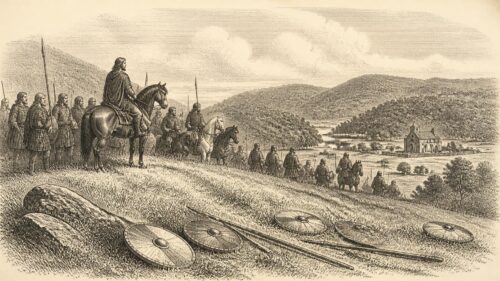
Tairdelbach responded with a hosting into Leinster and Mide. He took hostages from both and delivered them to Diarmait. Hostages were living guarantees of obedience, tribute and political agreements, normally drawn from the families of important rulers. By surrendering them to Diarmait rather than retaining them, Tairdelbach publicly upheld his ally’s superior position. At the same time, the campaign demonstrated that it was increasingly the Munster king who possessed the troops and mobility needed to enforce that position.
Raids and Regional Wars
Tairdelbach also pursued objectives of his own. The Annals of Inisfallen mention a great raid by Ua Briain during which the king of Fir Chell, identified as a son of Gilla Brigte, was killed. Fir Chell lay in the Irish midlands, broadly around the modern Birr district. Another entry records the killing of the son of Rígbardán, king of Éile, a territory extending through parts of today’s Tipperary and Offaly. The later Annals of the Four Masters add that he fell in battle against Donnchad, lord of Uí Maine, but that additional detail comes from a much later compilation and should be treated more cautiously.
These encounters show how provincial expansion was experienced locally. A royal hosting could be presented as the enforcement of overlordship, but for communities in its path it meant requisitioned food, driven cattle, damaged crops and the danger of enslavement or death. Raiding was not random lawlessness. It deprived rivals of livestock, rewarded followers and compelled lesser kings to submit. The death of a district ruler could also reopen disputes over land, tribute and succession long after an army had departed.
The northern annals describe a particularly abrupt upheaval in Ulaid. Cú Ulad Ua Flaithri was deposed by Ua Maelruanaid and the Ulaid, but Ua Maelruanaid was immediately killed in battle by Donn Sléibe Ua Eochada. The episode reveals the instability concealed by the simple title “king of Ulaid”. Kingship depended upon support among several powerful peoples and dynastic factions; deposition, exile and violent replacement were accepted political possibilities. The Four Masters say that the deposed Ua Flaithri fled to Leinster, although the contemporary northern entry does not provide that destination.
In Donegal, Ruaidrí Ua Canannáin, king of Cenél Conaill, was slain. The Four Masters name his killer as Aengus Ua Maeldoraid. That death continued the competition among leading families for control of Tír Conaill. The same compilation records further violence in the midlands: Aeghredan Ua Muiregain, lord of Tethba, was killed by the Conmaicne; Donnchad Got, a claimant to the kingship of Tara, was killed by Conchobar Ua Máel Sechnaill; and a battle in Uí Failge claimed its king, Gilla Pátraic Ua Siblén, and several other leaders. These notices are plausible parts of the year’s wider turbulence, though they are not all preserved in the earlier annalistic witnesses.
The Bridges of Munster
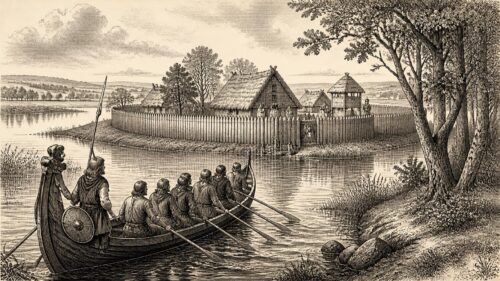
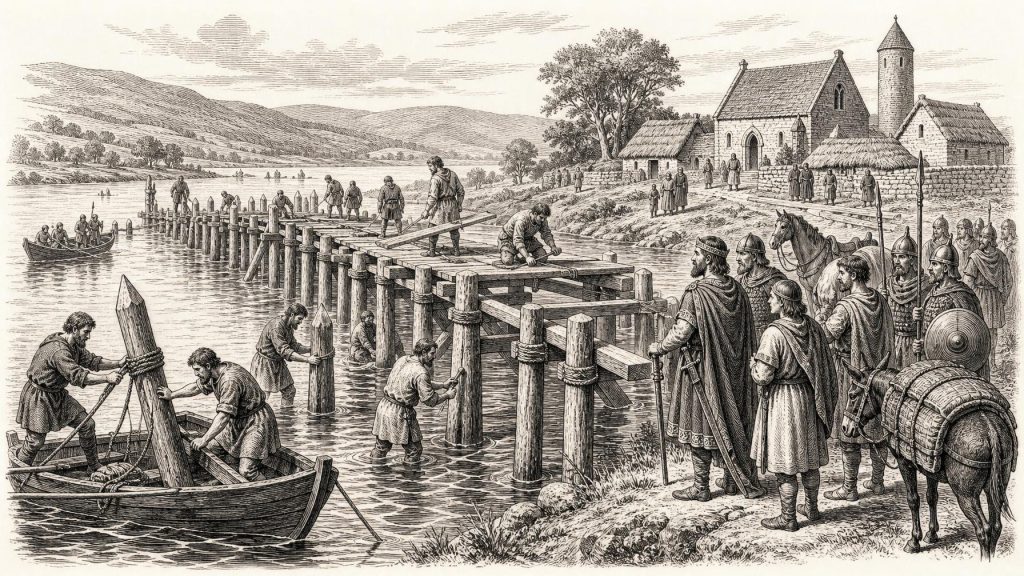
The most constructive achievement recorded for the year was also closely connected with warfare. Tairdelbach summoned the men of Munster, who built bridges at Áth Caille and Cell Dá Lua, or Killaloe, within a fortnight. The exact location of Áth Caille remains debated, but both crossings belonged to the strategically important Shannon region. The Killaloe bridge is the earliest securely recorded bridge at that crossing and was probably a substantial timber structure rather than the stone bridge known in later centuries.
The speed of construction suggests disciplined mobilisation on a provincial scale. Timber had to be felled and shaped, ropes and fittings prepared, transport organised and labour supplied while the workforce was fed. The project improved the movement of armies, messengers, tribute and livestock across the Shannon. It also strengthened Tairdelbach’s grip on the approaches to Killaloe and nearby Kincora, the heartland associated with his grandfather Brian Bóruma. Although the annalist admired the accomplishment, compulsory labour on such a muster would have imposed a heavy burden upon ordinary households.
Diarmait travelled into Munster with Tairdelbach and, in the annalist’s words, left his blessing with the Munstermen. The phrase probably describes a ceremonious and peaceful visit rather than another raid. It allowed the two kings to display solidarity before Munster’s assembled élite. In hindsight, it was among Diarmait’s last major public acts: he was killed at the battle of Odba in Mide on 7 February 1072. That death belongs to the following year, but it explains why the political and logistical preparations of 1071 proved so important. Tairdelbach was already positioned to inherit much of his ally’s influence.
Churches, Fire and Learning
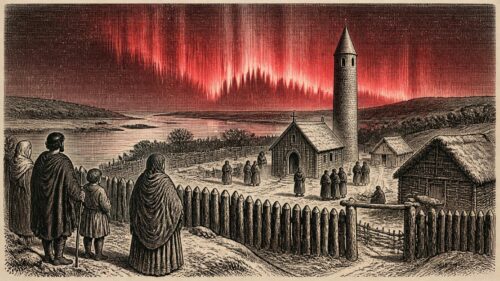
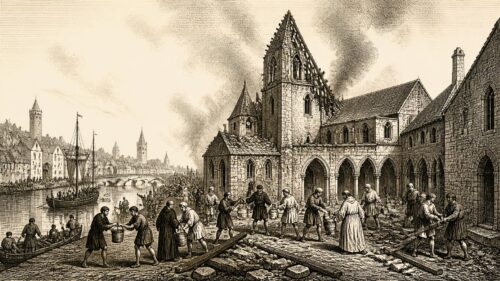
The Annals of Ulster record that Kildare, Glendalough and Clondalkin were burned. They do not identify an attacker or explain whether the fires were connected, so it would be unsafe to assign responsibility. “Burned” could describe hostile destruction, accidental fire or damage caused during local warfare. All three sites stood within the wider Leinster political sphere, however, and their simultaneous appearance in the record suggests an episode considered important by contemporary churchmen.
These were not isolated stone chapels. Major ecclesiastical settlements contained churches, shrines, schools, workshops, guest houses, stores and dwellings occupied by clergy, craftspeople, dependants and pilgrims. Much of that environment was built from timber, wattle and thatch. Fire could therefore destroy food reserves, books, liturgical furnishings and domestic buildings even when stone monuments survived. Glendalough was expanding during the eleventh century, while Kildare possessed exceptional religious prestige and extensive estates. Clondalkin stood near Dublin and important overland routes, making it both commercially connected and strategically exposed.
Learning remained central to ecclesiastical status. Gilla Críst Ua Clothacáin, lector of Armagh, died during the year; the Four Masters praise him as the chief doctor or scholar of the Irish. A lector directed advanced teaching and the interpretation of scripture, grammar and other learned subjects. His obituary demonstrates the continued authority of Armagh as both the principal centre of Patrick’s cult and a school of international standing. The Four Masters also record the death of Dongal Ua Coibdenaig, a distinguished priest of Clonenagh. No surviving manuscript or work of art can be assigned securely to this single year, but scribes, teachers and metalworkers continued traditions visible in Irish books, reliquaries and sculpture of the broader period.
Work, Wealth and Trade
For most inhabitants, life revolved around mixed farming rather than royal politics. Families cultivated cereals, kept cattle, pigs and sheep, produced butter and cheese, spun wool and worked within networks of kinship and obligation. Cattle remained a basic measure of wealth and tribute, explaining why annalists so often described the taking of herds. Seasonal scarcity, military requisitioning and raids could quickly threaten households whose survival depended upon livestock and stored grain.
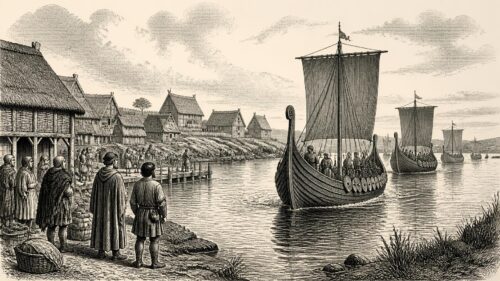
Ireland was nevertheless connected to a wider commercial world. Dublin, Waterford, Wexford, Cork and Limerick supported Hiberno-Norse populations whose Irish and Scandinavian traditions had long been intermingling. Dublin’s excavated houses and workshops reveal blacksmithing, weaving, leatherworking, woodworking and the manufacture of ornaments from bronze, bone, amber and imported materials. Silver pennies had been struck in Dublin since the late tenth century, although coins existed alongside cattle, bullion and valuable objects rather than replacing them. Ships linked the Irish ports with Britain, the Isles, Scandinavia and continental Europe.
The year therefore combined fragmentation with growing organisation. Local kings were slain and displaced, churches burned and rival branches of major dynasties fought for survival. Yet rulers could also raise provincial armies, negotiate through hostages and complete major river crossings with striking speed. Tairdelbach’s actions revealed a king learning to turn military service, infrastructure and diplomacy into lasting power. Diarmait still stood at the centre of southern politics, but the balance was already moving towards Munster.
Primary Sources
- Annals of Inisfallen: Annal AI1071
- Annals of Inisfallen: Irish Text
- The Annals of Ulster: Year U1071
- The Annals of Ulster: Complete English Edition
- The Annals of Tigernach: Annal T1071, English Translation
- The Annals of Tigernach: Annal T1071, Irish Text
- Annals of the Four Masters: Annal M1071
- Chronicon Scotorum
- Diarmait (Diarmait mac Maíl na Mbó)
- Ua Briain, Tairdelbach (1009–86)
- Donnchad Máel na Mbó
- Ireland Before the Normans
- The Vikings in Ireland
- The Viking Age in Ireland
- 950–1450: Vikings, Normans and Medieval Mints
- National Museum of Ireland Viking Resource: Notes for Teachers
- Reflections on Kingship, the Church, and Viking Age Silver in Ireland
- High Crosses
- Irish School of Illumination, c. 650–1100
- Glendalough Monastic Site and Visitor Centre
- Monuments in Glendalough
- Clondalkin Round Tower
- County Tipperary Urban Archaeology Survey 1993–1994
- County Clare Urban Archaeology Survey 1990
- Shannon Bridge Crossing: Route Selection Report Appendices