Bridges and Primacy1140 CE
Ireland in 1140 saw contests for political control and ecclesiastical reform. Toirdhealbhach Ua Conchobhair of Connacht sought dominance through Shannon bridges, campaigns, raids and negotiated settlements, but faced resistance from Meath, Bréifne and local peoples. Murchadh Ua Maeleachlainn strengthened his Meath kingship, while Tighearnán Ua Ruairc briefly lost and regained leadership. Gelasius of Armagh visited Connacht, asserting Patrician primacy with royal support. Malachy Ua Morgair pursued papal recognition and continental monastic links, preparing for Cistercian expansion. Dublin defeated Waterford’s Hiberno-Norse forces. Warfare, cattle-raiding, church offices, learning and urban trade reflected a politically fragmented yet increasingly connected Ireland during that year.
Dateline
Ireland in 1140 was shaped by two closely connected contests: the struggle of powerful kings to command routes, tribute and allegiance, and the effort of church reformers to turn claims of ecclesiastical authority into working institutions. The surviving record is uneven. The Annals of the Four Masters supply a detailed sequence for the year, but they were compiled centuries later from earlier material, while other major chronicles contain gaps or give only limited corroboration. Their entries can responsibly be assigned to 1140, but they rarely provide exact days or a complete national narrative.
The Connacht Offensive
The dominant political figure was Toirdhealbhach Ua Conchobhair, king of Connacht and the leading claimant to the high-kingship. Ireland had no central government capable of issuing commands everywhere. An ambitious overking instead sought submissions, hostages, military service and tribute from lesser rulers. Ua Conchobhair’s authority was substantial, but opposition remained strong in Meath, Bréifne and elsewhere. The campaigns of 1140 marked his return to aggressive eastward expansion after several difficult years.
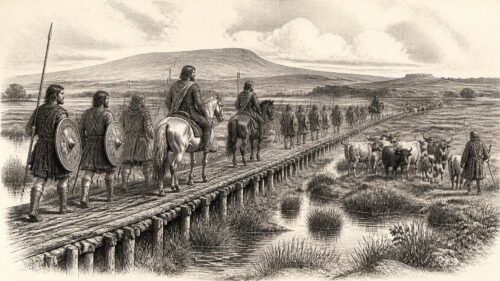
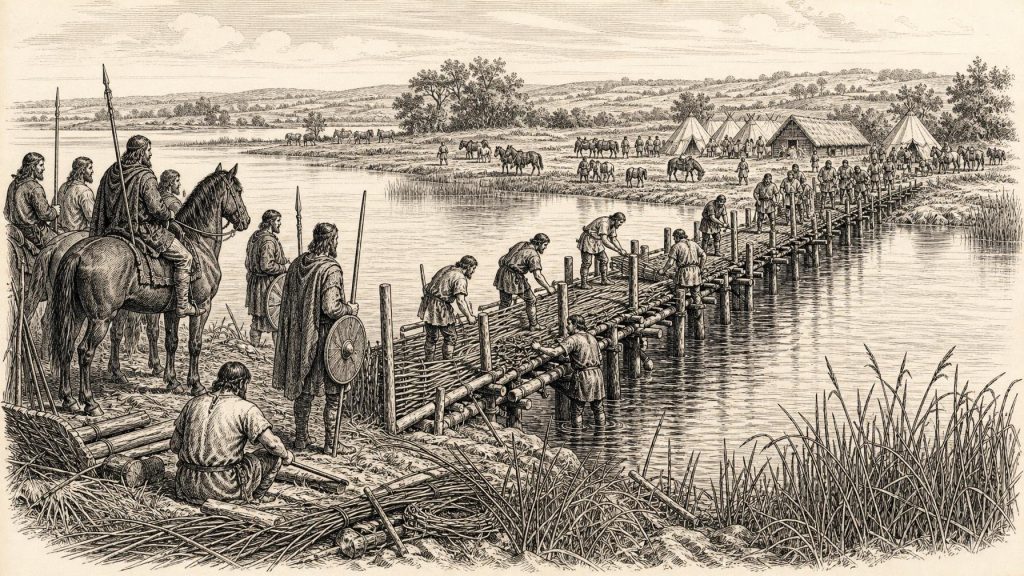
The year’s most revealing events occurred along the Shannon. Ua Conchobhair had a wicker bridge built across Áth Liag, the ‘ford of the stones’, generally identified with the Lanesborough–Ballyleague crossing near the northern end of Lough Ree. He then established a camp in Magh Teathbha, west of Meath, while guarding the neighbouring Conmhaicne. Bridges of timber and woven material were not merely conveniences. They allowed warriors, horses, livestock and supplies to pass a formidable river quickly, making them instruments of royal power.
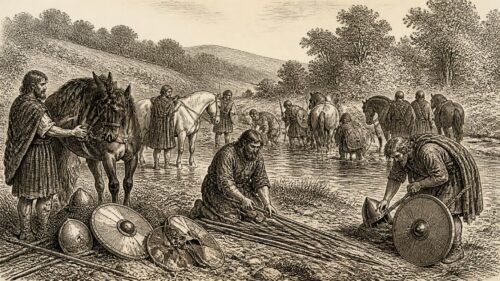
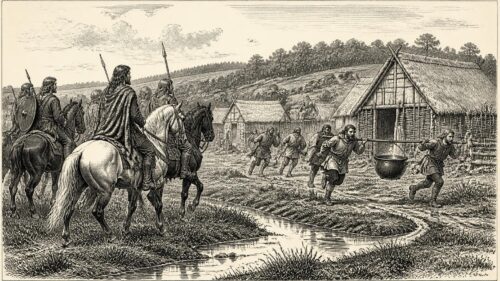
Murchadh Ua Maeleachlainn, king of Meath, responded with the forces of Meath and Teathbha. He was joined by Tighearnán Ua Ruairc and the men of Bréifne. The Connachtmen and Conmhaicne abandoned their camp, which the attacking coalition burned. Raghnall, grandson of Dubhdara and chief of Muintir Eolais, was killed with many others. The entry illustrates the structure of warfare: provincial rulers drew upon subject peoples and allied dynasties, while local chiefs bore much of the immediate danger.
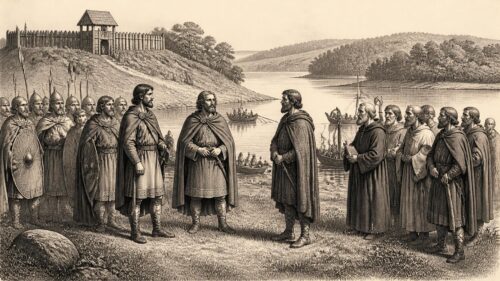
The setback did not halt Ua Conchobhair. At Áth Luain, modern Athlone, he and Murchadh Ua Maeleachlainn met in conference. They swore mutual oaths, agreed an armistice and parted peacefully. Such meetings were a normal part of politics, and sworn settlements could be reinforced by clerical witnesses, relics, hostages or guarantees. Yet peace remained conditional. The annals immediately report that Ua Conchobhair built another wicker bridge across the Shannon at Athlone and devastated western Meath. The juxtaposition may record a rapid collapse of the agreement, or separate stages in a confused campaign. It certainly shows that diplomacy and raiding were not opposites: both were tools used to negotiate power.
Meath and Bréifne
Ua Maeleachlainn was also consolidating authority within Meath. He captured Cú Uladh Ua Caindelbháin, lord of Laoghaire, Flaithbheartach Ua Cathasaigh, lord of the Saithni, and Flaithbheartach’s brother Domhnall. The annalist says they were taken for their own ‘injustice’, a morally charged phrase that may preserve Ua Maeleachlainn’s justification rather than an impartial judgement. Captivity allowed a king to remove rivals, demand guarantees or compel political obedience without necessarily killing them.
Tighearnán Ua Ruairc experienced instability within his own Uí Briúin power base. He was expelled from its chieftainship by the Uí Briúin themselves, but soon recovered the position. His swift return suggests that the challenge failed to assemble lasting support. It also warns against treating dynasties as unified blocs. Kingship depended upon acceptance among leading kindred members, clients and subordinate rulers, and even a formidable king could face replacement by relatives.
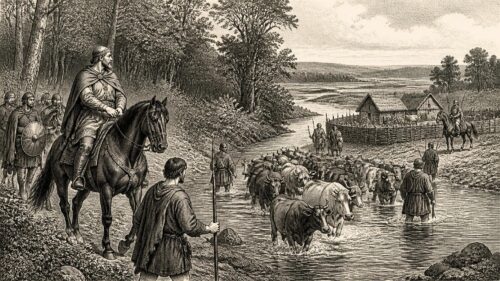
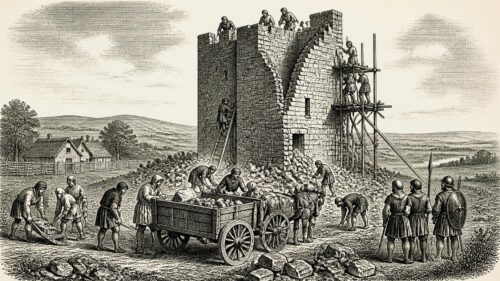
Ua Conchobhair later launched another predatory expedition against Muintir Mael-tSinna. The men of Teathbha counter-attacked fiercely and inflicted heavy losses, including Muireadhach Ua Finnachtaigh, chief of Clann Murchadha, and another prominent Connacht noble. Raiding was intended to seize cattle, damage an opponent’s resources and demonstrate superiority, but it could expose an army burdened with plunder to ambush. The reverses of 1140 therefore qualify any picture of effortless Connacht domination.
Armagh in Connacht
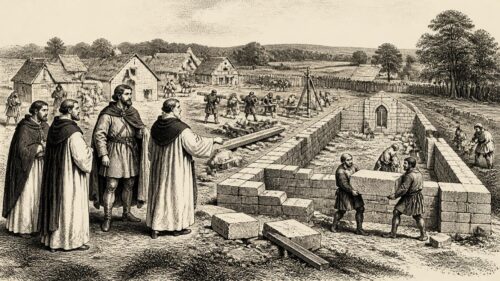
The year also brought a major ecclesiastical visitation. Gilla Meic Liac, known in Latin as Gelasius and recently established as successor of Patrick at Armagh, travelled through Connacht for the first time in that office. The annals state that he received his full tribute and that the churches were placed under his jurisdiction through the cooperation of Ua Conchobhair and the Connacht chieftains. Gelasius and his clergy then bestowed their blessing upon the king and nobles.
This was more than a devotional tour. The successor of Patrick represented Armagh’s claim to primacy throughout Ireland. A visitation made that claim visible through travel, ceremonial reception, settlement of ecclesiastical relationships and collection of customary dues. Ua Conchobhair’s assistance was indispensable: church authority moved through the same landscape of local rulers and territorial interests as royal authority. In return, the primate’s blessing strengthened the king’s presentation of himself as a Christian ruler and protector of reform.
The episode belongs to the long transformation following the Synod of Ráith Bressail in 1111. Reformers sought territorially defined dioceses, stronger bishops and closer conformity with wider Latin Christian practice. Older institutions centred upon famous saints, monasteries, coarbs and church-land administrators did not simply disappear. Gelasius’s visitation demonstrates change through negotiation: Armagh’s traditional Patrician prestige was being adapted to a more explicitly metropolitan form of jurisdiction.
Malachy and Europe
Another reforming churchman connected Ireland directly to Rome and continental monasticism. Malachy Ua Morgair had left Ireland in late 1139 or early 1140 to seek papal recognition, including pallia for the metropolitan sees of Armagh and Cashel. On his journey he visited Clairvaux and formed a close relationship with its abbot, Bernard. In Rome, Pope Innocent II did not immediately grant the pallia, requiring a formal request from an Irish council, but appointed Malachy papal legate.
On the return journey Malachy again visited Clairvaux and also encountered the Arrouaisian form of the Augustinian canonical life. He left Irish companions to receive Cistercian training. These decisions did not produce an Irish Cistercian monastery during 1140 itself: Mellifont was founded in 1142 under the patronage of Donnchad Ua Cerbaill of Airgialla. Nevertheless, the journey of 1139–40 was the decisive preparation for that foundation and for the wider arrival of continental religious observances. Ireland’s reform was not imposed from outside upon an isolated society; Irish bishops, kings and patrons actively selected international models and adapted them to local needs.
Dublin and Waterford
The annals record a battle in which the ‘foreigners’ of Dublin defeated the ‘foreigners’ of Waterford, and a son of Mac Tormair was killed. By this period the label denoted the Hiberno-Norse inhabitants of Ireland’s maritime towns rather than newly arrived Viking raiders. Dublin and Waterford possessed distinct political communities, fleets, trading interests and relationships with neighbouring Irish kings. Their inhabitants had been settled in Ireland for generations and participated fully in Irish warfare and diplomacy.
The cause and location of the battle are not given, so it should not be expanded into a detailed naval campaign. Its importance lies in showing that urban rivalries could operate independently of provincial kings. Diarmait Mac Murchadha, king of Leinster, claimed influence over Dublin, but the Dubliners’ attack may indicate that his control was incomplete. Both ports remained connected to Irish Sea commerce, importing materials and manufactured goods while exchanging products from rural hinterlands. Archaeology reveals houses, streets, craftworking and waterfront activity, although it cannot assign an ordinary workshop or shipment specifically to 1140.
Land, Wealth and Learning
For most people, life centred on dispersed farms, ringforts, church settlements and the households of local lords. Cattle remained fundamental measures of food, wealth, tribute and political loss; this helps explain why annalists treated predatory expeditions as major events. Dairying, livestock husbandry and some arable cultivation supported families and elites. Raids could remove herds, destroy stored produce and compel communities to feed armies, making high politics painfully immediate for cultivators and dependants.
Two prominent churchmen died during the year. Eochaidh Ua Ceallaigh, praised as an exceptionally distinguished bishop and senior figure among the men of Meath, died at Durrow, the Columban foundation in present-day County Offaly. Domhnall Ua Sealbhaigh, airchinneach of Cork, was remembered as a pillar of Munster’s splendour. An airchinneach, later anglicised as erenagh, managed church lands and temporal affairs and might be clerical or closely attached to an ecclesiastical lineage. His obituary reflects the continuing importance of older offices even while diocesan reform gathered pace.
Places such as Durrow, Cork and Armagh remained centres where worship, hospitality, estate management and learning met. Manuscripts and oral instruction were sustained by trained clerics, while professional poets, jurists and historians served churches and aristocratic households. No major surviving text can securely be said to have been composed in Ireland during this single year, but the annals themselves emerged from that literate environment. Their attention to oaths, reputations, offices and kinship reveals a society in which memory was an essential form of power.
A Year of Construction
The bridges of 1140 were repeatedly contested and ultimately temporary, yet they capture the year’s larger direction. Ua Conchobhair was trying to turn Connacht’s military strength into durable access across the Shannon. Gelasius was turning Patrician prestige into recognised jurisdiction, while Malachy was bringing Irish reform into direct conversation with Rome, Clairvaux and Arrouaise. None achieved uncontested authority. Burned camps, broken agreements, defeated raiders and resistant dynasties exposed the limits of every claim. Ireland in 1140 was not politically united, but its rulers and churchmen were building broader networks whose consequences would shape the middle decades of the twelfth century.
Primary Sources
- Annals of the Four Masters, Part 24
- Annals of the Four Masters, Part 24: Irish Text
- Mac Carthaigh's Book
- Chronicon Scotorum, Part 142
- Irish Texts at CELT
- St Bernard of Clairvaux's Life of St Malachy of Armagh
- Ua Conchobair, Tairdelbach (O'Conor, Turlough)
- Gilla meic Liac (Gelasius)
- Malachy (Máel-M'áedóc) Ua Morgair
- Ua Ruairc, Tigernán
- Ua Máelshechlainn, Murchad
- Mac Murchada, Diarmait (MacMurrough, Dermot)
- Ua Cerbaill, Donnchad
- The Transformation of the Irish Church in the Twelfth Century
- St Malachy
- Mellifont Old Cistercian Abbey
- Former Archbishops of Armagh
- Religious Orders
- Saint Malachy, the Gill Abbey of Cork, and the Rule of Arrouaise
- Durrow Church and High Cross
- Irish School of Illumination, c. 650–1100
- Athlone Public Realm Archaeological Assessment
- County Longford Urban Archaeology Survey: Lanesborough
- Medieval Ireland: Territorial, Political and Economic Divisions
- Early Medieval Farmsteads
- Viking Collections
- The Archaeology of Ireland's Viking-Age Towns
- County Waterford City Urban Archaeology Survey
- Merchants and Mariners in Medieval Ireland
- Animals and the Economy of Medieval Ireland