Mac Lochlainn1166 CE
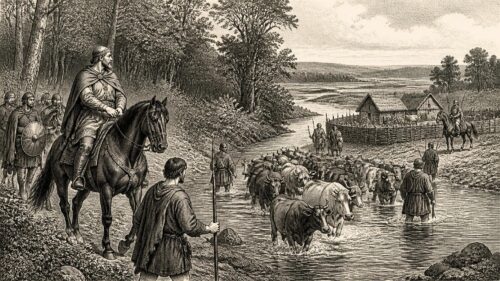
In 1166, Muirchertach Mac Lochlainn’s breach of a guaranteed settlement in Ulaid, including the blinding of King Eochaid, destroyed his authority. Abandoned by allies, he was defeated and killed. Ruaidrí Ua Conchobair of Connacht exploited the collapse, securing submissions, hostages and tribute from Dublin and regional rulers, while distributing wealth and arbitrating disputes. Diarmait Mac Murchada, deprived of Mac Lochlainn’s support and opposed within Leinster, was expelled after coalition campaigns destroyed his Ferns residence. He sought Henry II’s permission to recruit overseas, creating conditions for later Anglo-Norman intervention. Fires, church affairs, rural burdens, towns and royal patronage also marked 1166.
Dateline
Few years in medieval Irish history produced so rapid a reversal of political fortune. At the beginning of 1166, Muirchertach Mac Lochlainn of Cenél nEógain remained the dominant king in Ireland, while his ally Diarmait Mac Murchada held Leinster and exercised influence over Dublin. By the year’s end Mac Lochlainn was dead, Diarmait had been driven overseas, and Ruaidrí Ua Conchobair of Connacht had secured recognition as high king from rulers across much of the island. These changes arose from Irish rivalries, alliances and ideas of lawful kingship. Only afterwards did Diarmait’s search for foreign assistance connect the upheavals of 1166 to the Anglo-Norman intervention that followed.
The Breaking of a Guarantee
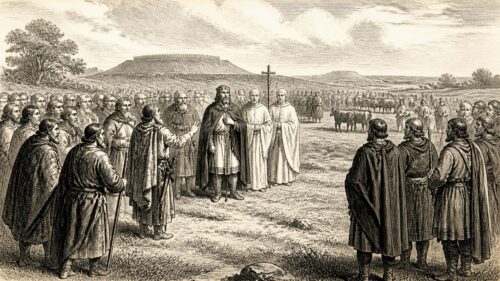
The crisis centred initially upon Ulaid in eastern Ulster. During 1165 Mac Lochlainn had invaded the kingdom, taken hostages and expelled its king, Eochaid Mac Duinn Sléibe Ua hEochada. Eochaid was subsequently restored under a settlement guaranteed by Donnchad Ua Cerbaill, king of Airgialla, and by the successor of Patrick at Armagh. Sacred relics, including the Bachall Ísu or Staff of Jesus, were invoked as sureties. Such guarantees were not merely ceremonial. They bound kings through personal honour, political obligation and the authority of major churches.
In 1166 Mac Lochlainn violated that settlement. He seized and blinded Eochaid, while several leading men of Dál nAraidi were killed. Blinding was a familiar means of making a rival ineligible for kingship, but the annalists treated this case as especially outrageous because Eochaid stood beneath ecclesiastical and secular protection. Mac Lochlainn had injured more than one opponent: he had publicly dishonoured Ua Cerbaill, Armagh and the network of clergy who had guaranteed the agreement.
The sources interpret what followed in explicitly moral terms. Medieval annalists commonly presented political disaster as divine judgement, and Mac Lochlainn’s enemies had every reason to encourage that reading. Nevertheless, their indignation preserves an important reality. A king’s power depended upon supporters believing that his oaths, safeguards and settlements could be trusted. Once Mac Lochlainn broke this guarantee, rulers and kindreds previously subject to him could desert without appearing simply rebellious.
The Fall of Mac Lochlainn
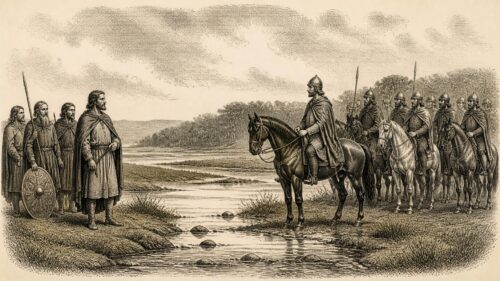
Donnchad Ua Cerbaill assembled forces from Airgialla, Bréifne and Conmaicne and entered Tír Eógain. The Annals of Ulster add that Cenél nEógain itself had abandoned Mac Lochlainn. With only a reduced following, the high king confronted the invaders in the wooded country of Uí Eachach, at a place variously called Fidh Ua nEchtach or Leitir Luin. The accounts disagree over the precise number killed beside him, giving totals between thirteen and sixteen, but agree that his defeat was complete.
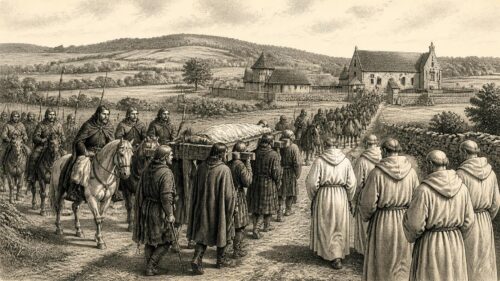
Mac Lochlainn’s death ended roughly a decade of supremacy. The Annals of Ulster, despite condemning his final actions, remembered him as an outstanding warrior of north-western Europe. His body was carried to Armagh for burial, but Columban clergy reportedly fasted in protest at his admission to Christian burial. That extraordinary dispute shows how closely political reputation, ecclesiastical privilege and care for the dead were intertwined.
Ruaidrí’s High Kingship
The chief beneficiary was Ruaidrí Ua Conchobair, king of Connacht. His success rested not upon a single coronation or permanent national administration, but upon hostings, submissions, hostages, payments and alliances. Supported by Tigernán Ua Ruairc of Bréifne and Diarmait Ua Máel Sechlainn of Meath, he moved through territories whose allegiance was essential to any credible claim to the high kingship.
At Dublin, the Hiberno-Norse inhabitants accepted Ruaidrí’s kingship and received a payment recorded as 4,000 cows. The Dubliners then accompanied his forces northwards towards Drogheda, where Donnchad Ua Cerbaill and the rulers of Airgialla submitted and provided hostages. Ruaidrí also obtained pledges from Cenél Conaill at Assaroe. Further circuits took his coalition through Leinster, Osraige and Munster. In the south he confirmed a division of Munster between the Uí Briain and the Mac Carthaig dynasty, presenting himself as an arbiter between competing royal houses.
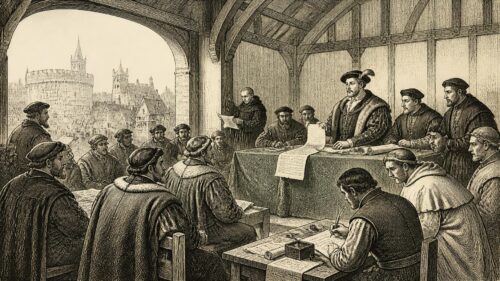
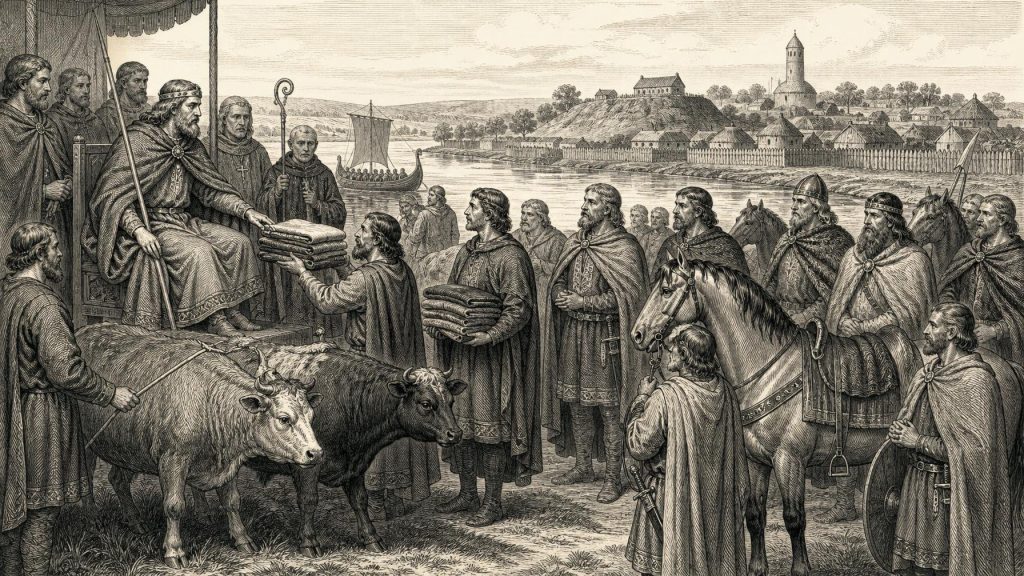
An assembly at Athlone illustrates the material foundations of this authority. The annals list distributions of cows, horses and coloured garments to regional rulers, while the enormous stipend promised to Dublin was levied more widely upon the Irish. Such gifts were not casual generosity. They rewarded service, recognised rank and converted movable wealth into political loyalty. Hostages provided security, but hospitality, livestock, clothing and precious objects made supremacy visible and useful to those who accepted it.
The Expulsion of Diarmait
Ruaidrí’s rise exposed Diarmait Mac Murchada, whose position in Leinster had depended heavily upon Mac Lochlainn. Opposition had already developed among the Leinstermen and Dubliners. The Annals of Tigernach blame Diarmait’s own wrongdoing and record his killing of hostages from Osraige and Uí Fáeláin, including a son of Mac Fáeláin. Ruaidrí’s first advance into Leinster defeated Diarmait’s resistance, forced the clearing of the wooded pass at Fidh Dorcha and extracted hostages from Uí Chennselaig.
Diarmait reportedly burned part of Ferns, his royal and ecclesiastical centre, rather than allow it to fall intact to the Connacht army. A later coalition led by Ua Ruairc, and including Meathmen, Dubliners and Leinstermen, returned to complete his overthrow. His stone residence at Ferns was demolished, and Murchad, a rival member of the wider Mac Murchada dynasty, was installed or granted a share of Uí Chennselaig. The differing annalistic versions suggest that Leinster was reorganised through compromise among several victorious interests rather than transferred neatly to one successor.
Some medieval accounts described the campaign as Ua Ruairc’s revenge for Diarmait’s removal of his wife Derbforgaill in 1152. That earlier affair remained politically potent, involving honour, marriage and lordship, but it is insufficient as a complete explanation. Fourteen years had passed. Diarmait fell because his chief protector was dead, his conduct had alienated regional rulers, and a powerful coalition now supported Ruaidrí.
An Appeal Overseas
Driven from Ireland, Diarmait travelled first to Bristol and then sought Henry II, who was in his continental dominions. The meeting is generally placed in the winter of 1166–67 rather than assigned confidently to a precise day. Diarmait offered allegiance and obtained royal permission to recruit among Henry’s subjects. His negotiations with Richard de Clare, Robert FitzStephen, Maurice FitzGerald and other marcher adventurers developed thereafter. Thus 1166 did not witness an English invasion, but it created the political circumstances in which Diarmait began arranging one.
Churches, Learning and Fire
The year’s political violence unfolded within a vigorous but vulnerable Christian landscape. The annals record destructive fires at Armagh, Derry, Kells, Louth, Iniskeen, Swords and Ardboe. At Armagh the flames crossed streets and the ecclesiastical enclosure, consuming churches and houses while sparing the monastery of Saints Peter and Paul and a limited number of other buildings. Derry’s loss included the Duibregles, described in one source as its penitential church. The entries do not prove that every fire had a military cause, but they reveal the density of timber buildings and the constant danger faced by settlements where worship, residence, craftwork and learning stood close together.
Ecclesiastical offices also continued to change hands. Mac Raith Ua Moráin resigned the bishopric of Conmaicne and Gilla Críst Ua hEochada succeeded him. Obituaries preserve the deaths of senior churchmen connected with Clonfert, Clonmacnoise and Rahin. These notices belong to an Irish Church already reshaped by diocesan reform and continental religious orders, yet still deeply rooted in older communities, hereditary offices and the cults of local saints.
Ruaidrí’s patronage of the shrine of Manchán of Maethail was one of the year’s most celebrated artistic acts. The annals state that the shrine was covered and embellished with gold at his expense. The exact identification of this object with the surviving shrine associated with Lemanaghan remains disputed, so the two should not be equated without qualification. What is secure is the political meaning of the commission: fine metalwork, relics and royal patronage joined devotion with a public declaration of wealth and legitimacy.
Life Beneath the Hostings
Beyond the named kings, most people experienced 1166 through farming, seasonal labour, rents, hospitality demands and the movement of armies. Ireland remained overwhelmingly rural, with households occupying dispersed farmsteads, ringforts, crannógs and ecclesiastical settlements. Mixed agriculture combined grain cultivation with cattle, sheep and pigs, while dairying was particularly important. A hosting could consume stored food, damage crops, take livestock and oblige communities to provide lodging or provisions.
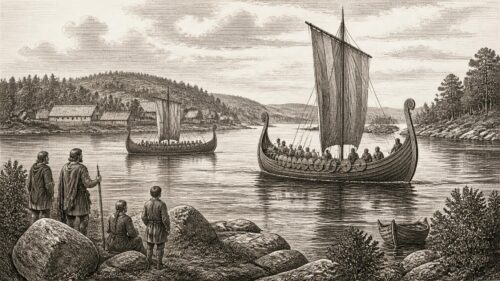
Dublin, Waterford, Wexford, Cork and Limerick formed a contrasting network of Hiberno-Norse towns. Archaeology reveals merchants, sailors, smiths, carpenters, leatherworkers, textile producers and craftspeople working bone, antler and precious metals. Dublin’s role in Ruaidrí’s accession reflected both its military value and its commercial connections with Britain and continental Europe. The vast cattle stipend recorded in 1166 joined a pastoral political economy to an urban community accustomed to trade, imported goods and maritime travel.
By the close of the year, Ruaidrí Ua Conchobair possessed the broadest recognition available to an Irish high king, but his authority still depended upon continued movement, negotiation and reward. Mac Lochlainn’s sudden ruin had demonstrated the fragility of supremacy founded on personal alliances. Diarmait’s exile, meanwhile, ensured that the contest for Leinster would not remain solely within Ireland. The consequences of his overseas appeal lay ahead, but the decisive Irish transformation had already taken place.

Primary Sources
- The Annals of Ulster: Year U1166
- Annals of the Four Masters: Annal M1166
- The Annals of Tigernach
- Song of Dermot and the Earl: English Translation
- CELT Project: Song of Dermot and the Earl
- Mac Lochlainn, Muirchertach
- Mac Murchada, Diarmait (MacMurrough, Dermot)
- Ua Conchobair, Ruaidrí
- Ua Ruairc, Tigernán
- Ua Cerbaill, Donnchad
- Ireland and its Invaders, 1166–1186
- Derbforgaill: Twelfth-Century Abductee, Patron and Wife
- Diarmait Mac Murchada and the Coming of the Anglo-Normans
- Ferns Church, Cathedral, Crosses and Abbey
- Viking Collections
- Guide to the National Museum of Ireland – Archaeology
- Irish School of Illumination, c. 650–1100
- High Crosses
- St Malachy and Twelfth-Century Church Reform
- The Dublin Region in the Middle Ages: Settlement, Land-use and Economy
- Medieval Ireland: Territorial, Political and Economic Divisions
- Irish Historic Towns Atlas: Tuam
- St Manchan’s Shrine
- Clonmacnoise Monastic Site
- Animals and the Economy of Medieval Ireland