Fractured Power1196 CE
In 1196, Ireland comprised competing regional lordships, churches and Anglo-Norman centres rather than a unified polity. Armagh’s canonry and precinct were burned, while conflict nearby saw Ruaidrí Mac Duinn Shléibhe’s mixed force defeated and Muirchertach Mac Lochlainn killed despite sacred guarantees. Sanctuary violations, retaliatory killings and dynastic successions demonstrated insecure local power. In Munster, Domnall Mac Carthaigh defeated English forces, challenged Limerick, attacked castles and negotiated over Cork, amid conflicts involving Irish and settler allies. Raids reached Louth and the midlands. Religious institutions remained politically influential, providing oaths, burial and retirement. Annalistic evidence depicts uneven disruption, not an island-wide crisis.
Dateline
In 1196, Ireland was not a single political unit but a crowded field of regional lordships, ecclesiastical jurisdictions and recently established Anglo-Norman power centres. The year’s surviving notices are unusually concentrated on violence: a religious complex burned at Armagh, a northern ruler killed after sworn guarantees, an invading army crushed near Armagh, and warfare across Munster. Yet the record also reveals negotiation, changing lordship, monastic life and the practical importance of towns, cattle, castles and sacred sites. The evidence is principally annalistic. It records what chroniclers and their patrons judged memorable, rather than offering a complete account of ordinary life; silence on harvests, prices, trade voyages or artistic production should not be mistaken for proof that these things stood still.
Armagh Under Pressure
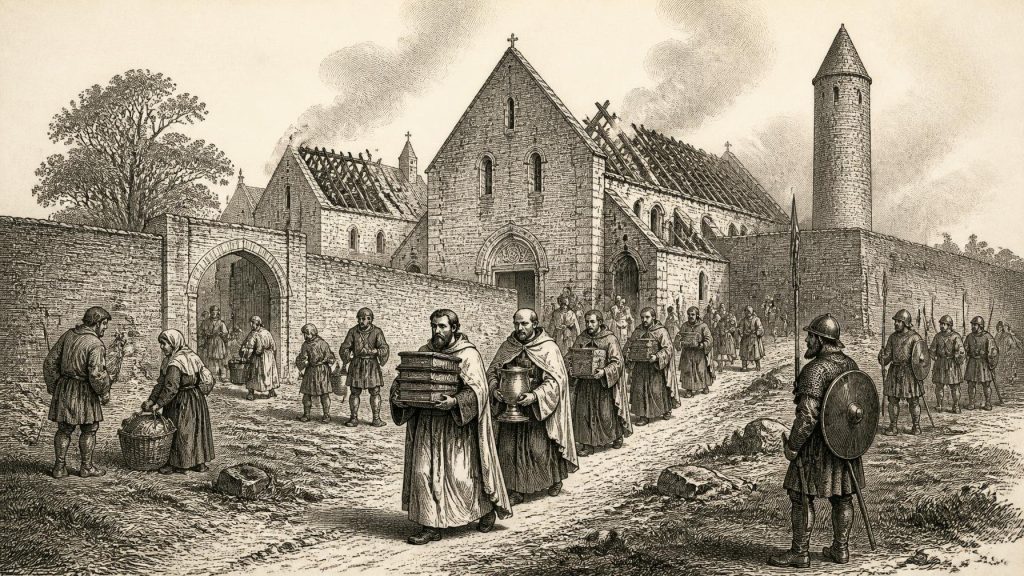
The most immediately striking event was the burning of the house of the Canons Regular of Saints Peter and Paul at Armagh, together with its churches and a substantial part of the surrounding enclosed precinct, or rath. The Annals of Ulster date this firmly to 1196, but do not name those responsible or explain how the fire began. It would therefore be unsafe to attach it to a particular raid or faction. Nonetheless, the destruction was grave. Armagh was both a major religious settlement associated with St Patrick and an important political place in the north. Its churches, clerical community, books, movable treasures, food stores and dependent households would all have been exposed to loss or disruption.
Its significance becomes clearer from the same year’s political language. The northern dynast Muirchertach son of Muirchertach Mac Lochlainn had received pledges of loyalty made upon the Three Shrines and the Canon of Patrick, identified in a later annalistic tradition with the Book of Armagh. Such pledges were not decorative ceremony. Relics, books and the authority of a saint’s church could underpin agreements between secular rulers. Armagh’s religious prestige was thus woven into the practice of government. The burning of part of its precinct and the invocation of its sacred objects belong to the same wider reality: church institutions were centres of devotion and learning, but also repositories of status, legal sanction and political trust.
Defeat and Betrayal in the North
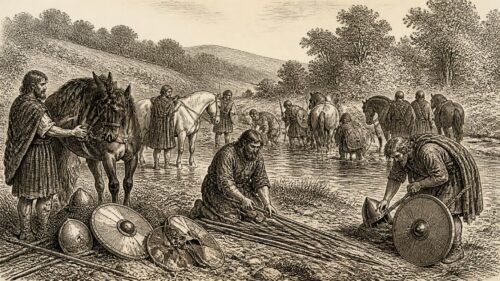
Conflict soon converged on the plain of Armagh. Ruaidrí Mac Duinn Shléibhe, ruler of Ulaid, led an expedition with English allies and the sons of Connacht chieftains against Cenél nEógain and the Airthir or Orior. The opposing force—men of Tullaghoge in Cenél nEógain and the people of Orior—met it on the plain and inflicted a decisive defeat. The Annals of Ulster stress the scale of aristocratic loss among the attackers: twelve sons of Connacht kings or leading rulers died. The Annals of the Four Masters additionally name Brian Buidhe Ó Flaithbheartaigh and heirs from Connacht, Offaly and the Déise among those killed. Exact numbers and every identification should be treated with caution, but the agreement that the expedition ended in a serious reverse is clear.
This was not a simple contest between “Irish” and “English”. Ruaidrí’s army combined an Ulster Gaelic ruler, English forces and Connacht aristocrats; its opponents joined separate northern Irish groupings. Alliances were expedient and regional. The presence of Connacht princes in the field also indicates that the contest for northern influence reached far beyond the immediate borderlands of Ulaid and Cenél nEógain. Military service, fosterage, kinship claims, compensation and the prospect of cattle and land could pull lords from distant regions into local wars.
Within that tense northern setting came the killing of Muirchertach Mac Lochlainn, king of Cenél nEógain and, in the chroniclers’ exalted phrasing, a royal heir of Ireland. He was killed by Donnchadh son of Bloscad Ó Catháin, with the assent or counsel of Cenél nEógain itself. The annals present this as treachery, because Muirchertach had previously been guaranteed security through the most solemn ecclesiastical pledges at Armagh. Their moral judgement is unmistakable, but the precise motives remain unstated. The killing exposed the fragility of a ruler’s position even after public oaths and altered the balance of power within Cenél nEógain. His body was carried to Derry and buried there with honour, an act which connected dynastic commemoration to another great Columban church.
Sanctuary was endangered elsewhere. A son of Bloscad Ó Cuirín plundered Termon Daveog, the protected territory of St Dabeoc at Termon in what is now County Fermanagh. The Annals of Ulster say that he and many of his followers were killed before the month was out, interpreting the outcome as the saint’s retribution. Whether or not one accepts the miraculous explanation, the entry shows how attacks upon church land were understood: they were material seizures and violations of a sacred protection, with consequences in both earthly politics and religious memory.
War Across Munster
Munster was equally unsettled. The Annals of Ulster state that Domnall son of Diarmaid Mac Carthaigh won a battle over the English of Munster and Limerick, with heavy casualties, and that they were subsequently expelled from Limerick. It adds that he inflicted two further defeats in the same year. This does not mean that Anglo-Norman influence vanished from the Shannon estuary or from Munster. Rather, it records a sharp and probably temporary reversal in a contested urban and regional landscape. Limerick was a fortified river-port of exceptional strategic value, while English-held castles and settlements depended on garrisons, supplies and local alliances.
Mac Carthaigh’s Book, a later annalistic compilation preserving a strong southern perspective, gives a more detailed but correspondingly partisan picture. It reports that Domnall took spoil from the castle of Ceall Fiacla, killed eight Galls—the term commonly used for the Anglo-Norman or English settlers—and captured two nobles. It also credits him with demolishing castles in Uí Mac Caille. Castles mattered because they allowed relatively small mounted and armed garrisons to control routes, collect renders and shelter raiding parties. Their destruction was therefore an attack upon the infrastructure of lordship as much as a battlefield success.
The same source shows that violence did not run in one direction. Men described as the Galls of Munster and Cork raided through Férdruim, killing local figures and others, before suffering losses on their return to Cork. It also preserves a conflict within the Irish political world: Donnchadh Ó Donnagáin was killed by Donnchadh Cairbreach Ó Briain, with the assent of Fínghin Mac Carthaigh; subsequently Conchobar Ruad Ó Briain captured Donnchadh Cairbreach. These notices are brief, but they underline how the rivalries of the Uí Briain and Mac Carthaigh kindreds intersected with fighting against settler communities.
Cork was at the centre of a particularly revealing episode. Cathal Crobhderg Ó Conchobair of Connacht and Munster nobles came, according to Mac Carthaigh’s Book, intending to destroy the town. Domnall Mac Carthaigh prevented this after handing Cork over to the Galls on his own conditions. The exact terms are unrecorded, and the account cannot establish a modern idea of municipal transfer. It does, however, demonstrate that a town could be an object of bargaining rather than merely a prize for burning. Cork’s harbour, mercantile connections, population and defensible position made preservation, control and negotiated access potentially more valuable than destruction.
Raids, Castles and Local Lordship
The year’s warfare reached the east and midlands too. Mac Carthaigh’s Book records that Niall Mac Mathghamhna and John de Courcy plundered and burned Louth, including its castle. De Courcy was the powerful Anglo-Norman lord whose base in eastern Ulster had been built through conquest, fortification and accommodation with local interests. The report should not be expanded into a securely dated campaign itinerary, but it is important evidence that his power operated through alliances with Irish rulers as well as through his own followers. In 1196, the political map was not divided into sealed Gaelic and colonial blocks.
Several less celebrated deaths illuminate the hazards of local rule. Hugh Ó Fearghail, lord of Muintir Annaly, was treacherously killed by the sons of Sitric Ó Cuinn. Chiefs of Muintir Eolais were also killed in an attack attributed to a son of Cathal Ó Ruairc, and Muiredach Mac Ragnaill, called Gilla Ruad, was killed amid the ensuing cycle of reprisals. In Connacht, Máel Sechnaill, son of Conchobar Maenmaige and a royal heir, was killed after taking spoil from the English; Domnall Ó Mór of the Laois was then killed by Cathal Carrach Ó Conchobair in revenge. Such entries make clear that lordship rested on vulnerable households, clients and kin networks. A killing could create obligations of vengeance, shift succession and redraw local allegiance.
Church, Retirement and Continuity
Not every change came through death or war. Conchobar Mac Diarmata, lord of Magh Luirg in north-west Connacht, entered religious orders at Boyle monastery, and Tomaltach succeeded to the lordship. The annals give no private explanation for this decision. It may have reflected piety, illness, political calculation or a combination of all three; historians should not choose between these possibilities without evidence. What is certain is that religious retirement provided a recognised route by which a secular lord could leave power, while dynastic succession continued outside the cloister.
Boyle, Armagh, Derry and Termon Daveog point to the density of religious institutions in Irish life. Monasteries and churches housed communities of clergy and dependants, guarded relics and books, held land, and received the patronage or protection of rulers. Their vulnerability in 1196 should not obscure their durability. The very fact that sanctuary violations, burnings, oaths and burials were recorded so carefully reflects a society in which sacred places retained formidable authority.
An Uneven Year
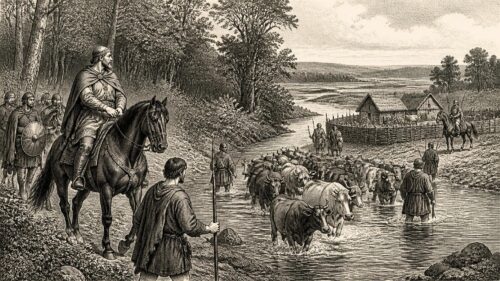
For most people, the consequences of 1196 were likely felt locally: a raiding force moving through a district, livestock driven away, the burden of feeding a lord’s men, the fear produced by a nearby castle, or the loss of a kinsman in factional violence. Cattle appear repeatedly because they were both wealth and the mobile resource by which armies were supplied and rivals punished. The sources offer no securely dated evidence for island-wide famine, plague, commercial crisis or a major literary work in this calendar year. The responsible picture is therefore an uneven one. Some districts experienced acute destruction; others continued their farming, worship, exchange and local routines beneath rapidly changing political allegiances.
What makes 1196 memorable is not a single conquest or national turning point. It is the visibility of several connected pressures: northern kingship fractured despite sacred guarantees, Armagh suffered fire and battle nearby, Munster’s towns and castles were fought over, and partnerships crossed cultural and political labels. Ireland remained a land of strong regional societies, but those societies were being reshaped by the growing reach of fortified Anglo-Norman lordships and by the resourcefulness, rivalries and resilience of Irish dynasties.
Primary Sources
- Annals of the Four Masters, Part 3
- Mac Carthaigh's Book, Part 7
- The Annals of Ulster
- The Annals of Loch Cé
- Annals of Inisfallen
- The Annals of Tigernach
- Annals of the Four Masters
- Mac Carthaigh's Book
- Courcy, John de
- Mac Carthaig (MacCarthy), Domnall Mór
- Ua Conchobair, Cathal Mór Crobderg
- Mac Lochlainn, Muirchertach
- Annals of Ulster Otherwise Annala Senait, Annals of Senat
- Annals of Ulster, Irish Text
- Annals of Inisfallen, Irish Text
- Annals of Tigernach, Irish Text
- List of Published Texts at CELT
- Calendar of Documents Relating to Ireland Preserved in Her Majesty's Public Record Office, London, 1171–1307
- Ireland in the Middle Ages
- From Kingdom to Colony: Framing the English Conquest of Ireland