Castlepook’s Cut-Marked Femur31987 BCE
Around 31,987 BCE, Ireland lay in the later Marine Isotope Stage 3, before the Last Glacial Maximum, amid cold, dry and unstable conditions. Open vegetation, periglacial terrain and expanding ice shaped habitats and preservation. Castlepook Cave, County Cork, preserves Pleistocene fauna, including mammoth, reindeer, giant deer, predators and cold-adapted animals, though deposits may mix different periods. Human occupation remains unproven: a reportedly cut-marked reindeer femur, dated about 33,000 years ago, may indicate brief butchery, not settlement. Later glaciation destroyed or buried evidence. Ireland’s deep history is therefore reconstructed cautiously through caves, bones, dating and glacial geology, without communities or events.
Dateline
“31,987 BCE” is a modern numerical label, not a date that anyone in prehistoric Ireland could have recognised, and it cannot identify a particular season, generation or event. Converted arithmetically, it lies about 33,936 years before AD 1950, the conventional reference point for “before present” (BP). At this depth in time, responsible chronology is expressed in broad calibrated ranges, not calendar-year precision. The appropriate setting is the later part of Marine Isotope Stage 3, within the Upper Palaeolithic and the last glacial cycle. The evidence does not permit an Irish annal for this year; it permits a carefully qualified reconstruction of a changing Ice Age landscape.
A Landscape Before Full Glaciation
Ireland was not yet the familiar green, wooded island. Ice sheets had repeatedly remodelled its terrain during the Quaternary, but the timing and extent of the final great advance varied by region and remains an active field of research. Cosmogenic exposure evidence from northern and central uplands indicates that some ground was ice-free until at least about 34,000 years ago. Larger reconstructions of the British–Irish Ice Sheet show substantial growth after about 31,000 BP, with maximum volume and extent coming later, during the Last Glacial Maximum. Thus, around the notional date of 31,987 BCE, parts of Ireland may have stood in a cold, exposed zone before the island was overwhelmed or encircled by expanding ice. It would be wrong, however, to turn that broad finding into a precise map for one year.
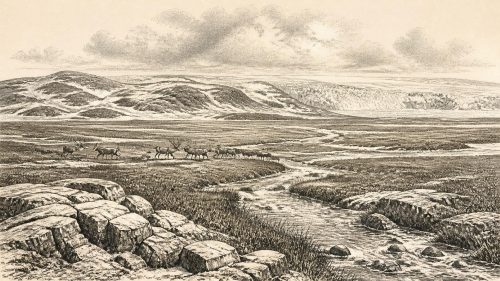
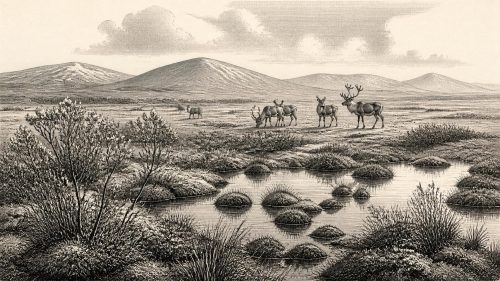
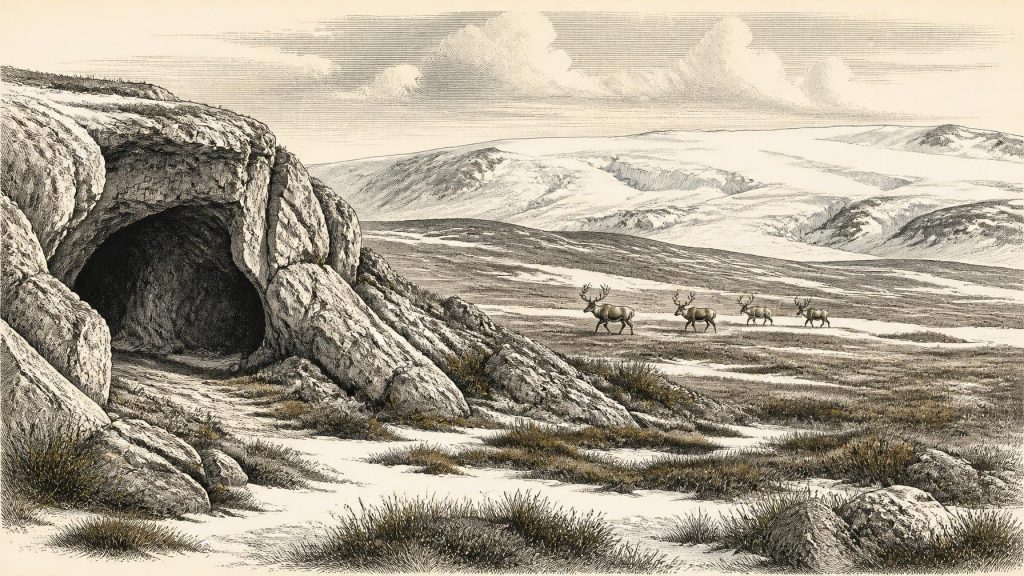
The climate was colder, drier and more variable than today. Vegetation would have been largely open rather than forested: a mosaic of grasses, sedges, herbs, dwarf shrubs and patches of more sheltered vegetation, shaped by wind, frost and short growing seasons. Bare rock, thin soils, braided streams and periglacial ground would have been familiar features in many districts. Limestone caves in the south and west offered protected cavities in which bones, sediments and later visitors could accumulate. They are consequently among the most important, but also most difficult, archives for this period. Their contents are rarely a neat snapshot: water, animals, frost, excavation and later disturbance may mix materials of very different ages.
What the Animal Bones Show
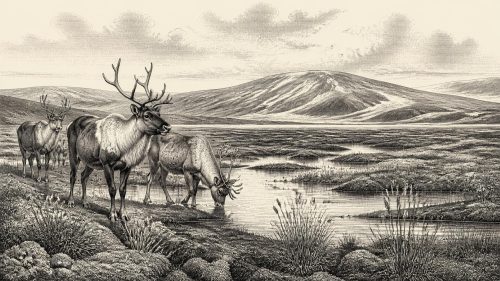
The strongest direct evidence for Ice Age Ireland at roughly this scale of time is palaeontological rather than archaeological. Castlepook Cave, near Doneraile in north County Cork, is exceptionally significant because it has yielded one of Ireland’s richest Pleistocene vertebrate assemblages. Its recorded fauna includes woolly mammoth, reindeer, giant deer, brown bear, wolf, Arctic fox, mountain hare, lemmings and spotted hyaena. These animals do not prove that every species shared the landscape at exactly the same moment; old excavations recovered remains from complex cave deposits, and later redating has shown that some earlier radiocarbon results were too young. But together they demonstrate that Ireland supported, at different points in the last glacial cycle, a cold-adapted and often large-bodied fauna far removed from the island’s modern animal communities.
This evidence gives the period its real drama. Reindeer imply open country suitable for mobile grazers; mammoth and giant deer evoke extensive grazing landscapes rather than closed woodland; predators and scavengers such as wolf, bear and hyaena indicate a food web capable of sustaining large carnivores. Yet the attractive phrase “mammoth steppe” should be used cautiously in an Irish context. The fossil record is patchy, individual deposits can be mixed, and the island lay at Europe’s north-western edge, where changing sea levels, ice margins and climate could sharply restrict or redirect movement. Absence of a species from the surviving Irish record is not necessarily proof that it never arrived, while presence in a cave does not show a permanent local population.
The Human Question
No securely dated settlement, hearth, dwelling, tool assemblage or human burial lets us describe a community living in Ireland in 31,987 BCE. The National Museum of Ireland consequently continues to characterise Palaeolithic human presence as unproven in the conventional archaeological record. Its famous Mell flint flake, found near Drogheda, is an artefact made elsewhere and transported in glacial deposits; it cannot testify to a Palaeolithic camp in Ireland. The first abundant and securely interpretable evidence for lasting settlement belongs much later, to Mesolithic hunter-gatherers after the final retreat of the ice, conventionally from around 8000–7000 BCE.
There is nevertheless an important, unresolved possibility. A reindeer femur from Castlepook Cave has been publicly reported as bearing chop marks consistent with stone-tool butchery and as dating to roughly 33,000 years ago. If that interpretation and chronology are sustained through full specialist publication and contextual study, it would indicate a remarkably early human visit to Ireland during the Upper Palaeolithic. It would not demonstrate a settled population. A cut-marked bone can record a brief hunting or carcass-processing episode by a very small party, while a cave collection assembled in antiquarian excavations cannot by itself reveal how long people stayed, where they camped, or whether they returned. The distinction between evidence and inference is crucial here.
For comparison, the better-established Late Upper Palaeolithic evidence comes from Alice and Gwendoline Cave in County Clare. There, a brown-bear patella bearing cut marks was independently dated to approximately 12,810–12,590 calibrated BP. Even that find represents a fleeting human trace, not a village. Recent excavation and dating have also demonstrated how cave sediments may be brought in by runoff and slope movement, reinforcing the need for restraint when reading any isolated bone as a record of human activity. The possibility of earlier visitors is historically important, but it remains very different from proof that Ireland was continuously occupied before the Last Glacial Maximum.
No Kingdoms, No Recorded Conflict
There were no Irish kingdoms, chiefs, treaties, named peoples or political boundaries that can responsibly be assigned to this time. There is no evidence for organised warfare, diplomacy, religion, formal learning, artistic traditions or trade networks within Ireland around this notional year. Nor should later Gaelic origin stories, medieval place traditions or the great prehistoric monuments be projected backwards into an Ice Age tens of millennia earlier. Newgrange, Tara, the Céide Fields and Ireland’s megalithic cemeteries belong to radically later farming societies. Their fame can obscure the fact that the deep Palaeolithic past is principally a history of land, climate, animals and sparse traces.
If humans did reach Ireland during this interval, their social world can only be inferred from wider Upper Palaeolithic Europe, not recovered directly from Irish sites. They would have depended on detailed seasonal knowledge, portable clothing and equipment, fire, cooperation and the ability to move through hazardous terrain. Such capacities are reasonable generalisations about Upper Palaeolithic hunter-gatherers; they are not evidence that a particular camp existed at Castlepook or anywhere else in Ireland in 31,987 BCE. Similarly, possible crossings from Britain or continental Europe must not be imagined as a simple journey across a permanent dry “land bridge”. Lower sea levels exposed areas now beneath the Irish Sea, but ice, water, coastlines and viable routes changed repeatedly.
Environment as Historical Force
The major development relevant to Ireland was environmental instability. Ice-sheet growth would soon alter drainage, erode older land surfaces, redistribute sediment and remove or bury much evidence of any earlier animal or human activity. This destructive history partly explains why Ireland’s Palaeolithic record is so slight compared with that of parts of Britain and mainland Europe. Archaeology therefore works alongside glacial geomorphology, cave taphonomy, faunal identification, radiocarbon dating and cosmogenic exposure dating. Each method answers a different question, and their results are often ranges rather than points. A date on a bone records the death of that animal; it does not automatically date the sediment around it, much less a human action inferred from a mark.
Regional variation matters especially. Southern limestone districts such as Cork preserve caves and fossil deposits, whereas areas later scoured by ice may have lost fragile deposits altogether. Mountain summits and peripheral zones may preserve clues to whether ice overtopped them, while offshore sediments record the movement of marine-terminating glaciers. Modern Ireland’s eskers, drumlins, U-shaped valleys and many basin landscapes are legacies of these glacial processes, though many formed or were reshaped later than the date considered here. The country’s physical geography was not merely scenery for prehistoric life: it controlled which animals could enter, which habitats persisted, and where any people could travel or survive.
For Ireland around 31,987 BCE, then, the honest history is deliberately modest. We can place the island within a late Ice Age world and identify a cold, changing environment inhabited at some stage by striking Pleistocene fauna. We can recognise Castlepook Cave as a key archive and acknowledge a tantalising but still limited suggestion of early human butchery. We cannot name inhabitants, narrate a battle, reconstruct a belief system or claim an enduring settlement. The significance of this period lies precisely in that threshold: before the later ice advance transformed the island, Ireland was a northern frontier whose deep past survives in fragmentary bones, caves and the geological imprint of ice.
Primary Sources
- First Evidence of a Late Upper Palaeolithic Human Presence in Ireland
- A Reconsideration of the Radiocarbon Dating of the Marine Isotope Stage 3 Fauna from Southern Ireland
- The Irish Quaternary Fauna Project
- New Insights on the Fauna of Ireland's Younger Dryas and Early Holocene from Alice & Gwendoline Cave
- Growth and Retreat of the Last British–Irish Ice Sheet, 31,000 to 15,000 Years Ago: The BRITICE-CHRONO Reconstruction
- Growth and Retreat of the Last British–Irish Ice Sheet, 31,000 to 15,000 Years Ago: The BRITICE-CHRONO Reconstruction
- Timing and Pace of Ice-Sheet Withdrawal Across the Marine–Terrestrial Transition West of Ireland During the Last Glaciation
- Trimlines, Blockfields and the Vertical Extent of the Last Ice Sheet in Southern Ireland
- Pattern and Timing of Retreat of the Last British-Irish Ice Sheet
- The Island of Ireland: Drowning the Myth of an Irish Land-Bridge?
- The Colonization of Ireland: A Human Ecology Perspective
- Ireland: Submerged Prehistoric Sites and Landscapes
- Prehistoric Details: Mell Flint Flake
- Guide to the National Museum of Ireland
- Castlepook Cave: County Geological Site Report
- The Archaeology of Caves in Ireland
- Irish Cave Exploration
- Ireland Through Geological Time
- Mesolithic – Iron Age
- The Mesolithic in Ireland: When Was It?
- Reindeer Bone Found in Cork Cave Shows Human Activity in Ireland 33,000 Years Ago
- First Evidence of a Late Upper Palaeolithic Human Presence in Ireland