Mammoth Cave’s Cold Corridor31676 BCE
At the notional date of 31,676 BCE, Ireland lay within the climatically unstable later Marine Isotope Stage 3, before the last British–Irish Ice Sheet reached maximum extent. Derryvree sediments in County Fermanagh record a cold, open, waterlogged interval between glaciations, supporting sparse wetland vegetation. Castlepook Cave in County Cork preserves diverse cold-stage fauna, including mammoth, reindeer, giant deer, lemmings, predators and hyenas, though its bones accumulated across long periods. A cut-marked reindeer femur may indicate brief human presence, but remains contested and isolated. No evidence establishes settlement or society. Subsequent ice advance buried, disturbed and destroyed much of this record.
Dateline
For Ireland, 31,676 BCE is not a year that can be recovered from human memory, written record or an archaeological calendar. It is a modern chronological label, equivalent only approximately to 33,600 calibrated years before present (cal BP, with “present” conventionally AD 1950). At this depth of time, radiocarbon calibration, laboratory uncertainty and the slow accumulation or disturbance of deposits make single-year precision impossible. The responsible history is therefore a history of an interval: later Marine Isotope Stage 3, within the Midlandian cold stage of the Irish Quaternary, before the fullest expansion of the last British–Irish Ice Sheet.
That interval matters because Ireland preserves a few unusually revealing, but very incomplete, traces. Freshwater sediments beneath a drumlin at Derryvree near Maguiresbridge, County Fermanagh, record an ice-free phase in the north. Cave deposits at Castlepook, or Mammoth Cave, near Doneraile in north County Cork contain the island’s most celebrated assemblage of Ice Age animal remains. A reindeer femur from the Castlepook collection has also prompted a consequential, still cautious debate about whether people briefly reached Ireland. None of this amounts to a dated event in 31,676 BCE. Together, however, the evidence gives a defensible picture of the country’s changing environments and the limits of what can be said about human life.
An Interval Rather Than a Date
Marine Isotope Stage 3, broadly spanning about 57,000 to 29,000 years ago, was not a single, uniformly frozen age. Across the North Atlantic it was marked by abrupt climatic oscillations: relatively milder interstadial episodes alternated with colder stadials. Temperature, precipitation, sea level, vegetation, river activity and the reach of glaciers all responded. Ireland’s record is too fragmentary to map those changes year by year, or even always century by century. It does show that the familiar image of an island continuously buried beneath a single immobile ice cap is wrong.
Recent reconstruction of the last British–Irish Ice Sheet places its principal growth from about 31,000 years ago, with maximum volume later, around 23,000 years ago. At the notional date considered here, the major later ice expansion was still ahead. Yet this does not mean that all Ireland was a hospitable, ice-free plain. Glaciation was regional, recurrent and dynamic. Earlier ice had shaped the terrain, while local ice masses, snowfields, frozen ground, wind action and meltwater affected particular districts differently. Uplands, coasts, river valleys and limestone cave systems would have offered sharply contrasting conditions.
Sea level was much lower than today because immense quantities of water were held in northern ice sheets. The exposed continental shelves changed the geography of north-west Europe, but it is unsafe to turn that fact into a simple claim of a dry, permanent land bridge from Britain to Ireland. Marine and relative-sea-level research has long questioned such a bridge. Animal movement may have been aided at different times by altered coastlines, short water crossings, islands, shore ice or glacial connections, but the precise routes remain uncertain. Ireland’s Pleistocene fauna demonstrates connectivity of some sort; it does not by itself identify a road followed by herds or people.
Wet Ground Beneath the Drumlins
The Derryvree sequence is central to understanding this broader setting. Roadworks in 1969 cut through a drumlin about two kilometres north-east of Maguiresbridge and exposed freshwater silts and fine sands enclosed between two substantial tills. Till is debris deposited directly by glacier ice. The order of the layers is crucial evidence: glacial ice deposited the lower till, a freshwater environment later developed, and a further ice advance sealed the sediments under upper till. The deposit is therefore an environmental window between episodes of glaciation, not evidence for a continuously benign climate.
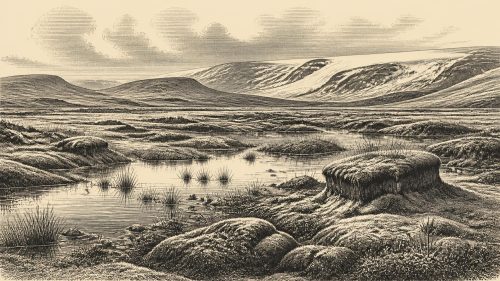
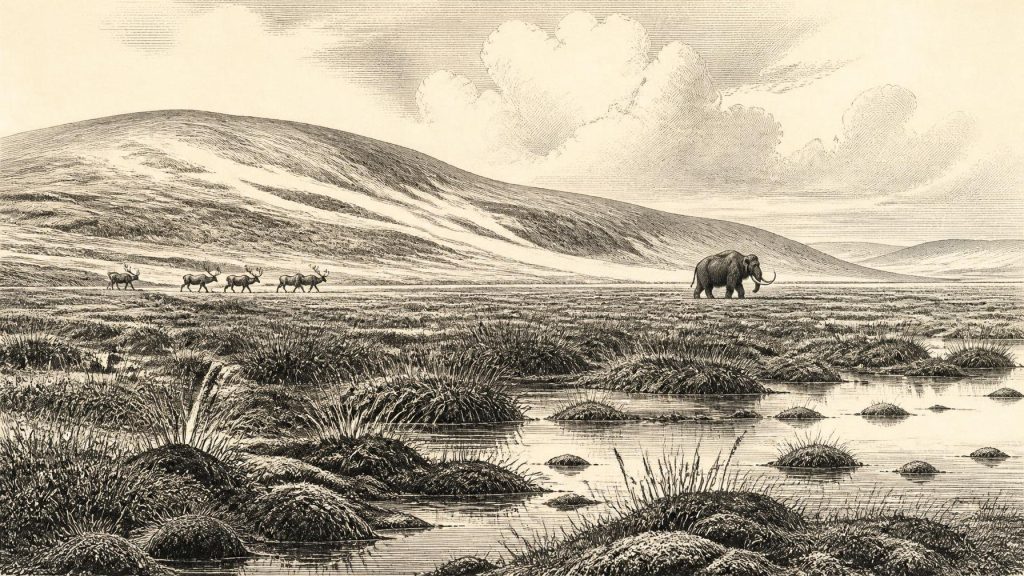
Organic material from Derryvree gave a radiocarbon age which, when calibrated, has been placed broadly at about 36,900–31,700 cal BP. The nominal year 31,676 BCE falls near this wide range, but it cannot be placed confidently at a particular level or season within it. Pollen, plant macrofossils and insects point to cold, open conditions rather than a closed temperate forest. Sedges, grasses, herbs, mosses and low shrubs occupied wet and exposed ground. The term “muskeg” has been used for the waterlogged, mossy terrain inferred from the deposits. There may have been shallow pools, sluggish streams and productive margins, but no evidence supports a vision of modern bogland, meadow or woodland transplanted into the Ice Age.
This was a landscape in which microhabitats mattered. Ground sheltered from the wind, south-facing slopes, stream edges and patches where snow melted early could have supported more vegetation than exposed ridges. In colder seasons, frozen ground and sparse cover would have restricted plant growth; in milder intervals, water and fresh forage could be concentrated around wetlands. Such variation helps explain why animal presence need not imply that every part of Ireland was equally habitable. It also explains the importance of buried sediments: later ice destroyed or obscured much of the land surface on which animals, and any people, once moved.
Castlepook’s Faunal Record
Far to the south, Castlepook Cave preserves a different kind of archive. Excavations in the early twentieth century recovered a very large and heterogeneous collection of bones from the limestone cave system near Doneraile. The National Museum of Ireland identifies Castlepook as the country’s most important site for mammals of the last cold stage. Its recorded fauna includes woolly mammoth, reindeer, giant deer, brown bear, wolf, fox, Arctic fox, mountain hare, collared lemming, Norway lemming and spotted hyena. A cave hyena skull from the site is especially striking: no hyenas live in Ireland or Europe today, but their fossils establish that these powerful carnivores once reached the island.
The collection must nevertheless be used carefully. Cave deposits can accumulate over long periods through carnivore activity, natural deaths, water movement, collapse and later disturbance. The older excavations also pre-date modern stratigraphic standards. A date obtained from one bone dates that animal, not necessarily every specimen in the cave or the exact moment at which a bone was deposited. Reassessment of the Castlepook radiocarbon chronology has emphasised these difficulties. The sound conclusion is that parts of Ireland supported a succession of cold-stage mammals between roughly 45,000 and 30,000 years ago, not that every listed species stood together in a single herd or shared one season at 31,676 BCE.
Even with that caution, the ecological implications are substantial. Reindeer and lemmings indicate environments unlike later wooded Ireland, while mammoths required enough plant biomass to sustain very large herbivores. Wolves, foxes and hyenas point to a food web containing carcasses and prey. Giant deer were not exclusively an Irish animal despite their later popular name; they ranged widely across Eurasia. Castlepook instead shows that Ireland lay, intermittently, at the north-western edge of wider European faunal worlds. It was neither a timeless wilderness nor the isolated, temperate island known in recent millennia.
A Possible Human Trace
The most arresting claim associated with this period concerns a reindeer femur from Castlepook. Ruth Carden’s examination identified a deep surface mark interpreted as consistent with a stone-tool cut made during carcass processing, and public heritage material has placed the bone at around 31,000 BCE. If the mark is ultimately confirmed as anthropogenic, it would be evidence that people reached Ireland far earlier than the well-established post-glacial settlement record. It would also place a possible human action in the broad chronological neighbourhood of this article’s nominal date.
But the distinction between evidence and interpretation is essential. The bone itself is direct evidence for a reindeer. Its radiocarbon result is evidence for the age of that animal within a broad calibrated range. The claim that the incision was made by a human tool rests on taphonomic analysis: researchers must distinguish deliberate cutting from carnivore damage, trampling, abrasion, breakage and other natural processes. Nor does one modified bone establish who made a mark, whether they hunted the animal, how many people were present, how long they stayed or whether they returned.
No securely associated house, hearth, stone-tool assemblage, burial, human bone, art or occupation surface has yet demonstrated a resident Upper Palaeolithic community in Ireland at this time. It is possible that a small, highly mobile party entered the island briefly and processed an animal; it is equally necessary to acknowledge that the claimed evidence remains isolated and that research at Castlepook continues. The cave is an important place for asking whether Ireland had fleeting Palaeolithic visitors, not a licence to invent a settled hunting society.
What Cannot Be Recovered
Accordingly, there is no responsible political narrative for 31,676 BCE. No chiefdom, kingdom, boundary, diplomatic encounter, war, treaty, language group or named people can be identified. There is no evidence for farming, livestock, fields, permanent villages, trade in goods, monuments, formal religious institutions or systems of learning. Reindeer, mammoths and hyenas are not evidence for human economy; they are evidence for the animals that occupied parts of the island. Likewise, a possible cut-mark is not evidence for a social order.
Religion and culture are similarly beyond recovery. People, if present, may have possessed rich beliefs, skills and oral traditions, as Upper Palaeolithic groups elsewhere certainly did. Yet comparisons with Britain or continental Europe cannot fill Ireland’s evidential silence with particular rituals, artworks or technologies. The appropriate historical lesson is methodological as well as prehistoric: absence of evidence is not proof that nothing happened, but it is a firm reason not to manufacture detail.
A Landscape Soon to Change
The importance of this horizon lies in its precariousness. Derryvree’s wet, treeless interval was eventually overrun and buried by ice. The animals represented at Castlepook belonged to ecological communities that would be repeatedly disrupted as the climate deteriorated and the last ice sheet expanded. Later glaciation scoured landscapes, shifted sediments and limited the survival of archaeological traces. Around 31,676 BCE, Ireland’s history is therefore best read through drumlin silts, cave bones and carefully calibrated dates: a cold, varied country, intermittently accessible to large mammals, and perhaps briefly to people, but not yet a recoverable human society.
Primary Sources
- A Middle Midlandian Freshwater Series at Derryvree, Maguiresbridge, County Fermanagh, Northern Ireland
- The Irish Quaternary Fauna Project
- A Reconsideration of the Radiocarbon Dating of the Marine Isotope Stage 3 Fauna from Southern Ireland
- Growth and Retreat of the Last British–Irish Ice Sheet, 31,000 to 15,000 Years Ago: the BRITICE-CHRONO Reconstruction
- Trimlines, Blockfields and the Vertical Extent of the Last Ice Sheet in Southern Ireland
- The Problem of a Late Quaternary Landbridge Between Britain and Ireland
- The Island of Ireland: Drowning the Myth of an Irish Land-bridge?
- Figure 6: The Subdivision of the Quaternary Period in Ireland
- Advances in Irish Quaternary Studies
- Middle Midlandian Interstadial Deposits at Greenagho, Near Belcoo, County Fermanagh, Northern Ireland
- Spotted Hyena Skull
- Ice Age Ireland: Cool Fossils!
- Prehistoric Details
- 2022:564 – Castlepook Cave, Castlepook South, Cork
- Archaeology Research Excavation Grant 2022: Final Report
- Archaeological Heritage of County Cork
- Heritage Artefacts of County Cork
- New Insights on the Fauna of Ireland’s Younger Dryas and Early Holocene from Alice & Gwendoline Cave
- Occurrence of Mammalia Relicts at Castlepook Cave
- BRITICE-CHRONO Maps and GIS Data of the Last British–Irish Ice Sheet, 31 to 15 ka
- Sedimentary Ancient DNA Reveals Late Pleistocene Faunal Connectivity Between Ireland and Eurasia
- Pleistocene Vertebrates in the British Isles