
Mammoth Cave’s Uncertain Visitors31588 BCE
Around 33,500 cal BP, Ireland was a climatically unstable Late Pleistocene landscape, not a defined historical society or consistently frozen island. Derryvree, County Fermanagh, preserves an ice-free wetland interval beneath later glacial deposits, indicating cold, treeless tundra-like environments supporting plants, insects and freshwater habitats. Castlepook Cave in County Cork yielded mammoth, reindeer, giant deer, predators and other cold-stage fauna, although its deposits represent accumulated, disturbed evidence rather than one moment. A cut-marked reindeer femur may indicate early Upper Palaeolithic human butchery, but cannot prove permanent settlement. No secure contemporary tools, communities, institutions, beliefs, trade, farming or political structures are known.
Dateline
31,588 BCE is not a year that can be narrated in the ordinary historical sense. There is no Irish calendar, written testimony, named ruler, excavated village or annually layered record that can be assigned to it. The label is a modern chronological convenience: it corresponds only approximately to 33,500 calibrated years before present (cal BP, with “present” conventionally fixed at AD 1950). At this depth of time, even a radiocarbon determination usually resolves into a range of centuries or millennia, not a particular year. The responsible subject is therefore Ireland during a broad Late Pleistocene window, within Marine Isotope Stage 3, rather than an invented event on a precise date.
“Ireland” also needs careful handling. No political Ireland existed, and the familiar coastline did not exist either. Sea level was lower than today, climates were colder, and ice, water and exposed shelf altered routes through the north-west European world. Yet lower sea level must not be simplified into a guaranteed land bridge or an open road for people and animals. The changing Irish Sea basin was a complicated physical barrier and corridor, while the evidence is too sparse to reconstruct one reliable crossing at this particular point. What survives instead is a small but extraordinary body of sediment, plant material and animal bone, mostly preserved by accident beneath later glacial deposits or within caves.
A Cold Interval, Not a Frozen Island
The period belongs to the Midlandian, the Irish expression for the last major glacial stage. It preceded the fullest extent of the last British–Irish Ice Sheet, which came substantially later, broadly during the interval from about 26,500 to 19,000 years ago. That distinction matters. It would be wrong to picture the whole landmass at 31,588 BCE as permanently buried beneath the immense ice sheet of the Last Glacial Maximum. It would be equally wrong to imagine a stable, temperate island. The evidence indicates a North Atlantic landscape subject to large climatic shifts, regional contrasts and successive advances of ice.
The best modern reconstructions trace the growth and retreat of the ice sheet across a long period from about 31,000 to 15,000 years ago. They greatly improve knowledge of the later glacial cycle, but they cannot produce a detailed island-wide weather map for roughly 33,500 cal BP. Ice margins did not behave as neat, simultaneous frontiers. Local glaciers, sea-facing lobes, upland snowfields and periglacial ground could respond differently to changing temperature and precipitation. Consequently, evidence that one place was ice-free at some point in a long interval is not proof that every Irish valley, coast or mountain was open at the same time.
The date considered here lies before the eventual maximum expansion, during a period in which habitable ground could exist but was environmentally demanding and potentially short-lived. Seasonal freezing, strong winds and sparse tree cover would have shaped the landscape. Later ice did more than transform the terrain: it scoured away surfaces and deposits that might otherwise have recorded plants, campsites or animal movements. The rarity of evidence is thus itself part of the history. Absence of a settlement is not automatically proof that no visitor ever arrived; but neither is it a licence to populate Ireland with undocumented communities.
Derryvree’s Buried Wetland
The strongest direct environmental evidence relevant to this broad horizon comes from Derryvree, near Maguiresbridge in County Fermanagh. Road excavations there exposed organic freshwater silts and fine sands trapped between two distinct layers of glacial till. The order of these deposits is unusually informative. First, an earlier glacier laid down till. Then, after the ice had withdrawn from the locality, waterborne sediments, plant remains and animal traces accumulated. Finally, a later advance covered and preserved the freshwater bed beneath another till sheet that became part of a drumlin.
A radiocarbon determination from the Derryvree organic material was 30,500 ± 1,170 radiocarbon years BP. Calibration with modern curves gives a much broader calendar range, commonly expressed as about 36,900–31,700 cal BP. The nominal date of 31,588 BCE, approximately 33,500 cal BP, falls within that range. This is valuable but limited evidence. It does not mean that the visible Derryvree pool, its plants and animals all existed in the notional year in question. It establishes that the site records an ice-free interval within which conditions relevant to that date occurred.
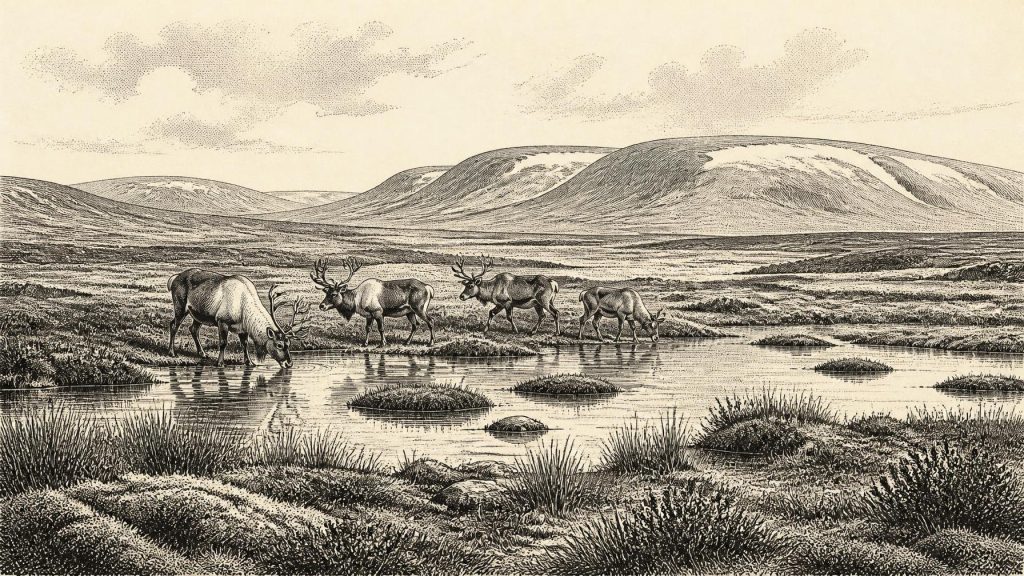
The deposit points to open, treeless and wet ground: a cold muskeg or tundra-like landscape with freshwater pools and channels, mosses, sedges, grasses, herbs and low shrubs. Pollen and plant macrofossils, together with insect evidence, show that severe cold did not make the area biologically empty. Short growing seasons could sustain productive wet patches, while long winters and frozen ground restricted woodland and made life highly seasonal. The record includes plants associated with cold, open conditions, including mountain avens and bogbean. Derryvree therefore provides an important corrective to a simple image of an ice-age wasteland: this was an exposed but living mosaic of water, vegetation and periglacial ground.
It is also a strictly local archive. The Fermanagh basin cannot stand for all Ireland. North Cork, the western seaboard, upland Donegal and the then-changing coastal shelves had different terrain and potentially different relationships to ice. Still, Derryvree demonstrates that parts of the landmass supported freshwater ecosystems before later glaciation overwhelmed or altered much of the evidence. In environmental terms, the central fact of the period is instability: not an island locked permanently into one state, but a landscape repeatedly reorganised by climate and ice.
Castlepook’s Animal World
For animal life, the most important Irish site is Castlepook Cave, also known as Mammoth Cave, near Doneraile in the Awbeg Valley of north County Cork. Antiquarian excavations and later study of museum collections recovered a striking cold-stage fauna. Material attributed to the wider pre-Last Glacial Maximum assemblage includes woolly mammoth, reindeer, giant deer, brown bear, wolf or fox, Arctic fox, lemmings and spotted hyaena. This combination shows that Ireland could be reached by, and at least intermittently sustain, animals associated with open northern environments and large carnivores that no longer occur in Europe.
The cave should not be mistaken for a snapshot of a single community. Cave deposits can accumulate over very long spans; carnivores can drag in carcass parts; water, collapse and later excavation can disturb layers; and some of Castlepook’s most important material came from early twentieth-century work rather than modern, fully recorded stratigraphic excavation. Modern reassessment has also shown why older radiocarbon results must be handled cautiously: advances in collagen pretreatment and ultrafiltration have changed the confidence that can be placed in some legacy dates. A mammoth or hyaena bone from the cave is sound evidence that such fauna reached Ireland during the broad cold stage; it is not automatic proof that every listed animal lived together beside the cave in 31,588 BCE.
Nevertheless, the cave fauna gives real substance to the environmental picture. Reindeer and giant deer imply grazing opportunities across open country; mammoths point towards extensive grass-and-herb resources; lemmings and Arctic foxes suit cold conditions; and spotted hyaenas indicate a carnivore ecology in which caves could become dens and bone accumulators. The animal evidence also hints at the changing regional geography of the time. These species had to enter an Irish landscape from the wider European or British–Irish world, but the timing, routes and duration of their populations remain open questions rather than settled facts.
A Reindeer Bone and Human Possibility
One Castlepook object makes this period especially significant for Irish human history: a reindeer femur with a deep linear mark that zooarchaeologist Ruth Carden has interpreted as a cut made by a sharp stone tool during butchery. County Cork heritage material presents the bone as dating to around 31,000 BCE, while the proposed human action belongs generally to an early Upper Palaeolithic context. If the interpretation is confirmed, it represents evidence that people handled a reindeer in Ireland far earlier than the long-established post-glacial record.
Its importance requires restraint. The bone’s date concerns the animal’s death, not a precisely dated human visit. It came from an old cave collection, not from a sealed camp floor with tools, hearths, shelters, butchered assemblages and human remains all in secure association. No securely identified Upper Palaeolithic lithic assemblage has yet been recovered in Ireland for this horizon. Nor does one cut-marked bone establish a permanent population, repeated seasonal occupation or a route of colonisation. The most cautious conclusion is also the most consequential: brief human presence in Ireland during this broad period is plausible and may be indicated by the Castlepook femur, but it remains far less securely documented than later prehistoric settlement.
If people were present, comparison with Upper Palaeolithic groups elsewhere in north-west Europe suggests small, mobile hunting parties able to exploit seasonal animal resources. That is an interpretation drawn from wider European archaeology, not a demonstrated description of an Irish band. The evidence supports possible carcass processing; it does not support claims for houses, clothing styles, language, kin groups, leadership or a local population size. There is no basis for identifying trade, exchange networks, territorial diplomacy or armed conflict in Ireland at this date.
Silences of Society and Belief
Political affairs, diplomacy and institutions are absent from the record, because no evidence identifies a polity or enduring community. Likewise, there are no Irish objects of this age from which to infer religious rites, visual art, formal teaching or named traditions. It would be tempting to import cave painting, ritual burial or elaborate toolkits from continental Europe; doing so would confuse useful comparison with Irish evidence. Castlepook is a cave with faunal deposits, not evidence of an Irish decorated sanctuary. Derryvree is a buried wetland, not a settlement landscape.
The economy that can responsibly be described is ecological before it is social. Wetland plants captured sunlight during brief summers; herbivores used open ground; predators and scavengers followed them; and, possibly, occasional people entered this unstable food web. There is no demonstrated farming, metallurgy, pottery, seafaring trade or managed herd. There were no towns, fields, monuments or political boundaries. The history of Ireland around 31,588 BCE is therefore one of potential and interruption: an intermittently habitable edge of Ice Age Europe, known through a Fermanagh wetland and a Cork cave, with a single marked reindeer bone raising a profound but still unresolved human question.
Primary Sources
- A Middle Midlandian Freshwater Series at Derryvree, Maguiresbridge, County Fermanagh, Northern Ireland
- The IntCal20 Northern Hemisphere Radiocarbon Age Calibration Curve (0–55 cal kBP)
- A Reconsideration of the Radiocarbon Dating of the Marine Isotope Stage 3 Fauna from Southern Ireland
- The Irish Quaternary Fauna Project
- Phylogeographic, Ancient DNA, Fossil and Morphometric Analyses Reveal Ancient and Modern Introductions of a Large Mammal: The Complex Case of Red Deer (Cervus elaphus) in Ireland
- Growth and Retreat of the Last British–Irish Ice Sheet, 31,000 to 15,000 Years Ago: The BRITICE-CHRONO Reconstruction
- BRITICE-CHRONO Maps and GIS Data of the Last British-Irish Ice Sheet 31 to 15 ka, Including Model Reconstruction, Geochronometric Age Spreadsheet, Palaeotopographies and Coastline Positions
- Timing, Pace and Controls on Ice Sheet Retreat: An Introduction to the BRITICE-CHRONO Transect Reconstructions of the British–Irish Ice Sheet
- The Deglaciation of the Western Sector of the Irish Ice Sheet from the Inner Continental Shelf to its Terrestrial Margin
- Dimensions and Chronology of the Last Ice Sheet in Western Ireland
- Trimlines, Blockfields and the Vertical Extent of the Last Ice Sheet in Southern Ireland
- Last Glacial Maximum Cirque Glaciation in Ireland and Implications for Reconstructions of the Irish Ice Sheet
- Maximum Extent and Readvance Dynamics of the Irish Sea Ice Stream and Irish Sea Glacier Since the Last Glacial Maximum
- A 10Be-Dated Record of Glacial Retreat in Connemara, Ireland, Following the Last Glacial Maximum and Implications for Regional Climate
- Irish Pleistocene Biostratigraphy
- Pleistocene Vertebrates in the British Isles
- New Insights on the Fauna of Ireland’s Younger Dryas and Early Holocene from Alice & Gwendoline Cave
- Heritage Artefacts of County Cork
- 2022:564 – Castlepook Cave, Castlepook South, Cork
- The Castlepook Cave Project
- The Archaeology of Caves in Ireland
- Karst of Ireland
- Introduction to the Late Quaternary and Holocene of Northern Ireland
- Figure 6.— The Subdivision of the Quaternary Period in Ireland