
Fermanagh’s Mountain-Avens Bed31297 BCE
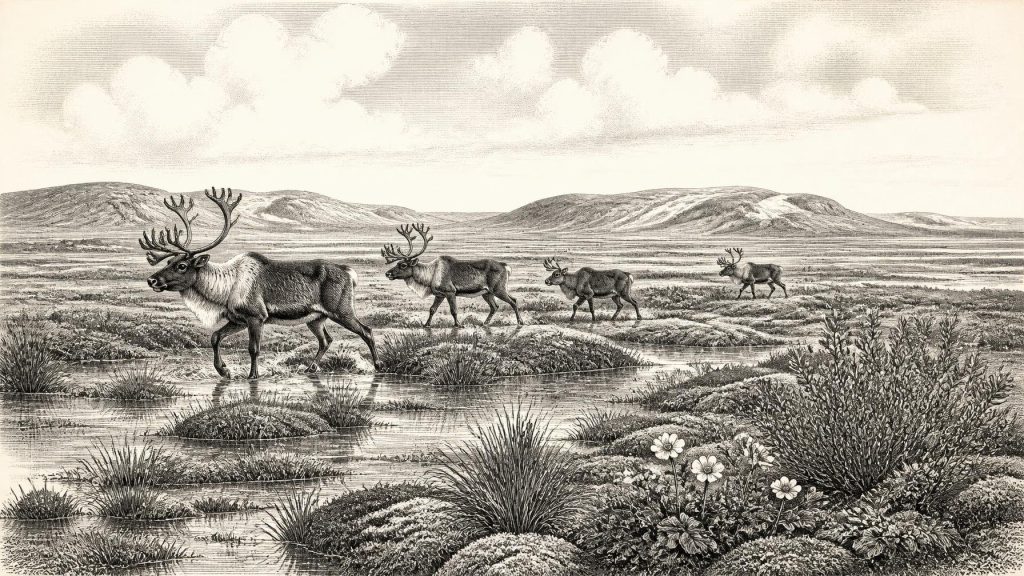
31,297 BCE denotes a broad Late Pleistocene horizon, not a recoverable Irish calendar year. At Derryvree, County Fermanagh, organic sediments between glacial tills indicate an ice-free interlude around 33,500 cal BP, with cold, wet, treeless tundra, pools and mountain avens. Crag Cave records intermittent liquid-water conditions, while Castlepook Cave preserves mammoth, reindeer, giant deer, predators and other open-country fauna. A marked reindeer femur may indicate human handling, but disturbed context prevents proof of settlement. Any visitors were probably mobile hunter-gatherers. Later ice-sheet expansion erased evidence, leaving fragmentary records of varied environments and only tentative evidence for early people in Ireland.
Dateline
31,297 BCE is a modern calendar label, not a year that can be recovered from Ireland’s prehistoric record. No Irish community then kept a calendar whose entries can be aligned with it, and no archaeological layer can identify a particular journey, hunt, birth or death in that single year. In chronological terms, the date falls about 33,250 calendar years before AD 1950 (cal BP), within the Late Pleistocene, broadly Marine Isotope Stage 3 (MIS 3). The responsible history of this moment is therefore one of calibrated ranges, sediments, fossils and changing climate rather than named people or events.
The closest unusually informative evidence comes from Derryvree, near Maguiresbridge in County Fermanagh. In 1969, road works cut through a drumlin and exposed fine freshwater sands, silts and organic deposits enclosed between two thick sheets of till, the unsorted debris left by glacier ice. The stratigraphy matters: the lower and upper tills demonstrate glacial episodes, while the organic bed proves that the locality experienced an intervening ice-free phase. Its original radiocarbon determination, 30,500 ± 1,100/1,030 radiocarbon years BP, calibrates only broadly, approximately 33,500 ± 1,200 cal BP. That span includes the requested date, but it cannot be narrowed responsibly to a precise calendar year.
An Ice-Free Fermanagh
Derryvree reveals a severe but living landscape. Pollen, plant macrofossils, mosses and insect remains point to treeless, tundra-like wetland rather than to the woods associated with later Irish prehistory. Grasses, sedges and herbs occurred alongside cold-tolerant plants such as mountain avens, dwarf willow and bogbean. The presence of aquatic and waterside plants shows that shallow pools, slow water and waterlogged ground existed despite the harsh climate. Moss-rich ground, decaying vegetation and open pools created a patchwork sometimes described as muskeg: wet, peaty tundra broken by small bodies of water.
This was not necessarily an unbroken white wilderness. Summer growth must have been sufficient for plants, insects and grazing animals; frost, snow cover and short growing seasons nonetheless shaped the annual rhythm. The evidence indicates sparse local vegetation, and probably cold winters, but it does not give a complete island-wide map. A handful of tree-pollen grains in the deposit cannot safely be taken as evidence of nearby woodland: pollen can travel far or be redeposited. The firm conclusion is more limited and more useful. Around this broad horizon, part of inland Fermanagh was open, cold and wet, yet not buried under permanent glacier ice.
Crag Cave in County Kerry supplies an independent climatic indication. Uranium-thorium dating of its speleothems shows episodes of calcite growth during MIS 3. Dripstone grows when liquid water passes through cave systems, so its formation demonstrates that south-west Ireland periodically experienced conditions allowing water circulation underground. It does not mean that every region was mild, nor does it date a human occupation. Together with Derryvree, however, it confirms that the long Ice Age was climatically changeable: cold phases and relatively milder interludes succeeded one another rather than proceeding as one simple descent into glaciation.
Animals in an Open Country
At Castlepook Cave, also called Mammoth Cave, near Doneraile in north County Cork, cave deposits and museum collections preserve a striking Late Pleistocene fauna. The assemblage includes woolly mammoth, reindeer, giant deer, brown bear, wolf, fox, Arctic fox, mountain hare, lemmings and spotted hyaena. Individual bones do not all necessarily belong to the same moment: early excavations disturbed deposits, and later dating has repeatedly shown that cave collections can contain material of different ages. Yet radiocarbon results place some Castlepook mammals broadly in the middle part of the last glacial cycle, including dates around 35,000–33,000 radiocarbon years BP for mammoth, hyaena and reindeer remains.
The animal evidence supports an interpretation of periodically open grass-herb and tundra environments capable of sustaining large grazers and browsers, as well as predators and scavengers. Reindeer were especially suited to cold open country; mammoths and giant deer attest a fauna now absent from Ireland. Spotted hyaena is important because it warns against treating caves as straightforward human shelters. Carnivores may have dragged prey or bone into cave passages, while water, collapse and later digging could mix deposits. A bone in a cave is evidence for an animal’s presence, but not automatically for a stable local herd, a kill-site or a human camp.
These animals also underline how different Ireland’s ecology was from that of later millennia. The large, distinctive Irish giant deer was not a product of medieval folklore or a single “Irish elk” landscape; it was one member of changing Pleistocene faunas shared, at intervals, with north-western Europe. Its enormous antlers and the remains of mammoth, hyaena and lemming survive because caves and protected sedimentary contexts occasionally escaped the destruction caused by later ice, erosion and acidic soils. The rarity of such survival is central to the story. Ireland’s record is fragmentary not because nothing happened, but because repeated glaciation removed or buried much of what might once have existed.
The Reindeer Femur Question
The possibility of people in Ireland near this period rests chiefly on one controversial but significant object: a reindeer femur fragment from Castlepook. It has been reported as bearing a deep linear mark consistent with fresh-bone cutting or chopping by a sharp stone implement, and the bone has been publicised as dating to roughly 33,000 years ago. If the modification is confirmed as anthropogenic, it would be evidence that Upper Palaeolithic people handled a reindeer in Ireland long before the Last Glacial Maximum. It would not, by itself, prove permanent settlement, a population size, an ethnicity, a language or a continuous human history on the island.
Caution is essential. The femur was recovered from an old cave collection rather than from a modern, sealed excavation context accompanied by an undisputed stone-tool assemblage, hearth, dwelling floor or burial. Natural breakage, carnivore damage and later disturbance must be excluded rigorously when interpreting marks on ancient bone. Renewed Castlepook excavations have demonstrated the potential of undisturbed portions of the cave system, but the wider archaeological case is still far thinner than the faunal evidence. The best-supported statement is that brief human activity is possible, perhaps plausible, around this horizon; an established Irish community remains unproven.
For comparison, securely dated evidence of terminal Pleistocene human activity comes much later from Alice and Gwendoline Cave in County Clare. A butchered brown-bear patella has produced calibrated dates of about 12,810–12,590 cal BP and 12,810–12,685 cal BP. Later work has also exposed the complex formation of that cave’s deposits, demonstrating why context and taphonomy matter so much. The contrast is instructive: a promising individual find at Castlepook should prompt investigation, not certainty beyond what its context permits.
People, Movement and Knowledge
If people did reach Ireland around 33,250 cal BP, they were mobile hunter-gatherers rather than farmers, town-builders or subjects of a state. Their practical knowledge would have included tracking animals, locating drinkable water, finding suitable stone, navigating seasonal weather and managing fire, clothing and food in a cold environment. These are reasonable inferences from Upper Palaeolithic survival elsewhere in north-west Europe, not observations directly made in Ireland. No Irish hearth, house, burial, tool workshop, ornament or art of this date presently allows a fuller reconstruction of daily life.
Nor is there evidence for political institutions, warfare, diplomacy, organised religion, trade routes or named regional groups. It would be misleading to create them merely because such headings suit later historical periods. Lower sea levels changed coastlines and enlarged exposed land around Ireland, potentially altering routes for animals and people, but they do not demonstrate a particular land crossing at this date. Any visitors may have arrived only occasionally, perhaps following animal movements during favourable climatic windows; equally, some animal remains could represent populations whose movements had no human counterpart.
Approaching a Major Transformation
This interval preceded, rather than belonged to, the fullest expansion of the last British-Irish Ice Sheet. Reconstructions differ in detail, but its maximum extent occurred considerably later, broadly around 27,000–21,000 years ago. As climate deteriorated, advancing ice and periglacial conditions profoundly reduced habitable landscapes and damaged older deposits. The environmental record at Derryvree, the cave fauna at Castlepook and the dripstones at Crag Cave are valuable precisely because they preserve glimpses of a shifting world before that later glacial maximum reshaped much of the island.
Thus the most important development relevant to 31,297 BCE was not a recorded political event but an environmental interval in which parts of Ireland were ice-free, cold and ecologically productive. Wet tundra in Fermanagh, intermittent liquid water in Kerry and a diverse cold-stage fauna in Cork show that this was a varied landscape, not an empty abstraction labelled “the Ice Age”. The evidence may yet reveal more about human visits. For now, it supports a careful history of Pleistocene environments and animals, with the possibility—but not the demonstrated permanence—of people at Ireland’s north-western edge.
Primary Sources
- A Middle Midlandian Freshwater Series at Derryvree, Maguiresbridge, County Fermanagh, Northern Ireland
- The Irish Quaternary Fauna Project
- First Evidence of a Late Upper Palaeolithic Human Presence in Ireland
- New Insights on the Fauna of Ireland's Younger Dryas and Early Holocene from Alice & Gwendoline Cave
- Episodic Speleothem Deposition Tracks the Terrestrial Impact of Millennial-Scale Last Glacial Climate Variability in SW Ireland
- Spatio-Temporal Dynamics of Speleothem Growth and Glaciation in the British Isles
- Last Glacial Maximum Cirque Glaciation in Ireland and Implications for Reconstructions of the Irish Ice Sheet
- Dimensions and Chronology of the Last Ice Sheet in Western Ireland
- Trimlines, Blockfields and the Vertical Extent of the Last Ice Sheet in Southern Ireland
- Oscillating Retreat of the Last British-Irish Ice Sheet on the Continental Shelf Offshore Galway Bay, Western Ireland
- Pleistocene Vertebrates in the British Isles
- Palaeoecology
- Figure 6.—The Subdivision of the Quaternary Period in Ireland
- Spotted Hyena Skull
- 32564: Castlepook Cave, Castlepook, Doneraile, Cork
- Archaeological Heritage of County Cork
- Heritage Artefacts of County Cork
- Ireland's Palaeolithic Archaeology – Fleeting Footprints in a Frozen Land
- Reindeer Bone Found in Cork Cave Shows Human Activity in Ireland 33,000 Years Ago
- The Geological Heritage of Clare