Maguiresbridge’s Organic Bed31189 BCE
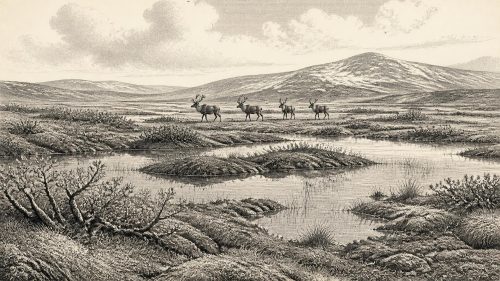
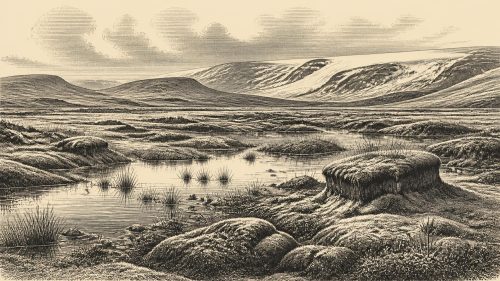
Around 31,189 BCE, Ireland’s history is reconstructed from environmental evidence rather than events or people. At Derryvree near Maguiresbridge, Fermanagh, freshwater silts beneath glacial till reveal a cold, treeless wetland of mosses, sedges, dwarf shrubs and insects during Marine Isotope Stage 3, before renewed ice advance. The deposit demonstrates locally ice-free conditions, not nationwide deglaciation. Castlepook Cave, Cork, preserves Late Pleistocene fauna, showing intermittent ecological connections with Europe, though its remains are not contemporaneous. A marked reindeer bone may indicate early human activity, but cannot prove settlement. Climatic instability, low sea levels and shifting ice margins defined this periglacial landscape.
Dateline
The label 31,189 BCE is not a date at which an Irish event can be placed. No calendar, settlement sequence or written tradition reaches remotely this far into the past. It is a modern chronological convenience: roughly 33,138 years before AD 1950, the reference point used for “before present” dating. The responsible history of Ireland at this depth is therefore not a story of named people or annual happenings. It is a reconstruction from sediments, fossils and glacial landforms, each with its own dating uncertainty.
The closest unusually detailed Irish evidence is a freshwater deposit found beneath a drumlin at Derryvree, near Maguiresbridge in County Fermanagh. Its conventional radiocarbon measurement, BIRM-166, was 30,500 ± 1,100 radiocarbon years BP. When calibrated, it spans broadly about 36,900–31,700 calendar years BP. That wide interval overlaps the modern label 31,189 BCE, but it does not mean that the silt was laid down in one identifiable year. It records a cold-phase environment at some point within a long and unstable stretch of the last Ice Age.
A Wetland Between Ice Advances
Derryvree was exposed in road cuttings during 1969. Investigators found freshwater silts and fine sands enclosed between two substantial layers of till: debris deposited directly by glacier ice. This sequence is the essential fact. Before later ice covered and reshaped the district, an area of open water, wet ground and plant growth existed there long enough to leave organic traces. The upper till eventually sealed that evidence, preserving it beneath the drumlin that is visible today.
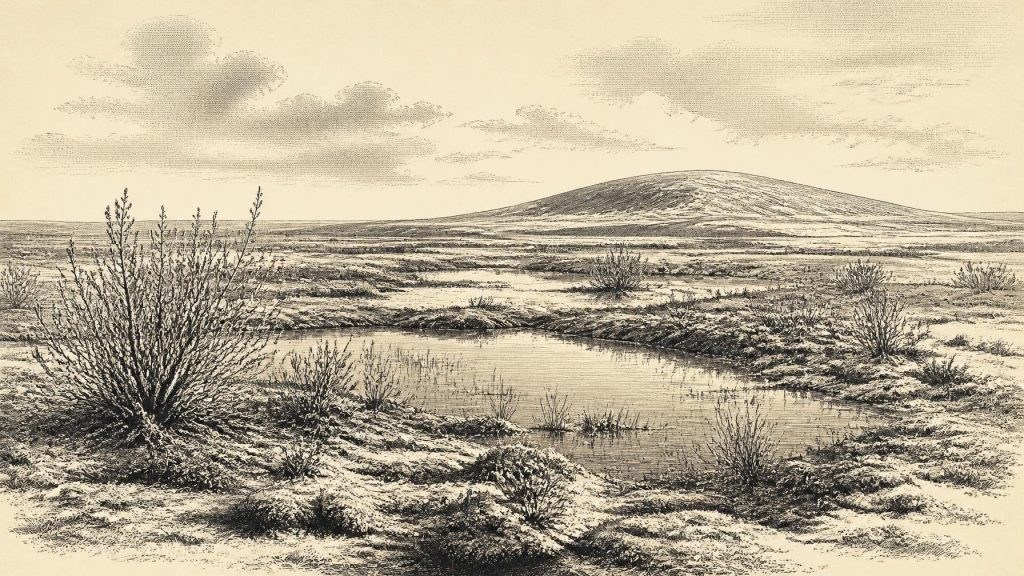
The fossils do not describe a mild, wooded Ireland. Pollen was predominantly from herbs, while plant macrofossils and insect evidence point to a cold, open, largely treeless wetland—often described as tundra or muskeg-like. Mosses, sedges and hardy flowering plants grew around pools and waterlogged ground. Dwarf willow and other low vegetation could occupy sheltered or damp niches. There were short productive seasons, but severe winters, frost-disturbed soils and little shelter from trees. Sparse grains from trees such as pine or hazel cannot safely be read as evidence of nearby forest: pollen may travel far beyond the plants that produced it.
This was not a dead landscape. Freshwater mud requires liquid water; aquatic and marsh plants require a growing season; insects require habitats and food. Yet biological activity should not be mistaken for abundance in the modern sense. A low, windswept mosaic of wet hollows, sedge margins, exposed mineral ground and scattered dwarf shrubs is a better guide than any picture of later Irish pasture, bog or woodland. The local landscape was shaped by cold as much as by life.
Before the Greatest Expansion
The wider climatic setting was Marine Isotope Stage 3, a long and fluctuating part of the Late Pleistocene. It preceded the best-established maximum of the last British–Irish Ice Sheet. Modern reconstructions show that ice growth, maximum extent and retreat were not simultaneous in every Irish region: margins advanced and altered according to topography, precipitation, sea level and the behaviour of marine-terminating ice. The major maximum came later, broadly during the interval from about 27,000 to 23,000 years ago in the Irish sector, rather than at the notional year considered here.
Derryvree is consequently important because it rules out a simple image of Ireland as continuously and uniformly buried beneath ice throughout the late Ice Age. It demonstrates locally ice-free conditions in north-central Ireland during part of this earlier cold phase. It does not prove that every county was ice-free at once. Uplands, western coasts, the Irish Sea basin and inland lowlands could have had sharply different conditions, and the evidence for ice cover before the later maximum remains incomplete. The strongest conclusion is local and chronological: a freshwater tundra wetland existed at Derryvree before renewed glaciation covered the site.
Sea level was also much lower than today, exposing extensive shelves around north-west Europe. Ireland’s coastlines were therefore very different, and crossings between land areas may at times have been easier than in the modern geography. But exact routes, shorelines and seasonal accessibility cannot be fixed for 31,189 BCE from the Irish evidence alone. The animal record shows that terrestrial mammals reached Ireland during favourable intervals; it does not provide a map of a particular crossing in a particular season.
Cork’s Time-Averaged Fauna
Far to the south, Castlepook Cave near Doneraile in County Cork provides a complementary record. It has produced Ireland’s richest known assemblage of Late Pleistocene mammals, including reindeer, woolly mammoth, giant deer, brown bear, wolf, Arctic fox, lemmings and spotted hyaena. Such animals demonstrate that Ireland was repeatedly part of wider north-west European ecological networks during the last cold stage. Large grazers and browsers imply open country capable, at least intermittently, of sustaining substantial herbivores; predators and scavengers indicate a more complex food web than Ireland’s later historical fauna suggests.
There is an important qualification. Castlepook is not a sealed snapshot of one valley or one generation. Its cave deposits accumulated through animal deaths, carnivore activity, water movement, sediment disturbance and early twentieth-century excavation. Re-dating has shown that several older determinations underestimated the age of specimens by thousands of years. Mammoth, hyaena, bear and reindeer remains from the assemblage need not represent one simultaneous community, and neither can they automatically be assigned to the Derryvree wetland interval. They establish repeated animal presence across a broad part of Marine Isotope Stage 3, not a census for this notional year.
Even so, the two records illuminate one another. Derryvree supplies the closest local environmental evidence: cold freshwater habitats and treeless vegetation in Fermanagh. Castlepook supplies the broader faunal possibility: open Irish landscapes were sufficiently accessible, at different times, for large herbivores and their predators to enter or persist. The Ireland of this period was not an isolated, fixed island landscape. It was an ecologically changeable western edge of the European cold-stage world.
The Human Question
One Castlepook object has made this era especially significant for Irish archaeology: a reindeer femur carrying a deep mark interpreted by its researcher as a cut or chopping trace made with a sharp stone tool while the bone was fresh. The bone has been publicised as dating to roughly 33,000 years ago, and, if the modification is confirmed as human-made, it would push evidence of human activity in Ireland vastly earlier than the securely documented post-glacial settlement record. It may indicate that a person or small group processed a reindeer carcass during a cold-stage visit.
That proposition must remain carefully limited. The femur is not a securely excavated campsite with associated tools, hearths, dwelling floors, burials or a sequence of repeated occupations. A modified bone, even if anthropogenic, cannot demonstrate a permanent population, a named culture or a settled hunting territory. Its exact relationship to 31,189 BCE is also unproven: the dating terminology used in public accounts must not be converted casually between radiocarbon years, calibrated years and BCE dates. It is evidence for a serious research question, not a licence to invent an Irish Palaeolithic community.
What Cannot Be Recovered
For that reason, there are no responsibly identifiable political affairs, wars, diplomacy, rulers, laws or territorial boundaries for Ireland at this point. There is likewise no direct Irish evidence for ritual monuments, formal religion, art, language, teaching, trade partnerships or social institutions. Upper Palaeolithic groups elsewhere in Europe made sophisticated tools, ornaments and images, but similarity in date does not establish that those practices occurred in Ireland. Importing continental evidence as if it were Irish would turn analogy into fact.
Everyday life is nearly as elusive. If people did reach Ireland, they would probably have needed exceptional knowledge of weather, terrain and animal movement to survive in a cold, exposed environment. That is a reasonable inference from the landscape and fauna, not evidence for specific homes, family structures, clothing, boats or seasonal routes. Likewise, a possible butchery mark may suggest carcass processing, but it does not reveal an Irish economy, established trade or regular hunting rounds.
A Deep-Time Irish Landscape
The principal development illuminated around 31,189 BCE is environmental change. At Derryvree, freshwater and organic sediment accumulated in a cold, treeless wetland during a pause between ice advances. Across Ireland, climatic instability, lower sea level and shifting ice margins altered what land was available to plants, animals and perhaps occasional people. Later glacier expansion would bury, erode and redistribute much of that fragile record.
This is therefore a history of limits as well as discoveries. The buried organic bed at Maguiresbridge proves that part of Ireland supported a living periglacial wetland; it does not supply an annual chronicle. Castlepook proves that remarkable cold-stage animals reached Ireland; it does not make them all contemporaries. A marked reindeer bone raises the possibility of a very early human presence; it does not yet demonstrate settlement. Such restraint is not a deficiency. It is the achievement of the evidence: a narrow but vivid glimpse of Irish ground, water, mosses, sedges and animals before the landscape was once again transformed by ice.
Primary Sources
- A Middle Midlandian Freshwater Series at Derryvree, Maguiresbridge, County Fermanagh, Northern Ireland
- Exploring Controls of the Early and Stepped Deglaciation on the Western Margin of the British Irish Ice Sheet
- Growth and Retreat of the Last British–Irish Ice Sheet, 31,000 to 15,000 Years Ago: The BRITICE-CHRONO Reconstruction
- BRITICE-CHRONO Maps and GIS Data of the Last British-Irish Ice Sheet 31 to 15 ka
- A Reconsideration of the Radiocarbon Dating of the Marine Isotope Stage 3 Fauna from Southern Ireland
- The Irish Quaternary Fauna Project
- Oscillating Retreat of the Last British-Irish Ice Sheet on the Continental Shelf Offshore Galway Bay, Western Ireland
- Maximum Extent and Dynamic Behaviour of the Last British–Irish Ice Sheet West of Ireland
- The Deglaciation of the Western Sector of the Irish Ice Sheet from the Inner Continental Shelf to its Terrestrial Margin
- Dimensions and Chronology of the Last Ice Sheet in Western Ireland
- Trimlines, Blockfields and the Vertical Extent of the Last Ice Sheet in Southern Ireland
- Last Glacial Maximum Cirque Glaciation in Ireland and Implications for Reconstructions of the Irish Ice Sheet
- New Data for the Last Glacial Maximum in Great Britain and Ireland
- A Critical Review and Re-investigation of the Pleistocene Deposits
- Irish Pleistocene Biostratigraphy
- Palaeoecology: The Middle Midlandian Palaeoenvironment of South Fermanagh
- Spotted Hyena Skull
- Ice Age Ireland
- Castlepook Cave, Co. Cork, 2022 Excavation Report
- Occurrence of Mammalia Relicts at Site Castlepook Cave
- New Insights on the Fauna of Ireland’s Younger Dryas and Early Holocene from Alice & Gwendoline Cave
- Timing, Pace and Controls on Ice Sheet Retreat: An Introduction to the BRITICE-CHRONO Transect Reconstructions of the British-Irish Ice Sheet