BIRM-166 Between Tills31124 BCE
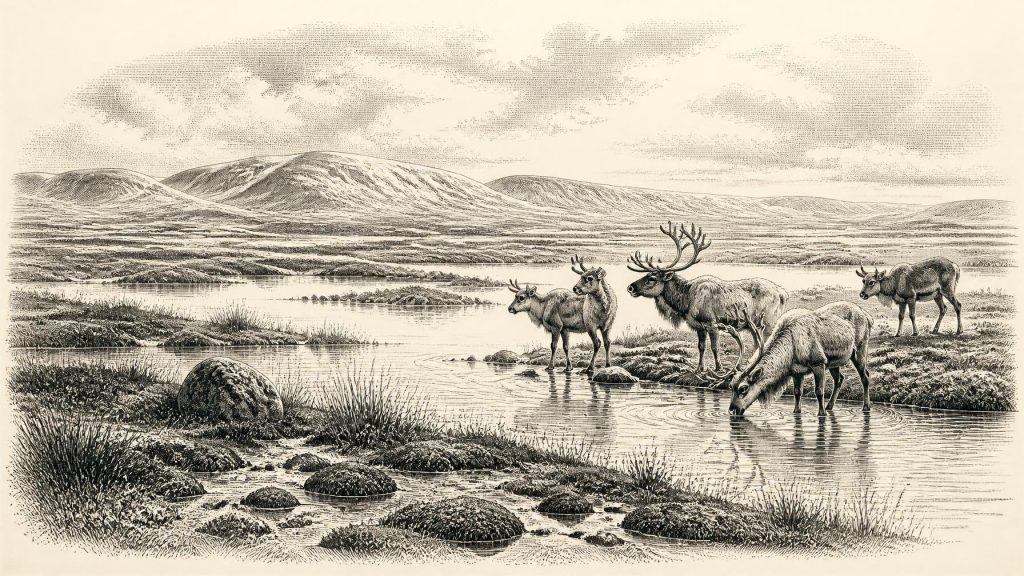
Around 31,124 BCE, Ireland lay within the climatically unstable Marine Isotope Stage 3, not a recordable historical year. Derryvree, County Fermanagh, preserves freshwater sediments between glacial tills, demonstrating local ice-free conditions between glacier advances. Its pollen, plants and small fossils indicate open, treeless, mossy and sedgy tundra wetland. Castlepook Cave, County Cork, contains remains of reindeer, mammoth, giant deer, predators and other cold-stage fauna, though not necessarily contemporaneous. No secure evidence confirms human occupation; a possibly cut-marked reindeer bone remains inconclusive. There were no known settlements, farming, polities or recorded societies. Environmental change, animal movement and glaciation define this period.
Dateline
The label 31,124 BCE is a modern chronological pin, not a date that people in Ireland could have named or recorded. There are no calendars, written sources, settlements, burials or securely dated activity surfaces that permit a history of one particular year. This point lies about 33,073 years before AD 1950, the conventional reference year for “before present” dating, in the Late Pleistocene’s Marine Isotope Stage 3. The responsible approach is therefore to examine evidence whose calibrated ranges overlap the date, while being clear that it records intervals of time rather than an anniversary.
A Date Within a Cold Phase
At this depth in time, radiocarbon ages cannot simply be converted into a single BCE number. Atmospheric radiocarbon varied substantially in the past; measurements must be calibrated against independently built curves and expressed as probability ranges. The key Irish deposit for this broad horizon, from Derryvree near Maguiresbridge in County Fermanagh, produced a conventional radiocarbon age of 30,500 +1,170/−1,030 radiocarbon years BP. Published calibrations place it broadly in the range of roughly 36,900–31,700 calibrated years BP, approximately 34,950–29,750 BCE. The modern label 31,124 BCE falls within that wide span, but cannot be attached to a particular layer, season or generation.
That distinction matters. Ireland was not a uniform land frozen in one fixed condition. Marine Isotope Stage 3 was climatically unsettled, with changes in temperature, snowfall, sea level, vegetation and ice extent over centuries and millennia. The Last Glacial Maximum, when the British–Irish Ice Sheet achieved its broad greatest extent, lay later. Nor was ice advance and retreat simultaneous in every region. A cold wetland in Fermanagh, a limestone cave in Cork, high ground, the Irish Sea basin and the exposed continental shelf each preserve different portions of a changing story.
The Derryvree Freshwater Record
Derryvree is exceptionally important because it preserves a local landscape that later ice might otherwise have erased. Road works in 1969 cut through a drumlin and revealed freshwater silts and fine sands enclosed between two thick, distinct sheets of till: unsorted sediment deposited by glacier ice. The sequence demonstrates a simple relative order. Glacial ice had affected the locality; a non-glacial interval then allowed water, mineral sediment and organic matter to accumulate; subsequently, ice returned and buried the deposit beneath another till. It is evidence for local ice-free conditions between glacial episodes, not proof that all Ireland was ice-free.
Pollen, plant remains, mosses and small animal fossils make the deposit more than a geological curiosity. They indicate an open, treeless, wet environment often described as tundra or muskeg: shallow freshwater, moss-rich and sedgy ground, grasses, herbs, dwarf plants and limited dry terrain. Plants including bogbean, lesser clubmoss and Arctic-alpine associates show that even severe cold did not mean lifelessness. Summer thaw and standing or slow-moving water could sustain wetland communities; long winters and frost would have imposed powerful limits on growth and movement.
This was not the wooded Ireland of later millennia. The assemblage does not support nearby oak, hazel or ash woodland, agriculture, grazing fields or permanent villages. Isolated tree pollen grains in ancient sediment need careful treatment, since pollen can travel far or be reworked from older deposits. The stronger evidence is for sparse, open vegetation around freshwater. Derryvree therefore provides a valuable environmental reconstruction, but not a precise temperature reading or a map of every habitat on the island.
Cork’s Cave Fauna
Caves in southern Ireland add a second, striking line of evidence. Castlepook Cave, also called Mammoth Cave, near Doneraile in County Cork has yielded remains attributed to reindeer, woolly mammoth, giant deer, brown bear, wolf, Arctic fox, mountain hare, lemmings and spotted hyaena. The National Museum of Ireland holds important material from the early twentieth-century excavations, including a spotted-hyaena skull. Together, these fossils establish that Ireland was intermittently part of a wider north-west European cold-stage animal world far richer in large mammals and predators than the modern island.
Yet the cave must not be treated as a census from 31,124 BCE. Its fossil-bearing deposits accumulated through more than one process: animals died, carnivores carried or disturbed bones, water moved sediment, and early excavators worked in contexts that were not recorded to modern standards. Re-dating using improved bone pretreatment and accelerator radiocarbon methods has shown that several older Irish cave dates were substantially too young. Castlepook remains are now understood to include fauna from Marine Isotope Stage 3, with some revised dates indicating a significantly older presence of species such as giant deer and spotted hyaena than formerly thought.
The safest conclusion is both substantial and limited. Reindeer and lemmings accord with open, cold habitats; mammoth, giant deer and horse elsewhere in southern cave records indicate large herbivores able to use productive grass-and-herb landscapes; hyaenas, wolves and foxes show that carnivores and scavengers followed such prey. These species need not all have lived together, occupied the same district, or survived through the entire Derryvree interval. Fossils demonstrate repeated ecological connections and the availability of suitable habitat at times, rather than one complete Ice Age scene.
The Human Question
No securely excavated camp, hearth, stone-tool assemblage, dwelling, grave or human bone dates to this horizon in Ireland. A reindeer femur from Castlepook has been reported as bearing a mark consistent with fresh-bone cutting by a stone tool, and this has prompted the important possibility of very early human activity. If the mark proves to be anthropogenic and securely contemporary with the bone, it would suggest that people reached Ireland tens of millennia before the better evidenced Late Upper Palaeolithic and Mesolithic occupations.
For 31,124 BCE, however, it cannot responsibly be made to prove a settled population, a hunting camp or even a particular visit. The bone was not recovered with unequivocal tools, a hearth or an intact butchery floor, and Castlepook’s historic excavation history complicates its context. Recent investigations have sought surviving deposits, refined dates and additional evidence precisely because the question is unresolved. The femur is best described as proposed evidence for a brief human presence, not as confirmation of continuous occupation.
No Polities, No Recorded Society
Accordingly, there is no evidential basis for political affairs, diplomacy, warfare, named communities, law or leadership in Ireland at this date. Nor can archaeology identify a religion, language, art tradition, teaching system or social rank. It would be misleading to project later Gaelic identities, Neolithic monuments or medieval county boundaries into this landscape. “Ireland” here means the landmass in its changing Late Pleistocene geography, not a state or people with a shared recorded identity.
Economy and everyday life are equally beyond direct recovery. There was no evidence of farming, herding, pottery, metalworking, trade networks or built settlement. If people occasionally entered the island, the available animal and environmental evidence makes mobile foraging a plausible general model, but it remains an inference drawn from comparable Upper Palaeolithic worlds elsewhere in Europe, not a demonstrated Irish way of life. Lower sea levels changed surrounding coasts and exposed shelf areas, but fossil evidence cannot yet reconstruct a dependable route, crossing or exchange corridor into Ireland.
An Archive of Change
The most meaningful development around this notional year was environmental rather than political: Ireland contained, at least in some regions and intervals, cold open ground and wetland habitats between episodes of glaciation. Derryvree’s BIRM-166 sample and the fauna preserved at Castlepook give this deep past a tangible character—sedges and mosses around cold water, large herbivores on open country, and formidable carnivores in the wider landscape. They do not supply an event for 31,124 BCE. They show why precision must yield to process: fluctuating ice, shifting habitats, animal movement and the rare survival of evidence beneath the tills.
Primary Sources
- A Middle Midlandian Freshwater Series at Derryvree, Maguiresbridge, County Fermanagh, Northern Ireland
- The Irish Quaternary Fauna Project
- A Reconsideration of the Radiocarbon Dating of the Marine Isotope Stage 3 Fauna from Southern Ireland
- New Insights on the Fauna of Ireland’s Younger Dryas and Early Holocene from Alice & Gwendoline Cave
- Growth and Retreat of the Last British–Irish Ice Sheet, 31,000 to 15,000 Years Ago: the BRITICE-CHRONO Reconstruction
- Dimensions and Chronology of the Last Ice Sheet in Western Ireland
- Trimlines, Blockfields and the Vertical Extent of the Last Ice Sheet in Southern Ireland
- Character of Advance and Retreat of the Southwest Sector of the British-Irish Ice Sheet During the Last Glaciation
- The IntCal20 Northern Hemisphere Radiocarbon Age Calibration Curve (0–55 cal kBP)
- Irish Cave Exploration
- Spotted Hyena Skull
- Ice Age Ireland: Cool Fossils!
- Archaeology Research Excavation Grant 2022: Castlepook Cave, Co Cork
- Castlepook Cave, Co. Cork, 2022 Excavation Report
- The Archaeological Heritage of County Cork
- Occurrence of Mammalia Relicts at Site Castlepook Cave
- Figure 6.— The Subdivision of the Quaternary Period in Ireland
- North of Ireland: Field Guide
- Landscapes and Environments of the Last Glacial-Interglacial Transition: a Time of Amazingly Rapid Change in Ireland
- Irish Pleistocene Biostratigraphy
- Menyanthes trifoliata L.
- Pleistocene Vertebrates in the British Isles