

Derryvree’s Sedge Country31058 BCE
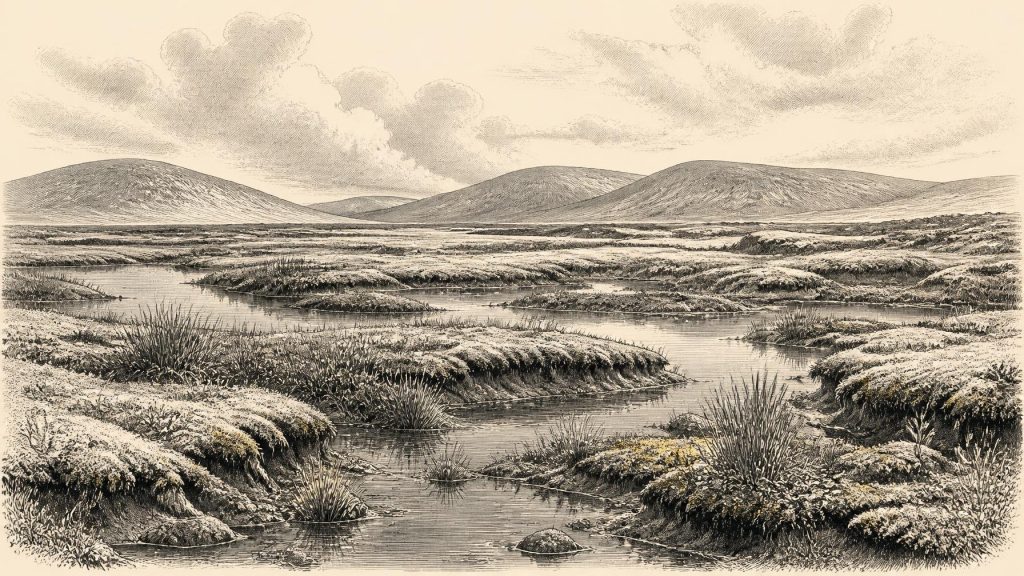
Around 31,058 BCE, Ireland was experiencing a cold, unstable Late Pleistocene climate, not a uniformly ice-covered landscape. At Derryvree, County Fermanagh, freshwater silts preserved between glacial tills record a locally ice-free interval before later ice advance. Radiocarbon calibration places these deposits within a broad range encompassing the notional date, rather than a precise year. Fossils indicate wet tundra of sedges, mosses, grasses, shallow pools and cold-adapted invertebrates. Cave fauna demonstrate intermittent connections with wider Europe but cannot establish contemporaneous species lists. No securely dated human occupation exists. Evidence supports environmental change, not institutions, settlement, economy or named events in Ireland.
Dateline
The label “31,058 BCE” cannot describe a dated Irish event, ruler or settlement episode. At this depth of time, modern calendar-year precision is unavailable. It is a convenient point within the Late Pleistocene, broadly Marine Isotope Stage 3, rather than an anniversary in any meaningful historical sense. The most responsible evidence comes from radiocarbon ranges, the order of sediments in a section, fossil plants and animals, and wider reconstructions of the growing British–Irish Ice Sheet. These sources can illuminate conditions in Ireland around this notional date; they cannot tell us what happened in one particular year.
The nearest unusually informative Irish archive is Derryvree townland, near Maguiresbridge in County Fermanagh. Roadworks in 1969 cut into a drumlin and exposed freshwater silts and fine sands containing organic remains between two thick layers of glacial till. The sequence gives a firm relative history: glacier ice deposited the lower till; an ice-free interval allowed water, sediment, plants and small animals to accumulate; later ice buried the deposit beneath fresh till. That order is evidence. It does not provide a continuous diary of the landscape.
A Date Inside a Range
Organic material from the Derryvree deposit produced a radiocarbon determination of about 30,500 radiocarbon years before present, with an uncertainty of roughly a millennium. Published calibrations have placed it broadly between about 36,900 and 31,700 calibrated years before present, approximately 34,950–29,750 BCE. The requested date falls within that wide span. It cannot be assigned to a particular pool, season, plant colony or animal track in the deposit. Calibration itself is essential: radiocarbon years are not identical to calendar years, because atmospheric carbon-14 has varied through time.
This caution matters particularly in an Irish context. Evidence from the island is sparse, discontinuous and often preserved only where later ice failed to remove it or where it sealed older material beneath till. The apparent precision of a numbered BCE year can therefore be misleading. What can be said is that Derryvree preserves an episode when north-central Ireland was locally ice-free, cold and wet before the great expansion of the final Irish ice sheet. It is one of the few Irish records able to give this otherwise almost invisible world some texture.
Ice Was Advancing, Not Yet Everywhere
About 31,058 BCE, Ireland was in the later part of the last Ice Age but was not simply a land uniformly entombed under ice. Research on the British–Irish Ice Sheet generally places its major build-up after roughly 35,000–32,000 years ago, with its maximum extent substantially later, broadly around 27,000–21,000 years ago. The Derryvree sequence, together with other dated deposits in Fermanagh and western Ireland, indicates that some regions remained ice-free during parts of this earlier interval. Conditions varied sharply by locality and changed over long, uneven timescales.
That does not imply a benign landscape. Ireland lay on the Atlantic edge of a northern world prone to abrupt climatic swings. Marine Isotope Stage 3 included rapid North Atlantic stadial and interstadial shifts, expressed in temperature, sea ice, rainfall and vegetation. A freshwater hollow might persist for generations or longer, while ice accumulated in uplands or advanced elsewhere. The later drumlin that enclosed Derryvree’s sediments is itself a reminder that this respite was temporary: moving ice would ultimately remodel and cover the ground.
Present coastlines should not be projected backwards without care. Global sea level was much lower than today because water was locked in continental ice sheets, but the shape of the Irish Sea region was also governed by local ice, changing crustal levels, marine basins and drainage. It is reasonable to see Ireland as less isolated geographically than it is now, with opportunities for animal movement from Britain during suitable phases. It is not responsible, however, to draw a single certain land bridge or migration route for this particular date.
Mosses, Sedges and Open Water
Derryvree’s fossil evidence gives the clearest view of everyday ecology. Pollen, plant macrofossils, mosses and invertebrate remains point to open tundra vegetation and a periglacial climate: land shaped by intense cold, seasonal thaw and frozen ground, rather than by permanent ice at that locality. Sedges and grasses, mossy wet ground, low herbs and scattered dwarf shrubs were more plausible components of the scene than woodland. Pollen attributed to trees must be treated cautiously, since it may have travelled long distances or been redeposited from older sediments.
The deposit has often been interpreted as a muskeg-like environment: saturated organic ground with shallow pools, silty water and patches of emergent vegetation. Such a place was ecologically active, not empty. Insects and freshwater organisms, moss carpets and sedge beds responded to the brief growing season; meltwater and poor drainage shaped the ground beneath them. Yet a productive summer wetland should not be mistaken for a stable refuge. Winters were severe, growing seasons short, and frost processes would have influenced soil, water flow and the distribution of plants.
This was also a regional landscape in transition. The forests, fields, bogs and settled shorelines familiar from later Irish history did not exist. Much of the modern surface expression of Ireland’s terrain would be altered by subsequent glacial erosion and deposition. Nonetheless, the sediments beneath Derryvree’s drumlin preserve evidence that the island’s glacial history was punctuated by environments in which freshwater life and tundra vegetation could flourish.
The Cave-Fauna Warning
Southern Irish caves provide another, more difficult line of evidence. Castlepook, or Mammoth Cave, near Doneraile in County Cork yielded Ireland’s richest known assemblage of mammals from the last cold stage, including remains attributed to woolly mammoth, giant deer, brown bear, wolf, Arctic fox, wild horse, lemmings and spotted hyena. The National Museum of Ireland notes that spotted hyena and other mammals reached Ireland from Britain during a broad interval around 45,000–30,000 years ago. Such remains demonstrate that Ireland could support, at different times in the Late Pleistocene, a strikingly varied large-mammal community.
But the cave record must not be turned into a neat wildlife list for 31,058 BCE. Many cave deposits were excavated in the early twentieth century, when recovery and recording standards differed from those now expected. Bones may have been disturbed, moved within caves or mixed from separate episodes. More recent radiocarbon work has shown that several earlier determinations from Castlepook were substantially too young, pushing some faunal evidence farther back into Marine Isotope Stage 3. A species represented in the cave therefore need not have lived there, or anywhere else in Ireland, in the exact calendar year under consideration.
The safest interpretation is broader: the island’s fauna changed repeatedly as climate, ice cover, vegetation and access routes changed. Animal bones attest to former presence, not to political territories, managed herds or a settled human economy. They do, however, show that cold-stage Ireland was connected to wider north-west European ecological systems rather than existing as an isolated biological backwater.
No Demonstrated Human Community
There is no securely dated evidence for a human community in Ireland around 31,058 BCE. No camp, hearth, stone-tool assemblage, burial, house, boat or worked bone can responsibly be placed in this year or in the Derryvree interval. The earliest widely accepted direct evidence for people in Ireland remains far later: a butchered brown-bear patella from County Clare dated to roughly 12,810–12,590 calibrated years before present. That finding is important precisely because it is direct, dated evidence rather than an inference from animal movements or a suggestive mark on a bone.
Humans certainly lived elsewhere in north-west Europe during the Upper Palaeolithic, and changing sea levels may have made Ireland more accessible at some periods. Neither fact proves occupation here. Potential access is not evidence of arrival; the survival of suitable game is not evidence of hunting; and the absence of surviving sites is not proof that no person ever entered the island. For this date, the appropriate conclusion is agnosticism: temporary visits remain conceivable, but permanent settlement, social groups and lifeways in Ireland have not been demonstrated.
History Before Institutions
Accordingly, political affairs, diplomacy, warfare, religion, formal learning, trade and named leaders cannot be recovered for Ireland at this point. There were no written records, and there is no material basis for reconstructing tribes, alliances, ritual centres or exchange networks. To supply them would be invention. The meaningful “regional change” was environmental: ice expansion, altered drainage, tundra development, shifts in animal range and the intermittent opening or closure of routes across the surrounding seas.
The evidence also changes the meaning of economy and settlement. There is no support for farming, pastoralism, villages or trade in Ireland around this date. The only securely visible economy is the ecological one: plants occupying wet ground, herbivores exploiting open vegetation when conditions allowed, and carnivores moving through wider territories. If people had visited, they would have lived by Upper Palaeolithic hunting and gathering, but that is a statement about contemporary Europe, not a documented Irish society.
Derryvree’s sediments are therefore more than a local curiosity. Sealed between tills, they preserve a rare Irish interval in which water, mosses, sedges and cold-adapted life occupied ground later overridden by ice. Around the chronological point called 31,058 BCE, Ireland’s history is not a story of events and institutions. It is a story of a changing Ice Age landscape, read cautiously from mud, pollen, fossils and the advance of ice.
Primary Sources
- A Middle Midlandian Freshwater Series at Derryvree, Maguiresbridge, County Fermanagh, Northern Ireland
- Palaeoecology: The Middle Midlandian Palaeoenvironment of South Fermanagh
- Trimlines, Blockfields and the Vertical Extent of the Last Ice Sheet in Southern Ireland
- Extent and Timing of the Last Glacial Maximum (LGM) in Britain and Ireland: A Review
- Growth and Retreat of the Last British–Irish Ice Sheet, 31,000 to 15,000 Years Ago: The BRITICE-CHRONO Reconstruction
- Pattern and Timing of Retreat of the Last British-Irish Ice Sheet
- Late Pleistocene Chronostratigraphy and Ice Sheet Limits, Southern Ireland
- Radiocarbon Constraints on the Age of the Maximum Advance of the British-Irish Ice Sheet in the Celtic Sea
- Dimensions and Chronology of the Last Ice Sheet in Western Ireland
- A Reconsideration of the Radiocarbon Dating of the Marine Isotope Stage 3 Fauna from Southern Ireland
- The Irish Quaternary Fauna Project
- Phylogeographic, Ancient DNA, Fossil and Morphometric Analyses Reveal Ancient and Modern Introductions of a Large Mammal: The Complex Case of Red Deer (Cervus elaphus) in Ireland
- Spotted Hyena Skull
- Areas of Scientific Interest in County Cork: Castlepook Caves
- First Evidence of a Late Upper Palaeolithic Human Presence in Ireland
- The IntCal20 Northern Hemisphere Radiocarbon Age Calibration Curve (0–55 cal kBP)
- IntCal Publications
- Geology of Ireland
- Quaternary
- Deglaciation, Earth Crustal Behaviour and Sea-Level Changes in the Determination of Insularity: A Perspective from Ireland
- The Problem of a Late Quaternary Landbridge Between Britain and Ireland
- Fast and Slow Components of Interstadial Warming in the North Atlantic During the Last Glacial