Elephant Hall’s Bone Mosaic31044 BCE
Around 33,000 years ago, Ireland experienced severe, changing Late Pleistocene conditions as ice expanded towards the last glacial maximum. Castlepook Cave, County Cork, preserves Ireland’s richest pre-glacial-maximum vertebrate archive, although disturbed, mixed deposits prevent precise reconstruction. Its fauna includes mammoth, giant deer, reindeer, brown bear and spotted hyaena, indicating open, cold grassland or tundra-like environments supporting grazers, predators and scavengers. Reassessed radiocarbon dates place important remains in Marine Isotope Stage 3. A possibly cut-marked reindeer bone may suggest human activity, but remains unconfirmed. No secure evidence demonstrates resident humans, settlement, farming, trade or organised society in Ireland at this time.
Dateline
“31,044 BCE” is a modern filing date, not a year that can be recovered from Irish prehistory. No calendar, written record or archaeological sequence can distinguish one season, let alone one day, at this depth of time. It corresponds only approximately to 33,000 calendar years before present, where “present” in radiocarbon practice is AD 1950. Evidence from this era is dated in ranges, often first in radiocarbon years and then calibrated against records of changing atmospheric carbon. Those ranges can be wide; individual finds may also be older or younger than one another by millennia. The responsible subject, therefore, is Ireland during the broad climatic interval around 33,000 years ago, rather than an event alleged to have happened in a single year.
A Mid-Glacial Ireland
This was the Late Pleistocene, within Marine Isotope Stage 3, before the coldest and most extensive phase of the last glaciation. Ireland was not yet the familiar island of later prehistory, with settled coasts, forests and a distinctive human archaeology. It was part of a changing north-west European world shaped by severe cold, unstable ice margins, lower sea levels and migrations of animals across landscapes repeatedly altered by frost, water and ice.
Even the ice cover requires caution. The BRITICE-CHRONO reconstruction begins at 31,000 years ago because earlier constraints are sparse. Its preferred model depicts centres of ice accumulation in Northern Ireland, central Scotland and Shetland, but this is a large-scale reconstruction with margins of error, not a map of a precisely dated Irish ice front. Other research argues that the British–Irish Ice Sheet may have had a longer and more dynamic pre-Last Glacial Maximum history, with advances and retreats during Marine Isotope Stage 3. The shared conclusion is important: around this date, Ireland’s climate and geography were in transition towards a far harsher glacial world.
There was no Irish state, tribe, kingdom, diplomacy or frontier that archaeology can identify. Nor is there evidence for a settlement network, farming, craft production, trade or religious practice. Such absences are not gaps to be imaginatively filled. They are central historical facts. If people did enter Ireland during this period, their presence was fleeting enough, or their traces fragile enough, that no securely stratified camp, hearth, stone-tool assemblage or burial has yet demonstrated a resident population.
Castlepook’s Uneven Archive
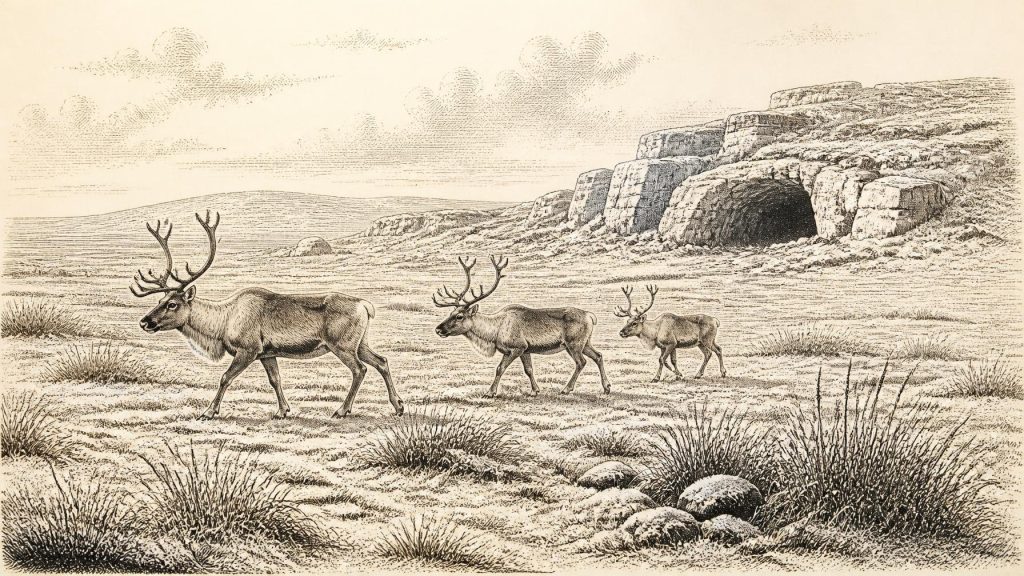
The chief Irish evidence for this remote interval comes from Castlepook Cave, near Doneraile in north County Cork. Its limestone passages include chambers named Elephant Hall and Hyaena Hall by early investigators. Excavations between 1904 and 1918 recovered a remarkable quantity of fossil bone, and the cave remains Ireland’s richest known archive of vertebrate life before the Last Glacial Maximum. More than 2,000 bones have been recovered; determinations on individual specimens span a long stretch of the Ice Age rather than a single occupation or one neatly bounded deposit.
That last qualification matters. A cave bone collection is not automatically a snapshot of the landscape outside. Bones may have been brought in by predators, dragged by scavengers, washed or reworked by water, moved by collapse, disturbed by animals, or displaced during historic excavation. Castlepook contains deposits affected by water, and its early excavations removed much of the material before modern standards of stratigraphic recording and sampling were available. The cave is invaluable precisely because its evidence is rich, but it is difficult precisely because its history is composite.
Radiocarbon results underline the problem and the opportunity. An early measurement on a woolly mammoth femur from disturbed Castlepook sediment gave 33,500 ± 1,200 radiocarbon years BP. Later accelerator dating and improved pretreatment of bone collagen showed that several older Irish cave dates had underestimated the true antiquity of the animals concerned. A 2020 reassessment found that new Castlepook dates could be roughly 5,000 to 12,000 radiocarbon years older than earlier results, placing important parts of the fauna firmly in Marine Isotope Stage 3. These are dates for animal remains, however, not a calendar for cave activity and certainly not proof that every bone entered the cave together.
Animals of an Open Country
The faunal list associated with Castlepook is striking: woolly mammoth, giant deer, reindeer, brown bear and spotted hyaena, with wolf, Arctic fox and lemmings represented in later cold-stage deposits. The overall assemblage shows that Ireland could support a varied Ice Age mammal community at different points before and during the last glacial maximum. It also shows that the island’s fauna was not simply a miniature copy of Britain’s. Some animals familiar from British late-Pleistocene sites, including woolly rhinoceros and steppe bison, are absent from the Castlepook record.
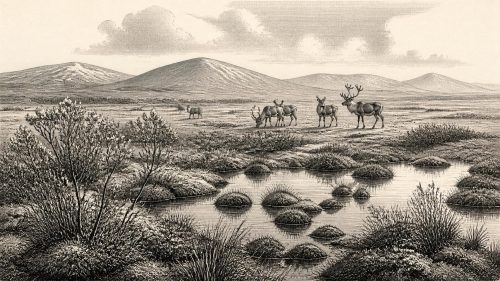
For a date around 33,000 calendar years ago, mammoth, reindeer, giant deer and spotted hyaena are especially relevant because dated or re-dated Castlepook material places their wider community in the middle part of the last glacial cycle. The safest reconstruction is not a crowded tableau in which every recorded species stands together at a Cork cave mouth. Rather, it is an intermittently occupied open landscape capable, over time, of supporting large grazers and browsers, formidable predators and cold-adapted small mammals. Reindeer and lemmings point towards cold, exposed conditions; mammoth and giant deer indicate substantial grazing resources; hyaenas testify to carnivores able to exploit carcasses and, at times, use caves as dens or repositories.
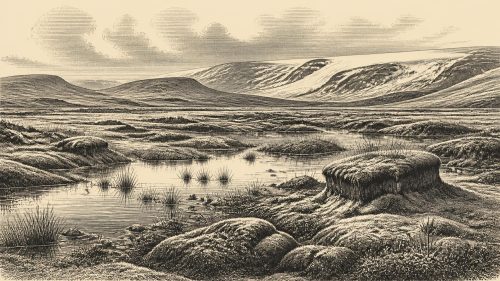
Vegetation must be reconstructed more cautiously still. No pollen diagram from Castlepook can provide a season-by-season picture of north Cork in 31,044 BCE. Yet the fauna, together with comparable north-west European evidence, is consistent with largely treeless grassland, herb-rich steppe or tundra-like mosaics, broken by wet ground, stream corridors and sheltered patches. Such country could look productive during a short growing season, while remaining punishingly cold, windy and unstable for much of the year. The familiar Irish patchwork of enclosed fields, hedgerows and wooded pasture lay far in the future.
Hyaenas, Carcasses and Ecological Risk
Spotted hyaena deserves emphasis because Castlepook is exceptional in Ireland for this animal. Its presence changes how the cave’s bones are read. Hyaenas are powerful bone-crushers and carcass collectors; gnawing, breakage and transport can resemble some humanly generated damage at first glance. A cache of bones may record hunting and scavenging on the landscape, but it also records the selective habits of a carnivore. Elephant Hall and Hyaena Hall therefore preserve evidence of an ecosystem and of cave use, not a straightforward record of human meals or domestic life.
This was a landscape of risk and opportunity for any visiting humans. Mammoth, reindeer and deer offered meat, hide, marrow, antler and bone, but obtaining or processing a carcass could bring people into competition with wolves and hyaenas. That observation is an ecological inference, not proof of a hunt at Castlepook. No weapons, hearths, dwellings or structured working areas of this date have been found in Ireland. The scale of the island’s surviving record does not permit claims about population, language, kinship, leadership, conflict or seasonal routes.
The Human Question
A reindeer femur from the Castlepook collection has been publicised as carrying a mark consistent with cutting or butchery by a stone tool, and as dating to roughly 33,000 years ago. If that interpretation is sustained by detailed taphonomic study and securely connected to the date of the bone, it would be of enormous importance: it could push evidence for human handling of animals in Ireland far back into the Upper Palaeolithic.
For now, it should be described as a significant but unconfirmed claim, not as the foundation for a story of settled Palaeolithic Ireland. A radiocarbon measurement dates the death of the reindeer, not automatically the making of a surface mark or the identity of its maker. Furthermore, Castlepook’s complicated depositional history and the capacity of carnivore damage, sediment abrasion and old excavation practices to obscure context set a high evidential threshold. A 2022 excavation located surviving sediments and recovered animal remains, but found no cultural artefacts; the site had previously been treated in the national record as lacking evidence for human occupation.
The contrast with County Clare is useful. At Alice and Gwendoline Cave, a brown-bear kneecap bearing cut marks has been independently radiocarbon dated to calibrated ranges around 12,810–12,590 and 12,810–12,685 years BP. That terminal-Pleistocene find is widely presented as Ireland’s first direct evidence of human presence, though debate continues over what a single modified bone can tell us about duration and scale of occupation. It is many thousands of years later than the Cork proposal. It should not be used to fill Castlepook’s silence.
Regional Change Without a Chronicle
Ireland’s position in the wider region was nevertheless crucial. Lower global sea levels altered coastlines and narrowed some sea passages, while ice, rivers, sea channels and changing land surfaces shaped possible movements between Ireland, Britain and continental Europe. Faunal arrivals demonstrate that connections existed at particular times, but they do not by themselves reveal a single route or prove an open land bridge at this exact date. Nor can the evidence establish trade or diplomacy: animal dispersal is not human exchange.
What can be said is that Ireland was part of a north-west European environmental zone undergoing profound regional change. The advancing and retreating ice system would eventually erode, bury or remove many open-air deposits. That helps explain why caves are so prominent in the evidence and why the archaeological record is so uneven. Castlepook survives as a deep archive of animal lives, carnivore behaviour, water movement and changing climates. It does not yield an Irish society in the conventional historical sense.
What This Date Can Mean
For Ireland around 31,044 BCE, the most important development is environmental rather than political: a cold-stage landscape was supporting a changing community of large mammals and predators while the British–Irish Ice Sheet was building towards its later maximum. Castlepook provides unusually strong evidence for that ecological world, but its mixed cave deposits demand restraint. The responsible historical picture is of open, cold country; mammoth, reindeer, giant deer and hyaena among its inhabitants; and a tantalising, unresolved possibility that people may have encountered or butchered a reindeer there. Beyond that lies possibility, not demonstrated history.
Primary Sources
- A reconsideration of the radiocarbon dating of the Marine Isotope Stage 3 fauna from southern Ireland
- Growth and retreat of the last British–Irish Ice Sheet, 31,000 to 15,000 years ago: the BRITICE-CHRONO reconstruction
- The timing and magnitude of the British–Irish Ice Sheet between Marine Isotope Stages 5d and 2
- Castlepook Cave: County Geological Site Report
- 2022:564 – Castlepook Cave, Castlepook South, Cork
- Dublin Radiocarbon Dates II
- The Irish Quaternary Fauna Project
- First evidence of a Late Upper Palaeolithic human presence in Ireland
- New insights on the fauna of Ireland's Younger Dryas and Early Holocene from Alice & Gwendoline Cave
- Revisiting Alice and Gwendoline Cave, Co. Clare: New light on the 1902 excavations
- Quaternary Site Descriptions
- Quaternary Geology of Ireland
- The IntCal20 Northern Hemisphere Radiocarbon Age Calibration Curve (0–55 cal kBP)
- OxCal
- Phylogeographic, ancient DNA, fossil and morphometric analyses reveal ancient and modern introductions of a large mammal: the complex case of red deer in Ireland
- Irish Cave Exploration
- Occurrence of mammalia relicts at site Castlepook Cave
- Could brown bears (Ursus arctos) have survived in Ireland during the Last Glacial Maximum?
- Mammoth Cave, County Cork
- Pleistocene vertebrates in the British Isles