Derryvree’s Open-Tundra Mosses30647 BCE
30,647 BCE is a modern label, not a recoverable Irish year. Derryvree, County Fermanagh, preserves freshwater sediments between glacial tills, radiocarbon dated broadly to 36,900–31,700 calendar years BP. Mosses and plant remains indicate treeless tundra, shallow water and seasonal productivity during a fluctuating MIS 3 climate. Castlepook Cave, County Cork, documents a diverse Pleistocene fauna, including mammoth, reindeer, giant deer, hyaena and horse, but its assemblage spans time and has complex formation histories. A possibly cut-marked reindeer femur suggests, without proving, human presence. No secure settlements, polities, trade networks or events are known; Ireland remained environmentally dynamic and archaeologically elusive.
Dateline
30,647 BCE is not a recoverable Irish year. It is a modern, proleptic calendar label applied to a time long before calendars, writing, named peoples or annual historical records. Mechanically, it falls about 32,596 years before AD 1950, the conventional radiocarbon reference point, but that arithmetic is not a calibrated archaeological date. At this depth of time, responsible history works with broad ranges, stratified deposits and changing probabilities. The most useful evidence places Ireland within the later part of the Last Glacial Period, in Marine Isotope Stage 3, when climate shifted abruptly between relatively milder interstadials and much colder stadials.
A Date Within Ranges
The best directly relevant environmental record is at Derryvree, near Maguiresbridge in County Fermanagh. Roadworks in 1969 cut through a drumlin and exposed freshwater silts and fine sands sealed between two separate layers of glacial till. The organic horizon contained plant and animal remains and produced a conventional radiocarbon age of 30,500 ± 1,170 radiocarbon years BP. Later calibration places the deposit broadly between about 36,900 and 31,700 calendar years BP. The notional year 30,647 BCE therefore lies within the wide calibrated envelope of the Derryvree evidence, but cannot be matched to a particular season, generation or episode in that deposit.
This distinction matters. Radiocarbon years are not identical to calendar years because atmospheric carbon-14 levels have varied through time. Calibration curves convert a measurement into one or more probability ranges, and uncertainties become substantial this far back. Moreover, the dated organic material records the age of material within a sedimentary unit, not a precise moment when every plant grew or every animal visited its shores. Derryvree is consequently evidence for an interval of open, cold environmental conditions in south Fermanagh, rather than proof that an identifiable event occurred across Ireland in 30,647 BCE.
The layers above and below the freshwater sediments are equally important. They show that ice advanced through the locality before and after the wetland interval. This is a powerful local sequence, yet it should not be made to bear more than it can. It does not yield a complete map of the island’s ice cover in a single year. Modern work on the British–Irish Ice Sheet stresses that its pre-Last Glacial Maximum extent and timing remain difficult to resolve, while the maximum and principal deglaciation phases lay later than this article’s notional date. Ireland was part of a volatile north-west European climate system, not a fixed white landscape.
A Wetland in Periglacial Ireland
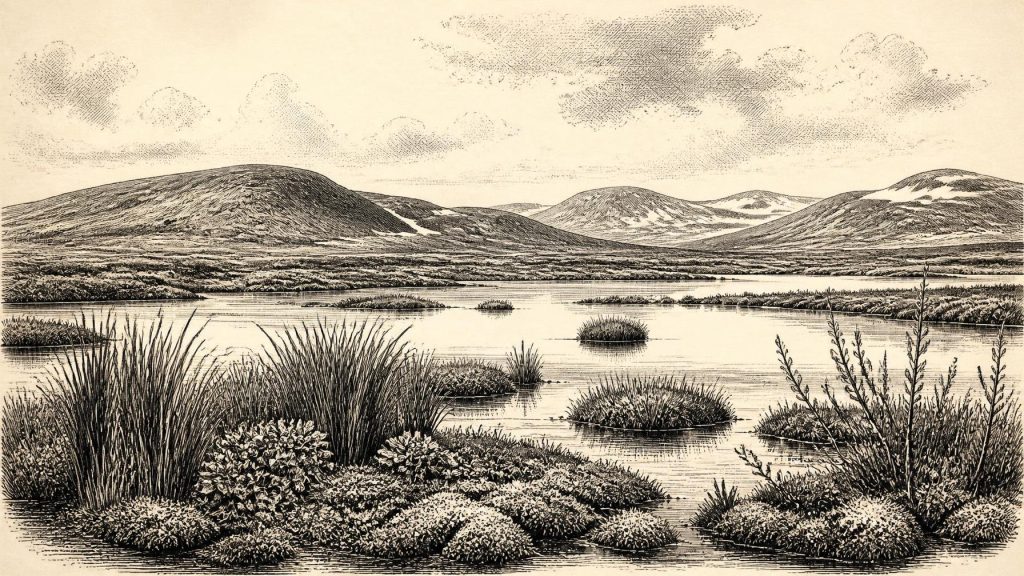
At Derryvree, the evidence points to a shallow freshwater body or wetland surrounded by sparse tundra and periglacial ground. Fossil mosses, plant macrofossils and poorly preserved pollen include species associated with cold, open habitats. Bogbean, water-milfoil, sedges, dwarf willow, mountain-avens and other herbaceous plants indicate that there was liquid water and a productive summer growing season, even though conditions were severe by modern Irish standards. The landscape was not a forest: pollen and macrofossils instead suggest largely treeless vegetation, with exposed mineral ground, wet margins and patches of low scrub.
That is a more complex scene than the shorthand “Ice Age” sometimes implies. Ice was present in the region at other points in the sequence, but a freshwater basin could support aquatic plants, mosses and invertebrates during an ice-free or ice-marginal interval. Seasonal thaw, meltwater and short summers mattered. Winter cold, frozen ground and strong winds would have limited woodland development, yet the local wetland had its own ecological richness. It was an environment of sedge banks, shallow pools and low-growing plants, not an empty wasteland.
Regional change was rapid on geological timescales. Irish cave speleothems from Crag Cave in County Kerry show episodes of calcite growth during warmer parts of the last glacial cycle; because speleothem formation requires liquid water, they independently demonstrate that climatic conditions repeatedly crossed important thresholds. Such evidence does not date Derryvree to a particular Greenland interstadial, but it reinforces the central lesson: Ireland experienced marked climatic oscillation rather than one unchanging glacial regime.
The Animal World Beyond the Mosses
For the larger animal world, Castlepook Cave near Doneraile in north County Cork is indispensable. Also called Mammoth Cave or Doneraile Cave, it has produced Ireland’s richest assemblage of pre-Last Glacial Maximum animal remains. Its cave deposits include woolly mammoth, reindeer, giant deer, brown bear, spotted hyaena, wolf, Arctic fox, wild horse and lemmings. The combination evokes a cold, open mosaic capable of supporting grazers and browsers, as well as formidable carnivores and scavengers. It also confirms that Ireland’s Pleistocene fauna was once markedly richer than the island’s modern terrestrial mammal fauna.
Yet Castlepook should not be read as a photograph of one day in prehistory. Many bones were recovered during nineteenth- and early twentieth-century excavations, before modern recording standards, and the cave accumulated remains over a long period. Animals may have died naturally, been dragged in by carnivores, been moved by water, or been disturbed by later digging. Re-dating has also shown that earlier radiocarbon determinations from Irish caves can be unreliable when compared with dates obtained using improved collagen pretreatment. Thus mammoth, reindeer and hyaena are securely relevant to the broader Pleistocene setting, but the evidence does not prove that every species stood together in County Cork in 30,647 BCE.
The relationship between Derryvree and Castlepook is therefore interpretative, not a direct archaeological link. Derryvree supplies a dated local environmental archive in Fermanagh; Castlepook supplies a longer, complicated faunal archive in Cork. Taken together, they make it reasonable to picture parts of Ireland as capable of sustaining cold-adapted vegetation and large mammals during portions of MIS 3. They do not supply a continuous island-wide census, a population estimate or a route map for animal migration.
The Human Question at Castlepook
The most arresting possibility concerns a reindeer femur from Castlepook. A mark on the bone has been interpreted as having been made by a sharp stone tool during butchery, and the bone has been publicised as dating to roughly 33,000 years ago. If that interpretation is confirmed, it would be extraordinarily important: it would indicate human handling of a reindeer in Ireland far earlier than the long-established evidence for post-glacial settlement.
But the proper conclusion remains cautious. A dated bone gives the age of the animal’s death, not an exact date for the incision. A cut-like mark requires its own taphonomic assessment, and the find lacks a securely associated hearth, stone-tool assemblage, dwelling floor, burial, human remains or undisturbed occupation layer. No excavated camp can therefore be assigned to this point in time. Recent fieldwork at Castlepook has sought surviving Pleistocene sediments precisely because better stratified evidence is needed. The femur is an important lead, not a licence to invent a settled hunting community in Cork.
There is useful wider context across the Irish Sea, but it cannot close that evidential gap. At Paviland Cave on the Gower coast of Wales, modern humans and Upper Palaeolithic material are known at a broadly comparable time depth, showing that people had reached parts of western Britain during the Late Pleistocene. That makes a brief human presence in Ireland environmentally conceivable, especially during favourable intervals. It does not demonstrate a crossing, a shared culture, regular contact or any political relationship with Ireland. Sea level, coastlines, ice margins and passage routes all differed substantially from the modern world and changed through time.
No Polities, No Proven Trade
There is no evidence for political authority, warfare, diplomacy, tribal names, territorial boundaries or institutions in Ireland at this date. Nor can archaeology identify religion, formal learning, language, art or exchange networks. If people did visit, they may have travelled in very small, mobile groups whose social lives left little durable trace; that is a hypothesis derived from wider Upper Palaeolithic comparison, not a demonstrated Irish fact. The Castlepook femur cannot tell us what its possible handlers called themselves, how many there were, where they slept, or whether they returned.
The same restraint applies to economy and everyday life. There is no evidence for farming, domestic animals, metalworking, pottery, houses or maritime trade. The only responsible economic inference is ecological: wild animals and seasonal wetland resources existed in some Irish landscapes, and these could have supported predators and perhaps occasional human foragers. Reindeer, horse or mammoth bones do not by themselves prove hunting strategies, while a possible butchered bone does not prove a specialised reindeer-hunting economy. The material record is too slight.
An Ireland of Evidence and Absence
For this notional point in deep time, the most important Irish development is not a named event but a recoverable environmental setting. Derryvree preserves evidence of freshwater life and open tundra between phases of glaciation. Castlepook preserves testimony to a lost community of large mammals and carnivores, together with a provocative but unconfirmed sign of human butchery. These archives show that Late Pleistocene Ireland was environmentally dynamic, intermittently habitable for a diverse fauna, and still archaeologically elusive.
The silences are as historically meaningful as the finds. There are no contemporary chronicles because writing lay tens of millennia in the future; there are no known rulers because the evidence cannot identify any; and there is no securely excavated Irish settlement from 30,647 BCE. What can responsibly be said is both modest and remarkable: around this broad period, wetlands, tundra plants and Ice Age mammals formed parts of Ireland’s changing landscape, while any human presence remains a question for further excavation, dating and microscopic analysis rather than a settled fact.
Primary Sources
- A Middle Midlandian Freshwater Series at Derryvree, Maguiresbridge, County Fermanagh, Northern Ireland
- Palaeoecology: Irish Quaternary Association Field Guide
- The Irish Quaternary Fauna Project
- A Reconsideration of the Radiocarbon Dating of the Marine Isotope Stage 3 Fauna from Southern Ireland
- Episodic Speleothem Deposition Tracks the Terrestrial Impact of Millennial-Scale Last Glacial Climate Variability in SW Ireland
- The Timing and Magnitude of the British–Irish Ice Sheet Between Marine Isotope Stages 5d and 2
- New Data for the Last Glacial Maximum in Great Britain and Ireland
- Trimlines, Blockfields and the Vertical Extent of the Last Ice Sheet in Southern Ireland
- New Insights on the Fauna of Ireland’s Younger Dryas and Early Holocene from Alice & Gwendoline Cave
- CASTLEPOOK CAVE, Castlepook South, Cork: 2022 Excavation Report
- Areas of Scientific Interest in County Cork: Castlepook Caves
- Heritage Artefacts of County Cork
- Mammoth Cave
- Guide to the National Museum of Ireland – Natural History
- Outreach and Education Resources
- IntCal Publications
- The IntCal20 Northern Hemisphere Radiocarbon Age Calibration Curve (0–55 cal kBP)
- The IntCal20 Approach to Radiocarbon Calibration Curve Construction
- Spatio-Temporal Dynamics of Speleothem Growth and Glaciation in the British Isles
- Upper Palaeolithic Bone Spatula, Paviland Cave
- Paviland Cave and the Ice Age Hunters
- The Late Quaternary History of East-Central Ireland