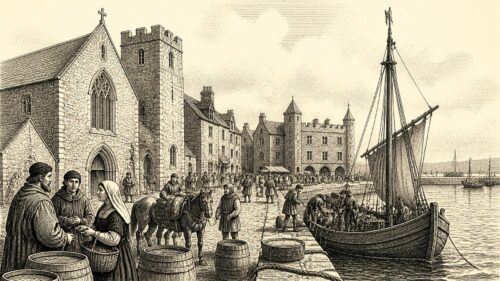
Cork Workhouse1735 CE
In 1735, Ireland’s Protestant governing system addressed poverty, security and economic improvement through parliamentary proposals, proclamations and print. Dublin’s parliament, constrained by Poynings’ Law and dominated by property-owning Protestants, considered measures reinforcing Catholic exclusion from juries and restricting mixed marriages. Cork advanced plans for St Fin Barre’s reconstruction and a workhouse combining relief, labour discipline, foundling care and Protestant instruction; legislation passed in 1736. Road schemes and liquor-credit regulation reflected social concerns. Proclamations pursued robbers across counties. George Berkeley’s Querist promoted debate on employment, consumption and national resources, while Protestant schooling and Ulster Scots print illustrated confessional and cultural currents.
Dateline
In 1735 Ireland’s public life was shaped less by a single dramatic rupture than by the machinery of a Protestant state confronting poverty, insecurity and economic constraint. The most revealing evidence comes from proclamations, print and the parliamentary session that opened at Dublin on 7 October. They show officials attempting to police the countryside, regulate religion and marriage, improve roads and direct the poor into institutions of work and discipline. The year also produced important Irish writing: George Berkeley began to publish The Querist, a searching sequence of questions about money, employment and national improvement. Together, these developments offer a close view of an unequal but changing country.
A Parliament Returns
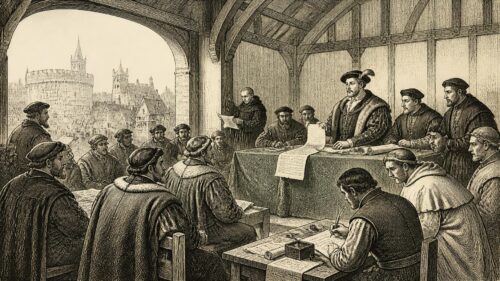
The Irish parliament met on 7 October 1735, beginning a session which continued until 30 March 1736. Its calendar-year opening matters. Ireland possessed a parliament in Dublin, but it was not a sovereign national legislature: under Poynings’ Law, prospective legislation passed through the Irish and English privy councils before it could return for enactment. The Lord Lieutenant, Lionel Sackville, Duke of Dorset, governed in the king’s interest; George II was monarch. Political authority therefore ran from Dublin Castle to London as well as through the Lords and Commons in Dublin.
Nor did the parliament represent Ireland’s population in any broad modern sense. Its political nation was Protestant and heavily property-based. Roman Catholics, who formed the large majority of the people, remained subject to the penal system; Presbyterians and other Protestant dissenters also occupied an insecure position within an established Church of Ireland order. The session’s business demonstrates how law helped preserve that order. It dealt with revenue and local improvement, but also with juries, marriage, poor relief, religious identity and the conduct of everyday commerce.
Care is needed over dates. Several measures associated with the “1735 session” became statutes only in March 1736, and should not be described as laws enacted during calendar year 1735. Yet their introduction and progress after October belong directly to the political world of 1735. They expose the assumptions of those who governed Ireland: social discipline, Protestant security and local economic management were closely intertwined.
Juries, Marriage and Confessional Power
One eventual statute of the session revised jury qualifications. It imposed substantial property requirements and expressly preserved existing exclusions on Catholics serving as jurors. The point was not merely technical. Jury service connected local men to the administration of justice; denying it confirmed that the law was administered by a restricted political and religious community. In a country whose Catholic inhabitants were numerous in town and countryside alike, this was a practical reminder that legal equality was absent.
A further measure, directed against clandestine marriages, likewise reveals anxieties that were familial, financial and confessional at once. Its stated concern was that under-age people with fortunes might marry without the consent of parents or guardians. But it also treated Protestant–Catholic marriage as a danger, asserting that such unions increased and spread the Catholic interest and religion. The proposed controls thus belonged to a wider system in which inheritance, household formation and denominational allegiance were matters of state policy. For Catholics, the consequences of such laws were felt not in abstract constitutional debate but in the choices open to families, clergy and local communities.
That politics was conducted through a parliament does not mean that its outcomes were wholly made in Dublin. Before 1782, Irish legislative proposals could be altered or stopped in London. The bills of this session travelled through both privy-council systems. This procedure helps explain why a date attached to a parliamentary session is not always the date of an act. It also underlines the limited autonomy of eighteenth-century Irish institutions, even while Irish officeholders and landowners bargained vigorously within them.
Cork’s Proposed Workhouse
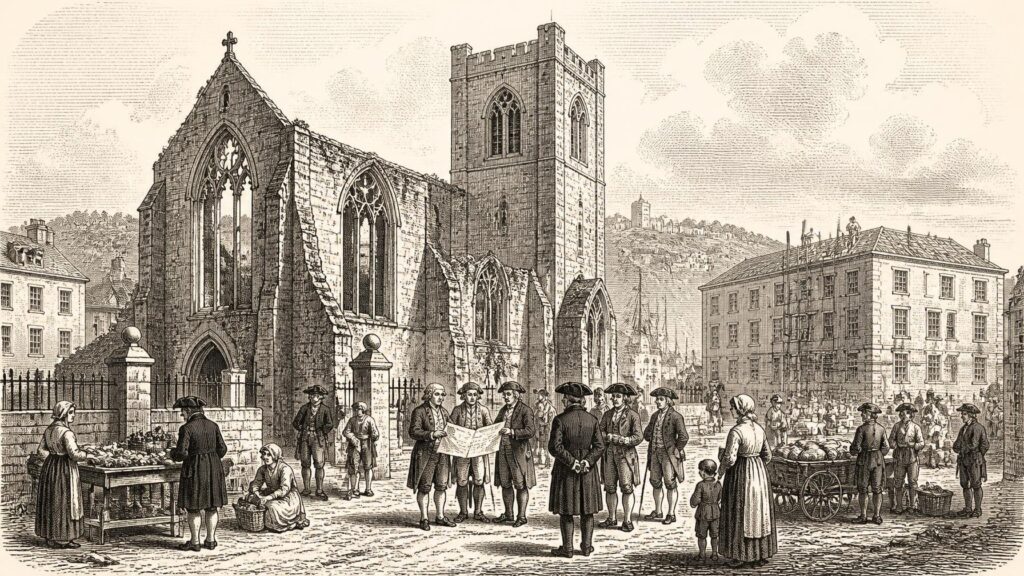
The session’s most vivid local project concerned Cork. A bill was advanced to rebuild the city’s cathedral church of St Fin Barre and to establish a workhouse corporation for the city and its liberties. The resulting City of Cork Act received royal assent in March 1736 and was to operate from 1 May, so neither the corporation nor the rebuilding should be placed fully in 1735. But the initiative, discussion and parliamentary passage through the 1735–36 session show what Cork’s civic authorities considered urgent as 1735 closed.
The bill’s preamble described St Fin Barre’s as ruinous and unsafe for worshippers. It also presented a stark official picture of urban distress: the poor and “idle vagrants” were said to be numerous and increasingly burdensome, while many were deemed able to work if a workhouse compelled and organised them. This language should not be accepted simply as a neutral description of Cork’s poor. It records the viewpoint of civic governors who classified hardship, unemployment, begging and mobility as problems of order. Still, it is powerful evidence that poverty was visible enough in Cork to demand a large institutional response.
The planned workhouse was intended to employ and maintain poor people, punish vagrancy and provide for foundling children. Its programme joined relief to coercion. Children were to be clothed and taught reading and writing, but the statute also required Protestant instruction. The future Cork institution therefore belonged to the same confessional state seen in the jury and marriage measures. Charity could supply food, shelter and schooling, yet it could also seek to reshape religious identity. The simultaneous plan for a cathedral and workhouse made civic improvement, established religion and social control parts of one municipal project.
Roads and the Geography of Improvement
Road legislation associated with this parliamentary session ranged across the island: routes in Westmeath and Longford, Antrim and Londonderry, Down and Armagh, Tipperary and Queen’s County, Kildare, Kilkenny and the road towards Clonmel all featured among the measures that became law in 1736. These acts should not be mistaken for proof that every road was built or transformed in 1735. Their importance is different. They show that improving communication between market towns, county centres and ports was an active concern as parliament assembled that autumn.
For landowners, merchants, carriers and farmers, passable roads affected the price and movement of grain, cattle, linen yarn, turf, timber and imported goods. For ordinary travellers, poor surfaces and river crossings could turn a short journey into a serious undertaking, particularly in bad weather. Road acts usually rested on local finance and local administration rather than a central national highway system. Their geographical spread nevertheless points to an Ireland increasingly conceived through connected markets and county networks, even though the benefits of improvement were uneven.
Commercial regulation appeared in smaller proposals too. Late in 1735 the Commons considered a measure against retailers who extended credit for beer, ale, brandy, rum, Geneva and other spirits to servants, day labourers and people paid wages. It did not become law until the following March. Its very wording is instructive: wage labour, drink, debt and household authority were perceived as linked problems. Masters could fear that credit at a public house would diminish a worker’s wages or reliability; legislators proposed to manage a familiar social transaction through statute.
Order in the Countryside
Government proclamations give another, necessarily official, view of the year. On 24 January 1735 the authorities ordered named “tories, robbers and rapparees” presented in Antrim, Down, Monaghan, Cavan, Clare, Tipperary and Carlow to surrender. Further proclamations in June addressed alleged offenders in several other counties and offered rewards in particular cases. Such notices do not establish a single island-wide crime wave, and the categories were politically charged. “Rapparee” carried memories of earlier wars and dispossession as well as criminality. They do show, however, that Dublin Castle relied upon county presentments, public notices and rewards to project authority beyond the capital.
The need to proclaim order across both Ulster and the south and west should not obscure regional differences. Much of rural life consisted of farming, seasonal labour, tenancy, fairs, parish obligations and local exchange. But the state’s published language drew attention to threats against property and persons. For those named, or living near them, the boundary between poverty, mobility, illicit activity and political suspicion could be dangerously thin.
Print, Schooling and Economic Argument
Print made 1735 intellectually significant. Late in the year, George Berkeley, Church of Ireland bishop of Cloyne, anonymously issued the first part of The Querist in Dublin. Rather than offering a conventional treatise, Berkeley posed compact questions about consumption, credit, banking, agriculture, manufacture and employment. He asked readers to consider whether an industrious country could be poor, whether imported luxuries drained resources, and how domestic work might be encouraged. The remaining parts appeared in 1736 and 1737, so only the first instalment belongs to this year.
Berkeley wrote from a position of privilege, but his intervention was closely connected to conditions in his diocese and to wider arguments about Irish economic dependence. He promoted local production and productive employment while identifying rural poverty as a grave social fact. The Querist did not itself alter the constitutional restrictions that shaped Irish trade, nor did it solve deprivation. Its importance in 1735 was to frame improvement as a public question: how could Ireland use its labour, land, credit and purchasing power differently?
Education was also an instrument of religious policy. In August, Dublin printer George Grierson reprinted an account of the Incorporated Society in Dublin for promoting English Protestant schools in Ireland. The publication is firm evidence of an active institutional campaign to establish schools that combined literacy with conversion and anglicisation. Schooling could create opportunity for individual pupils, but its stated Protestant purpose means it cannot be detached from the hierarchy of the penal era.
At the northern edge of the island’s print culture, scholarship places a Strabane broadsheet containing local verse in Scots at about 1735. The dating is approximate, not firm enough to assign a precise publication day or author. Even so, it is a useful sign of the durable cultural connections between Ulster and Scotland. Long before the better-known “rhyming weavers” of the later eighteenth and nineteenth centuries, readers and writers in Ulster encountered vernacular Scots alongside English-language print and the continuing, largely oral, Irish-language cultures of many districts.
A Year of Designs Rather Than Completion
Thus 1735 is best understood as a year of designs, proceedings and printed arguments. Parliament reopened in October; Cork’s civic leaders pressed a scheme that joined a rebuilt cathedral to a disciplinary workhouse; measures were set in motion that would reinforce Protestant control of juries and marriage; and road proposals mapped ambitions for a more connected commercial landscape. Berkeley’s questions gave unusually direct expression to concerns over idleness, industry and national resources.
The calendar year ended before many of these legislative designs became statutes or buildings. That distinction is important. Yet the record of 1735 already shows the direction of travel: an Ireland governed through a narrow constitutional system, concerned with mobility and poverty, increasingly attentive to infrastructure and economic improvement, and still determined to bind welfare, law and education to Protestant ascendancy.

Primary Sources
- City of Cork Act 1735
- Statute Law Revision Act 2015
- Acts of Parliament by Session, 1735
- How Irish Statutes Were Made
- Sources for Irish Legislation, 1692–1800
- Irish Legislation Database: Bill 3746, Retailers of Spirituous Liquors
- Berkeley, George
- The Querist
- The Querist: Containing Several Queries, Proposed to the Consideration of the Public
- A Brief Account of the Proceedings of the Incorporated Society in Dublin, for Erecting and Promoting English Protestant Schools in Ireland
- Setting His Own Standard: James Orr’s Employment of a Traditional Stanza Form
- Statutes in Chronological Order: The Reigns of King George I and II
- Index of Statutes in Chronological Order: Irish Penal Laws
- Holdings: The Dublin Journal
- Statute Law Revision Act 2007, Schedule 2
- Land Improvement Act (Ireland) 1735
- Irish Smuggling in the Eighteenth Century
- Minister O’Donovan Announces Plans for Magazine Fort in the Phoenix Park
- Restoring History: The Magazine Fort Revival
- Opening of Magazine Fort
- The Dublin Gazette Newspaper Archives, 9 September 1735
- The Works of George Berkeley, Bishop of Cloyne, Volume I