Ulster Emigration1718 CE
In 1718, Ireland’s significant developments centred on migration, religion and voluntary institutions rather than rebellion. Five vessels carried Presbyterian emigrants from Ulster to Boston, beginning a durable Atlantic movement driven by tenancy insecurity, economic pressures, religious disabilities and colonial opportunity. Ireland’s Protestant ruling order continued to disadvantage Catholics and dissenters, while Sherlock v Annesley highlighted contested Irish autonomy. Six surgeons founded Dublin’s Cook Street infirmary for injured poor, precursor to Jervis Street Hospital. A Ballybough cemetery lease recorded Jewish life. Church appointments and Catholic diocesan administration demonstrated competing authorities, while Thomas Parnell’s death connected Irish culture with British literary networks.
Dateline
In 1718 Ireland was not convulsed by a new rebellion or a decisive battle. Its defining developments were quieter, but consequential: families from Ulster embarked for New England; Dublin surgeons began a small charitable infirmary for the city’s injured poor; and religious institutions adjusted to an Ireland in which the established Church of Ireland, Roman Catholics, Presbyterians and a small Jewish community lived under sharply unequal conditions. The year is therefore best understood through movement, institutions and the pressures of everyday life rather than through a single national political drama.
Ulster’s Atlantic Departure
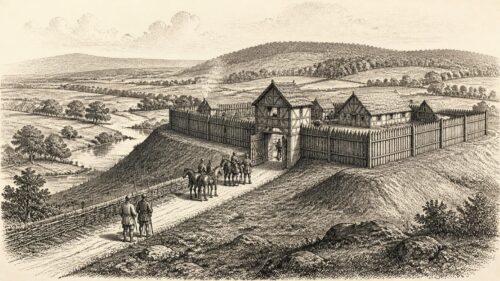
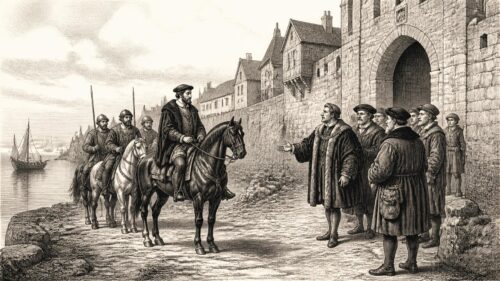
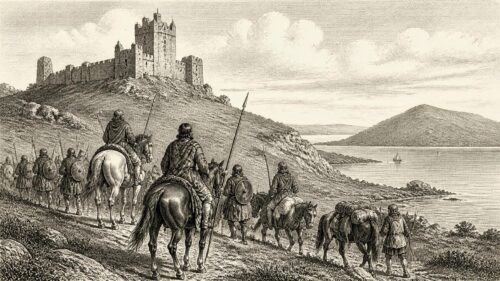
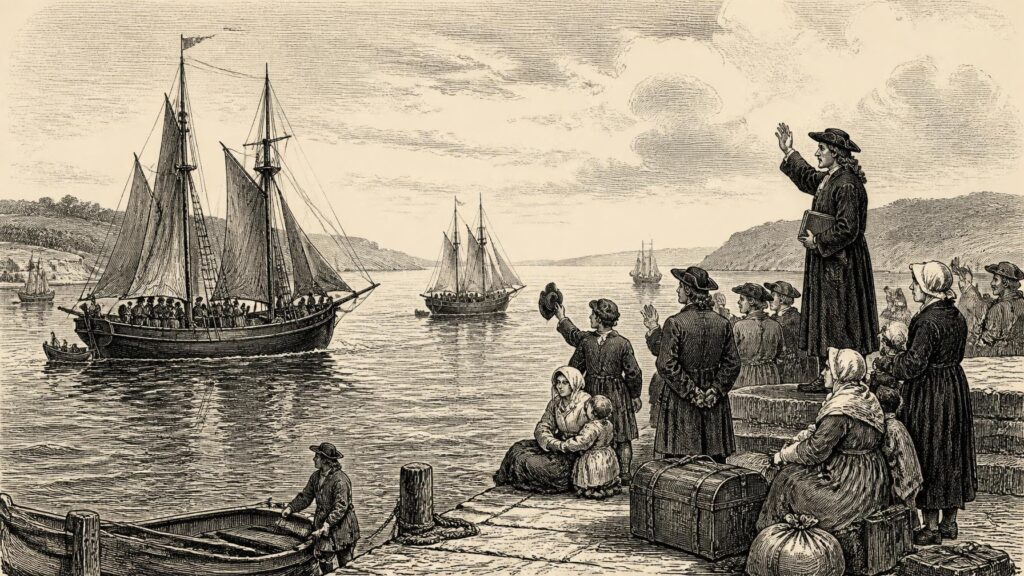
The firmly dated and best-known Irish development of 1718 was the summer departure of Presbyterian emigrants from Ulster for New England. Accounts conventionally identify five small vessels arriving in Boston during July and August, carrying people from communities connected especially with the Bann and Foyle valleys. Their numbers are often estimated at close to 700, but neither an exact passenger total nor a complete passenger list can safely be claimed. What is certain is that this was a conspicuous, organised migration, involving ministers, householders and families rather than merely isolated individuals seeking work.
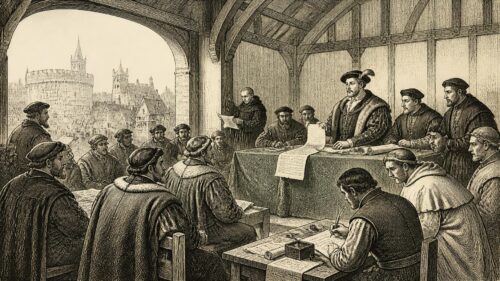
It was preceded by collective preparation. An early-1718 petition to Samuel Shute, governor of Massachusetts Bay, carried hundreds of names from the north of Ireland and sought encouragement for settlement. The document did not guarantee that every signatory emigrated, but it reveals the scale of intention and the degree of co-operation involved. Clergymen were central to this process. James McGregor of Aghadowey, in County Londonderry, was among the ministers associated with the migration and later with the community that became Londonderry, New Hampshire. Other emigrants travelled from neighbouring parts of Ulster, where kinship, congregation and commercial connections helped make a hazardous Atlantic crossing imaginable.
The voyage was an act of calculation as well as desperation. Passage required money, credit, contacts and a willingness to exchange familiar tenancy, language and parish for a distant colony. The people who left were commonly called “Scotch-Irish” in North America and are now often described in Ireland as Ulster Scots. Both labels can obscure as much as they explain: they were inhabitants of Ireland, many descended from seventeenth-century Scottish settlers, and they carried Presbyterian religious loyalties formed and sustained in Ulster.
Their decision cannot responsibly be reduced to one cause. Long leases granted after the Williamite wars were expiring or had recently expired; landlords could seek higher rents from incoming tenants; and rural households faced insecurity in years when harvests and food prices remained precarious. Presbyterians also bore the burdens of an Anglican confessional state. They paid tithes to the established Church of Ireland and, because they would not take Anglican communion, were excluded by the sacramental test from many public offices. These disadvantages mattered, though they affected people differently according to wealth, locality and occupation. New England’s demand for settlers, its land frontier and its existing Protestant networks supplied the pull.
For Ulster, the five ships were not the beginning of all emigration to America, nor did they empty the province. They did, however, mark the opening of a large and durable movement. The departure gave later migrants a practical precedent: ships could be found, ministers and congregations could relocate together, and colonial officials might receive them favourably. In that sense, an event limited in scale within Ireland in 1718 became an important hinge between Ulster’s local society and the wider British Atlantic world.
An Unequal Political Peace
Ireland in 1718 remained a separate kingdom under King George I, with its own parliament and administration, but political power was concentrated in a Protestant governing class. The Roman Catholic majority remained subject to penal legislation affecting property, education, office-holding and political participation. Protestant dissenters, particularly Presbyterians, enjoyed more security than Catholics but not full civic equality. The established Church of Ireland held legal and institutional privilege despite representing only a minority of the population.
These arrangements shaped daily life well beyond Dublin Castle. Religion influenced access to office, local authority, schooling, marriage networks and the payment of tithes. Yet enforcement and experience varied substantially. Catholics continued to maintain religious communities and clergy; Presbyterians maintained a vigorous network of congregations and presbyteries; and many practical relationships in market towns and rural districts crossed confessional boundaries. The island was neither uniformly passive nor permanently on the verge of rebellion. Its divisions were instead built into the rules by which land, authority and public recognition were distributed.
A legal dispute over land at Naas, County Kildare, also acquired constitutional importance during 1718. The case of Sherlock v Annesley exposed rival claims about whether the Irish or British House of Lords was the final court of appeal for Ireland. The conflict was still developing in 1718; its most dramatic parliamentary and legislative consequences belonged to 1719 and 1720. It should therefore not be presented as a settled constitutional outcome of this year. Even so, the litigation showed that Irish political elites were alert to the limits of their kingdom’s autonomy within the composite British state.
Dublin’s Small Infirmary
One of 1718’s most tangible urban foundations was made by six Dublin surgeons: Francis and George Duany, Patrick Kelly, Nathaniel Handson, John Dowdall and Peter Brenan. They opened a provision in Cook Street for what contemporary language called the “maim’d and wounded poor”. Initially it could accommodate only four patients. This modest enterprise became the Charitable Infirmary, later associated with Jervis Street Hospital.
The institution matters because its scale reveals the character of early eighteenth-century welfare. It was not a public hospital in the modern, tax-funded sense. It depended on the initiative of medical men and on charitable subscriptions. The sick poor of Dublin had few secure means of obtaining sustained medical care, and treatment often depended on household resources, parish relief, private beneficence or admission to an institution with very limited space. The Cook Street infirmary represented an attempt to supply organised surgical attention where need was visible and acute.
Its founders also helped establish a pattern that would transform Dublin’s medical landscape over the century: voluntary hospitals supported by philanthropic patrons, governors and subscriptions. That later development should not be projected wholesale back onto 1718. At its beginning, the infirmary was exceptionally small, fragile and practical. Yet the survival of its institutional lineage makes it one of the year’s clearest examples of citizens creating a durable urban service from private initiative.
Dublin’s diversity is also visible in a dated property transaction of 28 October. A plot at Ballybough, near the north side of the city, was leased for use as a Jewish cemetery. Later accounts have sometimes described the ground simply as Ashkenazi, but the names connected with the 1718 lease and the older Dublin congregation point to Sephardi or Portuguese-Jewish origins; the site subsequently served a wider Jewish community. The distinction is worth preserving. This was not evidence of a large or politically equal Jewish population, but it was an enduring material sign of Jewish religious life in Dublin. Ballybough became Ireland’s oldest known Jewish burial ground.
Churches, Authority and Continuity
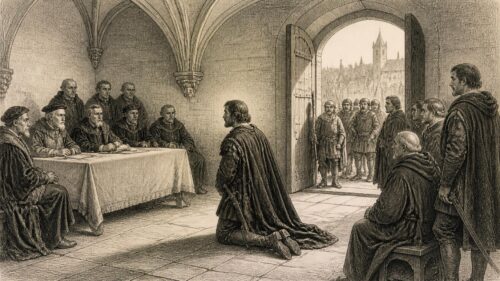
Ecclesiastical changes in 1718 illuminate the island’s several religious worlds. On 2 May William Nicolson, an English scholar and bishop, was appointed to the Church of Ireland bishopric of Derry. The position was wealthy by comparison with his previous see of Carlisle, but it also placed him in a province where Presbyterianism was powerful and where church appointments could carry political meaning. Nicolson’s arrival was resented by Archbishop William King of Dublin, who disliked the number of English-born clerics receiving Irish preferments. The disagreement reflected rival interests inside the established church, not merely a simple Protestant unity.
On 10 May, Pope Clement XI placed the Roman Catholic diocese of Emly under the permanent apostolic administration of the archbishop of Cashel. Later shorthand often calls this a union of Cashel and Emly, but the 1718 arrangement is more precisely described as an administrative joining under Cashel. It provided continuity of episcopal oversight in a period when Catholic diocesan organisation endured despite legal disabilities and restricted public standing. The change was ecclesiastical rather than a relaxation of the penal system.
These developments caution against imagining religion in 1718 solely as persecution or solely as doctrine. It was also administration: appointments, diocesan boundaries, patronage, parishes, burial grounds and the practical maintenance of communities. The established church’s authority was real, but it existed alongside religious traditions that retained members, clergy, institutions and collective memory.
A Year of Departures
1718 also saw the death of Thomas Parnell, the Dublin-born Anglican clergyman and poet, while travelling towards Ireland through Chester. Contemporary and later biographical accounts differ over the precise dating of his death, so it is safer to place it generally in 1718 than to insist on a day. His career linked Irish clerical life, Trinity College Dublin and the literary circles of Jonathan Swift and Alexander Pope. Parnell’s death was not a national political event, but it reminds us that Irish cultural life was connected to London publishing, patronage and debate.
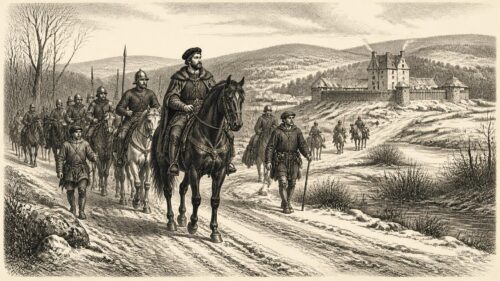
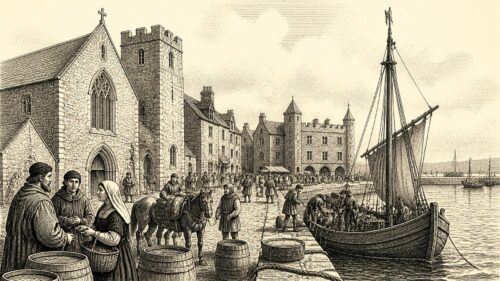
The year’s strongest image remains the western departure from Ulster: vessels leaving familiar coasts with people who carried Bibles, household goods, skills, debts and hopes across the Atlantic. Alongside it stand a four-bed infirmary in Cook Street and a leased burial ground at Ballybough. Each was small. Each nevertheless points to a larger truth about Ireland in 1718: communities facing constraint did not merely endure their circumstances. They organised, migrated, subscribed, worshipped and created institutions whose consequences would outlast the year itself.

Primary Sources
- Irish Statute Book: Pre-Union Irish Statutes
- Nicolson, William
- Parnell, Thomas
- Butler, Christopher
- History – Charitable Infirmary Charitable Trust
- Survey of Hospital Archives in Ireland
- Foundation – Dr Steevens’ Hospital
- 1718 Migration from Ulster to New England
- Dr James McConnel
- 1718 Migration
- 1718: The Migration from Ulster to New England
- Climate
- The Presbyterians of Ulster, 1680–1730
- “On the Wing for America”: Ulster Presbyterian Migration, 1718–1729
- A Bibliography of Ship Passenger Lists, 1538–1825
- Five Ships from Ulster, and What They Left Behind
- Constitutional Differences
- ‘Reasonable Inconveniences’: The Theory and Practice of the Penal Laws
- Penal Laws
- Emly (Diocese)
- Diocese of Emly, Ireland
- How Cashel and Emly Were United
- Timeline Events – Irish Jewish Museum
- The Former Crane Lane and Marlborough Green Synagogues
- Ballybough Jewish Cemetery
- NIAH Dublin Stage 4 – Ministerial Recommendations