O’Doherty’s Rising1608 CE
In 1608, Sir Cahir O’Doherty, formerly a Crown ally and lord of Inishowen, rebelled amid disputes over land, authority and Governor George Paulet’s conduct. His followers seized Culmore Fort, stormed, plundered and burned Derry, killing Paulet, but failed to create a wider Ulster coalition. Crown forces suppressed the rising after O’Doherty’s death near Kilmacrennan in July, followed by reprisals and executions. The revolt intensified official distrust of Gaelic landholders and expanded forfeitures. Surveys of six Ulster counties documented lands and resources for redistribution, while planning for plantation advanced. Deaths among exiled Gaelic leaders further weakened resistance, leaving Crown power strengthened.
Dateline
The most consequential Irish events of 1608 unfolded in Ulster, where an uprising led by Sir Cahir O’Doherty briefly overturned the Crown’s foothold at Derry and accelerated a far larger transformation of landholding and power. The year should not be treated simply as the beginning of the Ulster Plantation: the great organised settlement generally associated with that name was implemented later. But 1608 was the year in which rebellion, confiscatory investigation and administrative planning made a new colonial settlement appear practicable to government in Dublin and London.
A Crown Ally Turned Rebel
Cahir O’Doherty was not an obvious enemy of the English administration. Lord of Inishowen in north Donegal, he had assisted English forces during the Nine Years’ War and had received a royal patent confirming his lordship in 1603. He was a knight, a justice of the peace and an alderman of Derry. In early 1608 he even acted as foreman of the jury that indicted the departed Ulster earls for treason. These positions show the awkwardness of the political world created after the war: an Irish lord could be drawn into Crown institutions while still defending a local inheritance, kinship following and status founded on older Gaelic practice.
That accommodation had become increasingly brittle. O’Doherty disputed the loss of Inch Island in Lough Swilly, which he regarded as part of Inishowen but which had been granted to Sir Ralph Bingley. He was also alarmed by the conduct of Sir George Paulet, governor of Derry since 1606. Paulet had inherited a strategically important but socially delicate garrison town from Sir Henry Docwra, whose long local experience had allowed a working relationship with O’Doherty. Paulet’s manner was markedly less conciliatory. Following the Flight of the Earls in September 1607, he interpreted O’Doherty’s movements and castle repairs as evidence of treason. O’Doherty went to Dublin to complain but was briefly imprisoned and bound in heavy recognisances.
The immediate quarrel in Derry in April 1608 acquired lasting notoriety. The Annals of the Four Masters, a later but important Irish annalistic account, says that Paulet insulted O’Doherty verbally and struck him. The allegation cannot by itself explain a rising, and it should not obscure disputes over land, authority and security. Yet it conveys how personal humiliation could carry political force among people accustomed to honour as well as law. At roughly the same time, the English Privy Council had decided that Inch Island should be restored to O’Doherty. The decision came too late to prevent violence.
The Night at Culmore and Derry
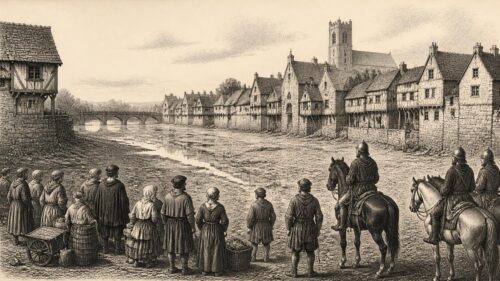
On the night of 18–19 April, O’Doherty’s followers gained control of Culmore Fort at the mouth of Lough Foyle. Captain Henry Hart, its commander, was lured out after an invitation to dine; the fort’s arms and ammunition then became available to the attackers. Before dawn they moved on Derry. In the usual modern chronology the town was stormed on 19 April. Paulet, the under-sheriff and other defenders were killed, while Susan Montgomery, wife of the Church of Ireland bishop of Derry, was taken prisoner. The settlement was plundered and burned.
This was a sharp strike at the exposed edge of English government, not the recovery of an independent Gaelic Ulster. O’Doherty withdrew after the attack rather than attempting to hold Derry. Nor is there sound evidence that he acted on instructions from Hugh O’Neill, earl of Tyrone, or Ruaidhrí O’Donnell, earl of Tyrconnell, then refugees on the Continent. The rebellion did, however, flourish in the fearful atmosphere their departure had created. To the authorities, the seizure of a fort and destruction of Derry seemed confirmation that loyal Irish intermediaries could not safely be trusted. To many people in the region, it demonstrated that military occupation and the new order of patents, grants and garrisons remained profoundly unsettled.
O’Doherty’s force was substantial for a local rising but limited in reach. One contemporary-informed estimate puts it at about 1,000 men at its height. Support was strongest in northern Tír Chonaill and Inishowen. His brother-in-law, Eochaidh Óg O’Hanlon, stirred resistance in south Armagh, but the rising did not unite Ulster. Sir Toirdhealbhach O’Neill, a major Catholic landholder who had remained in Ireland, was among those ordered to assist the government’s response. Such choices underline that political allegiance did not divide neatly along ethnic or confessional lines: local calculation, family interest, fear and the prospect of royal favour mattered greatly.
War, Reprisal and Defeat
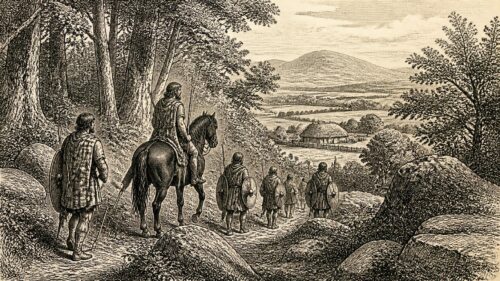
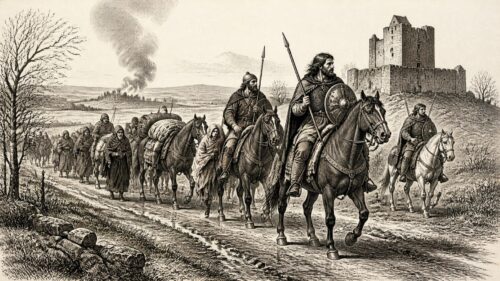
The Crown’s answer was swift. An English field force, supported by Irish auxiliaries, entered the north-west. O’Doherty’s men raided into Tyrone, burned Armagh town and killed Henry Óg O’Neill at Kinard. Government forces meanwhile sought to contain the insurgents in the difficult country of Donegal. English accounts emphasised the restoration of order; the Four Masters instead stressed the widespread suffering that followed, recording executions and the devastation brought upon Ulster. Both perspectives reveal essential parts of the event. The rising endangered garrisons and settlers, while the campaign against it exposed civilian communities to plunder, displacement and the destruction of food and property.
O’Doherty escaped an attempted trap in Glenveagh but was killed in battle near the Rock of Doon at Kilmacrennan in July. The precise day is not entirely consistent across surviving narratives: modern biographical accounts give 5 July, while the Four Masters records 18 July. It is safer to say that his death came in mid-summer, after only a few months of rebellion. He was about twenty-one. His death dissolved the movement’s military centre. Phelim Reagh MacDaid, his principal adviser and foster-brother, was captured after trying to escape and was executed at Lifford in September with other prisoners. Niall Garvach O’Donnell, accused of involvement, was arrested and eventually sent to the Tower of London.
The violence also had an institutional consequence. Sir John Vaughan, an experienced officer and military engineer, became governor of Derry and oversaw its rebuilding. What had been a vulnerable outpost was to become a more securely planned colonial town. Still, its later rebuilding and enlargement must not be projected backwards into April 1608. At the moment of the attack, Derry was a small garrison settlement, dependent on fortifications, river access and fragile local relationships.
Surveying a Confiscated Province
Even before the rising, Lord Deputy Sir Arthur Chichester had considered how the lands of the departed earls might be settled. O’Doherty’s defeat hardened policy. The Crown now claimed a greatly enlarged field of forfeited land: not only estates associated with Tyrone and Tyrconnell, but properties of lesser lords implicated in the new revolt. Chichester himself would later receive Inishowen. The consequence for many Gaelic landholders was stark: service to the Crown offered no certain protection once an official inquiry could represent a lordship as forfeit.
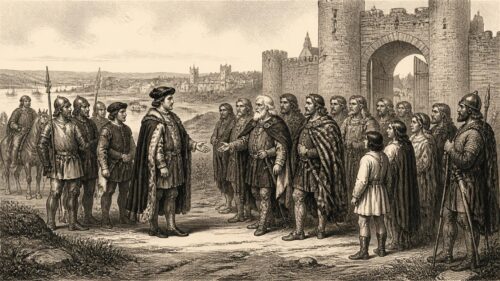
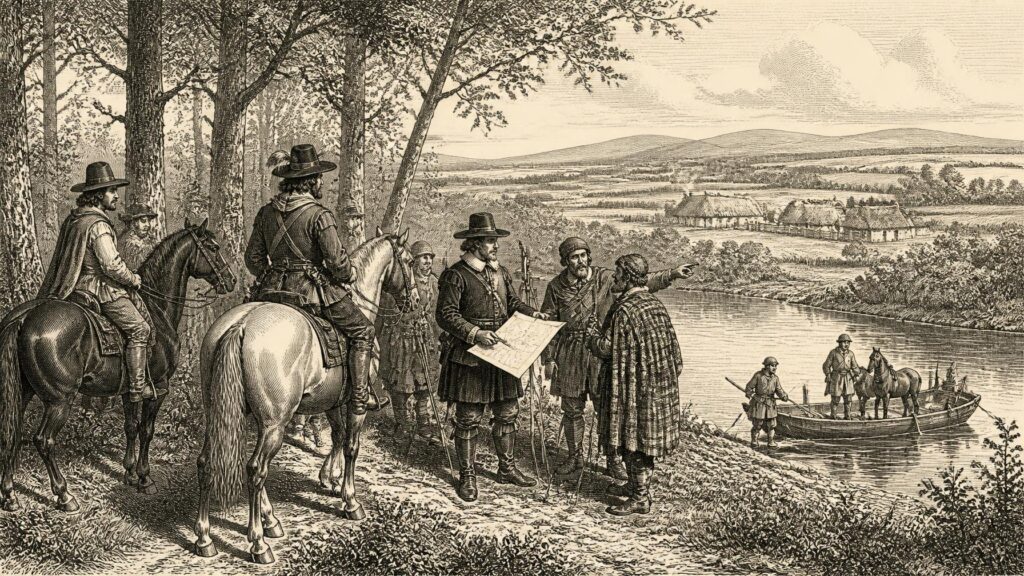
In July the English Privy Council instructed Chichester not to promise any of the escheated land before a survey and certificate had been returned to London. Commissioners subsequently examined the six principal escheated counties: Armagh, Tyrone, Coleraine, Donegal, Fermanagh and Cavan. This was neither a modern cadastral survey nor a mere exercise in map-making. It converted local landscapes into administratively legible assets. Investigators worked through traditional territorial units, identifying land claimed for the Crown and distinguishing secular from ecclesiastical property. The Cavan inquiry, held in September, also recorded practical features of economic life, including fairs, markets, fisheries and ferries. Such details mattered because a plantation was envisaged not simply as a transfer of acreage but as a reordered system of rents, communications, markets, parish provision and defence.
By the close of the year, officials had compiled a book of boundaries for land regarded as coming to the Crown in the six counties. On 20 December, Sir John Davies and Sir James Ley presented to the Privy Council a document described as a ‘Project for the Plantation of Tyrone’. It was an important planning stage, not the final settlement. Decisions over proportions, grantees, the position of native Irish people, the role of servitors and the participation of English and Scottish undertakers remained to be worked out. The surveys nevertheless gave official shape to a revolutionary premise: that the Crown could redesign much of Ulster’s social geography.
Exile, Rome and a Diminishing Leadership
While Ulster was being investigated for redistribution, the community of exiles associated with the Flight of the Earls suffered grievous losses. Ruaidhrí O’Donnell reached Rome with Hugh O’Neill and received a papal audience in April. In early summer he fell ill; he died in Rome on 28 July and was buried at San Pietro in Montorio. Cú Chonnacht Óg Maguire, the last Maguire chief to leave Ireland with the fugitives, died of fever at Genoa on 12 August while travelling towards Spain. Caffar O’Donnell, Ruaidhrí’s brother and O’Doherty’s brother-in-law, died in Rome in September. Hugh, baron of Dungannon and Tyrone’s heir, also died that summer.
These deaths were more than personal tragedies. They weakened the expatriate networks through which Ulster’s former ruling families hoped to obtain Spanish or papal support, and they deprived Gaelic Ireland of several recognised dynastic figures at the very point when their lands were being surveyed for redistribution. Catholic devotion, European diplomacy and Irish lordship remained connected in Rome and the Spanish world, but no foreign intervention arrived in 1608.
For Ireland, therefore, the year closed with no restored northern coalition and no completed plantation, but with the balance of power decisively altered. Derry lay damaged but under Crown control; O’Doherty’s lordship was broken; armed resistance had been defeated; and officials possessed an expanding archive of boundaries, titles and resources. The work of settlement still lay ahead. The events of 1608 made it possible.

Primary Sources
- O'Doherty (Ó Dochartaigh), Cahir
- Paulet, Sir George
- Chichester, Arthur
- Annals of the Four Masters, Part 20: Annal M1608
- O'Donnell (Ó Domhnall), Ruaidhrí
- Mág Uidhir (Maguire), Cú Chonnacht Óg (‘an Comharba’)
- O'Donnell, Caffar
- O'Neill, Hugh
- O'Neill, Sir Toirdhealbhach
- Vaughan, Sir John
- Plantation in Ireland 1603–1622: Theory and Practice
- Francis Bacon, colonisation, and the limits of Atlanticism
- Calendar of the State Papers, Relating to Ireland, of the Reign of James I, 1608–1610
- The Ulster Plantation in the Counties of Armagh and Cavan, 1608–41
- Guide to 17th Century Surveys of Cavan
- Ulster Plantation: Primary Sources and Activities
- Ulster: Map of the Six Escheated Counties
- National Library of Ireland Sources Database: Ulster Plantation and Forfeited Estates
- The Chronicle of Ireland
- An Historical Account of the Plantation in Ulster at the Commencement of the Seventeenth Century, 1608–1620