Mailin at Cluain Coirpthe1441 CE
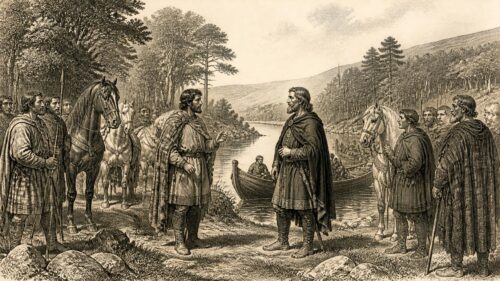
Annals for 1441 chiefly record deaths that exposed the importance of Ireland’s learned, ecclesiastical and lordly networks. Mailin mac Tanaide Ó Maolconaire, eminent historian and ollamh of Síol Muireadaigh, died in mid-February and was honourably buried at Cluain Coirpthe; other scholars, poets and churchmen also died. Conchobar Mac Donnchada, lord of Tír Oilella and patron of poets, was among them. Regional conflict continued through Mag Samradhain feuding, Maguire raids in Fermanagh, and Mac William Uachtarach’s capture of Ó Madden’s Shannon castle. Ecclesiastical offices linked kin, land and learning, while English administration remained significant chiefly in eastern Ireland during this year.

Dateline
A Year Recorded Through Loss
The evidence for Ireland in 1441 is unusually concentrated in obituaries. Rather than a single national turning point, the surviving annals preserve a succession of deaths: churchmen, regional lords, poets, historians and hereditary scholars. This is not merely a thin record of an uneventful year. In fifteenth-century Ireland, learned families and ecclesiastical officeholders carried practical political weight. They preserved pedigrees, legal memory, chronicles, religious teaching and the formal poetry through which rulers advertised authority and generosity. Their passing could therefore matter far beyond a household or monastery.
The fullest notice concerns Mailin mac Tanaide Ó Maolconaire, ollamh of Síol Muireadaigh, the ruling kindred of much of north Connacht. The Annals of Connacht call him the principal author of the learning of Ireland and Scotland and say that he had led his family for thirty-seven years. The Annals of Ulster similarly remembers him as chief professor of history for Síol Muireadaigh and a man of exceptional honour. Such phrases are formulaic praise, but their repetition across annalistic traditions confirms his standing in the learned world.
The annals do not allow a modern biography to be reconstructed. They do, however, show that Ó Maolconaire’s reputation rested on more than composing verse. An ollamh was a senior, hereditary professional: in this case a master of history, genealogy and literary learning whose expertise served patrons and helped order political society. His death made 1441 a landmark year for Connacht’s intellectual networks.
Mailin’s Death and Burial
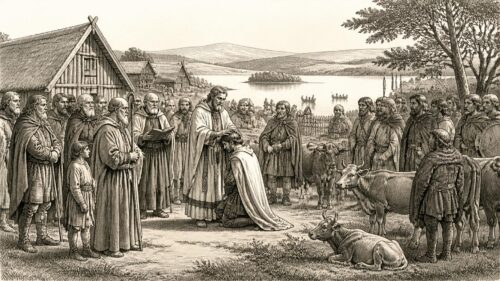
The dating is unusually close, though not perfectly uniform. The Annals of the Four Masters place Mailin’s death on 13 February and say that he was buried with honour in the church of Cluain Coirpthe. The Annals of Connacht, probably closer to Connacht traditions, gives his burial as Wednesday, 15 February; the Annals of Ulster places his death about the feast of St Berach. These notices should not be forced into a falsely exact modern chronology. What can safely be said is that Mailin died in mid-February 1441, aged eighty or more according to the Connacht annalist, and was ceremonially interred at Cluain Coirpthe.
The funeral was an event of public significance. A respected ollamh’s authority had been built through long service to kin and patrons, and burial in a church linked learned prestige to sacred space. His family’s position was hereditary but not automatic: future standing depended on maintaining the skills, manuscripts, teaching and relationships that had made such a household useful. The death of Diarmait Ruad Ó Maolconaire, recorded about a month later, compounded the loss within the same scholarly kindred.
Other deaths underline the density of that world. Duibgenn Ó Duibhgeannáin, described as highly learned in his art, also died. So did Mahon Roe Ó hUiginn, a learned poet. The names of the Ó Maolconaires, Ó Duibhgeannáins and Ó hUiginns point to the enduring importance of professional learned families, whose work crossed provincial boundaries even when their principal patrons were regional lords. The annals’ concern to name them is itself evidence of what contemporaries judged worth remembering.
Patrons, Poets and Tír Oilella
The death of Conchobar mac Taidg Mac Donnchada, lord of Tír Oilella in what is now south County Sligo, joined politics and learning particularly clearly. The Annals of Connacht styles him leader of Connacht’s armies and wars, as well as general protector of Ireland’s poets. The Annals of Ulster likewise calls him protector of the learned companies of Ireland. The language is laudatory, but it identifies an important obligation of lordship: a ruler was expected to feed, reward and protect poets, historians, lawyers and clerics.
Such patronage was not ornamental. Learned men could preserve a dynasty’s ancestry, articulate its claims to territory, compose its praise and circulate its reputation. Conversely, hospitality and gifts gave the patron a place in a wider Gaelic political culture. Conchobar’s death therefore meant the loss of a lord whose military position in Connacht was paired, in the annalists’ view, with cultural responsibility. It also illustrates why the record of 1441 is not reducible to a list of private bereavements.
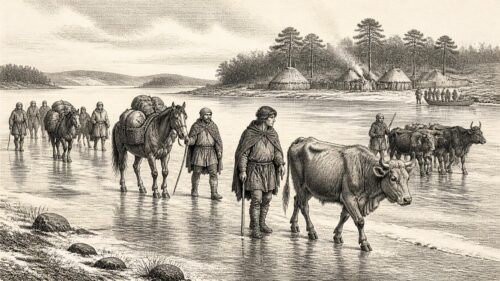
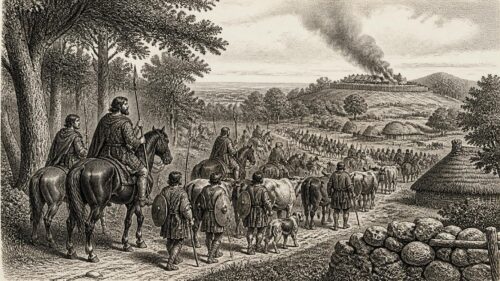
At the same time, lordship was local and contested. Cormac Mag Samradhain took a substantial prey from the sons of Donnchadh Ballach Mag Samradhain in Tullyhaw, in the Breifne borderlands. The brief notice gives no battle narrative, but it makes clear that conflict could erupt within a leading lineage. A ‘prey’ was principally movable wealth, above all cattle and horses, and its seizure hurt households as well as political rivals. Raiding was a means of enforcing claims, acquiring resources and demonstrating the capacity to command followers.
Raids in Fermanagh
In Fermanagh, violence involved the Maguires and the Mac Donnells of Clann Cellaigh. Aedh Mac Domnaill was killed by the sons of Cú Connacht Mag Uidhir. Thomas Óg Mag Uidhir then led major forays against the sons of Annadh Mac Domnaill, during which a descendant of Edmond Mac Domnaill was killed. These are firmly assigned to 1441 by the Annals of Ulster and are echoed by the Four Masters.
The notices are terse, and they do not justify a claim that either side controlled all Fermanagh. They do show a recurring pattern of regional warfare: kin-based lordships mobilised mounted men and retainers for fast attacks, killing selected rivals and driving off livestock or goods. The consequences extended to dependants who lost animals, crops’ protection or access to safer settlements. Yet the annals name only elite participants. The experience of farmers, herders, servants and religious communities must be inferred cautiously from the mechanics of raiding, not invented as a detailed story.
Conchobar Óg Mag Uidhir also died in 1441 after, in annalistic language, putting aside the world. The phrase indicates a pious withdrawal or penitential end rather than a political event that can be precisely defined. It is a reminder that rulers and their families moved between secular lordship and religious ideals, and that annalists evaluated death as well as power through Christian terms.
A Castle on the Shannon
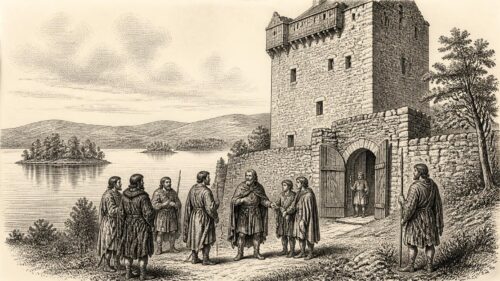
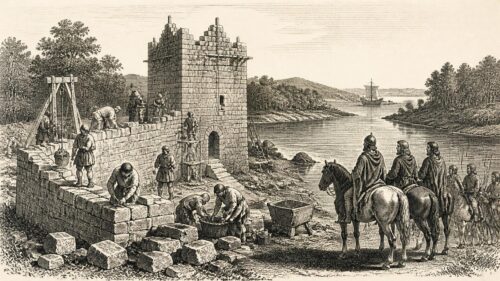
The clearest military success recorded in Connacht came at Port an Tulchain on the Shannon. Mac William Uachtarach and Clann Ricard captured Ó Madden’s castle there, seized Ó Madden’s son and fourteen other hostages, and carried away armour, weapons and other spoil. This was more than a raid. The taking of a defended residence and hostages placed immediate pressure on a rival lordship, while the capture of arms had practical military value.
The entry also illuminates the political geography of western Ireland. The Shannon was not simply a boundary: it was a corridor connecting lordships, settlements and crossing points. A castle beside it could protect a route, store goods and project authority. The annal does not tell us how long the captors held Port an Tulchain, what terms followed, or the fate of the prisoners. It would be irresponsible to supply those missing details. But the seizure demonstrates that regional competition in 1441 could involve fortified sites, negotiated coercion and the calculated use of hostages.
Church Offices and Religious Communities
Ecclesiastical deaths make up another major strand of the year. Gilla Pátraic Ó Maoluidhir, abbot of Clogher, died on 31 December according to the Annals of Ulster. Muirchertach mac Cathail Móir Mac Maghnusa, archdeacon of Clogher and parson of Airech Maoláin, died on 18 February; the annalist praises his hospitality and charity. Piaras Cam Ó Luinín, historian, poet and erenagh of Ard and part of Airech Maoláin, also died. An erenagh was a hereditary steward of church lands and resources, a role that linked local ecclesiastical administration to powerful familial networks.
In Connacht, Domhnall Ó Mocháin, abbot of the monks of Boyle, was remembered as head of the province’s wisdom, knowledge and instruction. The praise may be conventional, but it points to a monastery’s continuing place in education, devotion and elite society. Tomás Ó Ceallaigh also died. The Annals of Connacht identifies him as bishop of Clonfert, while the Four Masters calls him archbishop of Connacht or Tuam. Modern prosopography helps explain the difference: he had been elected to Tuam in 1438 but apparently never secured possession of that see. The discrepancy is valuable evidence of how title, election and effective office could diverge.
Limited Government, Enduring Networks
English royal government remained present in parts of the lordship, especially around Dublin and the eastern counties, but it did not organise the whole island’s politics. James Cornwalsh, chief baron of the Irish exchequer, died in autumn 1441 after a career in crown administration. His death belongs to the year, yet the Irish annals’ stronger attention to Connacht, Fermanagh and learned households reveals where their compilers located political importance. Ireland was not governed through one uniform system: royal courts, towns, dioceses, monasteries and Gaelic lordships overlapped, competed and collaborated in different regions.
For that reason, 1441 is best understood as a year of connected local change. A prominent historian was buried at Cluain Coirpthe; a lord celebrated as poets’ protector died in Tír Oilella; Maguire raids disturbed Fermanagh; a Shannon castle fell; and churchmen whose offices joined land, learning and pastoral authority passed from the scene. The annals do not offer a complete portrait of everyday Ireland. They do preserve, with unusual clarity, the institutions and relationships that contemporaries believed held society together.
Primary Sources
- Annála Connacht: Annal 1441 (English translation)
- Annála Connacht: Annal 1441 (Irish text)
- The Annals of Ulster: Year U1441
- CELT Project: The Annals of Ulster
- The Annals of the Four Masters: Annal M1441 (English translation)
- Annals of the Four Masters: Annal M1441 (Irish text)
- Navigator for Annals of the Four Masters
- Annals of Loch Cé, A.D. 1014–1590: Part 5 (Irish text)
- Annals of Loch Cé: Part 5 (English translation)
- The Annals of Loch Cé: A Chronicle of Irish Affairs from A.D. 1014 to A.D. 1590
- Ó Ceallaigh, Muircheartach (Mauricius, Maurice)
- Cornwalsh, James
- Lynegar, Charles (Ó Luinín, Cormac)
- Ó Duibhgeannáin, Cú Choigcríche
- Muirgius
- The Annals of Ulster, in Irish, 431–1541, originally compiled by Cathal Mac Manus Maguire
- National Library of Ireland Catalogue: Annals and Historical Manuscripts
- Genealogical Tracts I
- Materials for the History of the Franciscan Province of Ireland, A.D. 1230–1450
- The Governing of the Lancastrian Lordship of Ireland in the Time of James Butler, Fourth Earl of Ormond, c.1420–1452
- Annals of Ulster otherwise Annala Senait, Annals of Senat