Dunamon’s 126 Cows1400 CE
In 1400, Irish annals recorded the capture of Dunamon Castle in Connacht by Mac an Abaidh Ó Conchobair, the death of a Burke, and the release of an Ó Cellaigh captive. Nearby, Grigoir Ó Maelchonaire, a learned heir, was accidentally killed; 126 cows were paid in compensation. Warfare devastated grain and seized horses in Tír Chonaill, while feuds, expulsions and deaths unsettled Ulaid and Breifne. Annals also note uncertain English intervention. Around Longford, the Ó Fearghail foundation of a Dominican priory reflected regional patronage. Collectively, these records reveal competing lordships, cattle-based restitution, agricultural warfare, learned status and uneven English authority.
Dateline
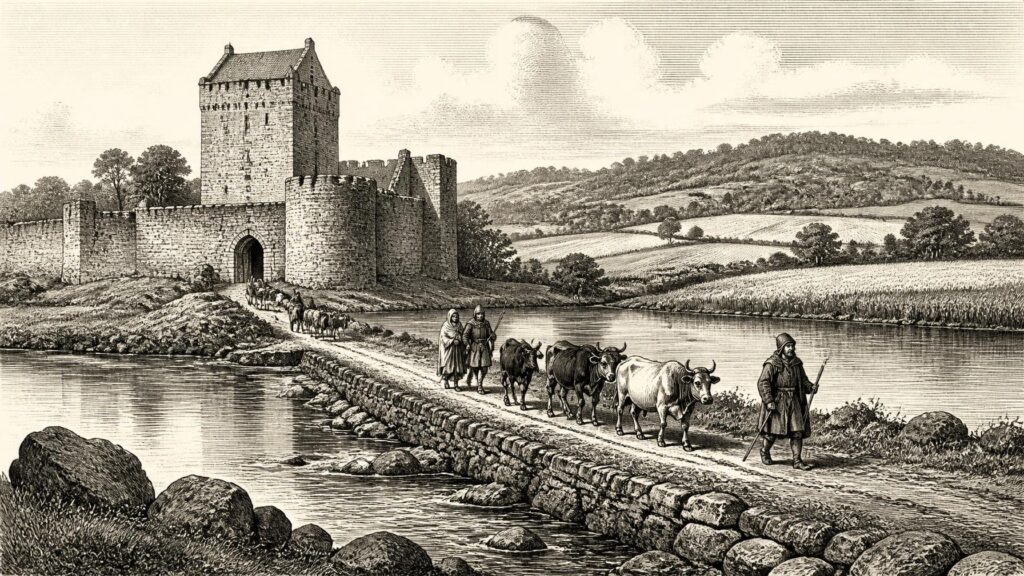
The surviving Irish annals make 1400 unusually vivid in one small corner of Connacht. They record the capture of Dunamon Castle, a killing on its causeway, and compensation assessed at 126 cows. These were not stray curiosities. Together they show how power worked in late-medieval Ireland: castles could change hands by force, captives were political assets, learned families were valued by lordships, and cattle remained a practical measure of wealth and redress. Elsewhere, the same year brought crop-burning in Tír Chonaill, feuding in Breifne and Ulaid, deaths among regional rulers, and an obscure visit by a son of the king of England.
A Castle Taken in Connacht
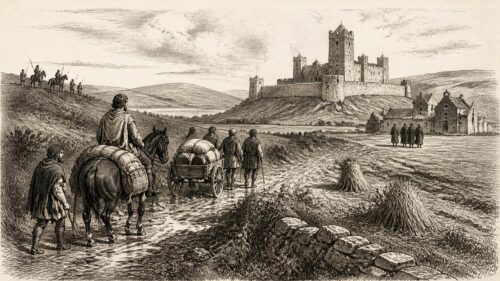
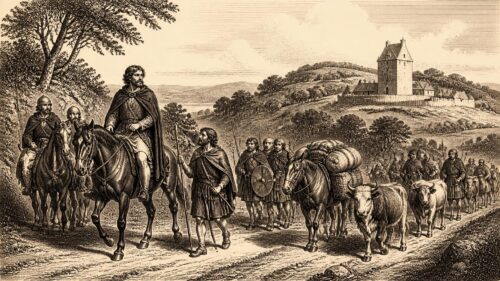
The most firmly recorded event was the seizure of Dunamon Castle, near the River Suck in what is now County Roscommon. Annals of Connacht and the Annals of Loch Cé agree that the fortress was taken by Mac an Abaidh Ó Conchobair, “the son of the Abbot” Ó Conchobair. Hubert, son of Edmund, son of Hubert Burke, was killed in the capture. A captive from the Ó Cellaigh kindred was released. The sources do not preserve a day or month, nor do they give a narrative of the assault; they simply register the result. Yet the combination of a dead Burke and a freed Ó Cellaigh makes clear that Dunamon was embedded in the contests of Gaelic and Hiberno-Norman Connacht, rather than standing outside them as an isolated Anglo-Norman outpost.
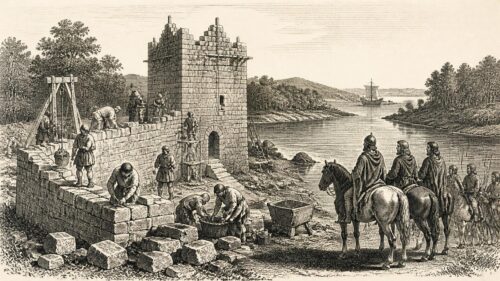
Castles in this period were centres of lordship as much as military buildings. They helped control routes, stores, tenants and prisoners, while also acting as residences and symbols of a family’s local claim. Dunamon’s capture therefore altered a small but meaningful balance of power in the Suck valley. The Burke family had deep roots in Connacht, and its branches did not form a single unified bloc. Nor did the Ó Conchobairs. Alliances and antagonisms could run through, rather than simply between, families of Gaelic and colonial origin. The annalists’ concern with the named captive is a useful reminder that imprisonment, hostage-taking and negotiated release were ordinary instruments of politics.
The Causeway and the Compensation
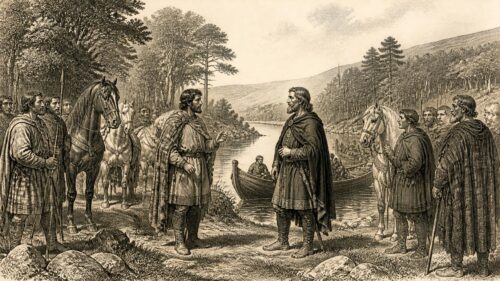
Close to the castle, another episode occurred which the annals connected directly to Dunamon. Grigoir, son of Tanaide Ó Maelchonaire, was accidentally killed by a spear-thrust on the causeway of Dunamon. The weapon had been thrown by William Garb, son of David Burke, who had mistaken him for somebody else. The record is strikingly precise about responsibility and outcome: six score and six cows, or 126 cattle, were paid as éric, compensation for the death.
Grigoir was described as a prospective ollamh of the Síl Muiredaig and as a fully accomplished master in his hereditary art. The Ó Maelchonaire family belonged to the professional learned orders that preserved genealogy, history, poetry and legal learning for major lordships. “Prospective” did not mean unimportant: it marked him as an intended successor in a recognised office. His death was therefore a loss to a family’s accumulated learning as well as to his immediate kin. The payment does not prove that every killing could be settled peacefully, or that an agreed tariff always prevailed. It does show that compensation in livestock was a meaningful, intelligible way to repair a grave wrong in this social world.
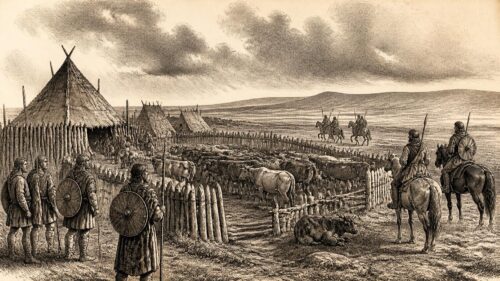
Cattle were wealth, food, breeding stock and a readily movable resource. They were also central to tribute, raiding, hospitality and restitution. The very fact that the annalist counted the settlement in cows demonstrates that this was not merely symbolic arithmetic. A transfer on that scale represented a substantial obligation. It also brings ordinary labour into view: herders, milkers, drovers and households had to sustain the animals on which an elite settlement depended. The Dunamon entries are consequently evidence not only for warfare but for the economy beneath lordly politics.
War Against the Harvest
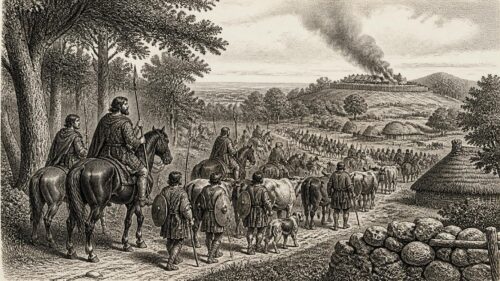
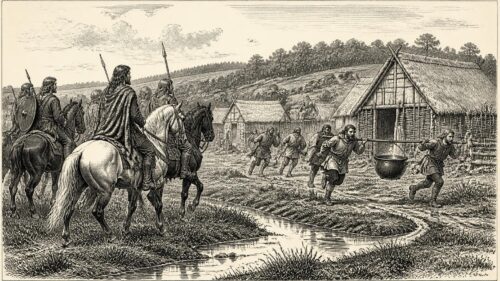
In the north, Niall Ó Néill led a large army into Tír Chonaill. The annals state that his force destroyed much of the country’s corn and that horses and men were taken from it. The Annals of the Four Masters add that the Cenél Conaill opposed the invasion, defeated the Cenél nEógain and captured many horses. The difference in emphasis is typical of medieval annals, but both traditions preserve the essential point: an invasion aimed deliberately at agricultural resources and met armed resistance.
“Corn” in such accounts meant grain generally, not the modern crop of maize. Destroying it was a direct attack on food security, seed supply and the rents owed to lord and church. It also reveals a more mixed rural economy than a simple picture of cattle pastoralism permits. Herds mattered enormously, but fields mattered too; an army that could burn or seize a harvest could damage a district long after the fighting ended. The taking of horses was likewise important. Horses enabled rapid raiding, transport and the movement of mounted retainers, and their loss could reduce a lord’s ability to respond.
Conflict in 1400 was not confined to an Ó Néill–Ó Domhnaill frontier. Ruaidri, son of Art Mag Aengusa, lord of Iveagh, was killed by the sons of Cu Ulad Ó Néill with help from Cathbarr Mag Aengusa, his own brother. This was a hard local political killing in Ulaid, involving both rivalry within the Magennis kindred and intervention by an Ó Néill branch. The event cautions against treating Irish lordships as permanent national blocs. Kinship provided political language and networks, but it did not prevent competition for succession, territory or influence.
Breifne’s Unsettled Lordship
Breifne also saw expulsion and rapid change. The descendants of Flaithbertach Ó Ruairc were driven out, but then raided Ó Ruairc territory. Gilla Ísa, son of Anrí Ó Raghallaigh, was made ruler in Breifne and died at the end of a month. Seaan Ó Raghallaigh, king of East Breifne, had died earlier in the year, reportedly from a sudden fit. Such entries reveal political instability without allowing us to impose a neat succession story upon it. They record outcomes, not the full negotiations, rival claims and local bargains behind them.
The year also brought the death of Tomas Ó Cuirnín, ollamh of the men of Breifne, and the death of Gilla Buidhe Mag Uidir after venesection. The latter notice is a rare glimpse of treatment rather than battle: bloodletting was a familiar medical practice across medieval Europe, though dangerous in the hands of any practitioner and especially hazardous for a seriously ill patient. The annals do not tell us why it was performed or who attended him. Their interest lies in the death of a figure of standing, not in offering a medical case history.
England’s Distant Lordship
One terse entry says that “the King of England’s son came to Ireland” in 1400. It should not be inflated into a well-documented royal campaign. The annals give no name, destination, programme or consequence. Later administrative evidence securely places Henry IV’s second son, Thomas of Lancaster, as lieutenant of Ireland from 1401, not 1400; the year’s annalistic reference may reflect an arrival or plan whose identity and timing cannot now be resolved with confidence. What is certain is that Henry IV had become king of England on 29 September 1399, and that his lordship in Ireland faced limited reach beyond its principal towns, estates and alliances.
That limitation had been exposed by Richard II’s Irish expeditions in the 1390s and by the continuing strength of Art Mac Murchadha Caomhánach in Leinster. But no securely dated event of 1400 permits a claim that Art Mac Murchadha himself launched a particular campaign that year. The prudent conclusion is narrower: the new Lancastrian regime inherited an Irish polity in which its authority was contested, negotiated and locally uneven, while regional rulers pursued their own wars irrespective of changes at Westminster.
A Friary Around Longford
Longford’s Dominican priory belongs beside, but not squarely inside, the dated events of 1400. Local and institutional histories place its foundation by the Ó Fearghail lords of Annaly at about 1400, beside their stronghold at Longford. The surviving evidence does not safely establish an exact foundation day or even require that the formal act occurred within this calendar year. It is best understood as a development of the years around 1400: a new house of Friars Preachers, associated with an important Gaelic lordship and a settlement at the Camlin crossing.
The foundation matters because it points towards a different kind of power. Dominican friars were urban-facing preachers and teachers, dependent on patronage, alms and ties to surrounding communities. A friary near the Ó Fearghail castle expressed religious commitment, but it could also strengthen the standing of lord and settlement alike. Longford was not yet a modern county town; it was Longphort Uí Fhearghail, a defended place in Annaly. The friary’s establishment around this point suggests the enduring capacity of regional Irish lords to sponsor institutions of worship and learning amid recurrent warfare.
Thus 1400 was not a threshold at which one Ireland replaced another. Its securely dated notices instead show multiple political worlds operating at once: a contested castle in Connacht, a learned man’s cattle-valued compensation, harvest warfare in the north, unstable successions in Breifne, and a new English dynasty whose Irish presence remained uncertain. The evidence is fragmentary, but it is enough to show an island connected by travel, religious patronage, cattle, grain, castles and kinship—while divided by the rival claims that each of those things could sustain.
Primary Sources
- Annála Connacht
- Annals of Loch Cé A.D.1014–1590, Part 3
- Annals of Loch Cé A.D.1014–1590
- Annals of the Four Masters, Volume 4 English Translation
- Annals of the Four Masters
- Annales Breves Hiberniae
- MacMurrough Kavanagh (Mac Murchadha Caomhánach), Art Mór
- A Lancastrian Prince in Ireland
- Demands Made by Thomas (de Lancaster) the King’s Son and Lieutenant of Ireland for the Better Safeguard of that Kingdom, Temp. Hen. IV.
- Longford: An Irish Historic Towns Atlas Study
- County Longford Urban Archaeology Survey 1985
- Buildings
- Ballinalee Road, Templemichael Glebe, Longford, County Longford
- Ancient Dominican Priories
- St John’s Longford
- Gaelic Society and Economy
- Animals and the Economy of Medieval Ireland: A Zooarchaeological Analysis of the Faunal Remains from Caherconnell Cashel, Co. Clare
- The Zooarchaeology of Medieval Ireland
- The Last Kings of Ireland: Material Expressions of Gaelic Lordship c.1300–1400 A.D.
- Mind the Gaps: The Archaeology of the Plantation of Ulster
- Changing Human-Cattle Relationships in Ireland: A 6000-Year Isotopic Perspective
- Great Britain and Ireland, 1400–1600 A.D.