Macwilliam’s Connacht Coup1350 CE
In 1350, plague remained active in Ireland, evidenced by legal notes, vacant Kilkenny holdings and deaths linked cautiously to pestilence, while its impact varied regionally. Connacht underwent a major coup when Sir Edmund Albanach de Burgh, Macwilliam Burke, and leading communities deposed Aed Ó Conchobair and installed another dynastic claimant. Killings and reprisals in Connacht, Moylurg, Breifne and Thomond exposed violent struggles over lordship, land and cattle. English administration nevertheless continued: Justiciar Thomas Rokeby held a Kilkenny council, raised taxation and negotiated service. Chancery, inheritance inquiries, religious leadership and learned culture endured amid demographic loss, insecurity and contested power locally.
Dateline
For Ireland, 1350 was above all a year in which the aftershocks of pestilence met the ordinary, dangerous business of lordship. The first great outbreak of plague had already been noticed in Irish records in 1349, but a contemporary marginal note written in 1350 describes the year as the second since the disease’s arrival in Ireland. The epidemic therefore belongs securely to the setting of this year, even where its local progress cannot be dated more precisely. At the same time, the annals preserve an unusually concentrated record of depositions, killings and retaliations in Connacht, Breifne and Thomond. Far from creating a single national crisis, disease and political violence were experienced through many local worlds: a vacant manor near Kilkenny, a bishop’s household in Roscommon, a contested provincial kingship, or the court of a Gaelic poet.
The Plague’s Second Year
It is responsible to say that plague remained active in Ireland during 1350; it is not responsible to assign an exact mortality for the island or to imagine that every district suffered in the same way. Medieval annals used broad terms for pestilence, and the surviving evidence is uneven. Yet the handwriting of the young legal scholar Aedh mac Conchobhair Mac Aedhagáin gives the year an especially human immediacy. In a note entered in his father’s copy of the Senchus Mór, the great Irish law-text, he marked 1350 as the second year after the coming of the plague to Ireland. Another note, made at Christmas, asked God to put the great plague past himself and his friends. This was not retrospective history: it was a fearful appeal written by somebody living through an uncertain danger.
The evidence from English-controlled estates is equally stark, though narrowly local. At Easter 1350, more than 127 acres and three cottages on the manor of Loughmoran in County Kilkenny were recorded as vacant because of pestilence. Such figures do not measure the fate of all Ireland, but they reveal practical consequences: holdings without tenants, houses without occupants, and landlords deprived of customary renders and labour. Fields might still be sown by neighbours, kin, servants or incoming tenants, but the ordinary pattern of cultivation and dues had been interrupted. The crisis was therefore visible not only in burials and prayers, but in the accounting vocabulary of waste, vacancy and missing people.
Kilkenny and its hinterland were particularly exposed in the surviving sources because they possessed towns, manors and ecclesiastical institutions that generated written records. Friar John Clyn’s harrowing account had described the preceding outbreak there, but his chronicle ends in 1349. It cannot simply be used as testimony for every month of 1350. The Mac Aedhagáin notes and the manorial evidence instead show continuation: plague was still a present condition, rather than a calamity neatly finished with the old year.
North-western evidence points the same way. Later annalistic traditions place the death of Uilliam Ó Dubhda, bishop of Killala, in 1350, and identify him as a founder of churches and sanctuaries. Other compilations connect his death, and several deaths in Mayo, with the pestilence. The dating of the bishop’s death is firm; the surrounding plague narrative should be treated more cautiously, since it reaches us through annalistic compilation rather than a surviving contemporary obituary. Even so, the loss of a bishop mattered beyond one household. A diocesan bishop was a religious leader, landholder, patron and organiser of clerical life. In a time of sickness, the death of such a figure could unsettle both spiritual care and local administration.
A Kingship Remade in Connacht
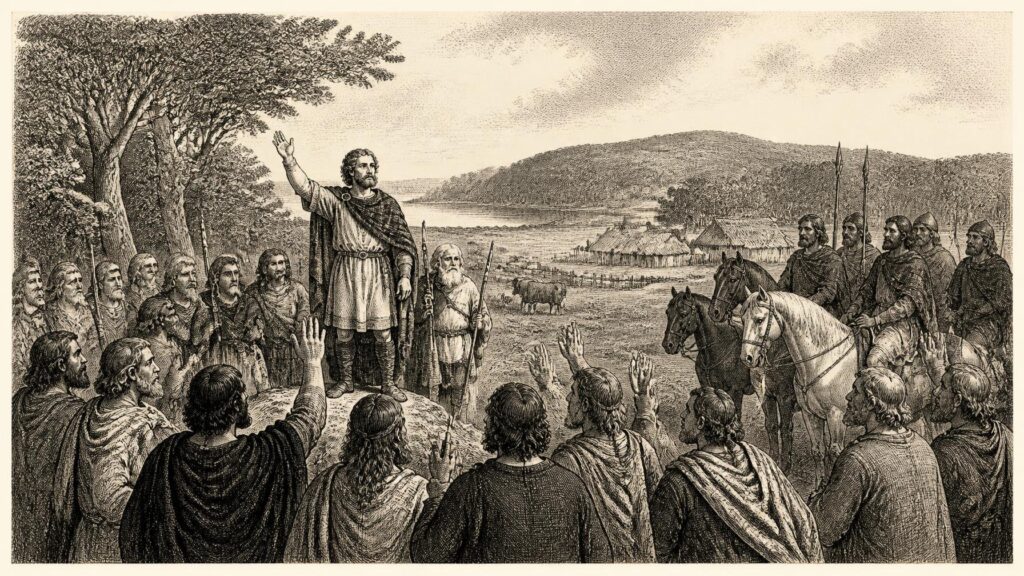
The clearest political development of 1350 occurred in Connacht. The Annals of Connacht report that Aed, son of Toirrdelbach Ó Conchobair, was deposed by Macwilliam Burke and the tuatha of Connacht, who made Aed, son of Feidlim, king in his place. This was a major intervention in the succession of a province whose kingship had long been disputed among branches of the Ó Conchobair dynasty and whose politics were inseparable from the power of the de Burgh or Burke lordships.
Macwilliam in this entry was Sir Edmund Albanach de Burgh, head of the powerful Burke interest in Lower Connacht. The phrase “the tuatha” is important. It does not imply a modern popular election; rather, it indicates the participation or support of the political communities and leading interests of Connacht. Gaelic kingship depended upon kinship, military capacity, hostages, alliances and the recognition of influential lords. In 1350, a Burke magnate could help decide who held the provincial kingship, while an Ó Conchobair claimant still supplied the dynastic legitimacy required for the office.
The deposition did not settle Connacht permanently. Aed son of Toirrdelbach later returned to power, which underlines a central feature of the year’s coup: it was a seizure of advantage, not a final constitutional settlement. Still, the event demonstrates that the distinction between “Gaelic” and “English” politics is too simple. The Burke lord and the Connacht tuatha acted together to install an Ó Conchobair king. Power was negotiated across languages, legal traditions and family networks, often through coercion as much as agreement.
Other killings recorded that year show the same competitive landscape. Aed, son of Aed Breifnech Ó Conchobair, was killed by Aed Ó Ruairc at Mag Engaite. Ruaidri, son of Cathal Ó Conchobair, was treacherously killed by the sons of Fergal Mac Donnchada, reportedly at the bidding of Aed son of Toirrdelbach. These entries do not prove a single coordinated campaign, and their sequence should not be made into a story the annalist did not tell. They do, however, reveal how lethal disputes among dynastic branches and their allies could be in the very year that Connacht’s kingship changed hands.
Arrows, Retaliation and Cattle
In Moylurg, around modern north Roscommon, Brian Mac Diarmata was killed at Roscommon by an arrow-shot from the men of Bishop Ó Finnachta. He was described as eligible for the kingship of Moylurg: not merely a private victim, but a man with a recognised claim to lordship. The annal calls his death unhappy or accidental in tone, yet the response was brutally deliberate. Ruaidri “of the Chamber” Ó Donnchada, blamed for the shot, was killed and mutilated for the deed. The episode is a rare glimpse of an immediate punitive settlement, in which the status of the dead claimant and the honour of his kindred demanded a visible reckoning.
Breifne also saw the killing of Fergal, son of Ualgarg Ó Ruairc, by the son of Cathal Cléireach Mac Donnchada. In Thomond, Brian, grandson of Brian Ruad Ó Briain, was treacherously killed by the sons of Lorcan Mac Ceothach. The annalist preserved a lament for him, presenting his death as a loss to the royal lineage of Brian Boru. Retaliation followed: Toirrdelbach Óg Ó Briain killed sixteen men of Clann Ceoch and took their cattle and land. The number may reflect annalistic emphasis, but the underlying pattern is unmistakable. Violence was tied to succession, but also to recoverable wealth: livestock, territory, dependants and the capacity to reward followers.
For most people, such conflicts were not distant aristocratic dramas. Armies and raiding parties consumed food, seized cattle, disrupted seasonal work and obliged communities to choose sides or seek protection. Yet 1350 should not be presented as continuous warfare everywhere. The sources record particular deaths and reprisals, not a complete map of violence. Their concentration in Connacht and neighbouring lordships partly reflects where the annalists had strong information and political interest.
Government in Kilkenny
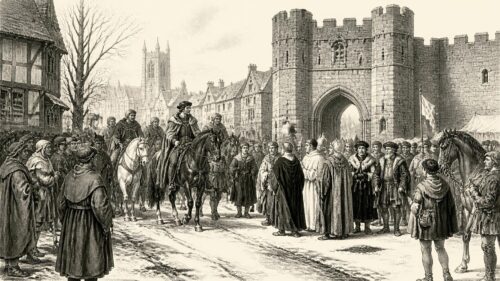
Within the English lordship, Thomas Rokeby was justiciar, the crown’s chief governor in Ireland. He held a great council at Kilkenny during 1350 and secured taxation from both lay and clerical interests. The meeting belongs to a wider effort to sustain royal government after plague, fiscal weakness and insecurity had reduced the resources available to the administration. Rokeby also campaigned in the south and east and made arrangements with leading Irish lords, exchanging royal payments for promised service. Such agreements were pragmatic recognitions that the lordship could not be governed by English officials and settler communities alone.
Church and government were closely intertwined in this effort. John de St Paul, archbishop of Dublin, became lord chancellor in July 1350. His appointment placed the keeper of the great seal at the centre of written administration: charters, writs, land transactions and royal justice. The chancery’s routine did not cease because of plague. An inquisition at Trim in April and further proceedings concerning the lands of the recently deceased Walter de Bermingham show that officials continued to assess inheritances and royal rights. But this administrative continuity existed beside unmistakable demographic strain. Government could record vacant acres; it could not readily replace the tenants who had held them.
Learning, Faith and Fragile Continuity
The year’s notices of death include Aengus Ó hEodhusa and Aengus Ruad Ó Dálaigh, called master-poet of Ireland. Their entries remind us that political society depended on learned families as well as warriors and churchmen. Poets preserved genealogies, composed praise and elegy, advised patrons, and helped articulate the status of ruling kindreds. The lament for Brian Ó Briain and the notice of Ó Dálaigh’s death reveal a culture in which verse could carry public political meaning. Plague and conflict threatened such networks, but did not silence them.
Thus 1350 was neither simply the end of one Ireland nor the beginning of another. The epidemic exposed the vulnerability of households, estates, towns and religious communities. Connacht’s deposition showed that provincial rule could be overturned through alliances joining a great Burke lord to Gaelic political communities. Killings in Moylurg, Breifne and Thomond demonstrated the high stakes of contested inheritance. Meanwhile, councils, chancery business, law manuscripts and poetry continued. The sources leave an Ireland scarred by loss, but still intensely organised: praying, accounting, judging, remembering and fighting over who would rule the land left behind.
Primary Sources
- Annála Connacht: Annal 1350
- Annals of the Four Masters: Annal M1350
- Annals of Loch Cé
- A Tract on the Plague
- The Genealogies, Tribes, and Customs of Hy-Fiachrach, Commonly Called O'Dowda's Country
- O'Connor (Ó Conchobair), Toirrdelbach
- Rokeby, Thomas
- Bermingham, Walter
- Clyn, John
- Inquisitions Post Mortem: Inquisitions and Extents of Medieval Ireland
- Kilkenny: Irish Historic Towns Atlas
- ‘Unheard-of Mortality’: The Black Death in Ireland
- The Identification of Some Pestilences Recorded in the Irish Annals
- Ireland: The Complete History of the Black Death
- Plagues, Pandemics and Epidemics in Irish History Prior to COVID-19
- The Hospital in Medieval Ireland, 1170–1540: An Archaeology
- Christ Church Cathedral Dublin: Conservation Management Plan
- Dublin City Urban Archaeology Survey: Christ Church
- Annales Breves Hiberniae
- Decline of the Norman Colony