Snow, Silver and Uí Maine1339 CE
In 1339, Ireland endured severe frost and snow that damaged livestock and winter crops, while warfare in Meath ruined grainlands and caused famine. Political violence accompanied hardship: Ruaidhrí Ó Cellaigh, king of Uí Maine, was killed, and Toirdhealbhach Ó Conchobhair reshaped Connacht alliances through marriage, repudiation and pressure upon Edmund Albanach Burke. Northern campaigning by Aodh Reamhar Ó Néill brought further deaths, while Tomás Mag Samhradháin was released from captivity. Despite instability, Fergal Muimhneach Ó Duibhgeannáin erected Kilronan church. In Dublin, Edward III’s administration briefly minted silver coinage, thereby linking local society to royal fiscal demands amid wider Anglo-French war.
Dateline
A Year of Hard Weather and Hard Power
The evidence for 1339 presents Ireland as a land in which a damaging winter, local war and dynastic manoeuvre overlapped. The most detailed contemporary-style record, Annála Connacht, explicitly heads its entry with the year 1339. Its notices range from Uí Maine and Connacht to Tír Chonaill, Meath and Dublin, a useful warning against treating the island as a single political unit. Ireland remained a mosaic of lordships, ecclesiastical territories, towns and royal jurisdictions. Edward III was lord of Ireland, but his government’s effective reach was uneven; Gaelic dynasties and increasingly Gaelicised descendants of the Anglo-Norman settlers exercised power over much of the country.
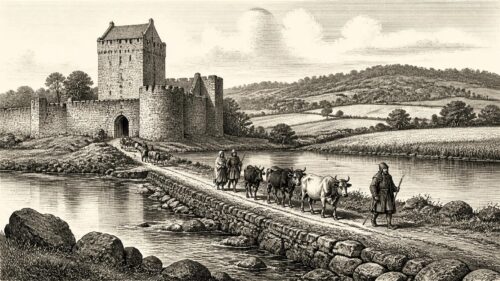
One condition is particularly firmly attached to this calendar year. Annála Connacht records a great affliction arising from frost and snow, affecting livestock and winter crops across Ireland from the beginning of winter until the approach of spring. The annalist’s word for “plague” should not be made to mean the later Black Death: here the explanation supplied is severe weather and its effects on animals and food. It describes a subsistence emergency. Households dependent on stored grain, cattle, sheep and the winter cultivation of cereals faced an unusually long season of loss before fresh spring growth could relieve them.
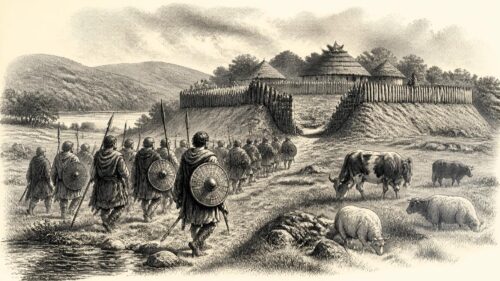
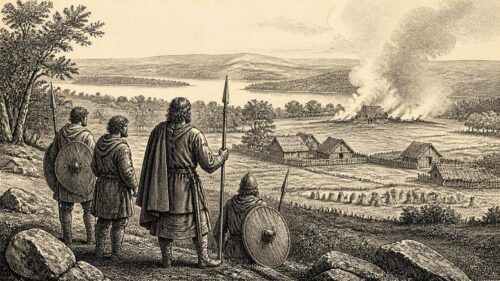
The same annal adds that warfare throughout Meath between “English and Irish” devastated the country’s grain lands and that a great famine followed there. Those labels were the annalist’s broad political shorthand, not simple ethnic descriptions: the contestants could include settlers, long-established Anglo-Irish families, Gaelic lords, tenants and armed retainers. Nevertheless, the pairing of ruined arable land with famine makes the immediate human consequence clear. Raiding and campaigning were especially ruinous when winter weather had already reduced fodder, seed corn and reserves. For ordinary people, the year’s headline was likely not a distant succession dispute but hunger, the protection of animals and the vulnerability of crops.
The Killing of Ruaidhrí Ó Cellaigh
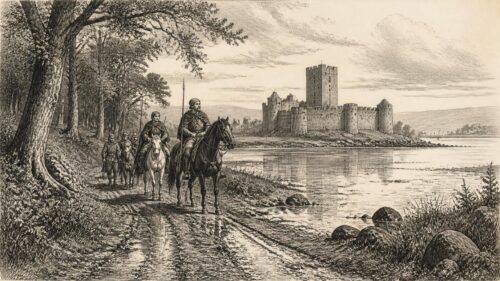
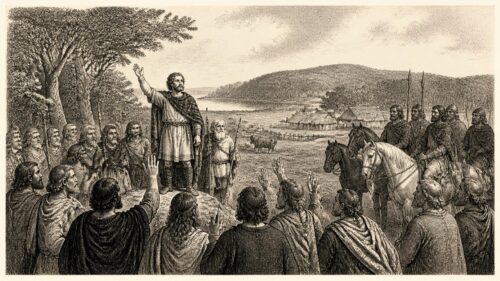
Against this bleak background, Ruaidhrí Ó Cellaigh, king of Uí Maine, was killed by Cathal, son of Aodh, son of Eóghan Ó Conchobhair, while travelling home from the residence of an Ó Conchobhair. The annals securely place the killing in 1339, but do not provide a day or a named location; later chronological summaries that supply a date should not obscure that limitation in the primary notice. Ruaidhrí’s death mattered far beyond one fatal encounter. Uí Maine, spanning much of eastern County Galway and southern County Roscommon, was an important Connacht lordship, and the Ó Cellaigh were among the region’s principal dynasties.
The episode also demonstrates the personal geography of high politics. A ruler travelled to a rival or ally’s house, apparently survived the visit itself, and was attacked on the return journey. Such movements were central to lordship: rulers maintained authority through assemblies, hospitality, clientship, marriage, tribute, military followings and negotiated submissions. But travel with a retinue did not guarantee safety. The killing exposed the peril in a political world where kinship linked competitors as often as it reconciled them. Its aftermath was not automatically determined, yet the removal of an established lord of Uí Maine gave other branches of the dynasty and neighbouring powers a reason to test the balance of force.
Connacht’s Contested Kingship
Toirdhealbhach Ó Conchobhair, presented by the annals as king of Connacht, was at the centre of several developments. In 1339 he married the daughter of Toirdhealbhach Ó Briain, who had been the wife of the son of the earl of Ulster, and he set aside Dearbhail, daughter of Aodh Ó Domhnaill. The wording matters. This was neither a private domestic change nor merely a ceremonial alliance: marriage tied the Connacht king to the leading Ó Briain house of Thomond and to the political wreckage of the de Burgh earldom of Ulster, while the repudiation loosened a connection to the Ó Domhnaill of Tír Chonaill.
The background had been transformed by the killing of Earl William de Burgh in 1333 and by subsequent struggle among his kinsmen. By 1339, claims derived from the de Burgh inheritance, Gaelic royal ambitions and the interests of local magnates were intertwined. The annals record the expulsion of Éamonn mac Uilliam de Búrca, known as Edmund Albanach Burke, with his following. Yet the sources are not wholly consistent about the direction of his displacement. Annála Connacht says he was driven from Ulster; the later Annals of the Four Masters says that Toirdhealbhach drove him from the sea-islands into Ulster. Both traditions agree on a forced removal and on the importance of Toirdhealbhach’s pressure, but they do not justify a more precise reconstruction of Edmund’s route.
This disagreement is instructive rather than disabling. It shows why 1339 should not be narrated as a clean conquest of Connacht. Control was mobile and conditional. Maritime islands, river routes, castles, pastoral districts and the households of allies all mattered. The de Búrca branches had roots in the Anglo-Norman lordship of Connacht but were increasingly participants in Gaelic political society, using Irish forms of name, alliance and lordship. Their rivalry helped create the regional political order later associated with Mac William of Mayo and Clanricarde, but that later outcome should not be read back as settled fact in 1339.
War in the North and a Released Prisoner
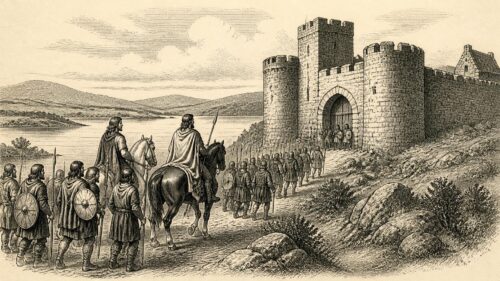
In the north, Aodh Reamhar Ó Néill led a great hosting into Tír Chonaill. During the expedition, the son of Seán Ó Néill and Gofraid Ó Domhnaill were killed by the people of Ó Dochartaigh. The annal gives no battle-site or fuller sequence of operations, so it is safest to see it as an armed incursion whose costs fell upon leading families on several sides. Tír Chonaill was no political vacuum: Ó Domhnaill lords, Ó Dochartaigh and other local powers could resist an Ó Néill advance, pursue their own interests and exact a price from invaders.
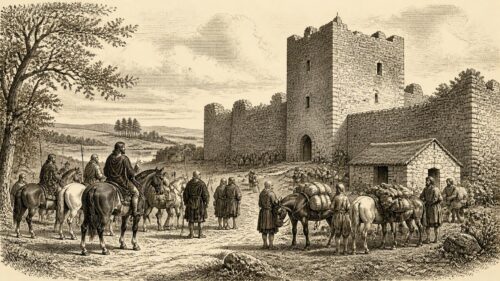
Another concise notice records that Tomás Mag Samhradháin was released from the custody of Clann Mhuircheartaigh. Captivity was a normal instrument of politics, warfare and bargaining, not simply an interruption to public life. A prisoner could represent a claim, a debt, a safeguard for a truce or leverage over a kindred. The bare announcement of release tells us that some negotiation or altered balance had occurred, though it does not identify the terms. Such small entries are valuable because they reveal the dense social infrastructure beneath grander words such as war and kingship: households, hostages, escorts, sureties and kin-groups made power work from day to day.
Building at Kilronan
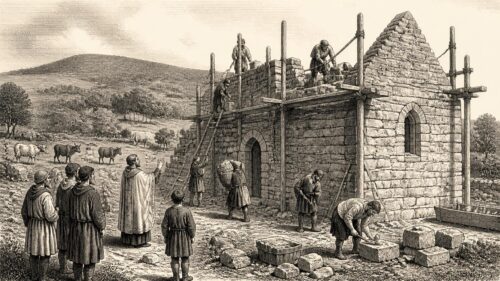
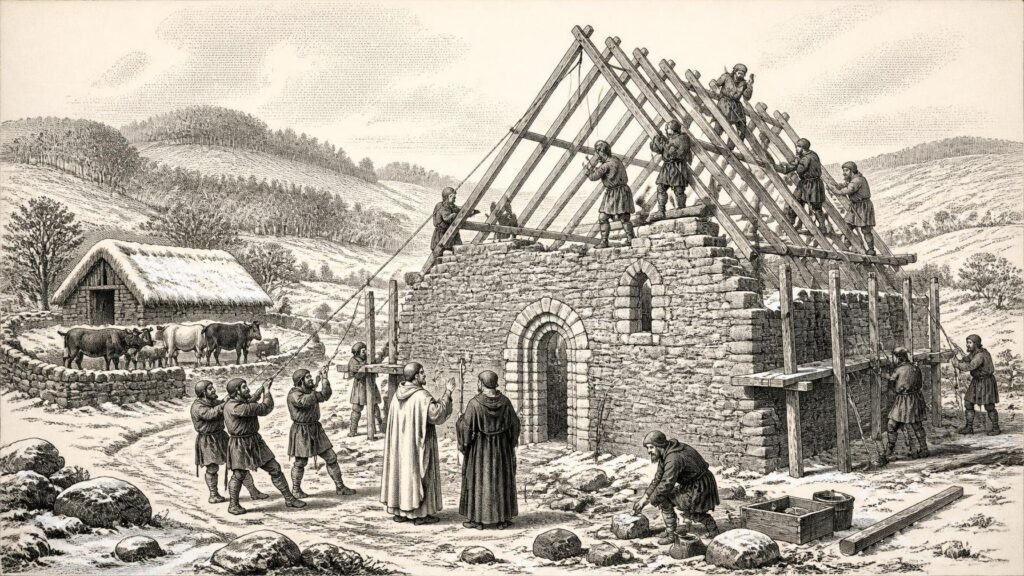
Amid cold, scarcity and conflict, the annals preserve a striking constructive act. Fergal Muimhneach Ó Duibhgeannáin made, or erected, the church of Kilronan in 1339. Kilronan lay in the Boyle area of modern County Roscommon, within the Connacht world from which much of the year’s record comes. The entry does not describe the building’s fabric, size or dedication, and it should not be inflated into a claim that an entire parish was newly founded. It does, however, securely show investment in a church at a moment when ecclesiastical places remained centres of worship, burial, local memory, learning and lordly display.
The Ó Duibhgeannáin were a learned family whose name appears repeatedly in the manuscript culture of late medieval Connacht. Fergal’s act therefore fits a society in which scholarship, clerical life and political patronage could overlap. A church required labour, materials, land, protection and continuing support. Its recording in an annal indicates that such work was considered worthy of remembrance beside killings and hostings. This is an important corrective to the impression that 1339 was only a year of collapse. Communities still repaired, built, worshipped and organised collective life, even when weather and war made those efforts more difficult.
Dublin’s Brief Coinage
Events in Dublin connected Irish affairs to the wider financial demands of Edward III’s government. Documentary and numismatic evidence shows that on 25 March 1339 dies for sterlings, halfpence and farthings were specially arranged for transport to Ireland under the chancellor’s seal. Coining began at Dublin under John Rees, treasurer of Ireland and keeper of the mint. The operation was brief. By June the royal council was again permitting the circulation of continental “Turneys”, and the surviving evidence suggests that the Dublin issue may have ceased by, or before, Rees left the treasurership on 12 August. The precise closing date cannot be proved.
This was more than a technical footnote. Coinage enabled payments, rents, purchases and royal accounting in the lordship’s towns and administered districts. Yet the small and short-lived mint also reveals constraint. The Crown sought Irish revenue while pursuing costly war in France, but it could not simply create a stable currency by decree. In a year when the Connacht annalist described famine and damaged crops, Dublin’s experiment in silver currency belonged to a different but connected reality: an island where local subsistence, regional lordship and the fiscal ambitions of a transmarine monarchy met uneasily.
Thus 1339 was defined by pressure rather than resolution. Severe winter weather and famine threatened survival; the death of Ruaidhrí Ó Cellaigh disturbed the politics of Uí Maine; Toirdhealbhach Ó Conchobhair rearranged alliances while contesting de Búrca power; northern lords fought and bargained; a church rose at Kilronan; and a short-lived mint worked in Dublin. Taken together, these firmly dated notices show Ireland not as peripheral or static, but as a society of closely connected regions whose people faced environmental hardship while continuing to compete, build, worship and trade.
Primary Sources
- Annála Connacht: Annal 1339
- Annála Connacht
- Annals of the Four Masters: Annal M1339
- Annals of the Four Masters, Volume 3
- Annala Uladh: Annals of Ulster, 1202–1378
- The Annals of Ulster: Bibliographical and Manuscript Information
- The Annals of Loch Cé, Volume I
- Annals of Loch Cé: Translation, Part 1
- Annals of Loch Cé, Volume II
- The Anglo-Irish Coinage of Edward III
- The Annals of Ireland by Friar John Clyn: Edited and translated with an Introduction by Bernadette Williams
- Friar John Clynn
- Annals of the Kingdom of Ireland by the Four Masters
- Exploring the Irish Annals
- CELT: Corpus of Electronic Texts
- List of Published Texts at CELT
- Normans & Natives in Medieval Connacht
- The Rise and Fall of the Clann Éinrí Aimhréidh Uí Néill: Dynastic Feuding and Geopolitics in the Late Medieval Irish Sea World
- The Templars and the Mysterious Holy Rood of Ballinrobe
- Kindred Lines: How Anglo-Norman Names Were Hibernicised
- Mapping and Measuring the Impact of the Bruce Invasion
- Cill Rónáin/Kilronan, County Roscommon
- Annals of Loch Cé, Volume II: Irish Manuscripts Commission
- The Annals of Ireland by Friar John Clyn (1849 edition)