Coill an Chlocháin1309 CE
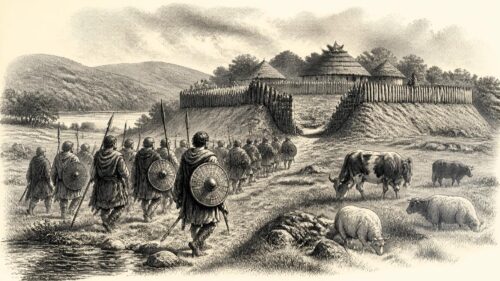
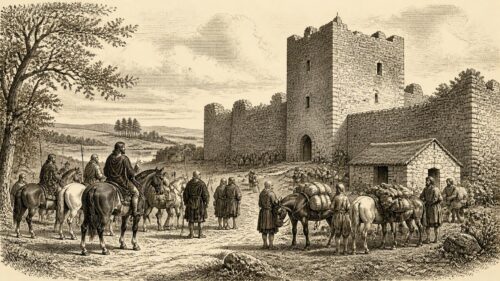
In 1309, Áed mac Éogain Ó Conchobair, king of Connacht, was killed at Coill an Chlocháin by Áed Brefnech, triggering wider conflict among rival dynasties and allies. Elite casualties included legal scholar Gilla na Naem Mac Aodhagáin, illustrating the political importance of learned service. Competing claimants sought submissions, tribute, royal jewels and military support, while raids damaged grain and monasteries served strategic roles. Elsewhere, violence involved Leinster magnates and Thomond rivals; Cathal Ó Conchobair became bishop of Elphin. Roger Mortimer and Joan de Geneville assumed Meath’s lordship, while Dublin received murage for bridge-tower repairs, revealing Ireland’s interconnected local politics clearly.
Dateline
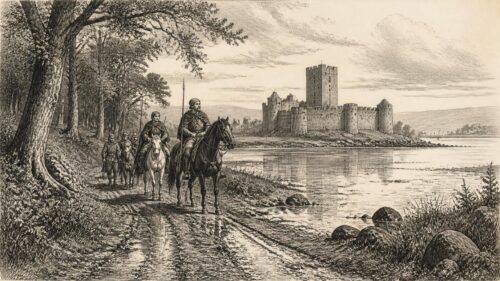
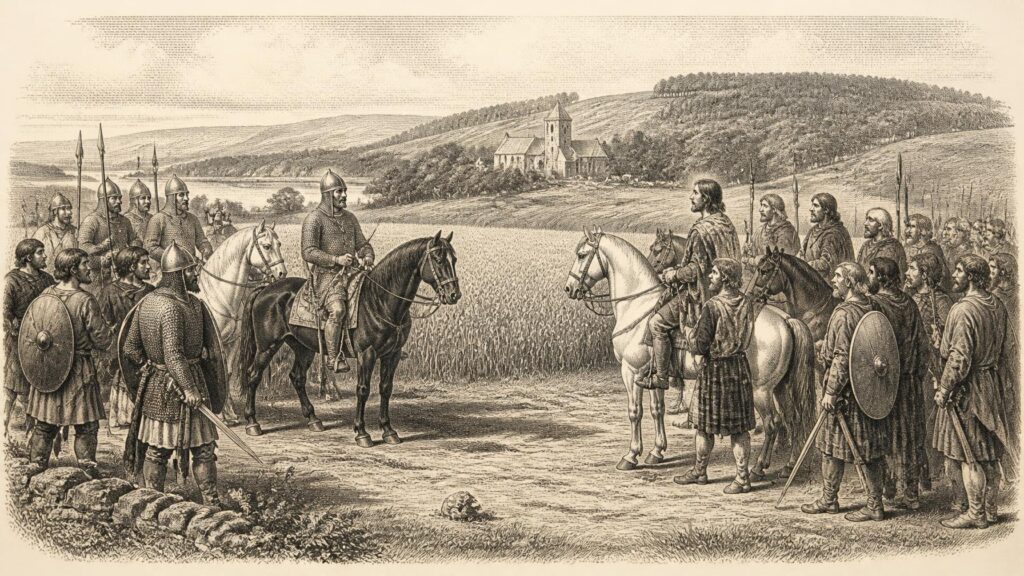
The defining Irish event recorded for 1309 was a killing in Breifne that unsettled Connacht from its ruling family outward. Áed mac Éogain Ó Conchobair, recognised in the annals as king of Connacht, was killed at Coill an Chlocháin by Áed Brefnech, son of Cathal Ruad Ó Conchobair. The sources do not supply a day or month for the encounter, so it should be treated as a firmly year-dated event rather than a precisely dated battle. Its importance lay not merely in the death of a claimant: men from several leading Connacht kindreds fell with him, and the loss exposed how kingship, military service, learned office and lordly patronage were entangled.
A Connacht King Killed
Annála Connacht gives the fullest surviving account. Alongside Áed mac Éogain died Conchobar Mac Diarmata, members of branches of the Ó Conchobair and Mac Diarmata families, and other prominent followers. On the opposing side the dead included Máeldomnaig the gallowglass and Gilla na Naem Mac Aodhagáin, described as ollamh of Connacht in law and a master of many arts. The annalist puts total losses on both sides at no fewer than a hundred. Such figures should not be read as a modern casualty return, but the record is unequivocal that this was a serious, elite-dominated clash rather than an isolated murder.
Gilla na Naem’s death is especially revealing. An ollamh was a holder of the highest learned rank, here in legal learning. His presence in a king’s following shows that lordship required more than armed retainers. Dynasties needed professional judges, poets, clerics, advisers and men able to articulate precedent and status. The death of such a figure was therefore a cultural as well as political loss. The Connacht annalist’s lavish praise for Áed mac Éogain—his nobility, valour and generosity—also belongs to this political language: generosity sustained a ruler’s household, reputation and claims upon allies.
Succession Without Settlement
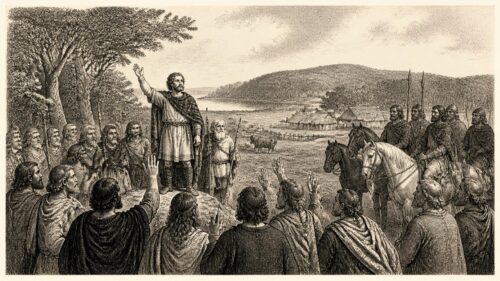
The killing did not settle Connacht. Áed Brefnech entered the country and obtained the submission of the Three Tuatha, yet another coalition immediately gathered around Máelruanaid Mac Diarmata, king of Moylurg. He promoted his foster-son Feidlimid Ó Conchobair, summoned both Gall and Gaelic allies, and obtained the support of William de Burgh, known in Irish sources as Mac William. The use of Gall, literally ‘foreigner’, reflects the annalists’ vocabulary; it should not obscure the dense alliances that crossed ancestry, language and legal custom. Connacht’s struggle was not a simple contest of Irish against English, but a fight among related claimants and their shifting regional backers.
Máelruanaid’s camp at Fiad Rátha Cruachan was also a centre of government. The annal says that he received the submission of chieftains and sub-kings, exacted rents and tribute, and secured the royal jewels of Connacht. Oaths and guarantees were taken from Síol Muiredaig not to surrender lordship elsewhere. These details show what was materially at stake in a disputed kingship: rights to food-renders, livestock, service, prestigious objects and the obedience of lesser rulers. Fosterage likewise mattered politically. Feidlimid’s claim was advanced not only through blood but through the practical commitment of his foster-father and that man’s household.
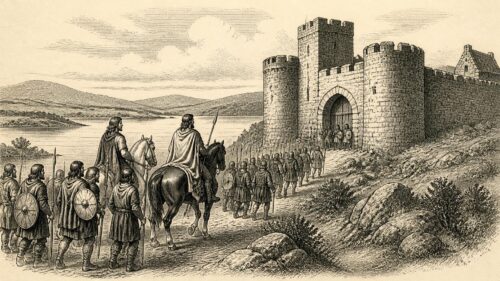
William de Burgh’s intervention gave the conflict a further dimension. His family’s influence was already fundamental to politics in Connacht, and the annals portray Mac William moving with the local forces of Síol Muiredaig. Áed Brefnech sought a meeting with the earl in Meath; while he was away, the Three Tuatha revolted. A raid on Áed Ó Flannacáin followed. Ruaidhrí, another son of Cathal Ruad, and Ó Floinn then killed a Mac Feorais, or Bermingham. A proposed meeting at Áth Slisen between the son of Cathal and Mac William broke down and became a rout. Diplomacy, raiding and battlefield action overlapped continually.
Grain, Garrisons and Monasteries
The consequences were felt far beyond the men who fought. After the failed meeting, William de Burgh went to the monastery of Boyle while Clann Mhuircheartaigh entered Tír Oilealla, burning and destroying much corn—that is, grain, not the American crop later called maize. The annal does not say whether this was standing grain, stored food or both, nor does it date the raid within the year. It does show, however, why warfare threatened ordinary households: burning grain imperilled seed, bread, animal fodder, rents and hospitality alike. Mac William then crossed the Curlew Mountains, drove his opponent from a stronghold, and raided as far as Benbulbin.
Boyle’s monastery appears here not as a remote refuge from politics but as a known strategic place in a contested landscape. Churches and monasteries possessed land, stores, accommodation, communications and influential communities. The same year, Cathal Ó Conchobair, abbot of the Trinity, was elected bishop of Elphin according to Connacht and Munster annals. The notice is brief, and no precise date is given in those texts; nonetheless it reminds us that ecclesiastical office remained connected to leading families and to the political geography of north-west Connacht.
Violence in Leinster and Thomond
Conflict was not confined to Connacht. The Annals of Inisfallen report ‘great warfare’ in Leinster between the settlers or ‘foreigners’ themselves. Maurice Condon was killed by the justiciar of Ireland, John Wogan, together with William Roche and his brother Pátraicín; another figure, named as In Talúnach in the annal, also died. The result was open strife between the Condon and Roche interests. The entry is too compressed to reconstruct a full campaign or assign a location, but it is valuable evidence that the crown’s chief governor was involved in violence among magnates within the lordship.
In Thomond, Conchobar Ó Briain, son of Donnchad, was killed when Clann Ódo—called ‘the Archdeacons’ in the Inisfallen annal—attacked the house at Dún Eochaille where he was drinking. Other annals call the killers Black Galls and stress treachery. The variation warns against treating any one wording as a complete explanation. What can responsibly be said is that a prominent Ó Briain was killed in 1309 amid the protracted contests that followed the death of Toirdelbach Mór Ó Briain in 1306. Local rivalries in north Munster remained capable of producing sudden, personal violence.
Meath’s New Lord
A more securely dated development joined Irish lordship to wider aristocratic networks. The Annales Breves Hiberniae states that Roger Mortimer arrived in Ireland with his wife Joan de Geneville on the vigil of Saints Simon and Jude, 27 October. A related chronicle places the arrival on the feast itself, 28 October. Both agree on the essential point: Mortimer and Joan took possession of the Meath lordship through Joan’s inheritance from her grandfather Geoffrey de Geneville, lord of Trim, who retired to the Dominican house at Trim.
This was not simply a private family transaction. Mortimer’s arrival strengthened one of the great marcher families within the Irish polity, centred on Trim and eastern Meath. Its effects would become clearer in later crises, but 1309 itself marks the moment at which possession, lordship and residence were publicly asserted. Joan’s place in the record is equally important: the right came through her inheritance, even though subsequent power is usually narrated under Mortimer’s name.
Dublin’s Damaged Bridge Tower
Urban administration offers a quieter but unusually exact glimpse of the year. On 1 June, Edward II granted Geoffrey Moretone, a Dublin citizen and merchant, the right to collect murage—customs earmarked for civic fabric—to repair the tower of Dublin Bridge, accidentally burned, and the adjoining wall that had fallen. The grant ran initially to 20 July and then for seven further years. It does not date the fire itself, nor does it describe its cause beyond accident. But it establishes that the bridge’s defensive and commercial infrastructure needed urgent repair.
The measure points to the practical workings of colonial Dublin: a merchant was entrusted with a revenue stream, toll collection was backed by royal authority, and the city’s bridge was important enough to merit a long-term levy. In a year of raiding, faction and disputed succession elsewhere, Dublin still generated the administrative records and taxable movement needed to fund masonry, a bridge-tower and its adjacent wall.
Thus 1309 was not a year with a single Irish story. Its surviving record is strongest for Connacht, where the killing at Coill an Chlocháin fractured a kingship and brought grain, tribute and learned service into the orbit of war. Yet the same year also saw aristocratic transition at Trim, Anglo-Irish factional violence in Leinster, an Ó Briain killing in Thomond, ecclesiastical change at Elphin, and civic repair in Dublin. Together they show an Ireland of connected but highly local political worlds, in which power was claimed through kinship, force, negotiated submission, inherited right and control of resources.
Primary Sources
- Annála Connacht: Annal 1309
- Annals of Inisfallen: Annal AI1309
- Annals of the Four Masters: Annal M1309
- Mac Carthaigh’s Book: Annal MCB1309
- Annales Breves Hiberniae
- Annales Hiberniae
- Annalium Hiberniae Chronicon ad annum MCCCXLIX
- A Calendar of Irish Chancery Letters, Patent Roll 2 Edward II, item 7
- Grant of Murage for Dublin, 1 June 1309
- Memoranda Roll 3 Edward II
- Calendar of the Justiciary Rolls: I to VII Years of Edward II, 1308–1314
- Wogan, John
- Mortimer, Roger
- Burgh, William Liath de
- Burgh, Richard de
- The Bruces in Ireland, 1315–18
- Normans & Natives in Medieval Connacht
- Exploring the Irish Annals
- Annals of Connacht (AD 1224–1544)
- The ‘Dublin Annals’ and the political history of late medieval Ireland