Editorial — Rónán son of Fergus — Death
Welcome to the Emerald Archives Gazette. In today’s issue we look back at the latest additions to the archive. EU Enlargement — Trade Dynamics — Enlargement ContextThe European Union’s enlargement process in the late 20th and early 21st centuries saw several waves of new member states joining the bloc, notably the significant accession of Central and Eastern European (CEE) states in 2004. Ireland, having joined the European Economic Community in 1973, observed these developments from a position of membership with prior experience of enlargement integration.
Dateline
The Day in Irish History
Welcome to the Emerald Archives Gazette. In today’s issue we look back at the latest additions to the archive.
EU Enlargement — Trade Dynamics — Enlargement ContextThe European Union's enlargement process in the late 20th and early 21st centuries saw several waves of new member states joining the bloc, notably the significant accession of Central and Eastern European (CEE) states in 2004. Ireland, having joined the European Economic Community in 1973, observed these developments from a position of membership with prior experience of enlargement integration. The accession of ten primarily CEE countries marked a profound expansion of the EU's economic landscape, creating both challenges and opportunities for existing members, including Ireland. [1] [2] [3]Ireland's historical accession in the 1970s, detailed in studies of that era,…
Irish Mission — Irish ContextThe supplied evidence begins with an important distinction: Aidan was Irish, but the mission discussed here did not unfold in Ireland itself. One source describes him as an Irish monk who had studied under St. Senan and then became a monk at Iona about 630, while another identifies him as an Irish monk from the monastery founded by St. Columba on Iona. That matters because the evidence links Aidan’s identity to Irish monastic formation, but the actual setting of the 635 mission was elsewhere. The sources therefore support an Irish connection through person and training, not through the geography…
Belfast Settlement — Foundational StructureThe 1998 accord is a multi-layered arrangement that fundamentally restructured the political landscape of Northern Ireland. By weaving together a Multi-Party Agreement and a British–Irish Agreement, the architects of this settlement ensured that internal governance was inextricably linked to external relations. The dual-referendum process held on 22 May 1998 served as a vital democratic mandate, cementing the legitimacy of the proposed institutions in the eyes of the public. This collective endorsement was essential for moving beyond the hostilities that had plagued the region for so long, providing a peaceful mechanism for managing societal divisions through structured cooperation rather than…
Palestine Solidarity — Dublin StreetsPalestine solidarity in Dublin appeared publicly through demonstrations that were small enough to be counted yet large enough to attract national attention. In April 2002 protesters gathered outside the Westin Hotel during Israeli independence celebrations, while another protest that month involved demonstrators at the Israeli Embassy and support for events in Ramallah. The reports show a movement that connected Irish streets to a wider conflict rather than remaining a purely local campaign.These early actions were framed as expressions of solidarity rather than isolated outbursts. One report noted that protesters gathered in support of Caoimhe Butterly and sought a response…
Language Revival — Revival OriginsThe modern revival of Irish emerged in the late nineteenth century as a cultural project tied to identity, education, and public life. University of Galway’s library history notes that the revival has been central to Irish identity since that period, while its collections bring together material on language, culture, and activism. That framing is interpretive, but it is grounded in the surviving institutional record rather than a single founding moment.The evidence preserved by the National Library of Ireland also points to broad historical depth. Its manuscript holdings include Gaelic manuscripts from the fourteenth century to the present, and among…
Rural Development — Rural OriginsLEADER is presented in contemporary Irish material as a long-running rural development programme rather than a short-term scheme. One local development company describes it as beginning in 1991 as an experimental programme, then evolving through five programming periods into a key intervention within EU rural policy. That account supports a broad historical reading, but it does not by itself explain every policy change or local effect. The safest conclusion is that LEADER has had institutional continuity alongside gradual adaptation.The same account links LEADER to innovation, sustainability, and increased jobs and vibrancy in rural communities across the European Union. This…
Tariff Trade — Union TariffsIn the 1804 Commons debate on Irish revenue acts, the central concern was not a single new tax but the arrangement of duties across import, export, excise, drawbacks, and countervailing charges. The schedule was described as serving merchant convenience and better revenue collection, while remaining limited to foreign trade in Ireland and leaving trade between Great Britain and Ireland to the Act of Union. The passage shows a fiscal system being reorganized for administration as much as for yield.That same discussion also made clear that tariff revision could change forms without necessarily increasing total revenue. Duties were consolidated, fractions…
Paper Streets — Before a street could be searched on a screen, it could be found in a printed directory: a dense, commercially produced book that attempted to make the city legible through names, numbers, occupations, institutions and addresses. In Ireland, and above all in Dublin, such volumes became among the most revealing surviving records of urban life. They do not tell the whole story of the streets they describe, but they preserve a remarkable paper geography of commerce, authority, aspiration and change. Printed Bearings A street directory is easily mistaken for a mere ancestor of the telephone book. That comparison is useful…
Young Ireland — Origins Circle — Origins CircleYoung Ireland formed around the Nation newspaper. Thomas Davis, Charles Gavan Duffy, and John Blake Dillon founded the paper in 1842, and the movement soon gathered writers and agitators around it. James Quinn’s account stresses the centrality of history, education, and print to their project, while later summaries show that their influence extended beyond one newspaper office into wider nationalist culture.The evidence does not support imagining Young Ireland as socially uniform. Its leading names included barrister-educated figures such as Davis and Dillon, the journalist Mitchel, and William Smith O’Brien, an MP. The broader record also points to a movement…
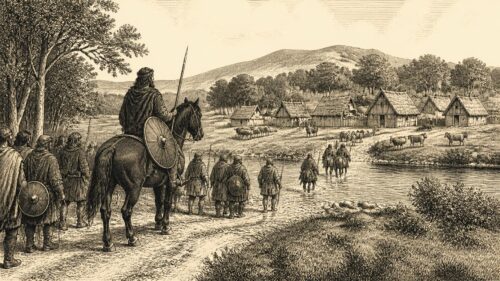
Magh Rath — Year FrameFor 634 CE, the safest starting point is the annalistic year itself rather than any attempt to build a continuous event story. The surviving Irish annals do not present a modern narrative; they list brief notices under year headings, and the preserved evidence for this year is uneven across texts. In the Annals of Inisfallen, the entry for 634 contains three short notices: the repose of Mo-Bae moccu Alldae, the death of Rónán son of Fergus, and the slaying of Catluan. In the Annals of the Four Masters, the equivalent year also preserves several notices, including deaths and battles,…
Democratic Algorithms — Digital PublicsIrish debates about AI and democracy begin from a policy language that treats digital systems as tools for public benefit rather than inevitable threats. The national strategy says Ireland should aim to be an international leader in using AI through a people-centred and ethical approach. That framing matters for democracy because it places legitimacy, not only efficiency, at the centre of development. It is an aspiration, however, rather than proof that such principles are already secure in practice.The same broad public sphere is also reflected in the scale of national and university-based digital humanities infrastructure. UCC describes CELT as…
Private Justice — Conceptual FrameThe phrase private justice is best understood as an analytic label rather than a single institution. Stuart Henry’s work presents it as a way to study discipline in industry and other forms of social control that exist outside formal legal procedures yet remain bound up with them. That framing does not claim a fixed Irish origin; it offers a sociological lens for seeing how law, authority, and regulation can overlap rather than sit in separate spheres.Henry’s table of contents also shows that the topic is not limited to one setting. It moves from factory law and managerial justice to…
Silent Munster — Yearly FrameThe annalistic evidence for 633 CE in the retrieved material is extremely slight. In the Annals of the Four Masters, the year entry states only that Failbhe Flann, king of Munster, died. That is the secure core of the year’s record here. No second event is attached to the same year in this witness, and no explanatory detail follows the notice. A careful account must therefore begin from the fact of the death and from the limits of the record, not from any imagined fuller story.This brevity is not a defect in the historian’s work but a condition of…
Glendalough Raids — Memory Layers — Raid RecordThe clearest evidence for the Glendalough raids is the annal entry for 983, which states that Glendalough was plundered by the Foreigners of Dublin. That notice is brief and restrained. It confirms an attack and identifies the assailants in broad political terms, but it gives no casualty list, no description of seized goods, and no explanation for why the valley was targeted. The notice supports the fact of plunder, while leaving the mechanics of the raid uncertain.The surrounding annal entries place that plundering within a wider pattern of conflict. In 982 the text records the destruction of Kildare by…
Irish Causes — Political OriginsThe archival guidance does not identify one single cause of the 1848 rebellion, but it does show a long political setting in which rebellion was repeatedly recorded and managed. The Rebellion Papers are described as essential for understanding Ireland between 1790 and 1808, with related material on law and order continuing to 1831 and official papers extending later. That range supports an interpretation of persistent political conflict, though it does not by itself explain the uprising of 1848.A careful conclusion is that 1848 emerged from a political environment shaped by administration, law, and recurrent disturbance rather than from a…
Irish Harp — Hidden OriginsThe surviving harp associated with Brian Boru should be understood first as a later medieval object whose beginnings are not securely documented. Trinity College Dublin calls it the oldest surviving Irish harp, but also says its early history is uncertain and that it probably dates from the later Middle Ages. That evidence places the instrument after Brian Boru’s lifetime and makes its royal association an issue of memory, not direct proof.The same institution identifies the harp’s materials as oak and willow and notes twenty-nine brass strings. Those details matter because they anchor the object in its physical survival rather…
Thank you for reading today’s Gazette. Follow any of the links above to read the full article and explore its sources.