
Maguirebridge’s Trifoliate Marsh
At the notional date of 31,373 BCE, Ireland lay within the climatically unstable Late Pleistocene, for which evidence permits only broad ranges rather than annual history. At Derryvree near Maguiresbridge, freshwater organic sediments between tills, radiocarbon dated broadly to this period, demonstrate an ice-free or ice-marginal interval with cold wetlands, bogbean, mountain avens, insects and active water. Castlepook Cave records a diverse cold-climate fauna, including reindeer, mammoth and predators, but mixed deposits prevent a single-date reconstruction. A possibly cut-marked reindeer bone suggests disputed transient Upper Palaeolithic human activity. No evidence supports settlement, farming or society; climate and glaciation reshaped Ireland.
View Record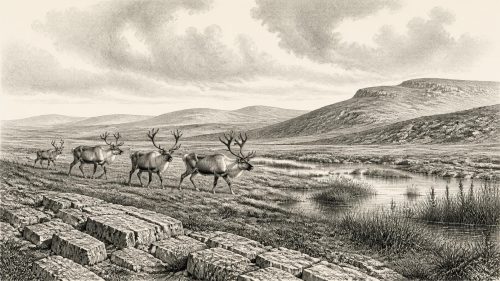
Castlepook’s Bone Horizon
31,374 BCE cannot be treated as a precisely datable Irish event, but belongs to the unstable, cold later Marine Isotope Stage 3, before the Last Glacial Maximum. Castlepook Cave, County Cork, preserves re-dated remains of mammoth, giant deer, reindeer, carnivores and lemmings, demonstrating varied open, wetland and tundra-like habitats. Deposits elsewhere confirm ecological diversity, although ice, erosion and rising seas have fragmented evidence. A possibly cut-marked reindeer femur may indicate fleeting human activity, but its old collection context prevents certainty. Ireland has no secure evidence then for settlement, society or continuous occupation; caves chiefly record animal communities and environmental change.
View Record
A Reindeer Mark at Doneraile
Around 31,375 BCE, a label rather than a precise Irish date, Ireland lay within cold conditions of Marine Isotope Stage 3. Treeless tundra-like landscapes and lower sea levels supported fauna, though advancing ice and later glaciation destroyed much evidence. Castlepook Cave near Doneraile preserves remains of reindeer, mammoth, giant deer, predators and cold-adapted animals, demonstrating intermittent access for mammals before the Last Glacial Maximum. A marked reindeer femur may indicate butchery by people, Ireland’s earliest human trace. However, it proves neither settlement nor continuous occupation. No evidence exists for farming, trade, politics or identifiable culture, only possible brief hunter-gatherer visits.
View Record
Cork’s Cave-Hyaena World
Labelled 31,376 BCE, this period cannot be reconstructed as a single Irish year, but falls within the climatically unstable Late Pleistocene. Derryvree, County Fermanagh, preserves an ice-free interval between glaciations, when cold, treeless wetlands supported freshwater plants and insects. Growing ice, altered coastlines and later erosion produced a patchy, seasonal landscape and destroyed much evidence. Castlepook Cave, County Cork, contains time-averaged remains of mammoth, reindeer, giant deer, hyaena and other cold-adapted fauna, indicating intermittent animal movements. No secure human settlement is known. A possibly cut-marked reindeer bone suggests provisional human activity. Its record survives in sediments, fossils and glacial landforms.
View Record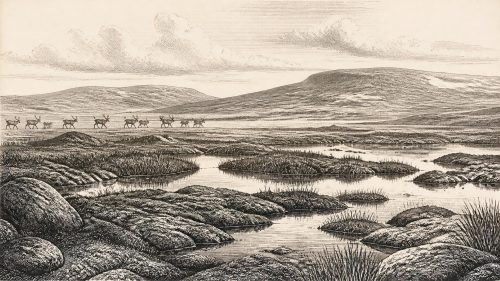
Fermanagh Between Two Ice Sheets
Around 31,377 BCE, Ireland lay within the climatically unstable Late Pleistocene, not a period of recorded history. At Derryvree, County Fermanagh, freshwater organic deposits between glacial tills show an ice-free interval, supporting treeless tundra vegetation, wetlands and cold-adapted life. Kerry speleothems likewise indicate unfrozen conditions. Castlepook Cave’s mammal remains demonstrate access for species including mammoth, reindeer, giant deer and hyaena, though not a uniform fauna. A marked reindeer bone may indicate brief human carcass processing, but cannot prove settlement. Changing sea levels and ice conditions left access routes uncertain before later British–Irish Ice Sheet expansion transformed Ireland and erased evidence.
View Record
The Doneraile Hindlimb
31,378 BCE is a modern label for a climatically unstable phase of Marine Isotope Stage 3, rather than a recoverable Irish year. Ireland had variable ice cover, open tundra-steppe, wetlands and changing coastlines, with freshwater evidence at Derryvree and Greenagho indicating intermittent ice-free conditions. Castlepook Cave, County Cork, preserves remains of reindeer, mammoth, giant deer and predators. A reindeer femur, reportedly bearing a possible stone-tool cutmark, may record brief Upper Palaeolithic human activity around 33,000 years ago. However, disturbed contexts and absent tools, hearths or settlements prevent conclusions. The evidence documents an environment and fauna, while human presence remains uncertain.
View Record
Cork’s Mid-Glacial Reindeer
Around 31,379 BCE, Ireland lay within the climatically volatile Late Pleistocene, not a precisely datable historical year. At Derryvree, County Fermanagh, freshwater sediments between glacial tills demonstrate a local ice-free interval, supporting cold, wet tundra-like habitats with sparse vegetation. Cave evidence, especially from Castlepook, County Cork, records reindeer, mammoth, giant deer and predators during broad MIS 3 ranges, though deposits and dates require caution. A cut-marked reindeer femur may indicate brief Upper Palaeolithic human activity, but proves neither settlement nor culture. Ireland had no known farming, polities or trade; its surviving record chiefly documents fluctuating ice, water, plants and animals.
View Record
BIRM-166 and Crag Cave
31,380 BCE is not a recoverable Irish historical year but a broad Late Pleistocene MIS 3 horizon. At Derryvree, County Fermanagh, organic deposits between glacial tills, including BIRM-166, indicate an ice-free interval with cold, open freshwater tundra environments, though radiocarbon calibration prevents precise dating. Crag Cave, Kerry, records milder episodes allowing calcite growth. Castlepook Cave, Cork, preserves diverse Ice Age fauna, demonstrating varied cold-climate ecosystems. A reportedly butchered reindeer bone may signal early human visitation, but remains disputed and cannot establish settlement or continuity. Subsequent expansion of the British–Irish Ice Sheet transformed and obscured this fragile environmental record in Ireland.
View Record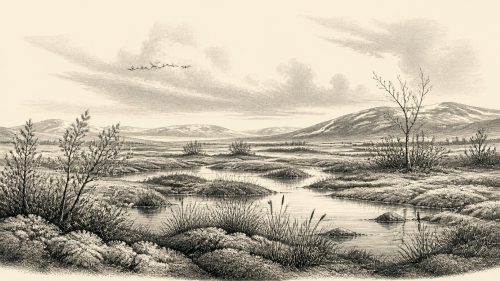
Derryvree’s Beetle Marsh
Around the notional date 31,381 BCE, Derryvree, County Fermanagh, preserves evidence of a freshwater wetland occupying an ice-free interval between glacial advances during MIS 3. Radiocarbon calibration places its organic sediments broadly between 34,950 and 29,750 BCE, precluding annual precision. Mosses, sedges, aquatic plants and twenty-eight cold-adapted beetle species indicate open, periglacial tundra with shallow water and short growing seasons. Wider Irish sites show climatically unstable conditions and varied cold-fauna. A cut-marked reindeer bone from Castlepook Cave tentatively suggests early human presence, but cannot prove settlement or continuity. The record documents ecological complexity, not political or social history in detail.
View Record
Derryvree’s Coldwater Sedges
Around 31,382 BCE, Ireland lay within the unstable later Marine Isotope Stage 3, although no event can be dated precisely to that year. Derryvree, County Fermanagh, preserves freshwater sediments between glacial tills, indicating cold, open periglacial terrain with sedges, mosses, aquatic plants and insects during an ice-free interval. Other deposits confirm that Ireland was not continuously ice-covered. Castlepook Cave, County Cork, contains remains of mammoth, giant deer, reindeer, hyaena and other cold-adapted animals. A marked reindeer bone may indicate human butchery, but no secure settlement evidence exists. Later glaciation destroyed much earlier evidence, limiting reconstruction to environmental and faunal traces.
View Record