Archived: 10 November 2026
Abstract
Year BoundsThe evidence for 614 CE is narrow, and the surviving notices do not create a continuous narrative. In one annalistic sequence, the year marker for 614 is followed only by the burning of Bennchor. In another tradition, a 614 entry concerns a battle in Britain. A fragmentary sequence also places a star sighting under 614. These notices are separate, brief, and differently framed, so any account of the year has to stay close to each entry’s own wording.The immediate surrounding years help define the limits of the record, but they do not enlarge 614 itself. In the same Tigernach
Read Article
Archived: 10 November 2026
Abstract
The annals preserve only a narrow and uneven picture of Ireland in 613 CE. For that year, one tradition records the death of Mael Coba son of Aed in battle and the succession of Suibne Menn, while another tradition records the death of Aed Allain, the accession of Mael Coba, and the repose of Colman abbot of Cluain. Nearby notices are explicitly dated to adjacent years, and several later compilations attach 613-year headings to material that appears elsewhere under different regnal schemes. This account distinguishes securely dated notices from broader contextual entries and refrains from filling annal gaps with conjecture.
Read Article
Archived: 11 November 2026
Abstract
Year LimitsThe surviving evidence for 612 CE is sparse and brief, but it is explicitly year-marked in several annalistic sequences. The Fragmentary Annals begin their 612 material with the beginning of Mael Coba’s reign and add that he reigned three years. Tigernach also has a 612 entry, but its contents are different: To-Lua the Tall rests, and a star is seen at the seventh hour of the day. The year is visible, yet never expanded into a continuous narrative.Inisfallen likewise preserves a 612 sequence, but its notices are different again. It records the repose of Sillán and Aedán, the burial
Read Article
Archived: 11 November 2026
Abstract
Dating FrameThe surviving notices place 611 CE inside annalistic year markers rather than a developed narrative. In the Annals of the Four Masters, the year appears as the Age of Christ 611 and the first year of Suibhne Meann in the sovereignty of Ireland. In the Annals of Inisfallen, the same year is represented by an entry labeled AI611.1, so the excerpt preserves a dated notice rather than a gap.This frame matters because it separates what is securely dated from what is only adjacent context. The Four Masters give 611 as a named year and add one church burning. Inisfallen
Read Article
Archived: 12 November 2026
Abstract
Year EvidenceUnder the label CS610, Chronicon Scotorum records the death of Áed son of Colgu, king of Ind Airther, while on pilgrimage at Cluain moccu Nóis. The same entry records the death of Sillán moccu Minn, abbot of Bennchor, and of Aedán, described as the anchorite. It also names Mael Umai son of Baetán among the dead. The entry opens with the words “Kalends fifth feria” and includes a short verse in the notice concerning Áed. These are the named deaths and accompanying details presented within that chronicle entry.The same annalistic sequence also records a disturbance in Bairche. In Tigernach
Read Article
Archived: 12 November 2026
Abstract
Year NoticesTigernach places a compact group of notices under its internal heading T609. It names an army of the Ulaid in Bairche being struck, the death of Mael-dúin son of Aline, the repose of Colmán Ela, Aed Róin and Aed Laigen, and Neman, abbot of Lismore. These are notices printed under that particular heading. The wording must be distinguished from an independently reconciled date of 609 CE, because the other annals preserve different chronological labels for related material.In Tigernach, the notices gathered under T609 are brief and varied. The sequence begins with an army of the Ulaid in Bairche struck
Read Article
Archived: 12 November 2026
Abstract
Year RecordThe year 608 in the Annals of Tigernach survives as a compact cluster of notices rather than a continuous story. The entry records the death of Aodh son of Colgu, described as king of Airgiall and the Oriors, and places that death at Clonmacnois in pilgrimage. The same year also includes separate notices for the deaths of Sillán son of Cumaine, abbot of Bennchor, and Aedán the anchorite.Tigernach also lists the deaths of Mael-umai son of Baetán and Colgu son of Fiachne, though the surviving excerpt breaks off after Colgu's name. The preserved passage therefore shows a year framed
Read Article
Archived: 12 November 2026
Abstract
Year DatingThe evidence for 607 CE is not arranged identically across the annals. In the Annals of Tigernach, the entry numbered T607 records the slaying of Sechnusach son of Garbán by Domnall son of Aod and the death of Conall Redspear son of Daimine, with the rest of Lugaid following in the same entry. In Inisfallen, AI607 records the slaying of Aed Sláine, Aed Rón, and Aed Buide, then notes that Aed Allain held the kingship. The Ulster text places related material under a different year label.The notices around 607 are deaths and killings, but the year labels differ from
Read Article
Archived: 12 November 2026
Abstract
Year LabelsThe excerpts do not present 606 CE as a single, stable point across the annals. In Annals of Tigernach, the year labeled T606 includes the death of Fiachra the One-eyed son of Baetán and the repose of Eochaid. In the Annals of Ulster, the year labeled U606 includes the repose of Beóguin, the death of Aedán son of Gabrán, and a notice about Pope Gregory. The Annals of Inisfallen place a cluster of deaths under AI606, while the Annals of the Four Masters begin a separate entry under the Age of Christ 606.These headings also show that the same
Read Article
Archived: 12 November 2026
Abstract
The annals preserve a small cluster of notices around 605 CE, but they do not present a full narrative for the year. In the Irish annals, the clearest 605 entries concern the death of Brandub son of Eochu, king of Laigin, and the repose or death of several ecclesiastics. Different compilations place some of these notices in 605, while others shift nearby events into adjacent years. This makes 605 best read as a year of scattered record rather than a complete sequence. The evidence allows careful comparison of dating and wording, but not reconstruction beyond what the texts explicitly state.
Read Article
Archived: 12 November 2026
Abstract
Year NoticeThe annalistic record for 604 CE is brief and clustered around deaths and slayings. In one version, the year is marked by the repose of Gregory of Rome, the repose of Saint Sinech, the death of king Suibne son of Colmán Mór, and the repose of Senach abbot of Cluain Ferta Brénainn. Another version places a different set of notices under the same chronological span, showing that the year is preserved through short annal entries rather than a continuous account.The same year is also represented in the Annals of Ulster as AD 603, where several deaths and slayings are
Read Article
Archived: 12 November 2026
Abstract
Year RecordThe explicit year-entry for 603 in the Annals of Inisfallen is brief and unadorned. It records the repose of bishop Sillán and the repose of Cainnech moccu Dálann. The wording gives deaths, or the language of religious repose, rather than a battle, raid, eclipse, famine, or change of kingship. On this evidence alone, 603 is marked by two clerical obituary notices and nothing more specific.Nothing in that annal line adds a date beyond the year label itself, and nothing in it identifies a place, a ruler, or an immediate cause. The secure facts are limited to the two named
Read Article
Archived: 12 November 2026
Abstract
Dating FrameThe surviving year notices do not line up in the same way. In the Annals of Ulster, the heading marked AD 601 is followed by entries for the kalends of January and then by notices placed under U602, which is explicitly marked AD 601. In the Annals of the Four Masters, M601 is headed as the Age of Christ, 601. The comparison is direct: one witness labels the material one way, while the other places the year at 601 without that shift.The same comparison also shows that the Ulster chronicle preserves a short block of notices under AD 601
Read Article

Archived: 8 October 2026
Abstract
Ireland around 30,117 BCE lay within the climatically unstable Late Pleistocene, as the British–Irish Ice Sheet expanded unevenly and low sea levels reshaped coasts and possible dispersal routes. Derryvree, County Fermanagh, preserves freshwater organic deposits between glacial tills, indicating a treeless, wet tundra-like mosaic during a local ice-free interval. Castlepook Cave, County Cork, contains a time-spanning fauna including reindeer, mammoth, giant deer, predators and cold-adapted small mammals, demonstrating ecological richness but not a single contemporary assemblage. A cut-marked reindeer bone may suggest human carcass processing, yet no secure evidence proves settlement. Regional records reveal ice, water, vegetation and animal movements.
Read Article

Archived: 8 October 2026
Abstract
Labelled 30,118 BCE, this horizon represents an uncertain Late Pleistocene interval, not a precise Irish date. During Marine Isotope Stage 3, Ireland contained shifting ice, periglacial terrain, wetlands and open grazing country as the British–Irish Ice Sheet expanded towards its later maximum. Derryvree sediments indicate local ice-free freshwater environments, while Castlepook Cave preserves cold-adapted fauna including mammoth, reindeer, giant deer, hyaena and wolf. An incised reindeer femur may indicate early human butchery, but its insecure context and lack of associated tools prevent firm conclusions. Later glaciation destroyed much evidence, requiring cautious interpretations based on dated deposits, animal remains and landforms.
Read Article
Archived: 8 October 2026
Abstract
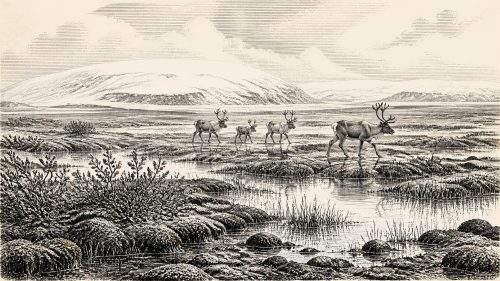
At approximately 30,119 BCE, Ireland lay within the climatically unstable later Marine Isotope Stage 3, beyond precise calendar dating or historical record. At Derryvree, County Fermanagh, organic sediments between two glacial tills document an ice-free local landscape of shallow pools, mosses, sedges, herbs and tundra-like vegetation. They demonstrate regional climatic fluctuation, not an ice-free island. Lower seas and shifting ice altered coasts, while Crag Cave records intermittent conditions. Faunal remains at Castlepook Cave indicate open-country mammals. A marked reindeer bone suggests tentative Upper Palaeolithic human activity, but no secure settlement evidence exists. Environmental change and renewed glaciation define this period.
Read Article

Archived: 8 October 2026
Abstract
Although 30,120 BCE lies within Derryvree’s calibrated radiocarbon range, no year-specific Irish history can be recovered. During unstable Marine Isotope Stage 3, Fermanagh’s Derryvree deposits record an ice-free interval between glacial advances: cold, treeless wetlands of pools, sedges, grasses, mosses, juniper and herbs. Later ice buried and preserved this evidence. Castlepook Cave in Cork contains remains of diverse Ice Age animals, but mixed deposits prevent a single contemporary reconstruction. A modified reindeer bone may indicate brief human butchery, not settlement. Ireland was periodically habitable amid shifting ice and sea conditions, yet lacks evidence for societies, economies, culture or enduring occupation.
Read Article

Archived: 8 October 2026
Abstract
About 30,121 BCE, Ireland lay in a cold, unstable Late Ice Age landscape as the British–Irish Ice Sheet expanded. Open tundra-like habitats, altered coastlines and routes supported cold-adapted fauna, while glaciation later destroyed or buried much evidence. Castlepook Cave in County Cork preserves Ireland’s vertebrate archive for this period, though its mixed deposits span many millennia and were excavated. Bones of mammoth, reindeer, giant deer, hyaena, wolves and Arctic mammals demonstrate animal access. A possibly tool-marked reindeer bone may indicate human activity around 33,000 years ago, but cannot establish settlement, society or sustained occupation. The period remains an environmental history.
Read Article

Archived: 8 October 2026
Abstract
30,122 BCE cannot be reconstructed as a precise year, but falls within a late-MIS-3 interval represented by the Derryvree BIRM-166 organic silt. Deposited between glacial tills in County Fermanagh, it records a locally ice-free freshwater tundra wetland with grasses, sedges, dwarf shrubs, mosses, insects and water plants. Ireland formed an unstable mosaic of ice, periglacial terrain and open habitats before later ice-sheet expansion. Castlepook Cave, County Cork, preserves diverse cold-stage fauna, including mammoth, reindeer and predators, though remains accumulated over time. A marked reindeer bone may indicate human butchery, but sustained occupation remains unproven. Evidence illuminates environmental change, not society.
Read Article

Archived: 7 October 2026
Abstract
30,123 BCE is a modern label for an uncertain Late Pleistocene horizon, not a recorded Irish year. At Derryvree, County Fermanagh, organic freshwater sediments between glacial tills, radiocarbon-dated broadly to this period, preserve bogbean, pollen, mosses and insects. They indicate locally ice-free, treeless tundra wetland with pools, sedges, grasses, herbs and juniper. Ireland experienced changing ice margins before the later Last Glacial Maximum, while lower sea levels did not guarantee access routes. Castlepook Cave, County Cork, contains cold-climate fauna. A possibly tool-marked reindeer bone may indicate human carcass processing, but cannot demonstrate settlement. No evidence supports society, agriculture or institutions.
Read Article

Archived: 7 October 2026
Abstract
About 32,000 calibrated years before AD 1950, Ireland lay within the climatically unstable Late Pleistocene. Derryvree, County Fermanagh, preserves freshwater organic sediments between glacial tills, demonstrating an interval of ice-free, treeless wetland amid advancing ice. Its plants indicate sedges, mosses and hardy herbs in tundra-like, periglacial conditions. Cave remains show that cold-adapted fauna, including reindeer, giant deer, mammoth and hyaena, reached Ireland during wider MIS 3, though not necessarily together. A potentially cut-marked Castlepook reindeer bone suggests, but does not establish, Upper Palaeolithic human presence. Evidence supports environmental change and episodic animal movement, not settlement, society, trade or recorded events.
Read Article

Archived: 7 October 2026
Abstract
About 32,000 years before present, Ireland was a cold, unstable Marine Isotope Stage 3 landscape, increasingly affected by the expanding British–Irish Ice Sheet. Open grassland, steppe and tundra-like habitats supported mobile large mammals, although coasts, ice margins and sea routes remained variable. Castlepook Cave in County Cork, Ireland’s richest pre-Last Glacial Maximum vertebrate archive, preserves time-mixed remains including mammoth, reindeer, giant deer, bear and hyena. Its disturbed deposits cannot prove simultaneous species or human hunting. A possibly cut-marked reindeer bone may indicate a brief human visit, but no secure settlement exists. Growing ice later reshaped terrain and obscured earlier evidence.
Read Article

Archived: 7 October 2026
Abstract
Thirty-thousand years BCE is a modern chronological label, not a recoverable Irish year. Around this period, during MIS 3, Ireland experienced fluctuating climates and advancing, retreating ice. At Derryvree near Maguiresbridge, freshwater silts between two tills, broadly dated to 34,950–29,750 BCE, preserve cold treeless wetland plants and insects, demonstrating locally habitable refuges between glacial episodes. Castlepook Cave’s imperfectly recorded fauna, including mammoth, reindeer, giant deer and predators, indicates connections with wider mammoth-steppe ecosystems. A possible cut-marked reindeer bone may suggest human presence, but no secure evidence establishes settlement. Environmental instability, later glaciation and fragmented survival of evidence prevent conventional history.
Read Article
Archived: 7 October 2026
Abstract
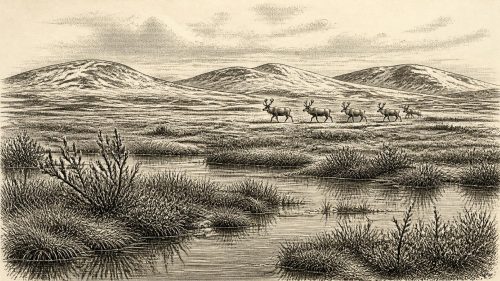
Rather than a precise historical year, 30,127 BCE denotes a Late Pleistocene, Marine Isotope Stage 3 interval of climatic instability before the Last Glacial Maximum. Ireland comprised shifting cold environments, with uncertain ice extent. Derryvree, County Fermanagh, preserves a buried freshwater wetland, dated broadly to this period, whose plants indicate treeless periglacial conditions and shallow water. Castlepook Cave, County Cork, contains a long, disturbed accumulation of mammal bones, including mammoth, reindeer and hyaena, demonstrating diverse Ice-Age fauna. A cut-marked reindeer femur may indicate human butchery, but cannot prove settlement. Evidence reveals ecological richness, not a historical chronicle for this island.
Read Article
Archived: 7 October 2026
Abstract
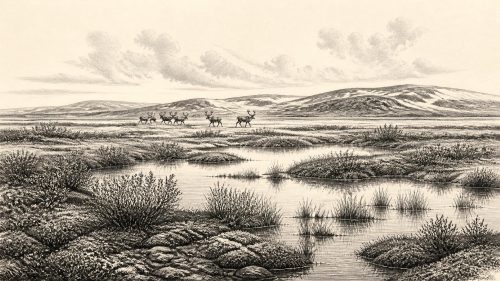
30,128 BCE is a modern label for a Late Pleistocene interval, not a recoverable Irish historical date. Environmental evidence from Derryvree, County Fermanagh, records a cold, treeless wetland between glacial advances, with sedges, grasses, mosses, aquatic plants and hardy shrubs. Castlepook Cave, County Cork, preserves MIS 3 fauna including mammoth, reindeer, giant deer, predators and scavengers, indicating productive open habitats. A possibly tool-marked reindeer bone suggests, but does not establish, early human presence. Lower sea levels altered routes, while later ice destroyed evidence. These fragile archives reveal changing ecosystems before extensive glaciation, not named communities, events or institutions in Ireland.
Read Article

Archived: 7 October 2026
Abstract
Thirty thousand years BCE is not a precise recoverable Irish date, but falls within unstable late Marine Isotope Stage 3. At Derryvree, County Fermanagh, organic sediments between glacial tills, dated broadly to 36,900–31,700 calibrated years BP, preserve a cold, treeless freshwater wetland of mosses, sedges, hardy plants and periglacial insects. Ireland experienced shifting ice margins before the later glacial maximum, with fragmented evidence of changing environments. Castlepook Cave, County Cork, records cold-adapted mammals, including mammoth, reindeer and giant deer, across long periods. A possibly tool-marked reindeer bone may indicate a human visit, but no evidence demonstrates settlement, culture or institutions.
Read Article

Archived: 7 October 2026
Abstract
Labelled 30,130 BCE, this period falls in late Marine Isotope Stage 3, as Ireland moved towards, but had not reached, maximum glaciation. Conditions were cold, open and changing, with lower seas and unstable ice margins linking Ireland ecologically to north-west Europe. Castlepook Cave, County Cork, preserves Ireland’s principal pre-maximum vertebrate archive, including mammoth, giant deer, reindeer, bear, hyena, lemmings, Arctic fox and wolf. Its mixed, disturbed deposits cannot date all species together, though modern redating has revised ages older. The evidence indicates mobile Ice Age fauna in patchy tundra-like habitats, not human settlement. Secure human activity appears 12,800 years ago.
Read Article
Archived: 7 October 2026
Abstract
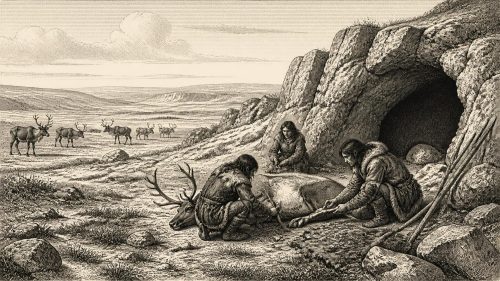
About 32,000 calibrated years BP, Ireland lay within an unstable Ice Age environment, as ice, sea levels and climates changed over periods. The British–Irish Ice Sheet's local extent remains uncertain, while open tundra-steppe supported reindeer, mammoth, horse and predators. Castlepook Cave, County Cork, produced a reindeer femur with a possible stone-tool cut or chop, tentatively indicating Palaeolithic human handling around 31,000 BC. However, disturbed deposits, antiquarian excavation and absence of associated tools or habitation evidence prevent claims of settlement or continuity. The record instead suggests possible brief hunter incursions amid ecological opportunity, reconstructed through fragmentary bones, sediments, landforms and dates.
Read Article
Archived: 7 October 2026
Abstract
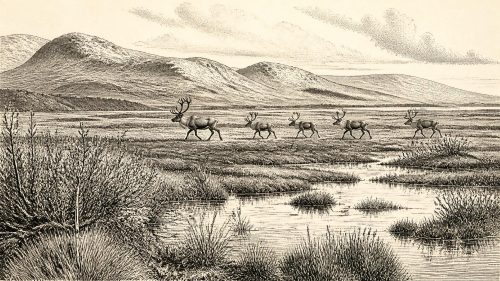
At roughly 32,000 years before present, Ireland lay within the climatically unstable Marine Isotope Stage 3. Evidence from sediments, fossils, caves and glacial landforms permits environmental reconstruction but not precise history. At Derryvree, County Fermanagh, freshwater deposits between tills record tundra-like marsh vegetation, aquatic life and ice-free conditions during a broad calibrated interval encompassing 30,132 BCE. Castlepook Cave, County Cork, preserves remains of mammoth, reindeer, giant deer and predators, though its mixed deposits cannot establish contemporaneity. A cut-marked reindeer bone may indicate human activity, but no secure settlement evidence exists. Later glaciation erased much evidence, leaving a fragmentary environmental record.
Read Article

Archived: 7 October 2026
Abstract
About 30,133 BCE, Ireland cannot be described through annual history, but Late Pleistocene evidence indicates a cold, changing MIS 3 environment. Derryvree, County Fermanagh, preserves freshwater deposits dated broadly to this period, showing treeless tundra-like wetlands with sedges, mosses and cold-adapted plants between glacial episodes. Castlepook Cave, County Cork, contains a mixed, complex fauna including mammoth, reindeer, giant deer, lemmings, Arctic fox, wolf and hyaena, demonstrating open cold habitats but not contemporaneity. A possibly tool-marked reindeer bone suggests human activity around 33,000 years ago, although no settlement is proven. Later ice and sea-level change destroyed or obscured much surviving evidence.
Read Article





