
War on Two Fronts(c.1050s)
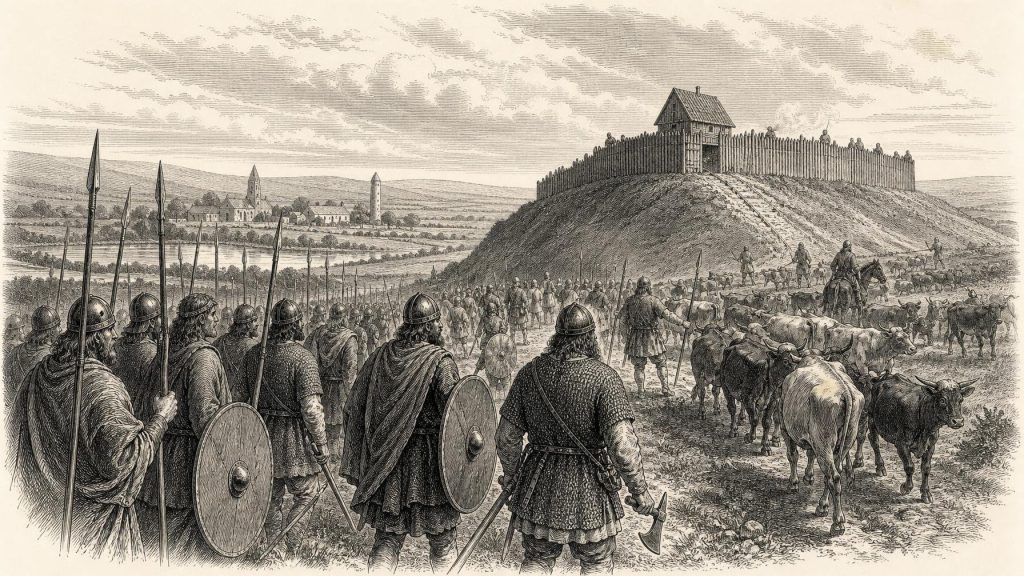
Ireland’s annalists remembered this as “a year of much warfare”. That description, preserved in the Annals of Inisfallen, is especially apt for Munster, where Donnchad mac Briain’s authority was attacked from several directions. Leinster, Osraige, Dublin and Connacht all participated in operations against territories associated with his rule, while his nephew Tairdelbach Ua Briain emerged more clearly as an internal rival. Fighting also disturbed northern Ireland, and the deaths of rulers, churchmen and scholars reveal a political landscape in which kingship, kinship and ecclesiastical office were closely intertwined.
The surviving annals do not provide a continuous narrative. Some were compiled near the events; others preserve later selections or rearrangements. They agree on several major occurrences but differ in detail, particularly over alliances and responsibility. Events assigned directly to 1054 can therefore be distinguished from broader conditions—such as farming, settlement and trade—which cannot usually be dated to a single year but formed the setting in which those events occurred.
Contested Supremacy
No king exercised uncontested government over the whole island. Donnchad mac Briain, son of Brian Bórama, ruled much of Munster and had previously extracted hostages from several kingdoms. His prestige was nevertheless declining. Diarmait mac Máel na mBó, king of Leinster and Uí Chennselaig, had seized control of Dublin in 1052 and was building a formidable combination of Leinster military strength, Norse-Gaelic maritime resources and alliances beyond his own province.
The relationship between the two men was complicated by marriage and fosterage. Diarmait was Donnchad’s son-in-law, yet supported Tairdelbach Ua Briain, Donnchad’s nephew and dynastic enemy. Tairdelbach’s father, Tadc, had been killed in 1023 during Donnchad’s rise. By 1053 Tairdelbach was already campaigning against the upper Dál Cais. The warfare of 1054 was consequently more than a frontier dispute: it formed part of a sustained attempt to break Donnchad’s position within Munster itself.
The Invasion of Munster
The Annals of Tigernach and the Annals of the Four Masters record an expedition led by Diarmait and Gilla Pátraic, king of Osraige. Their army included Leinstermen, Osraige troops and the “foreigners”, meaning forces drawn from Norse-Gaelic Dublin. It advanced into Munster as far as Imlech Ibuir, modern Emly, and burned Dún Trí Liac, apparently an important fortified place in that region. The Annals of Inisfallen summarise the campaign more broadly, stating that the Leinstermen burned eastern Cliú.
Donnchad did not intercept the invaders. One account says that he was then in southern Ireland, suggesting either that the attack exploited his absence or that simultaneous threats stretched his forces. The expedition demonstrated how control of Dublin strengthened Diarmait. Ships, experienced fighting men and commercial wealth could now reinforce Leinster’s land armies, while Osraige provided a route towards Munster. The burning of a stronghold near Emly was both material destruction and a public challenge to Donnchad’s ability to protect his dependants.
Pressure also came from the west. Áed in Gaí Bernaig Ua Conchobair, king of Connacht, raided Corcu Baiscinn and Tradraige in present-day County Clare, taking extensive spoils. Áed son of Cennétig, an eminent Dál Cais leader associated with Clann Tairdelbaig, was killed. The Four Masters add that Tairdelbach accompanied the Connachtmen into Thomond, plundered Tuam Finlocha and participated in Áed’s overthrow. Although the sources describe the operations differently, they reveal coordinated or overlapping attacks on both the eastern and western approaches to Donnchad’s realm.
Donnchad’s own family remained active. The Annals of Inisfallen report that three of his sons carried off cattle and other booty from Corcu Modruad, the kingdom around what later became Corcomroe in north-west Clare. This may represent retaliation, an effort to secure resources or an attempt to enforce authority among uncertain dependants. Raiding was not random destruction alone: livestock financed households, rewarded followers and measured a king’s capacity to defend or dominate territory.
Violence Across the North
Northern politics were equally fragmented. Áed Ua Fergail, king of the Cenél Eógain district centred on Tulach Óg and a potential successor to the kingship of Ailech, was killed with others. The sources associate his death with Lethlobar Ua Laidgnén, king of Airgialla, and with forces from Fir Manach or Fernmag. His loss weakened an important branch of the northern Uí Néill and illustrates how provincial titles concealed competition among regional dynasties.
Other northern deaths included Dubgall Ua hAedacáin, king of Uí Nialláin. At Finnmag, the Uí Echach defeated the Uí Méith and the forces of Uachtar Tíre; Croibderg, heir-designate of Uachtar Tíre, was killed. These notices preserve little explanation, but they show warfare operating at several levels simultaneously. A provincial king might pursue distant ambitions while local rulers fought over succession, tribute, grazing lands, clientship and control of strategic routes.
Churches and Learned Communities
The church was deeply embedded in this competitive order. Ua Gerruidir, bishop of Killaloe, died during the year. Killaloe stood within the Dál Cais heartland and close to the royal centre at Kincora, so its bishopric possessed political as well as religious significance. Muirchertach Ua Sculu, coarb or successor of St Senán, also died. His office linked him with the important ecclesiastical community of Inis Cathaig, Scattery Island, near the Shannon estuary.
Two notable teachers or lectors died: Guaire Ua Lachtnáin of Clonmacnoise and Cuilennán Claen, associated with Leighlin and Dísert Diarmata. Lectors taught scripture, Latin learning and other branches of scholarship within major churches. Their appearance in the annals reflects the prestige accorded to learned office. Clonmacnoise remained a particularly important centre for manuscripts, historical writing and teaching, while also holding land and treasures that made it vulnerable to secular competition.
The death of Cacht daughter of Ragnall was recorded with the striking title “queen of Ireland”. She was probably the daughter of the Norse ruler Ragnall whom Donnchad had married in 1032. Her title should not be read as evidence for a centralised monarchy, but it reflects Donnchad’s high royal claims and the diplomatic importance of marriage between Gaelic and Norse-Gaelic dynasties. The death of Ímar son of Aralt, styled king of the foreigners in the Annals of Ulster, likewise marked the passing of a figure connected with Dublin’s older ruling house, although Diarmait remained the city’s dominant overlord.
Land, Cattle and Trade
Most people lived in dispersed farmsteads rather than towns. Ringforts, cashels and unenclosed settlements housed farming families, dependants and craftspeople. Cattle were central to diet, status, tribute and compensation, explaining why the annals repeatedly counted success in captured herds. Sheep supplied wool and meat; pigs exploited woodland mast; grain was cultivated where soils allowed. Dairy products were especially important, while seasonal movement of animals helped communities use upland and marginal pasture.
Dublin offered a contrasting environment of closely packed houses, workshops, quays and property boundaries. Its craftspeople worked wood, iron, bone, antler, leather and precious metals. Merchants connected Ireland with Britain, Scandinavia and continental Europe. Silver circulated by weight and as coin, although cattle and valued objects remained fundamental outside the towns. Diarmait’s possession of Dublin therefore brought more than soldiers: it gave him access to ships, customs, manufactured goods, bullion and far-reaching diplomatic contacts.
Wonders in the Annals
The chroniclers also recorded two extraordinary occurrences. On Sunday, 23 April, the feast of St George, a “steeple of fire” was reportedly seen at Ros Dela for five hours. The account describes countless black birds, a larger bird, trembling trees, clothing lifted into the air and a hound carried up and dropped. It may preserve a memory of violent wind, fire or unusual bird behaviour, but the text presents it as a wonder; no precise modern explanation can be established.
Late on the night before Michaelmas, 29 September, Loch Suide Odráin in Sliab Guaire was said to have disappeared and flowed into the River Febail. This probably reflects a dramatic drainage, flood or change in a small lake system, interpreted by observers as an unprecedented marvel. Such notices belonged naturally beside battles and royal deaths. Medieval annalists regarded disturbances in nature as meaningful parts of history, not as a separate category of curiosity.
Beyond Ireland, the annals noted a major battle between Scots and English, evidence of Irish clerical awareness of events across the Irish Sea. By contrast, they show no immediate Irish response to the breach between Rome and Constantinople conventionally associated with 1054. For Ireland, the year’s defining development was domestic: the tightening alliance around Diarmait and Tairdelbach, the growing reach of Connacht, and the exposure of Donnchad’s rule to attack from within and without. His kingdom survived, but the balance of power was moving decisively against him.
Primary Sources
- The Annals of Ulster: Year U1054
- The Annals of Tigernach: Part 18
- Annals of Inisfallen
- Chronicon Scotorum
- Annals of the Four Masters, Volume 2
- Diarmait (Diarmait mac Maíl na mBó)
- Donnchad
- Ua Briain, Tairdelbach
- Ua Ruairc, Áed
- Tadc
- Exploring the Irish Annals
- Transformation — A Concise History of Ireland
- Viking
- The Viking Age in Ireland
- 950–1450: Vikings, Normans and Medieval Mints
- Irish School of Illumination, c. 650–1100
- High Crosses
- Clonmacnoise Monastic Site
- Dublin, Part I, to 1610: Irish Historic Towns Atlas, No. 11
- Animals and the Economy of Medieval Ireland
- Reflections on Kingship, the Church and Viking-Age Silver in Ireland
- Western Stone Forts Project