A Year of Raids(c.1050s)

The surviving Irish chronicles present 1053 as a year of warfare conducted on several overlapping fronts. Their entries are terse and sometimes contradictory, but they consistently describe armies crossing provincial boundaries, cattle and captives being carried away, hostages changing hands and rulers dying through ambush or betrayal. The Annals of Inisfallen explicitly report ‘great warfare’ between Munster and Connacht, while the Annals of Tigernach, Annals of Ulster, Chronicon Scotorum and the later Annals of the Four Masters preserve additional events from Brega, Mide, Fermanagh, Lurg, Airgialla and north-western Ulster.
The year is securely identified within the annalistic calendar: the Annals of Inisfallen and Annals of Ulster place the first day of January on a Friday and record the lunar age used by ecclesiastical timekeepers. Nevertheless, individual incidents may have been entered under slightly different years as chronicles were copied and synchronised. Events appearing under 1053 in several independent annalistic traditions can be treated with reasonable confidence; explanations found only in later compilations require greater caution.
War in Munster
The most consequential development was the widening struggle within the political world created by Brian Bóruma. Brian’s son Donnchad mac Briain remained king of Munster, but his authority faced a determined challenge from his nephew Toirdelbach Ua Briain. Toirdelbach was the son of Tadc, whose killing in 1023 had been arranged at Donnchad’s instigation. This family grievance became inseparable from the ambitions of neighbouring kings, particularly Áed Ua Conchobair of Connacht and Diarmait mac Máel na mBó of Leinster.
The Annals of Inisfallen state that great war prevailed between the men of Munster and the Connachta and that Toirdelbach beleaguered upper Dál Cais. This entry places him in open action against the heartland of his own dynasty. Although the chronicle gives neither a named fortress nor the duration of the operation, the language suggests more than a passing cattle raid. Toirdelbach was testing Donnchad’s control of north Munster with support, direct or indirect, from Connacht.
Another Inisfallen entry records the treacherous killing of Áed Ua Cuiléin by Domnall Ruad Ua Briain. Ua Cuiléin belonged to the Uí Chonaill Gabra, a powerful group in the Limerick region, while Domnall Ruad was another member of Brian’s extended dynasty. The episode shows how the greater contest penetrated local politics: allegiances among neighbouring kindreds and collateral branches mattered as much as formal provincial boundaries. Donnchad Ua Ceallacháin, described as a royal heir of Cashel, was also killed by the Osraige during the year. His death further weakened interests associated with the older Eóganacht traditions of Munster kingship.
Dublin, Brega and Mide
Eastern Ireland formed a second major theatre. Diarmait mac Máel na mBó had seized control of Dublin in 1052 after driving its Hiberno-Norse king, Echmarcach mac Ragnaill, overseas. Possession of Dublin gave Diarmait access to ships, warriors, merchants and a wealthy port, but it also exposed him to coalitions assembled by rival Irish rulers. In 1053 Donnchad mac Briain and Conchobar Ua Máelshechlainn led an army into Fine Gall, the fertile district north of Dublin, and obtained hostages from Diarmait.
Warriors identified as the Sinnaig, or Foxes, of Tethba accompanied the expedition. They took numerous captives from the stone church at Lusk. This is among the year’s most revealing notices. Churches were sacred places and economic centres, yet neither their sanctity nor masonry guaranteed protection. People, livestock and portable wealth might be gathered within an ecclesiastical enclosure during danger, making it an attractive target. The raid therefore combined political coercion with profitable seizure.
Diarmait answered forcefully. The Annals of Tigernach report that he marched into Brega and Mide, burned territory from Slane westwards and carried away many cattle and prisoners. The Four Masters add that Gilla Pátraic, king of Osraige, accompanied him and connect the retaliation with disputed marriage arrangements involving Mór, daughter of Congalach Ua Conchobair, as well as cattle exactions made by Ua Máelshechlainn. These motives may preserve genuine political memory, but they come from a compilation completed centuries later and should not be accepted as certain in every detail.
Máel Crón son of Cathal, king of southern Brega, was killed by Ua Riacáin around Easter, after which raids were made against the ‘foreigners’, the annalists’ customary term for the Hiberno-Norse. His death belongs to the same unstable landscape of Brega, Fine Gall and Dublin. Authority there depended upon shifting combinations of local dynasties, Mide rulers, the Dublin population and powerful outsiders such as Diarmait and Donnchad.
Violence Across the Regions
The chronicles also record interconnected killings in the north-west. Niall Ua hEignigh, king of Fermanagh, and his brother Gilla Críst were treacherously killed by the Fir Luirg. Cú Chiar Ua Maíl Dúin, king of Lurg, was then slain at his own assembly by a member of the Ua Ruairc family. The killer or a close relative was immediately killed by the Conmaicne; the surviving chronicles differ over the precise identity. Assemblies were places for judgement, inauguration, negotiation and the display of rank, so an assassination at such a gathering violated both personal trust and public order.
Elsewhere, Cochlán, king of Delbna Bethra, was killed through treachery by his own people. In the north, Mac Lochlainn and the men of Mag nÍtha raided Cenél mBinnigh near Loch Drochait and took three hundred cows, according to the Annals of Ulster and Four Masters. The Ulster account adds that Dub Emna, vice-abbot of Clonfeacle, and Cú Macha, an official associated with Dál Cais, were killed. Another raid by Lethlobar Ua Laidgnén, king of Airgialla, against the Gailenga developed into a pursuit and battle in which Congalach son of Senán, king of Gailenga, fell with many companions.
Churches and Learning
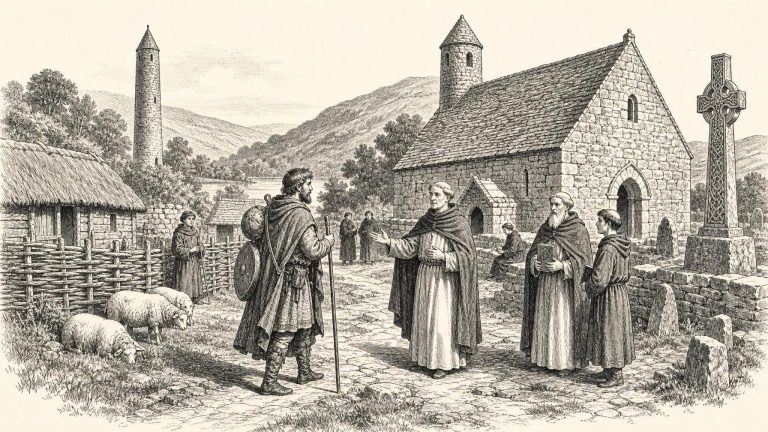
The death notices of 1053 reveal a network of churches extending far beyond the famous monasteries. Doilgén, a distinguished priest of Armagh, died, as did church superiors associated with Roscrea, Slane, Termonfeckin and Drumcliff. Muiredach son of Diarmait was airchinnech of Roscrea; Cormac Ua Ruadrach held that office at Termonfeckin; Domnall Ua Céile served at Slane; and Murchad Ua Beolláin at Drumcliff. An airchinnech could act as the administrator or steward of a church, its lands and dependants, although the exact balance between clerical, familial and secular authority varied from place to place.
These obituaries are evidence of institutional continuity amid political violence. Churches maintained worship, burial grounds, estates, hospitality and education, while trained readers and scribes calculated the calendar and preserved historical records. Irish and Latin learning coexisted within this world. No major literary work can be assigned securely to 1053 itself, but the annals demonstrate the continuing practice of placing local deaths, battles and natural phenomena within a Christian chronology. Their silence about ordinary routines should not be mistaken for cultural inactivity.
Work, Wealth and Settlement
For most inhabitants, life remained rural and agricultural. Families occupied dispersed farmsteads, many enclosed by earthen ringforts or stone cashels, and depended upon mixed farming. Cattle supplied milk, meat, hides, status and transferable wealth; this explains why annalists repeatedly counted cows among the proceeds of war. Grain cultivation, pig keeping, textile production, woodworking and ironworking supported households and local exchange. Raiding threatened this entire system by removing animals, destroying crops and buildings, and carrying people into captivity.
Dublin, Limerick, Waterford, Cork and Wexford provided a different environment. Their Hiberno-Norse populations lived in densely arranged timber and wattle houses and supported specialised crafts, shipping and overseas commerce. Dublin struck silver pennies, although bullion, livestock, valuables and obligations remained important forms of wealth elsewhere. Its merchants connected Ireland with Britain, Scandinavia and continental markets. Diarmait’s possession of the town was therefore economically and strategically significant, while the attacks on Fine Gall and Brega show how closely an urban port depended upon its agricultural hinterland.
A Fragmenting Balance
No single battle decided Ireland’s political future in 1053. Instead, the year exposed a balance of power that was becoming increasingly difficult to sustain. Donnchad mac Briain could still campaign near Dublin, but Toirdelbach was attacking Dál Cais with Connacht pressure behind him. Diarmait mac Máel na mBó could be forced to surrender hostages, yet he retained enough strength to devastate Brega and Mide in reply. Lesser kings pursued their own feuds within this wider contest, often through surprise killings and rapidly assembled raids.
The annals record no securely identifiable island-wide famine, epidemic or extraordinary natural disaster for the year. That absence does not prove universal peace or plenty; their authors selected what they considered memorable. What survives is a portrait of political insecurity resting upon a resilient society of farms, churches, learned communities and maritime towns. The campaigns of 1053 did not end Donnchad’s reign, but they marked the emergence of Toirdelbach Ua Briain as an active challenger and anticipated the coalition that would eventually drive Donnchad from Munster.
Primary Sources
- Annals of Inisfallen, AI1052–AI1061: English Translation
- Annals of Inisfallen, I1050–I1092: Irish Text
- The Annals of Ulster, U1053: English Translation
- The Annals of Ulster, U1053: Irish Text
- The Annals of Tigernach, T1053: English Translation
- The Annals of Tigernach, T1053: Irish Text
- Chronicon Scotorum, CS1050–CS1053: English Translation
- Chronicon Scotorum, CS1053: Irish Text
- Annals of the Four Masters, M1053: English Translation
- Annals of the Four Masters, M1053: Irish Text
- Donnchad
- Ua Briain, Tairdelbach
- Diarmait (Diarmait mac Maíl (Máel) na Mbó)
- Ireland and Her Neighbours, c.1014–c.1072
- The Irish Church, 800–c.1050
- High-Kings with Opposition, 1072–1166
- The Archaeology of Ireland’s Viking-Age Towns
- Coins and Coinage in Pre-Norman Ireland
- Language and Literature to 1169
- Hiberno-Latin Literature to 1169
- A New History of Ireland: Prehistoric and Early Ireland
- The Viking Age in Ireland
- 950–1450: Vikings, Normans and Medieval Mints
- Early Medieval Ireland, AD 400–1100: The Evidence from Archaeological Excavations
- Ringforts / Ráthanna
- Western Stone Forts Project
- Exploring the Irish Annals
- Hunting for the First Irish Surnames