Maguirebridge’s Tundra Lake31896 BCE
About 31,896 BCE, a modern label, Ireland lay in later Marine Isotope Stage 3, before the Last Glacial Maximum. Derryvree near Maguiresbridge preserves sediments beneath glacial tills, indicating ice-free northern ground with treeless tundra, wetlands, pools and cold-adapted plants and insects. Cave evidence from Cork records MIS 3 fauna including mammoth, reindeer, giant deer, bears and hyaenas, though remains span episodes and disturbed contexts. Kerry speleothems indicate milder conditions. Ice expansion was regionally varied and intensified later. No secure human settlement dates to this period; possible butchery evidence remains uncertain. Surviving sediments, bones and calcite reveal a diverse Ice-Age landscape.
Dateline
“31,896 BCE” is a modern calendar label, not a year that anybody in Ireland could have recorded or to which archaeology can attach an event. It corresponds only approximately to 33,846 calendar years before AD 1950, the reference point used for calibrated archaeological dates. At this depth of time, radiocarbon ages come with substantial ranges, calibration curves are periodically refined, and deposits may have formed over generations or millennia. The responsible historical setting is therefore later Marine Isotope Stage 3 (MIS 3), during the Midlandian glacial cycle and before the Last Glacial Maximum, rather than an imagined occurrence in one particular year.
A Landscape Known in Fragments
Ireland at roughly 33.8 thousand calibrated years ago is known through a thin and difficult archive: fossil bones from caves, plant and insect remains preserved in sediments, layers of glacial debris, and mineral growth in caves. These are not historical records. They cannot reveal a ruler, community name, battle, treaty, shrine, market or spoken language. Indeed, they do not securely demonstrate a settled human population. They instead allow a more fundamental question: what kinds of landscapes and animal communities could exist in Ireland as the last great ice-sheet expansion approached?
The evidence is uneven because later ice repeatedly eroded older surfaces and deposits. Cave deposits in particular are invaluable but troublesome: bones can be washed in, moved by carnivores, mixed by earlier excavation or derived from different episodes. The Irish Quaternary Fauna Project cautioned that many of the cave collections excavated in the nineteenth and early twentieth centuries came from disturbed contexts. Modern re-dating and renewed excavation have therefore changed, and will continue to change, the story.
The Derryvree Evidence
The closest major environmental evidence to this notional date lies at Derryvree, near Maguiresbridge in County Fermanagh. Roadworks there exposed freshwater silts and fine sands enclosed between two thick tills: deposits left by glacier ice. The organic-rich layer contained plant and animal evidence from a cold, open environment. Its conventional radiocarbon determination was 30,500 years BP, with a large uncertainty; later calibration places the deposit broadly between about 36.9 and 31.7 thousand calibrated years BP. The date 31,896 BCE falls within that broad range, but this does not mean the sediment identifies conditions in that individual year.
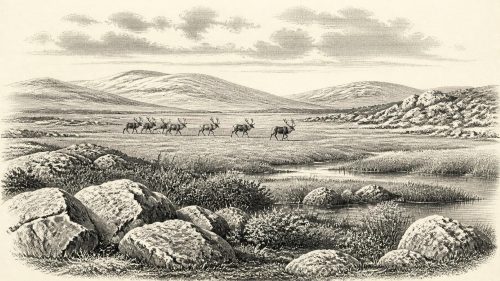
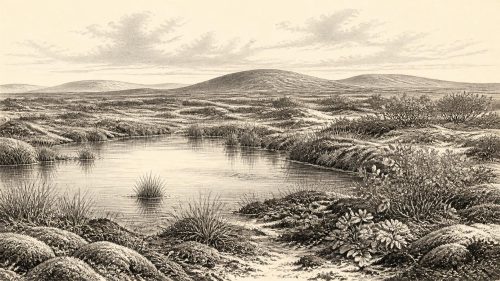
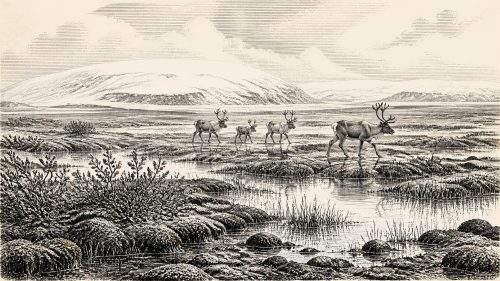
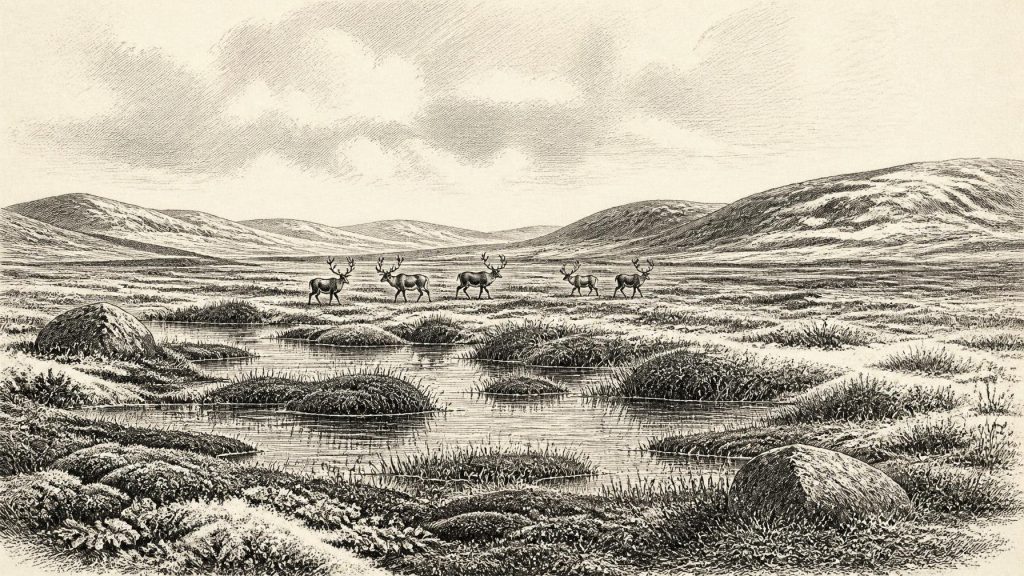
Derryvree indicates treeless tundra or muskeg: wet, peaty ground, shallow pools, mosses and low vegetation under a periglacial climate. Fossil insects and plant remains suggest a patchwork rather than a featureless white waste. Water persisted locally in summer, plant litter accumulated, and organisms adapted to cold conditions occupied the margins of pools and saturated ground. The winters, however, were severe. This was an exposed northern landscape, likely subject to frozen ground, strong seasonality and a short growing season. It was ecologically productive in restricted places, but not hospitable in the later agricultural sense.
That northern Fermanagh archive also establishes an important regional point. Organic material beneath later glacial deposits proves that at least parts of north-central Ireland were ice-free when the plants grew and the sediments accumulated. It does not prove that every district was ice-free at the same moment. Ireland’s ice history was regional and dynamic, involving expanding local ice masses, marine margins and changing connections with ice in Britain. The surviving evidence supports a landscape in transition, not a simple advance of a single uniform ice blanket.
Before the Great Expansion
In broad terms, this point in MIS 3 preceded the maximum extent of the last British–Irish Ice Sheet. A widely used working model places major ice-sheet build-up after about 35–32 thousand years ago and the Last Glacial Maximum itself around 27–21 thousand years ago. More recent BRITICE-CHRONO research likewise shows that ice-sheet growth and retreat varied markedly between sectors. Thus 31,896 BCE belongs near the threshold of worsening glacial conditions, not to the maximum phase when ice later covered much of Ireland.
Crag Cave in County Kerry provides a separate, long-term climatic clue. Uranium-thorium dating of broken and reworked speleothems shows that calcite sometimes formed in the cave during MIS 3. Because such growth required infiltrating liquid water and conditions generally above freezing, the dated phases indicate episodic climatic amelioration linked to Greenland interstadials. This does not supply a local weather report for Maguiresbridge or a precise annual temperature for 31,896 BCE. It does show that the Atlantic edge of south-west Ireland responded sharply to millennial climate swings, alternating between colder phases and intervals capable of sustaining cave-water circulation.
Animals of the Open Country
South of Fermanagh, Castlepook Cave near Doneraile in County Cork preserves Ireland’s richest known pre-Last Glacial Maximum vertebrate assemblage. Reassessment of its radiocarbon chronology places significant fauna in MIS 3, while the full cave collection represents a long span rather than a single living herd or one moment of deposition. Among the animals represented are woolly mammoth, reindeer, giant deer, brown bear and spotted hyaena; the wider cold-stage list includes wolf, Arctic fox, mountain hare and lemmings. Such species make clear that Ireland could support a substantially richer Pleistocene fauna than survives today.
It would nevertheless be misleading to arrange all these animals together in a single scene dated exactly to 31,896 BCE. Some remains may be older or younger than the Derryvree deposits, and cave accumulation has complex causes. Spotted hyaenas may have carried bones into the cave; water movement and earlier digging disturbed materials; and animals occupied different habitats and seasons. The sound conclusion is modest but powerful: during the middle and later parts of MIS 3, Irish landscapes intermittently accommodated large herbivores and their predators, including species now extinct in Ireland or globally.
Reindeer and mammoth point towards open, cold-adapted grazing landscapes. Giant deer require more caution: their presence demonstrates that this imposing species occurred in Pleistocene Ireland, but does not establish the precise vegetation structure of every locality. Brown bear and hyaena, meanwhile, warn against treating the landscape as biologically simple. Predators, scavengers, herbivores, small mammals and freshwater organisms occupied a mosaic of ground conditions. Their movements would have followed food, shelter, snow cover and seasonal water, not modern county boundaries.
People: An Important Silence
There is no securely established settlement, hearth, stone-tool assemblage, burial or house in Ireland that can responsibly be assigned to 31,896 BCE. Therefore there can be no evidence-based account of political affairs, warfare, diplomacy, religion, trade, social organisation, education or everyday human labour for this year. Nor should the large mammals be casually converted into proof of hunters: animal bones demonstrate animals, not necessarily people.
A claim publicised in 2021 concerned a Castlepook reindeer femur interpreted as bearing marks consistent with butchery and reportedly dating to about 33,000 years ago. It is potentially important, but it is not the same as a published, stratified settlement context, and the cave’s disturbed history demands careful assessment. The 2022 excavation report explicitly noted that Castlepook’s earlier record had lacked evidence for human occupation, while identifying surviving deposits with potential for further study. For now, the firm peer-reviewed evidence for human presence in Ireland is much later: a butchered brown-bear patella from Alice and Gwendoline Cave, County Clare, directly dated to roughly 12,810–12,590 calibrated years BP.
An Ireland Without a Historical Year
The most meaningful development around 31,896 BCE was environmental, not political: parts of Ireland remained capable of supporting cold-adapted life while the climatic system was moving towards a more extensive glaciation. At Derryvree, freshwater sediments preserve a northern tundra wetland; in southern caves, bones and speleothems preserve complementary evidence for fauna and climatic fluctuation. These archives show that Ireland was neither timeless nor uniformly frozen. It was a changing Atlantic peninsula-or-island landscape whose exact coastlines, ice margins and ecological zones remain imperfectly known.
Its legacy is written in what survived subsequent ice and erosion. The silts beneath a Fermanagh drumlin, the bones in a Cork cave and the calcite of a Kerry cavern are not substitutes for chronicles. They are more valuable than invented chronicles: hard-won traces from which a cautious history of Ice-Age Ireland can begin.
Primary Sources
- A Middle Midlandian Freshwater Series at Derryvree, Maguiresbridge, County Fermanagh, Northern Ireland
- A Reconsideration of the Radiocarbon Dating of the Marine Isotope Stage 3 Fauna from Southern Ireland
- The Irish Quaternary Fauna Project
- Episodic Speleothem Deposition Tracks the Terrestrial Impact of Millennial-Scale Last Glacial Climate Variability in SW Ireland
- Extent and Timing of the Last Glacial Maximum (LGM) in Britain and Ireland: A Review
- Growth and Retreat of the Last British–Irish Ice Sheet, 31,000 to 15,000 Years Ago: The BRITICE-CHRONO Reconstruction
- Pattern, Style and Timing of British–Irish Ice Sheet Advance and Retreat Over the Last 45,000 Years: Evidence from NW Scotland and the Adjacent Continental Shelf
- The Timing and Magnitude of the British–Irish Ice Sheet Between Marine Isotope Stages 5d and 2
- The IntCal20 Northern Hemisphere Radiocarbon Age Calibration Curve (0–55 cal kBP)
- First Evidence of a Late Upper Palaeolithic Human Presence in Ireland
- Phylogeographic, Ancient DNA, Fossil and Morphometric Analyses Reveal Ancient and Modern Introductions of a Large Mammal: The Complex Case of Red Deer (Cervus elaphus) in Ireland
- New Insights on the Fauna of Ireland's Younger Dryas and Early Holocene from Alice & Gwendoline Cave
- Castlepook Cave, County Geological Site Report
- Archaeological Heritage of County Cork
- 2022:564 – Castlepook Cave, Castlepook South, Cork
- Guide to the National Museum of Ireland – Natural History
- Ice Age Ireland: Cool Fossils!
- Figure 6: The Subdivision of the Quaternary Period in Ireland
- Irish Association for Quaternary Studies: Fermanagh Field Guide
- Outreach and Education Resources – Irish Quaternary Association